What You Need to Know About the Emotional Support Animal Airline Policy Right Now
The emotional support animal airline policy in the U.S. changed fundamentally in 2021 — and millions of travelers are still catching up.
Here is the short version:
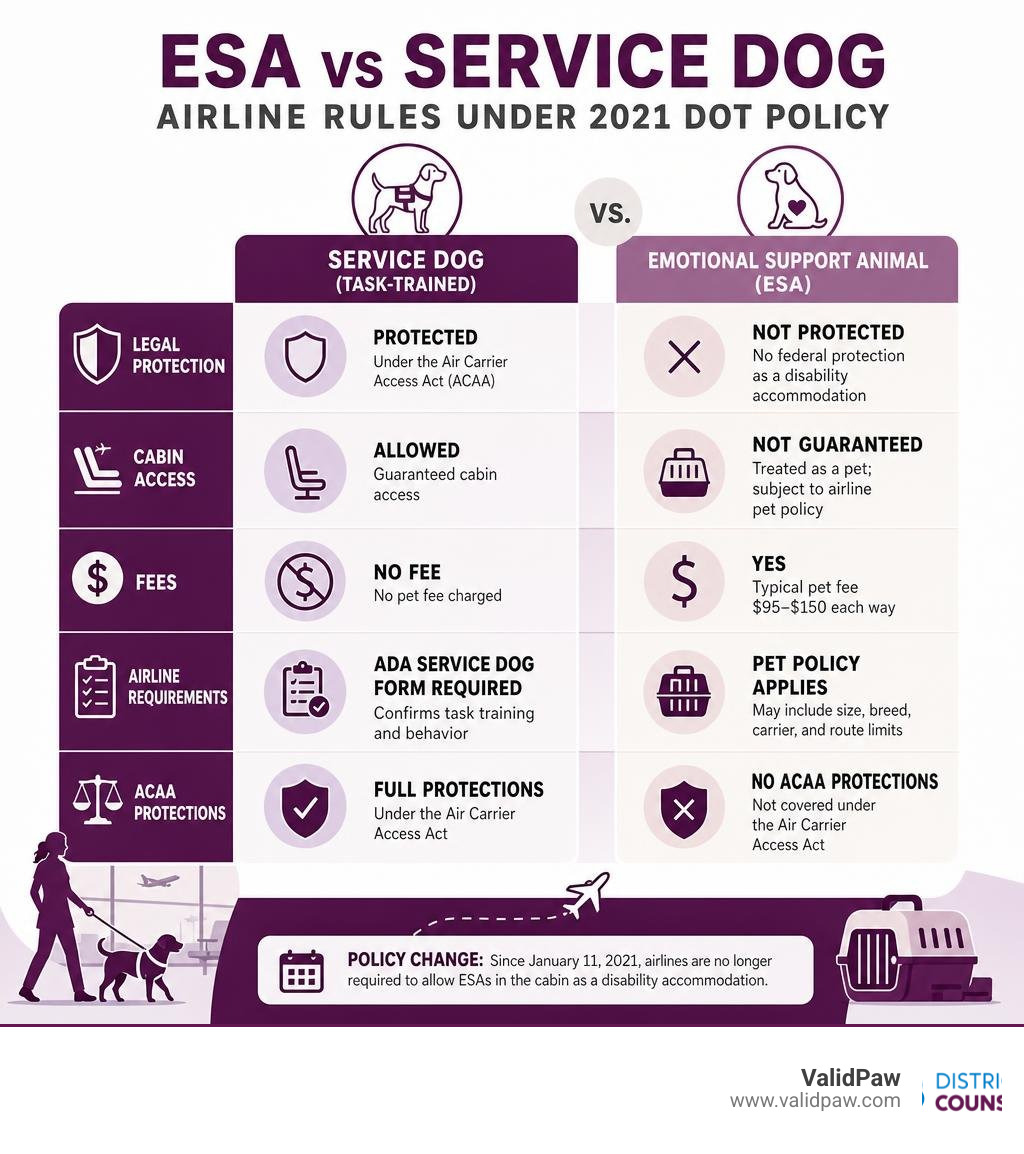
| Animal Type | Cabin Access in 2026 | Fee Required? | |---|---|---| | Trained service dog (task-trained) | Yes, protected under ACAA | No | | Psychiatric service dog (task-trained) | Yes, protected under ACAA | No | | Emotional support animal | No federal protection | Yes, $95–$150 each way | | Pet | Airline pet policy only | Yes, $95–$150 each way |
The bottom line: Since January 11, 2021, U.S. airlines are no longer required to allow emotional support animals in the cabin as a disability accommodation. Most major carriers — Delta, American, United, and others — now treat ESAs exactly like regular pets. That means carrier requirements, size limits, and per-segment fees.
Only dogs individually trained to perform specific tasks for a person with a disability still have protected cabin access under the Air Carrier Access Act (ACAA).
If your ESA flies with you today, it flies as a pet — full stop.
I'm Francisco Ortiz, Lead Forensic Mental Health Evaluator and Director of Behavioral Health at District Counseling PLLC, where I conduct clinically rigorous ESA evaluations that meet the legal and ethical standards relevant to the emotional support animal airline policy and housing accommodations. My work spans forensic disability assessment across six states, giving me a grounded perspective on how these regulatory changes affect people who genuinely rely on animal support for mental health conditions like anxiety, PTSD, and depression.
The Evolution of the Emotional Support Animal Airline Policy

To understand where we are in 2026, we have to look back at how we got here. For years, the Air Carrier Access Act (ACAA) grouped emotional support animals (ESAs) together with trained service animals. This allowed passengers with an ESA letter from a licensed mental health professional to fly with their animals in the cabin free of charge, without needing any specialized task training.
However, this lenient system led to widespread challenges. The U.S. Department of Transportation (DOT) stepped in with a landmark ruling published in the Federal Register, Volume 85 Issue 238 (Thursday, December 10, 2020), which officially took effect in early 2021. This rule amended the ACAA regulations, aligning the definition of a "service animal" much more closely with the Americans with Disabilities Act (ADA). Under the updated rules, airlines are only required to recognize individually trained dogs as service animals. ESAs were officially reclassified as pets.
Why the 2021 DOT Rule Changed Cabin Access
The regulatory shift was not arbitrary. Between 2017 and 2020, airlines reported a massive 50% surge in animal incidents in the cabin. These incidents ranged from minor disruptions to severe safety hazards, including:
- Untrained animals biting passengers and crew members.
- Animals urinating or defecating in the cabin.
- Disruptive barking, growling, and lunging.
- Attempts by passengers to board with highly unusual, non-traditional support animals (including peacocks, pigs, and snakes).
The FAA Reauthorization Act of 2018 mandated that the DOT address these safety concerns while maintaining access for individuals with legitimate, trained service dogs. The resulting 2021 rule successfully balanced passenger safety with accessibility, but it left ESA owners navigating a much more restrictive travel landscape.
How the Current Emotional Support Animal Airline Policy Treats ESAs as Pets
Under the current emotional support animal airline policy adopted by virtually all domestic carriers, your ESA is subject to standard pet travel rules. This means:
- Pet Fees: You must pay the airline's standard in-cabin pet fee. In 2026, most U.S. airlines charge between $95 and $150 each way. If you have a connecting flight on separate segments, some airlines may charge you per segment, potentially pushing the cost over $400 for a round trip.
- Carrier Requirements: Your animal must remain inside an approved, hard-sided or soft-sided carrier that fits entirely under the seat in front of you.
- Cabin Limits: Airlines limit the total number of pets allowed in the cabin per flight (usually between 2 and 6 pets total). If you do not reserve your pet's slot early, you may be denied boarding.
Service Dogs vs. ESAs: Key Differences Under Airline Rules
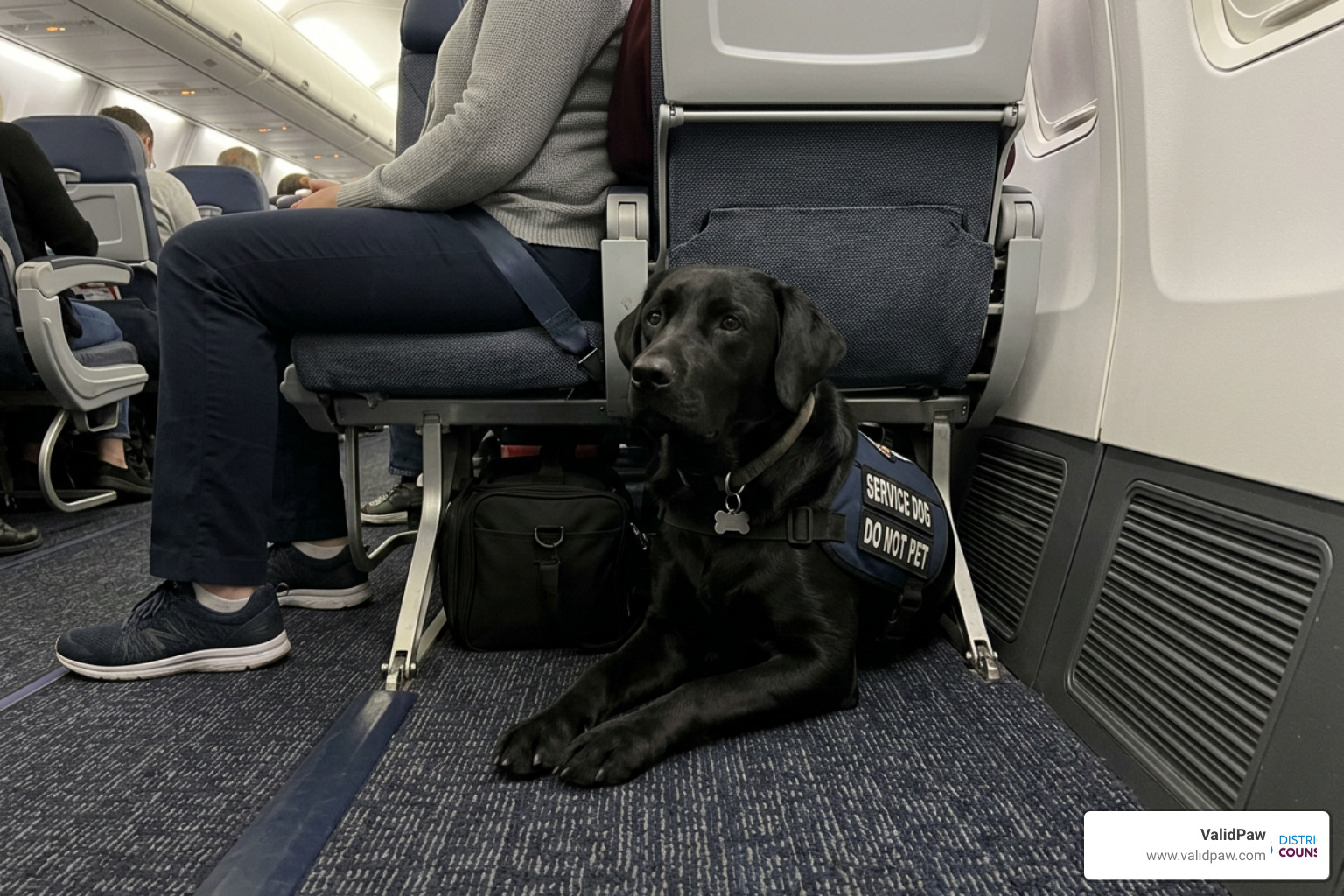
The line dividing service dogs and emotional support animals is strictly enforced at the airport gate. To avoid travel delays, it is critical to understand how these two categories differ under federal law and Guidance Concerning Service Animals.
- Service Dogs (including Psychiatric Service Dogs): These are dogs that have been individually trained to perform specific tasks that directly mitigate a physical, sensory, psychiatric, intellectual, or mental disability. Because they perform active tasks, they are legally protected under the ACAA and fly in the cabin free of charge.
- Emotional Support Animals: These animals provide therapeutic comfort to their owners simply through their presence. They do not require any specialized task training. Because they do not perform active tasks, they do not have public access rights under the ADA or travel protections under the ACAA.
Psychiatric Service Dogs (PSDs) vs. Emotional Support Animals
Many travelers ask us if a Psychiatric Service Dog (PSD) is the same as an ESA. The answer is a definitive no, and the distinction lies entirely in training.
While both support individuals with mental health conditions like anxiety, PTSD, depression, or panic disorders, a PSD is trained to take action. For example, a PSD might be trained to:
- Apply deep pressure therapy (DPT) by lying across its handler’s chest during a panic attack.
- Tactilely stimulate or nudge its handler to interrupt a repetitive negative behavior or dissociative episode.
- Provide a physical buffer between the handler and crowds to alleviate severe claustrophobia.
If your dog is trained to perform at least one task that helps manage your mental health condition, it qualifies as a psychiatric service dog and can fly with you for free, provided you complete the necessary federal paperwork. If the dog simply provides comfort by being near you, it remains an ESA.
How Airlines Verify Legitimate Service Dogs
Airline personnel are trained to distinguish legitimate service dogs from pets and ESAs using methods outlined in federal guidelines. To determine if an animal is a service dog, airline staff may:
- Ask Two Questions: They can ask if the dog is required because of a disability, and what specific task or work the dog has been trained to perform. (They cannot ask you to describe your disability or demand that the dog demonstrate the task).
- Observe Behavior: Legitimate service dogs are trained to behave impeccably in public. Staff will look for indicators of professional training. If a dog is whining, barking excessively, running around, or lunging, it can be denied boarding regardless of its status.
- Look for Physical Indicators: While vests, harnesses, and ID cards are helpful visual cues, they are not legally required and do not verify service dog status on their own.
Comparing Major Airline Policies for Service Animals and Pets
Every airline has adapted its rules to match the updated DOT guidelines. Below is a breakdown of how the major U.S. carriers handle service animals and pets (including ESAs) in 2026.
| Airline | Trained Service Dog Fee | In-Cabin Pet / ESA Fee (Each Way) | Advance Notice Required? | Key Carrier Restrictions | |---|---|---|---|---| | Delta Air Lines | Free | $95 | 48 hours (for Service Dogs) | Must fit in carrier under seat; max 1 pet per passenger | | United Airlines | Free | $125 | 48 hours (for Service Dogs) | Carrier must fit under seat; limits on total pets per flight | | American Airlines | Free | $125 | 48 hours (for Service Dogs) | Maximum of 2 service dogs per passenger |
Delta Air Lines Service Animal Guidelines
Under the Delta Service and Support Animals Policy, only trained service dogs are permitted to fly in the cabin for free.
- Documentation: Handlers must submit the DOT Service Animal Air Transportation Form at least 48 hours before departure. For flights lasting 8 hours or longer, Delta also requires the DOT Service Animal Relief Attestation Form.
- CDC Import Rules: Effective August 2024, the CDC updated its entry requirements for dogs entering the United States. If you are flying internationally into the U.S. with your service dog, you must comply with these strict CDC guidelines, which include microchipping and vaccination records.
- Seating: Service animals are welcome in any cabin class, including Delta One and First Class, but they are strictly prohibited from sitting in exit rows.
United Airlines Service Animal Requirements
United Airlines aligns its rules directly with the current ACAA standards.
- Booking and Submission: United requests that passengers submit their DOT paperwork through the United Airlines Service Animal Rules portal at least 48 hours before their flight.
- In-Cabin Behavior: The dog must remain harnessed, leashed, or tethered at all times and must fit entirely within the passenger's foot space or on their lap (if the dog is smaller than a two-year-old child).
- Limit: Passengers are limited to a maximum of two service dogs.
American Airlines Service Animal Procedures
American Airlines offers a streamlined digital process for frequent travelers.
- SVAN ID Program: When you submit your DOT forms to American Airlines Service Animal Travel and they are approved, you will receive a Service Animal (SVAN) ID. This allows you to book future flights without resubmitting paperwork until your dog's rabies vaccination expires.
- International Restrictions: American Airlines notes that destinations like Hawaii, Great Britain (London Heathrow), and Japan have strict local quarantine rules. For instance, traveling to London requires pre-approval from the Heathrow Animal Reception Center, which can carry steep fees if requirements are missed.
How to Prepare for Air Travel with an Assistance Animal
Whether you are flying with a trained service dog or traveling with your ESA as a paid pet, proper preparation is the key to a stress-free flight.
- Locate Airport Relief Areas: Under federal rules, all U.S. airports must provide designated animal relief areas. Ask airport staff for directions or look up maps before you arrive at your terminal.
- Carrier Training: If your ESA is traveling as a pet, spend several weeks before the flight acclimating them to their travel carrier. They should be able to stand up, turn around, and lie down comfortably inside it.
- Health and Hygiene: Ensure your animal is clean and well-groomed. A smelly or dirty animal can be denied boarding under airline safety and hygiene rules.
Completing the DOT Service Animal Air Transportation Form
If you are traveling with a trained service dog or a psychiatric service dog, you must fill out the official DOT Service Animal Air Transportation Form. This form requires you to attest to three main areas:
- Animal Health: You must confirm that the dog is vaccinated against rabies, is free of pests, and is healthy enough to travel. You will need to provide your veterinarian's name and contact information.
- Animal Behavior and Training: You must attest that your dog has been individually trained to perform tasks and behave in public settings. You must acknowledge that the dog must be leashed or tethered and that disruptive behavior can result in the dog being reclassified as a pet or removed.
- Trainer Information: You must list the name of the trainer or training organization. (Note: Under federal law, you are allowed to self-train your service dog, so you may write your own name in this section).
Alternatives to the Traditional Emotional Support Animal Airline Policy
If your emotional support animal is too large to fit in an under-seat carrier, or if you do not want to pay the steep in-cabin pet fees, you have a few practical alternatives:
- Psychiatric Service Dog Training: If you have a diagnosed mental health condition and your dog has the temperament for public work, you can train them to perform specific tasks that assist you. Once trained, they can travel as a PSD under the ACAA.
- In-Cabin Pet Program: For smaller ESAs, paying the pet fee and using an approved carrier remains a highly reliable way to keep your companion by your side.
- Utilize Your FHA Housing Rights: While the emotional support animal airline policy has changed, your rights on land have not! Under the Fair Housing Act (FHA), individuals with legitimate ESA letters are still fully protected against pet fees, pet deposits, and breed restrictions in rental housing.
Frequently Asked Questions about Flying with Support Animals
Can I still fly with my emotional support animal for free in 2026?
No. Under current U.S. airline rules, emotional support animals do not receive free cabin access. They are treated as regular pets, meaning you must pay the standard pet fee (typically $95 to $150 each way) and keep them in an approved carrier under the seat in front of you. A few select international carriers (such as LATAM or Volaris) still allow ESAs on specific routes, but you must check their individual policies directly.
What is the difference between an ESA and a Psychiatric Service Dog (PSD) on flights?
The difference is task training. A PSD is individually trained to perform specific, active tasks to help mitigate a mental health disability (such as deep pressure therapy or tactile grounding). Because of this training, PSDs fly for free in the cabin under the ACAA. An ESA provides comfort through its presence alone and does not have task-specific training, meaning it must fly under standard pet rules.
Can an airline deny boarding to a trained service dog?
Yes. Airlines have the legal right to deny boarding to any service dog that poses a direct threat to the health or safety of others, causes a significant cabin disruption (such as continuous barking or growling), relieves itself in an unsanitary manner at the gate or in the cabin, or does not fit within the footprint of the handler's seat.
Conclusion
Navigating the modern skies with an animal companion requires careful planning and a clear understanding of federal regulations. While the emotional support animal airline policy no longer grants free cabin access to ESAs, these rules ensure that flights remain safe, orderly, and comfortable for all passengers.
It is important to remember that while air travel laws have changed, housing laws have not. Your emotional support animal still has robust legal protections under the Fair Housing Act. If you need a reliable, legally compliant document for your housing needs, we are here to help. At ValidPaw, we connect you with licensed therapists to secure legitimate, FHA-compliant ESA letters quickly and securely.
Ready to protect your housing rights? Apply for a legitimate ESA letter with ValidPaw today.