
How to ask for an emotional support animal in housing
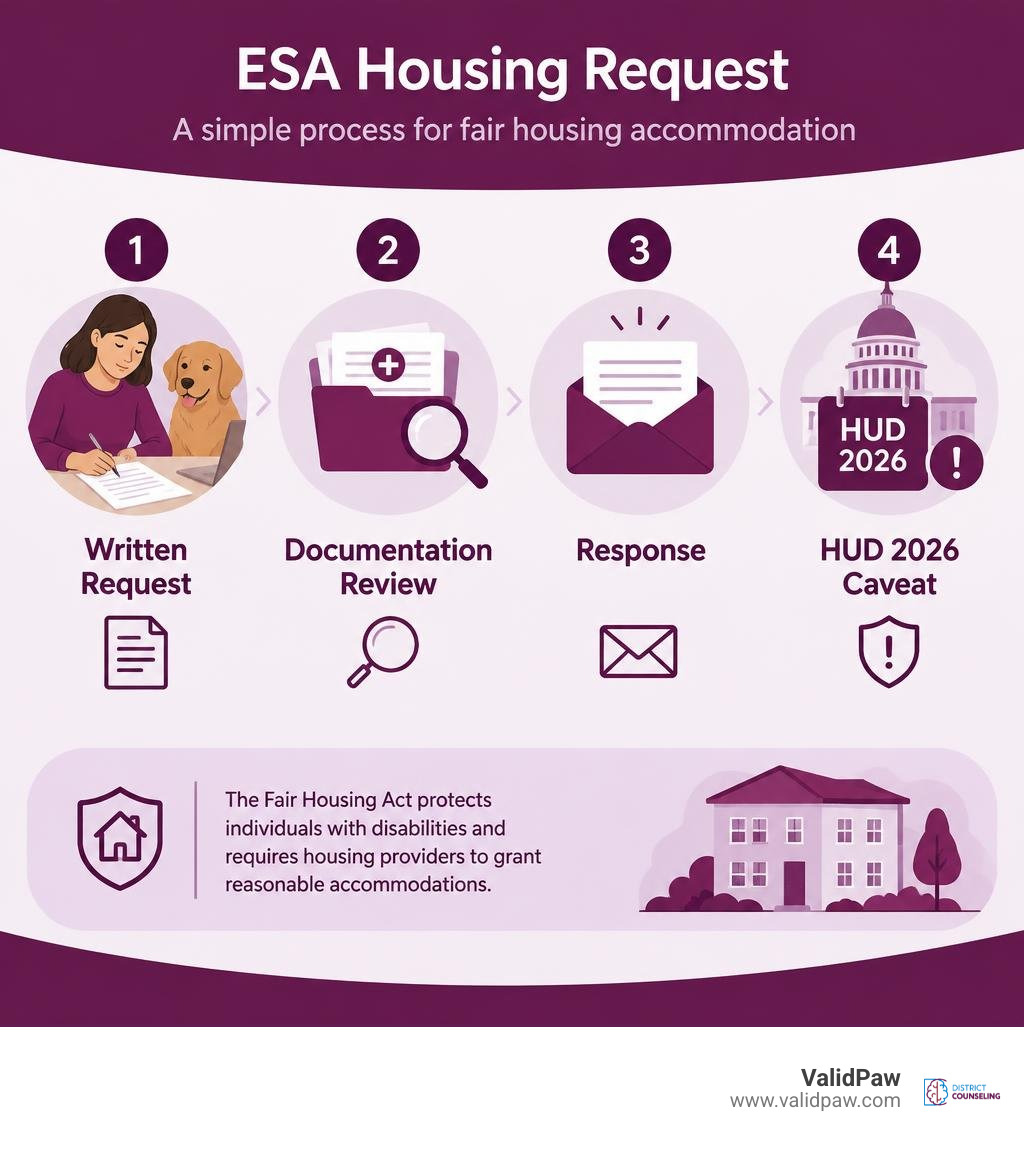
To request an emotional support animal (ESA), ask your housing provider in writing for a disability-related exception to its pet rules. Explain how the animal helps you use and enjoy your home. If your need is not clear, you may need reliable documentation, but you generally do not need to share your diagnosis.
Federal enforcement changed in 2026: HUD now pursues Fair Housing Act animal-accommodation complaints only when the animal is trained to perform disability-related tasks. That policy did not change the law itself, and state laws may still protect untrained ESAs. Keep a copy of your request and check the rules where you live before accepting a denial.
I'm Francisco Ortiz, a forensic mental health evaluator whose work includes disability assessments for fair housing law emotional support animal requests. I use thorough clinical evaluations to document disability-related needs.
Fair housing law for emotional support animals in 2026
Navigating federal protections requires understanding both statutory rights and recent regulatory shifts. The federal Fair Housing Act (FHA) prohibits discrimination against individuals with disabilities and requires housing providers to grant reasonable accommodations. Historically, this included waiving no-pet policies and pet fees for assistance animals that provide therapeutic comfort.
However, federal administrative enforcement experienced a major pivot. Under HUD’s May 22, 2026 enforcement guidance, the Office of Fair Housing and Equal Opportunity (FHEO) announced that it will find reasonable cause and pursue formal administrative charges only when an assistance animal is individually trained to perform disability-related tasks. This policy memo permanently rescinded previous guidance notices (such as FHEO-2013-01 and FHEO-2020-01).
While this administrative shift restricts the complaints HUD will investigate directly, it did not alter the text of the Fair Housing Act passed by Congress, nor does it override robust state fair housing laws that continue to protect untrained ESAs.
What does fair housing law require for an emotional support animal?
Under the FHA, a tenant with a physical or mental impairment that substantially limits one or more major life activities has the right to request a reasonable accommodation. When an individual has a verifiable disability and a clear disability-related need for an animal, the housing provider must adjust rules, policies, or practices to allow that tenant an equal opportunity to use and enjoy their dwelling.
An ESA does not require specialized task training under traditional statutory interpretation; its therapeutic presence helps alleviate symptoms such as severe anxiety, depression, or PTSD. To trigger these protections, the tenant must submit an accommodation request demonstrating the nexus between their disability and the support the animal provides.
How is an emotional support animal different from a service animal?
Service animals and emotional support animals serve distinct functions under federal law. A service animal—defined under the Americans with Disabilities Act (ADA)—is strictly a dog (or in rare cases, a miniature horse) individually trained to perform specific tasks directly related to a disability, such as guiding a person who is blind, alerting someone who is deaf, or interrupting a panic attack. Because they are working animals, service animals have broad public access rights in restaurants, stores, and hotels.
In contrast, an ESA provides comfort, companionship, and emotional stability without task-specific training. Under housing rules, both categories have historically been treated as assistance animals rather than pets.
| Feature | Service Animal (ADA & FHA) | Emotional Support Animal (FHA & State Law) | | :--- | :--- | :--- | | Primary Species | Dogs (and miniature horses) | Any common domestic household animal | | Specialized Training | Required (individual task-trained) | Not required (presence provides support) | | Public Access | Broad (stores, restaurants, transit) | Restricted to private housing dwellings | | Housing Protection | Full protection under ADA & FHA | Protected under FHA & state civil rights laws | | Standard Inquiries | Two questions permitted | Medical verification letter if not obvious |
Which housing is covered—and what exceptions may apply?
Fair housing provisions cover nearly all residential dwellings across the United States. This includes:
- Private rental apartments and single-family rental homes
- Condominiums and properties governed by Homeowners Associations (HOAs)
- Public housing and federally subsidized residential programs
- Group homes, supportive housing facilities, and university residence halls
Certain statutory exemptions exist under federal law, including owner-occupied buildings with four or fewer units (the "Mrs. Murphy" exemption) and single-family houses sold or rented without the use of a real estate broker (provided the owner owns no more than three such homes). Additionally, federally assisted housing remains subject to Section 504 of the Rehabilitation Act of 1973, which maintains independent disability accommodation mandates. Short-term lodging like hotels and motels falls under Title III of the ADA rather than the FHA.
How to request an ESA accommodation and support it with documentation
Securing an accommodation is a straightforward legal process. We always advise submitting a formal written request to your landlord or property management company before moving an animal into the unit.

You can download our Free reasonable-accommodation request template to format your submission properly. Providing compliant documentation from the start initiates an interactive dialogue and prevents unnecessary leasing disputes. For step-by-step guidance on presenting your records, review our guide on how to provide landlord-ready ESA proof.
What should an ESA accommodation request say?
Your written accommodation notice should be professional and concise. Make sure to include:
- Your full legal name, rental unit number, and date.
- A clear statement that you are an individual with a disability under fair housing laws.
- The species, breed, and name of your assistance animal.
- An explanation of how the animal assists in mitigating your symptoms or limitations.
- The specific policy exception requested (e.g., waiver of a "no-pets" lease clause or pet fees).
- A reasonable deadline for the landlord’s response (typically 7 to 10 business days).
What documentation can a landlord reasonably request?
If your disability or disability-related need is not readily observable, a landlord may request supporting documentation from a licensed healthcare professional. Legitimate documentation must come from an individualized clinical assessment establishing that you have a qualifying impairment and that the animal provides therapeutic relief.
Housing providers cannot demand:
- Access to your detailed medical records, therapy notes, or psychiatric history.
- A specific medical diagnosis or disclosure of private symptoms.
- Mandatory use of proprietary landlord forms if your provider's letter contains all legally necessary details.
Furthermore, commercial registries, ID cards, badges, and instant online "certifications" carry no legal weight. Housing providers routinely reject these products. Legitimate accommodation requires a clinical relationship with a licensed professional.
How has HUD’s 2026 policy changed an emotional support animal request?

Following HUD’s May 22, 2026 guidance memo, federal investigators will no longer issue discrimination charges against housing providers solely for refusing untrained ESAs.
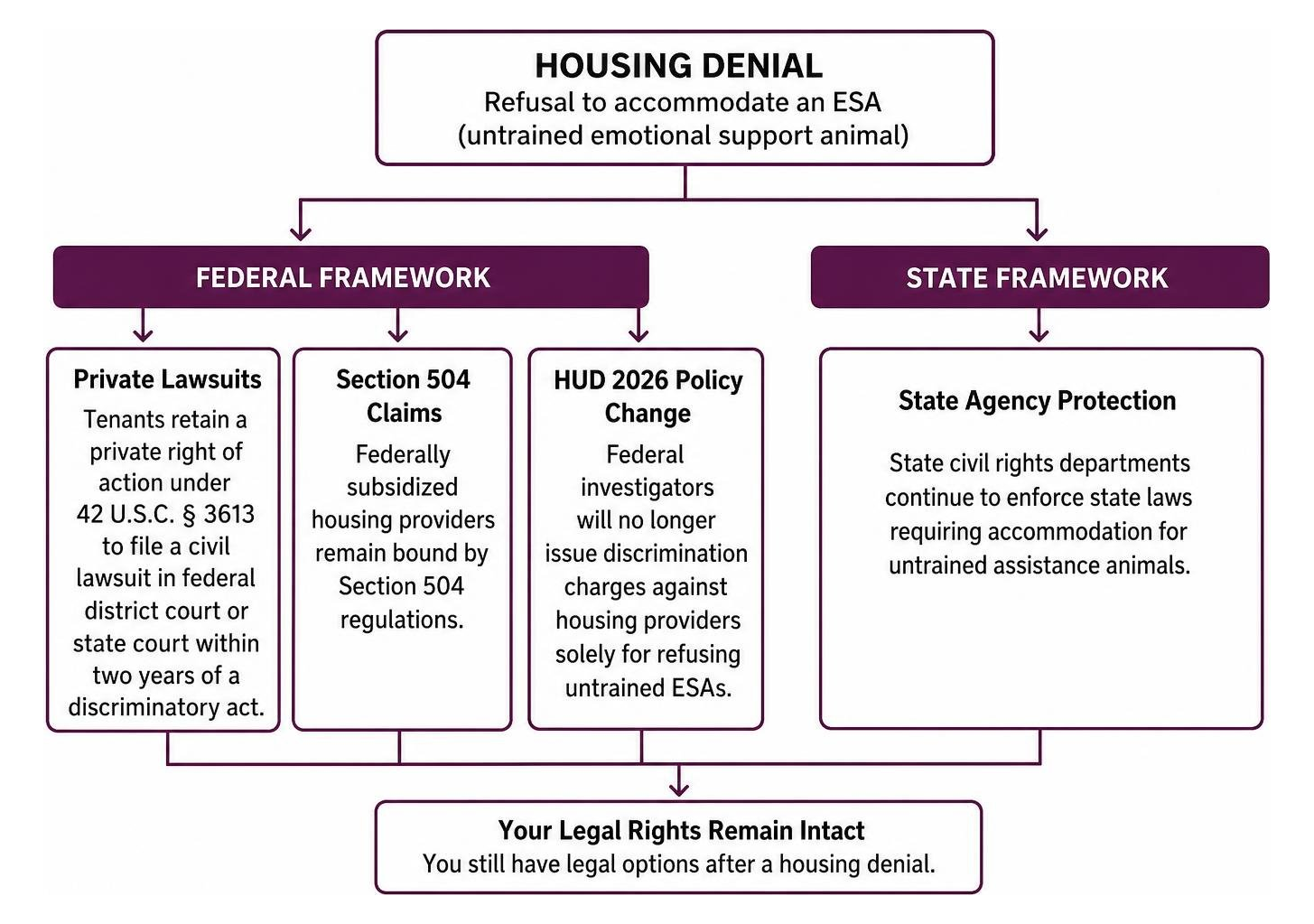
This policy prioritizes administrative resources toward trained service animals. However, this does not strip away your legal rights:
- Private Lawsuits: Tenants retain a private right of action under 42 U.S.C. § 3613 to file a civil lawsuit in federal district court or state court within two years of a discriminatory act.
- Section 504 Claims: Federally subsidized housing providers remain bound by Section 504 regulations.
- State Agency Protection: State civil rights departments continue to enforce state laws requiring accommodation for untrained assistance animals.
When may a landlord deny an animal or impose conditions?
While fair housing protections are broad, they are not absolute. Landlords may deny an accommodation request only under specific, legally defined circumstances. Knowing what landlords cannot do to renters with ESAs helps you identify unlawful refusals versus legitimate property management concerns.
Can a landlord charge pet rent or a deposit?
Under established fair housing principles, assistance animals are not pets. Consequently, housing providers cannot charge upfront pet deposits, monthly pet rent, or nonrefundable pet application fees for a verified ESA.
While HUD's 2026 enforcement memo cited judicial decisions regarding fee disputes (such as Henderson v. Five Properties LLC), charging pet fees for valid assistance animals remains unlawful under most state statutes and traditional FHA interpretations. However, tenants remain strictly liable for any actual property damage their animal causes beyond normal wear and tear.
Can a landlord deny an animal because of breed, size, or weight?
Housing providers cannot enforce blanket breed bans, weight limits, or size restrictions against emotional support animals. A denial cannot be based on generalized insurance restrictions, breed stereotypes, or assumptions about specific breeds like Pit Bulls, German Shepherds, or Rottweilers.
A landlord may deny a specific animal only if their property insurance provider explicitly issues written notice that insuring the property will be canceled or substantially burdened by that specific animal, and no alternative accommodation exists.
What counts as a direct threat?
A landlord may exclude an assistance animal if it poses a direct threat to the health or safety of others that cannot be eliminated by another reasonable accommodation. To establish a direct threat, the housing provider must present credible, objective evidence based on the specific animal's actual behavior—such as a documented history of unprovoked biting, repeated lunging, or uncontrolled aggression.
Generalized fears, neighbor allergies, or neighborhood complaints about the animal's presence do not constitute a direct threat.
What responsibilities remain with the tenant?
Having an ESA comes with practical tenant responsibilities:
- Control: You must keep your animal under control at all times via leash, harness, or carrier in common areas.
- Nuisance Prevention: You must prevent excessive, continuous noise (such as incessant barking) that disrupts other residents.
- Sanitation: You are responsible for prompt waste cleanup and maintaining clean living quarters.
- Legal Compliance: You must comply with local animal licensing and rabies vaccination mandates.
State protections and next steps after a denial
Because HUD’s 2026 memo narrowed federal administrative enforcement, state fair housing frameworks have become the primary line of protection for renters with emotional support animals.
How does HUD’s policy affect California and Massachusetts tenants?
State laws provide robust, independent protections that operate entirely outside HUD’s enforcement jurisdiction:
- California: The California Civil Rights Department (CRD) enforces the Fair Employment and Housing Act (FEHA) and the Unruh Civil Rights Act. As detailed in California’s ESA and fair housing FAQ, California explicitly requires landlords to accommodate untrained ESAs, completely unaffected by HUD's federal memo.
- Massachusetts: Under state law, the Massachusetts Commission Against Discrimination (MCAD) continues to process assistance animal complaints for untrained ESAs. The Massachusetts assistance-animal housing guidance confirms that ESAs are protected in multi-family dwellings.
- Other Jurisdictions: Many other states, including South Carolina, maintain independent state fair housing laws requiring the waiver of pet rules for therapeutic assistance animals.
For an in-depth breakdown of jurisdictional differences, read our guide on HUD guidance and state-law differences.
What can a tenant do if a landlord denies the request?
If your housing provider refuses your reasonable accommodation request, follow these practical steps:
- Request Written Reasons: Ask the landlord to provide their denial and specific factual reasons in writing.
- Engage in the Interactive Process: If the landlord cites insufficient documentation, ask what specific information is missing and offer supplemental verification from your healthcare provider.
- File a State Complaint: Submit a housing discrimination complaint directly to your state civil rights commission (such as the California CRD or Massachusetts MCAD) within state statutory deadlines (often 300 to 365 days).
- Consult Legal Aid: Contact a local fair housing advocacy organization or disability rights legal group to explore filing a private civil action in court.
Frequently Asked Questions about fair housing law for emotional support animals
Does an ESA need training, certification, or registration for housing?
No. Under statutory fair housing laws and state civil rights codes, an emotional support animal does not require task training, government registration, or behavioral certification. Legitimate protection stems entirely from an individualized assessment conducted by a licensed healthcare professional.
Can a landlord ask for medical records or a diagnosis?
No. Landlords are legally prohibited from demanding your psychiatric records, medical charts, or specific medical diagnoses. Your documentation only needs to confirm that you have an impairment that meets the legal definition of a disability and that the animal provides therapeutic benefit.
Does an existing ESA approval automatically end under HUD’s 2026 guidance?
No. If your landlord previously approved your ESA accommodation in writing, that agreement remains legally binding under your lease terms and state law. A housing provider cannot arbitrarily revoke an approved accommodation simply because HUD adjusted its administrative complaint intake priorities.
Conclusion
Requesting a housing accommodation for your emotional support animal is a legally protected right when handled correctly. Always submit your request in writing, maintain organized records of all communications, and verify both state and federal protections in your jurisdiction.
At ValidPaw, we provide legitimate, fully compliant ESA letters through thorough telehealth evaluations conducted by licensed therapists. We deliver fast 24–48 hour turnarounds with instant landlord verification support to ensure your housing rights remain protected without unnecessary delays.