
ESA Letter Wording Requirements for Housing
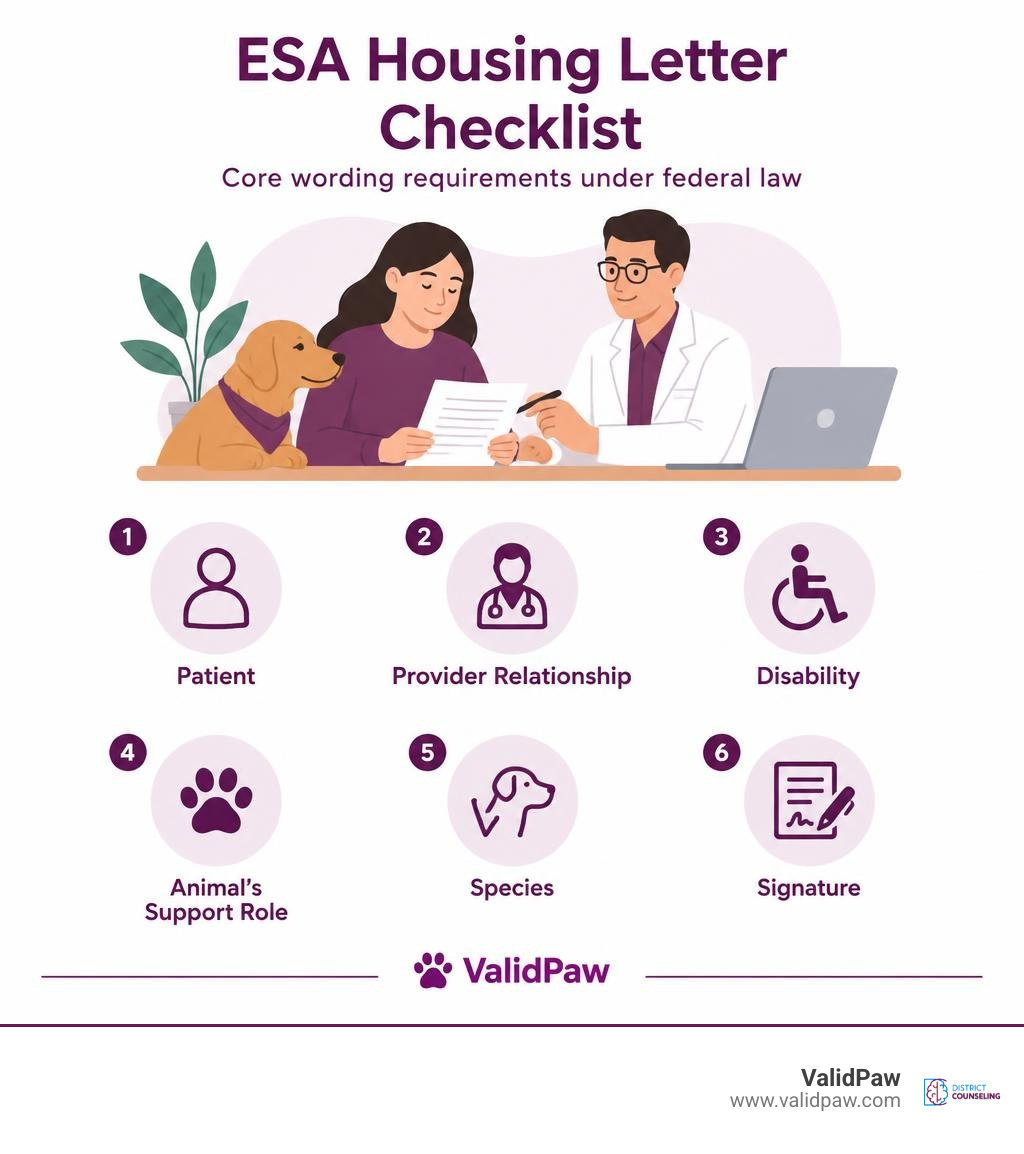
The wording requirements for an ESA letter focus on disability and need. For a housing request, the clinician should identify the patient and their professional relationship, confirm that a disability substantially limits a major life activity, and explain how the animal helps relieve a symptom or effect of that disability. The letter should identify the type of animal and include the clinician's name, credentials, contact information, date, and signature. A specific diagnosis and proof of animal training are not required.
There is no single HUD-approved script. What matters is a clear link between the person's disability and their need for the animal in their home.
I'm Francisco Ortiz, a forensic mental health evaluator and behavioral health director with experience assessing disability-related needs across multiple states. My work with esa letter wording requirements focuses on clear clinical reasoning and protecting patients from unnecessary disclosure.
The article editor does not render LaTeX. Do not write LaTeX commands or math delimiters in article copy. Explain calculations in plain language, or use an ordinary-text formula when useful, such as watts = volts × amps. Write units as readable text, such as ft³/hour or gallons/kWh. When asked to remove formulas or confusing mathematical notation, replace them with prose; do not substitute different equations or hide the notation in code.
Core ESA Letter Wording Requirements Under Federal Law

Navigating housing accommodations can feel like learning a second language, but federal guidelines make the baseline expectations clear. Under the Fair Housing Act (FHA) and the U.S. Department of Housing and Urban Development (HUD) guidelines outlined in Notice FHEO-2020-01, emotional support animals are categorized as assistance animals rather than everyday pets.
To help a tenant secure a reasonable accommodation, the clinician must draft a document that directly bridges clinical care with housing law. Meeting the legal standard does not require pages of medical jargon. Instead, a well-drafted document satisfies the key elements of an ESA letter per HUD by establishing who the provider is, who the patient is, that a qualifying impairment exists, and why the animal is clinically necessary. When you understand the broader framework of FHA assistance animal accommodation guidelines, crafting or reviewing the letter becomes much simpler.
Provider Credentials and Letterhead Standards
A legitimate letter must be written on the professional, formal letterhead of an actively licensed healthcare or mental health practitioner. Whether issued by a clinical psychologist, psychiatrist, licensed clinical social worker (LCSW), licensed professional counselor (LPC), or marriage and family therapist (LMFT), the document must display:
- Full professional name and title
- Type of clinical license (e.g., LCSW, MD, PsyD, LPC)
- State regulatory jurisdiction and active license number
- Clinical office address, phone number, and professional email
- Date of issuance and signature
Landlords and property management teams have a legal right to confirm that the professional signing the document is authorized to practice in the state where the tenant resides. Sticking to essential ESA documentation standards ensures that basic administrative questions never delay your housing accommodation.
Essential ESA Letter Wording Requirements for the Disability Nexus
The most critical part of an assistance animal letter is the "disability nexus"—the clinical connection between the patient's limitations and the support the animal provides. According to What Does an ESA Letter Need to Say? HUD Requirements - LegalClarity, the letter must confirm two things:
- The individual has a physical or mental impairment that substantially limits one or more major life activities (such as sleeping, coping with stress, concentrating, or interacting with others).
- The animal provides emotional support, grounding, or companionship that directly alleviates one or more identified symptoms or functional effects of that disability.
Phrasing that simply states "a pet makes my client happy" does not meet statutory thresholds. Effective clinical phrasing sounds like this:
"The patient has an established clinical relationship with our practice. Under the standards of the Fair Housing Act, the patient has a mental health condition that substantially limits major life activities, including sleep regulation and managing acute anxiety. The presence of this assistance animal is a necessary accommodation that alleviates these symptoms, enabling the patient to use and enjoy the dwelling fully."
Describing the Animal: Species, Name, and Support Role
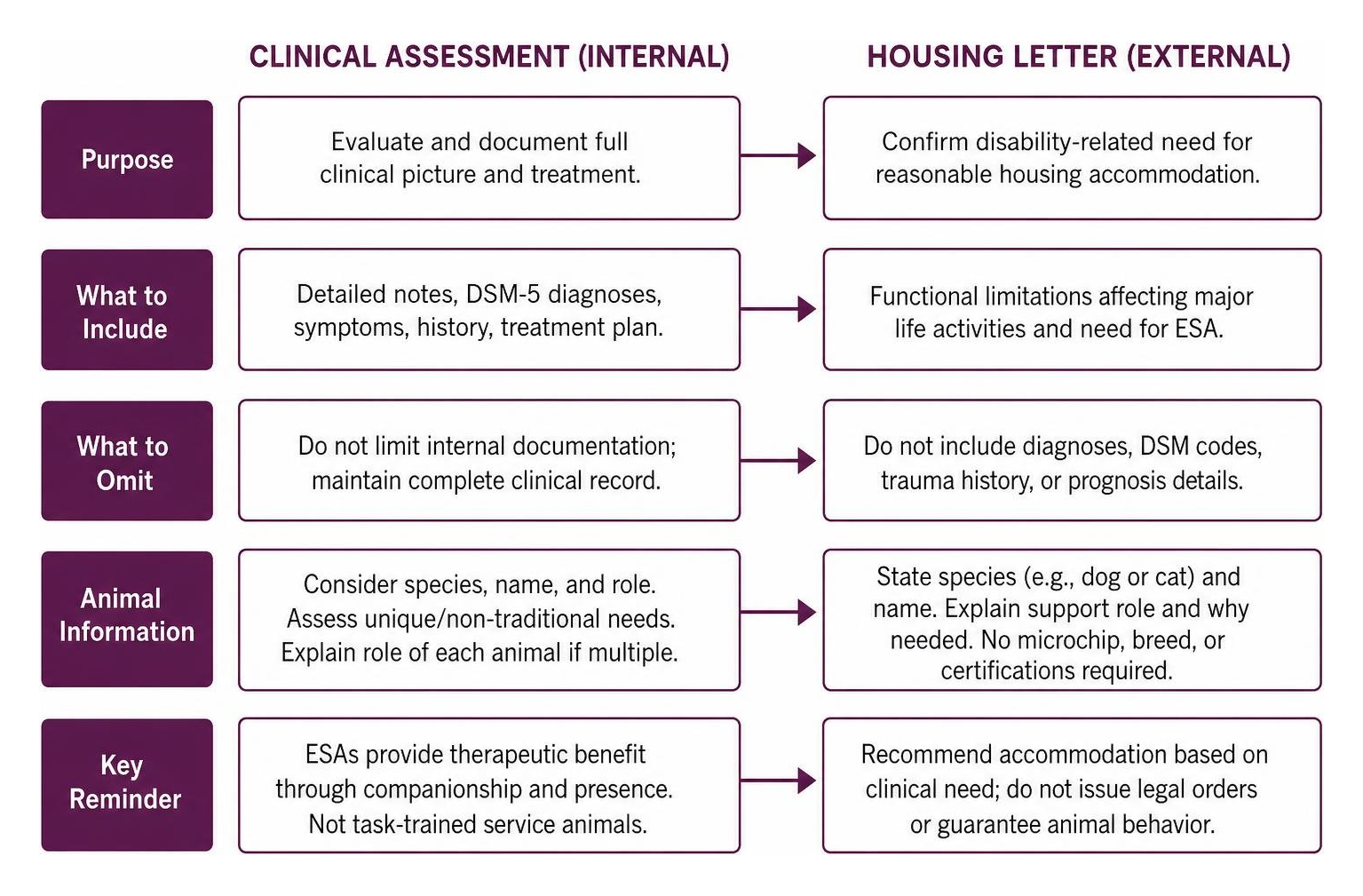
HUD guidance requires the letter to identify the species of the requested animal (for example, a dog or a cat). While including the animal's name is standard practice, listing specific microchip numbers, breed lineage, or formal certifications is unnecessary under federal law.
If a patient requests accommodation for a unique or non-traditional species—such as a miniature horse, reptile, or rabbit—HUD allows housing providers to request additional justification. In those cases, the clinician should briefly state why a traditional domesticated pet cannot meet the functional need. When managing multiple emotional support animals, the clinician must specifically explain the unique therapeutic role of each individual animal. Reviewing everything required in an ESA letter helps prevent common omissions when handling multi-animal households.
What Clinicians Must Omit to Protect Patient Privacy and Legal Standing
Writing an effective letter requires knowing what to leave out just as much as what to include. Over-disclosing personal history or promising specific behavioral outcomes can compromise patient privacy or create legal headaches for clinicians and tenants alike. When spotting legitimate vs invalid documentation, knowing where clinical boundaries lie is essential.
| Required / Recommended Phrasing | Phrases to Avoid (Problematic Wording) | Why the Distinction Matters | | :--- | :--- | :--- | | "Client meets federal disability criteria limiting major life activities." | "Client is formally diagnosed with DSM-5 Generalized Anxiety Disorder (Code F41.1)." | Protects private health details under HIPAA; HUD does not permit landlords to demand diagnoses. | | "This assistance animal provides therapeutic support that reduces symptoms." | "This dog is certified as a fully trained psychiatric service animal." | ESAs do not require task training under the ADA; misrepresenting them as service animals creates legal friction. | | "I recommend this reasonable housing accommodation for my patient." | "The landlord is legally mandated to accept this pet immediately." | Clinicians recommend accommodations based on clinical need; they do not issue binding legal orders to landlords. | | "The animal provides grounding and reduces acute stress responses." | "I guarantee this dog will never bark, bite, or damage property." | Clinicians evaluate human mental health, not canine behavioral liability. |
Functional Limitations Versus Specific Diagnostic Disclosures
Under HUD regulations and standard healthcare privacy principles, housing providers are strictly prohibited from demanding a tenant's medical charts, detailed case notes, or explicit DSM-5 psychiatric diagnoses. A clinician only needs to state that the individual experiences functional limitations affecting major life activities.
Keeping diagnostic codes and personal trauma histories in internal clinical charts safeguards patient confidentiality while giving landlords all the documentation required under federal law.
Avoiding Service Animal Terminology and Public Access Claims
A common error in poorly drafted letters is confusing an emotional support animal with a service animal under Title III of the Americans with Disabilities Act (ADA).
Service animals are dogs (or miniature horses) individually trained to perform specific tasks directly related to a disability (such as guiding a visually impaired individual or alerting to seizures). Emotional support animals provide therapeutic benefit through companionship and presence; they do not require specialized behavioral task training.
Conflating the two terms by claiming an ESA has "public access rights" to enter grocery stores, restaurants, or airline cabins can lead housing providers to question the legitimacy of the entire request. Under current Department of Transportation rules implemented in 2021, airlines treat ESAs as standard pets, reserving cabin accommodations strictly for task-trained service dogs.
Red Flags and Invalid Phrasing That Landlords Reject

Housing providers routinely spot invalid letters generated by instant certificate websites or unverified templates. Clinicians should avoid:
- Boilerplate Guarantees: Promising that an animal will never make noise or cause damage. Clinicians assess patient health, not animal temperament.
- Legal Demands: Writing that a landlord "must" waive policies without exception. The clinician makes the medical recommendation; the housing provider grants the reasonable accommodation via the interactive process.
- Generic "Feel Good" Claims: Stating simply that a pet brings happiness without identifying how it mitigates a disabling functional impairment.
When questions arise during property management reviews, understanding the process for handling landlord verification requests keeps the accommodation moving smoothly.
State Variations and Specialized Legal Mandates
While the Fair Housing Act provides a uniform federal baseline across the United States, several states have enacted specific requirements to reduce fraudulent documentation while protecting legitimate tenants.
State-Specific ESA Letter Wording Requirements and Telehealth Rules
Different jurisdictions enforce specific rules regarding practitioner credentials, telehealth consultations, and fraud warnings. For instance, in Texas—including major hubs like Houston, Dallas, Austin, San Antonio, and Fort Worth—clinicians must hold an active license within their state jurisdiction and conduct a clinical assessment of disability-related need. Reviewing Texas assistance animal documentation laws helps local tenants and providers ensure full compliance with regional statutes.
Other states, such as California under Assembly Bill 468, mandate that clinicians include the effective date of their professional license, license number, and maintain an established provider-patient relationship of at least 30 days prior to issuing documentation for an emotional support dog. Regardless of where you live, telehealth consultations are recognized across all 50 states as long as the provider is licensed in your state and conducts an evaluation of your functional needs.
Frequently Asked Questions About ESA Letter Wording
Does an ESA letter have to name my specific mental health diagnosis?
No. Federal housing guidelines explicitly state that a housing provider cannot require disclosure of your specific medical condition or psychiatric diagnosis. The letter only needs to confirm that you have an impairment that substantially limits a major life activity and that the animal helps alleviate symptoms of that impairment.
Can a landlord reject an ESA letter if it does not state the dog is trained?
No. Under the Fair Housing Act, emotional support animals do not require specialized task training. Unlike ADA service animals, an ESA's therapeutic value comes from its presence and companionship. As long as the animal is housebroken and well-behaved, a landlord cannot reject an ESA simply because it has not completed formal behavioral training.
How recent must the doctor's wording and issuance date be?
While federal law does not specify a strict expiration date, standard industry practice and HUD guidelines suggest that an ESA letter should be dated within the past 12 months. Housing providers can reasonably request updated documentation if your letter is several years old to confirm an active clinical relationship.
Conclusion
Securing a compliant emotional support animal letter comes down to clear clinical reasoning, valid licensing, and precise wording. A legitimate letter identifies the clinical relationship, confirms a functional limitation under federal disability definitions, and clearly connects the presence of the animal to symptom relief—all without over-sharing private medical records.
At ValidPaw, we connect individuals with licensed mental health professionals who conduct thorough telehealth evaluations. We provide fast 24 to 48-hour FHA-compliant letters with instant landlord verification, serving residents across Texas—from Houston, Dallas, Austin, San Antonio, and Fort Worth—to Chicago, Illinois, and across all 50 states without the need for in-office visits. If you are preparing your accommodation request, reviewing compliant ESA letter samples that work will give you confidence that your documentation meets every legal standard.