What Are Emotional Support Letter Requirements in 2026?

Emotional support letter requirements are the specific elements that make an ESA letter legally valid for housing under the Fair Housing Act.
Here's what a valid ESA letter must include:
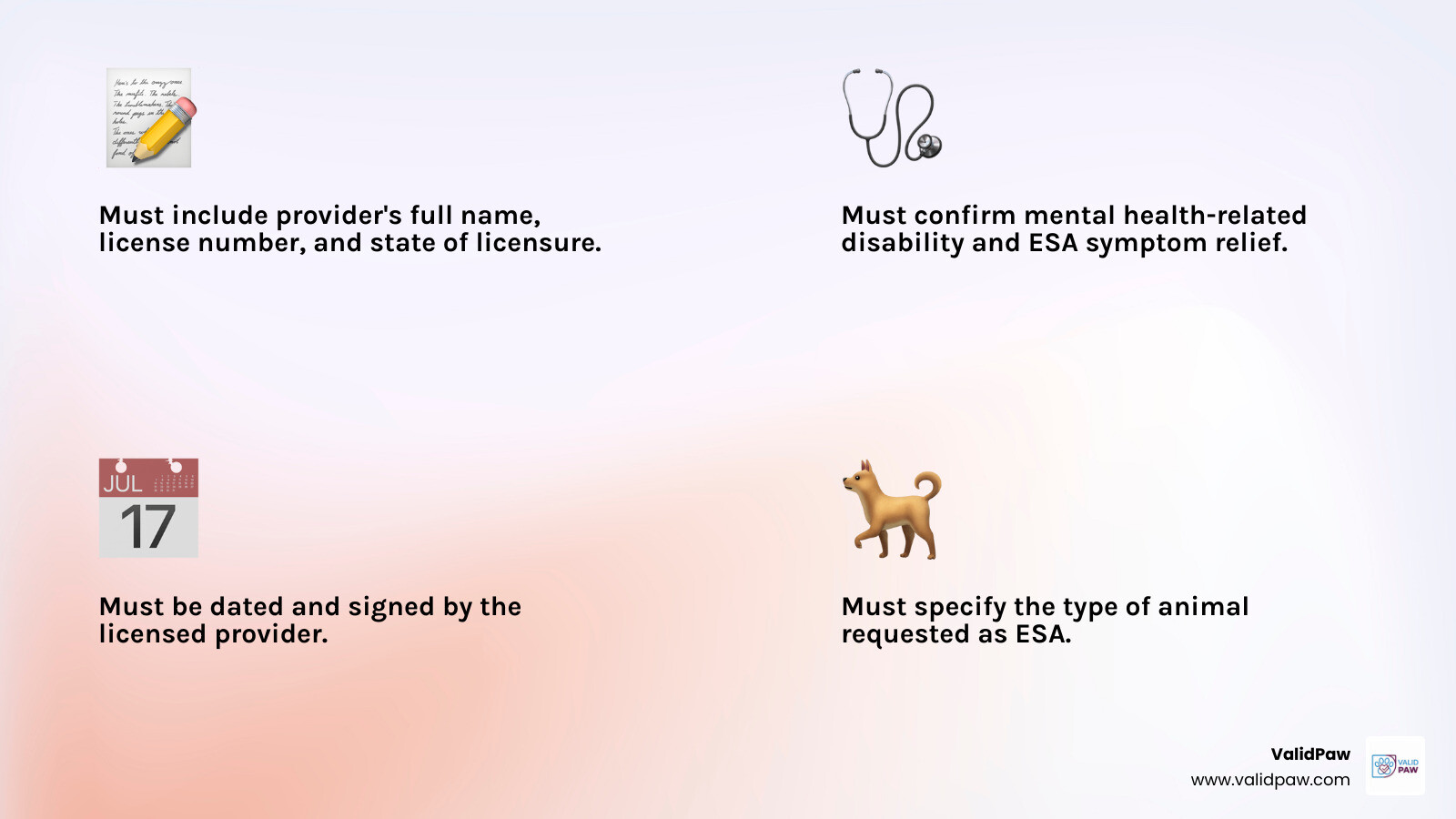
- Provider's full name, license number, and state of licensure
- Type of license and contact information
- Statement confirming you have a mental health-related disability
- Statement that the ESA alleviates one or more symptoms of that disability
- The date the letter was issued
- Provider's signature (digital is acceptable)
- The type of animal being requested as an ESA
Note: You do not need a specific diagnosis listed, animal certification, notarization, or proof of special training.
Getting an ESA letter wrong can cost you your housing accommodation. A landlord can legally reject a letter that's missing required elements — even if you have a genuine need.
The rules aren't complicated, but they are specific. A letter from just any doctor won't cut it. An online certificate from a pet registry is worthless. And in states like California, there are extra requirements most people don't know about.
This guide breaks down exactly what your ESA letter must include, who can write it, and how to make sure your housing request doesn't get denied on a technicality.
Understanding ESAs Under Fair Housing Law

When we talk about emotional support animals (ESAs), we aren't just talking about pets. Under the Fair Housing Act (FHA) and Department of Housing and Urban Development (HUD) regulations, ESAs are legally classified as "assistance animals." This is a crucial distinction that separates them from standard household pets.
In April 2026, the law remains clear: an assistance animal is an animal that works, provides assistance, or performs tasks for the benefit of a person with a disability, or provides emotional support that alleviates one or more identified symptoms or effects of a person's disability.
Service Animals vs. Emotional Support Animals
It is common for housing providers and tenants to confuse ESAs with service animals. However, the legal protections and requirements differ significantly.
| Feature | Service Animal (ADA) | Emotional Support Animal (FHA) | | :--- | :--- | :--- | | Training Required | Yes, must perform specific tasks | No special training required | | Species | Dogs (and miniature horses) | Any domesticated animal | | Public Access | Yes (restaurants, stores, etc.) | No (housing only) | | Housing Protection | Yes | Yes | | Documentation | Not required for housing | Emotional support letter requirements must be met |
Housing Protections and Rights
Because ESAs are assistance animals, they are exempt from many standard "no-pet" policies. Whether you live in a multi-family apartment complex, a single-family home, or a community governed by a Homeowners Association (HOA), you have the right to request a "reasonable accommodation."
If your request is granted:
- No Pet Fees: Landlords cannot charge monthly pet rent.
- No Pet Deposits: You cannot be required to pay an additional security deposit for your ESA.
- Exemption from Restrictions: Breed, size, and weight restrictions typically do not apply to assistance animals.
For more details on how these laws apply to your specific area, you can visit ValidPaw ESA State Guides.
Mandatory Emotional Support Letter Requirements for 2026

A "certificate" or "ID card" from a random website has zero legal standing. To be valid, your documentation must be a signed letter from a licensed healthcare professional. As we navigate the emotional support letter requirements in 2026, the emphasis is on the clinical relationship and the verification of a disability.
The letter serves as proof that you have a physical or mental impairment that substantially limits one or more major life activities. While you do not need to disclose your specific diagnosis (like "Major Depressive Disorder"), the provider must confirm that you meet the legal definition of disability.
Furthermore, the letter must establish a "nexus"—a direct link—between your disability and the assistance the animal provides. This is often called "medical necessity." If you are concerned about your data, you can review our Privacy Policy to see how we protect your clinical information.
Essential Components of Emotional Support Letter Requirements
To ensure your letter is FHA-compliant and resistant to landlord challenges, it must include these specific details:
- Provider Signature & Credentials: The letter must be signed by the licensed professional.
- License Information: This includes the professional’s license number, the type of license (e.g., LCSW, LMFT, MD), and the state where they are licensed to practice.
- State of Jurisdiction: The provider must be licensed in the state where the patient resides. For example, if you live in Houston, TX, your letter should ideally come from a Texas-licensed professional.
- Contact Information: The professional's office address, phone number, and email must be present so the landlord can verify the letter's authenticity.
- Issue Date: Letters should be current. Most housing providers expect a letter issued within the last 12 months.
- Specific Animal Information: While you don't need to name the animal, the letter should specify the type (e.g., dog, cat) and, if you have multiple ESAs, the letter must justify why each individual animal is necessary.
Who Can Legally Issue Emotional Support Letter Requirements?
Not just anyone can write an ESA letter. According to HUD guidelines, the professional must be a "licensed healthcare professional." This includes:
- Psychiatrists and Psychologists
- Licensed Clinical Social Workers (LCSWs)
- Licensed Marriage and Family Therapists (LMFTs)
- Licensed Professional Counselors (LPCs)
- Nurse Practitioners and Physician Assistants
- Primary Care Physicians
Telehealth providers are perfectly legal, provided they are licensed in your state and follow proper clinical protocols. At ValidPaw, we connect you with licensed Texas therapists (and therapists in all 50 states) who understand these legal nuances. For more answers on who can help, check our FAQ.
Navigating California’s AB-468 and State ESA Laws
If you live in California, the emotional support letter requirements are stricter than in most other states due to Assembly Bill 468 (AB-468). This law was designed to curb the sale of fraudulent ESA letters and ensure that patients have a genuine therapeutic relationship with their providers.
Key requirements under California AB-468 include:
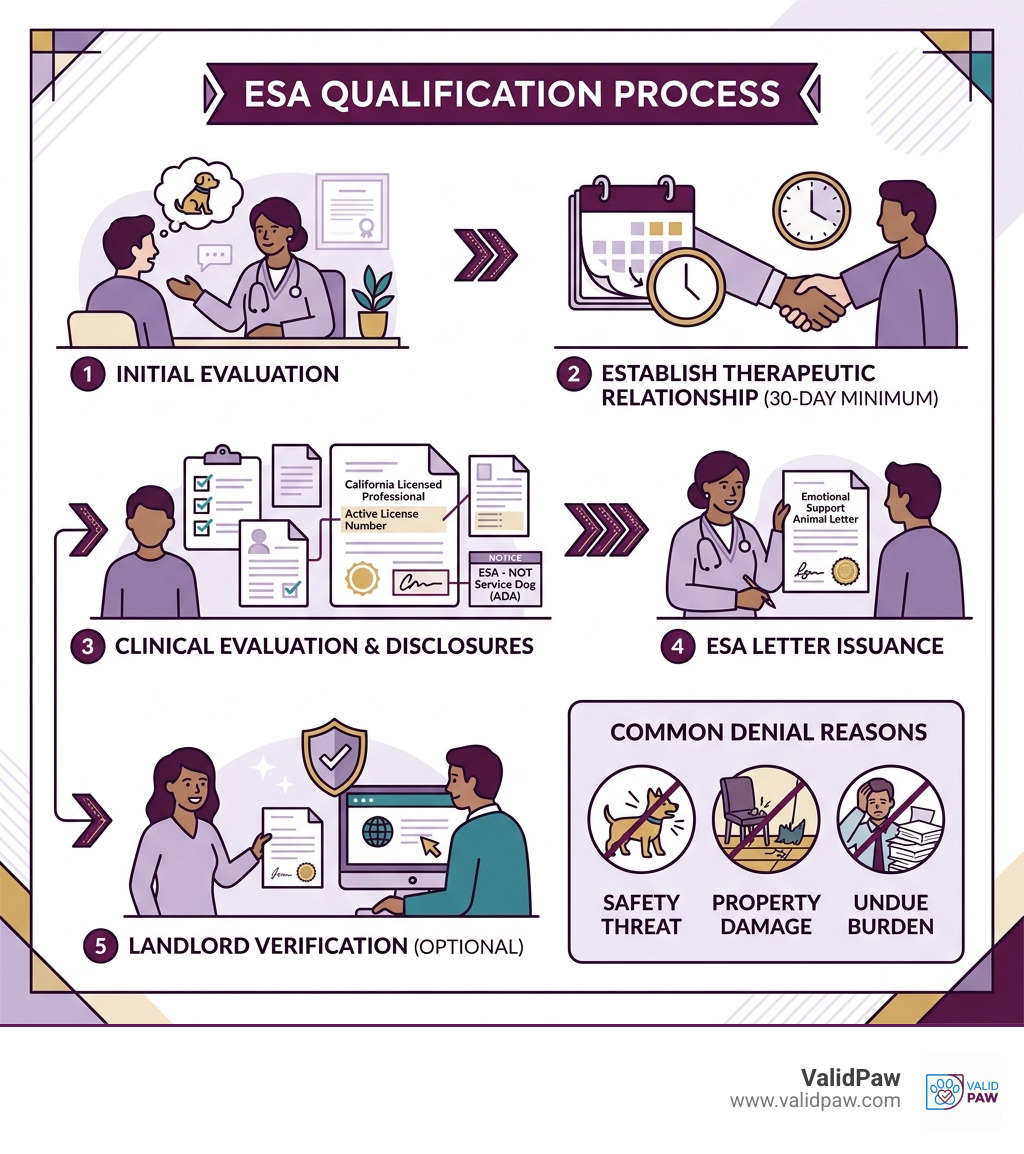
- 30-Day Relationship: A licensed mental health professional must have an established client-provider relationship with the individual for at least 30 days before issuing an ESA letter.
- Clinical Evaluation: The provider must complete a thorough clinical evaluation of the individual.
- Specific Disclosures: The letter must state that the professional is licensed in California, include their license number, and provide a notice that an ESA does not have the same public access rights as a service dog under the ADA.
Misrepresenting a pet as a service animal or using fraudulent ESA documentation in California can result in civil penalties and fines of up to $2,500. It is vital to work with a provider who follows these state-specific rules. You can find more details on California-specific questions in our FAQES section.
Landlord Rights and the ESA Verification Process
While tenants have significant rights, housing providers also have the right to verify that a request for a reasonable accommodation is legitimate. We often see tenants surprised when a landlord asks questions, but it is within their rights to ensure the emotional support letter requirements are met.
What Landlords CAN Do:
- Verify the Provider: Landlords can check the state licensing board to ensure the professional who signed your letter has an active, valid license.
- Request the Letter: They can ask for the formal ESA letter if your disability is not "readily apparent."
- Use Verification Services: Many landlords now use third-party services to verify the authenticity of the letter. ValidPaw offers Verify Letter services to make this process seamless for both parties.
What Landlords CANNOT Do:
- Ask for Medical Records: They cannot demand to see your detailed medical history or specific test results.
- Require Notarization: They cannot insist that the letter be notarized or written on a specific form they provide.
- Charge Fees: They cannot charge a "processing fee" for your accommodation request.
Common Reasons for Denial
A landlord can legally deny an ESA request if:
- Safety Threat: The specific animal has a documented history of aggression or poses a direct threat to the health and safety of others.
- Property Damage: The animal has caused substantial physical damage to the property in the past.
- Undue Burden: Accommodating the animal would impose an "undue financial and administrative burden" on the housing provider (this is a high legal bar and rarely applies to standard residential housing).
Tenant Responsibilities and Legal Recourse
Having an ESA is a right, but it comes with responsibilities. We always remind our clients that "assistance animal" status is not a "get out of jail free" card for bad behavior.
Tenant Obligations:
- Behavioral Standards: You are responsible for ensuring your ESA is well-behaved and does not create a nuisance (such as excessive barking) for other tenants.
- Waste Disposal: You must follow all local and building-specific rules regarding the proper disposal of animal waste.
- Damage Liability: While you don't pay a pet deposit, you are financially responsible for any damage your ESA causes to the apartment. If your cat ruins the carpet, the landlord can deduct the repair costs from your standard security deposit.
What to Do if You Are Wrongfully Denied
If you have provided a valid letter that meets all emotional support letter requirements and your landlord still refuses to accommodate you, you have options:
- Internal Appeal: Ask the landlord for the specific reason for the denial in writing. Often, providing additional information or clarifying the law can resolve the issue.
- HUD Complaint: You can file a formal complaint with the Department of Housing and Urban Development (HUD). They investigate Fair Housing Act violations at no cost to the tenant.
- Legal Action: You may choose to consult with an attorney who specializes in disability or housing law.
To start your journey toward a legally protected ESA, you can fill out our Application Form.
Frequently Asked Questions
Can a landlord charge a pet deposit for an ESA in 2026?
No. Under the Fair Housing Act, emotional support animals are not pets; they are assistance animals. Therefore, landlords are prohibited from charging pet deposits, pet rent, or non-refundable pet fees. You are, however, responsible for any actual damage the animal causes.
Do I need to register my ESA on a national database?
Absolutely not. In fact, "national ESA registries" are often a red flag for scams. There is no government-mandated or legally recognized national database for ESAs. The only document that grants you legal protection in housing is a valid ESA letter from a licensed healthcare professional.
How often does an ESA letter need to be renewed?
While the FHA doesn't explicitly state an expiration date, most housing providers consider a letter "current" if it was issued within the last year. If you are moving to a new apartment, it is best practice to have an updated letter to ensure all emotional support letter requirements are satisfied for your new landlord.
Conclusion
Navigating emotional support animals can feel overwhelming, but it doesn't have to be. By ensuring your documentation meets the latest emotional support letter requirements, you protect your rights and your peace of mind.
At ValidPaw, we specialize in helping residents in Texas and across all 50 states—including major hubs like Houston, Austin, Dallas, Chicago, and San Antonio—obtain legitimate, FHA-compliant ESA letters. Our telehealth evaluations are conducted by licensed mental health professionals, and we take pride in our fast 24-48 hour turnaround.
Don't let a "no-pets" policy stand in the way of your mental health. With instant landlord verification and a commitment to legal compliance, we are here to support you and your animal companion.