
What Landlords Must See in an Emotional Support Verification Letter
An emotional support verification letter is the only legally recognized document that gives renters with mental health disabilities the right to live with their support animal — even in buildings with strict no-pet policies.
Here's what a valid ESA verification letter must include, at a glance:
| Required Element | What It Means | |---|---| | Official letterhead | The provider's practice name, address, and contact info | | Provider's license number | Verifiable with your state licensing board | | Issuance date | Must be within the last 12 months | | Patient's full name | Identifies the specific individual | | Disability confirmation | States a qualifying condition under the Fair Housing Act | | Therapeutic role of the animal | Explains how the animal helps manage symptoms | | Provider's signature | Confirms authenticity |
No registry. No ID card. No vest. Just this letter.
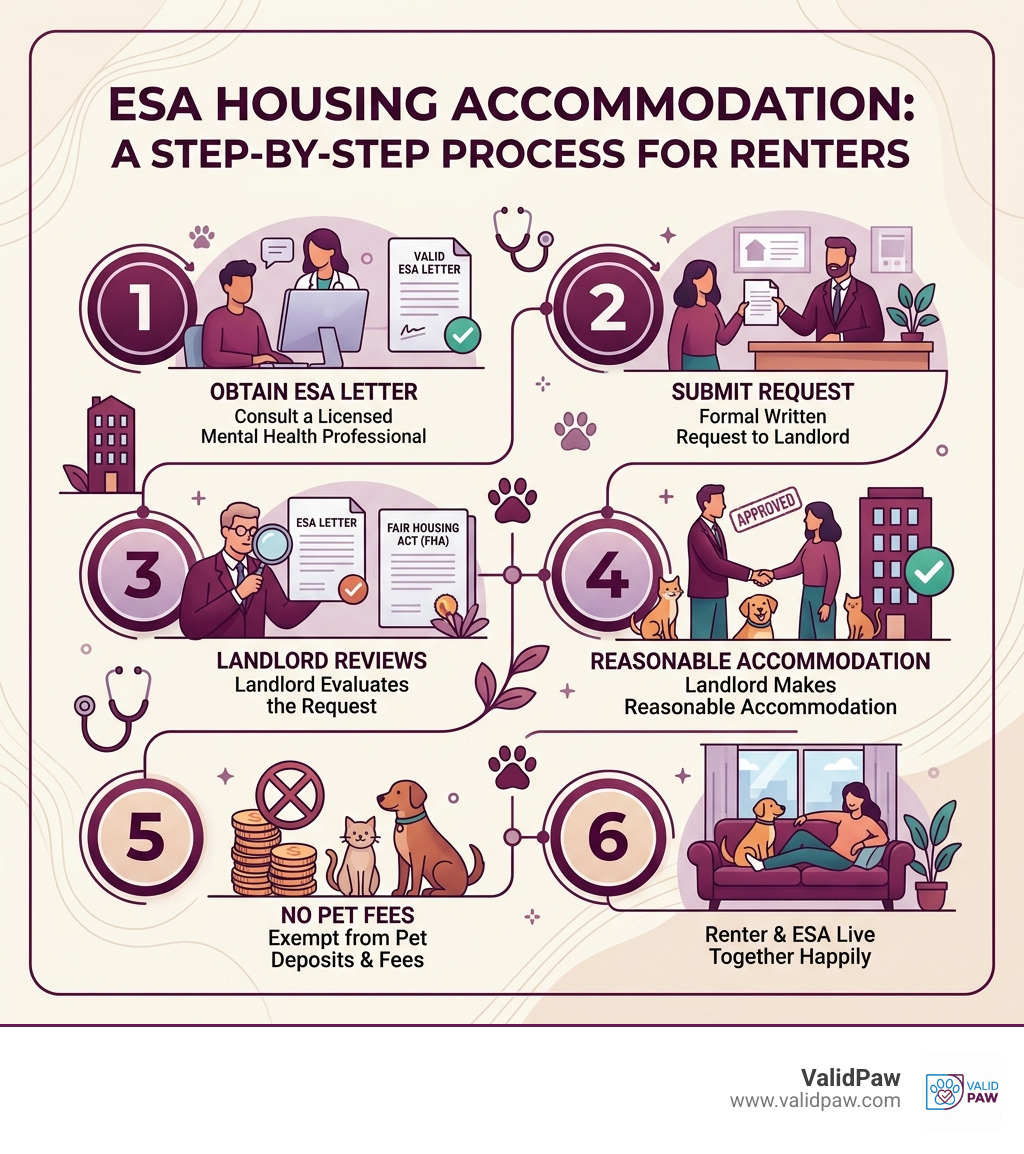
Under the Fair Housing Act (FHA), landlords are required to make reasonable accommodations for tenants with verified mental health disabilities. A properly written ESA letter is the key to that protection. Without one — or with an incomplete one — a landlord can legally deny your request.
The challenge is that many renters don't know what a legitimate letter looks like. And far too many online services sell documents that won't hold up to landlord scrutiny.
This guide breaks down exactly what every landlord needs to see, what your rights are, and how to get documentation that actually works.
I'm Francisco Ortiz, Lead Forensic Mental Health Evaluator and Director of Behavioral Health at District Counseling PLLC, and I've spent years conducting clinically rigorous emotional support verification letter evaluations across six states, grounded in forensic protocols that meet strict legal and housing standards. In this guide, I'll walk you through everything you need to know to get it right the first time.
What is an Emotional Support Verification Letter?
At its core, an emotional support verification letter is a prescription for a non-human companion that plays a vital role in a patient's mental health treatment plan. It is not just a "pet permit." It is a formal clinical document that bridges the gap between a medical necessity and housing law.
The therapeutic purpose of an ESA is to provide comfort, stability, and symptom relief for individuals struggling with a mental health disability. These disabilities can range from chronic anxiety and clinical depression to Post-Traumatic Stress Disorder (PTSD) and bipolar disorder. To be legally valid, the letter must establish that the individual has a physical or mental impairment that substantially limits one or more "major life activities."
What exactly are major life activities? According to the Department of Housing and Urban Development (HUD), these include essential functions like sleeping, working, interacting with others, or caring for oneself. If a person's anxiety is so severe they cannot sleep through the night, and the presence of a dog provides the calming influence necessary to rest, that animal is performing a therapeutic role.
For a letter to be HUD-compliant, it must clearly link the disability to the animal's presence. It should state that the animal provides symptom mitigation, helping the individual function on a daily basis. If you are a mental health professional looking for the right wording, you can reference this EMOTIONAL SUPPORT ANIMAL LETTER TEMPLATE to see the structure required for legal standing.
Who is Qualified to Issue an Emotional Support Verification Letter?
Not just anyone can write this letter. To be legally binding in April 2026, the document must be issued by a Licensed Mental Health Professional (LMHP) who is actively licensed to practice in your state. This includes:
- Licensed Clinical Social Workers (LCSW)
- Licensed Professional Counselors (LPC/LMHC)
- Licensed Marriage and Family Therapists (LMFT)
- Psychologists and Psychiatrists
- Licensed Nurse Practitioners specializing in mental health
The key requirement is that the provider must have "personal knowledge" of the patient. This is why many "instant" online services are rejected; they lack a legitimate clinical relationship. A psychologist's role in providing letters for emotional support animals involves a careful clinical assessment. This evaluation determines whether an ESA is a legitimate medical necessity or simply a preference for a pet.
At ValidPaw, we utilize telehealth evaluations to establish this relationship. Our licensed therapists in Texas and across all 50 states conduct thorough interviews to ensure every letter we issue is ethically sound and legally defensible. This process respects the ethical responsibilities of the clinician while ensuring the tenant gets the protection they deserve.
Legal Rights and Housing Protections Under the Fair Housing Act
The Fair Housing Act is the "gold standard" for ESA protections. It mandates that housing providers offer "reasonable accommodation" to individuals with disabilities. This means that if you have a valid emotional support verification letter, the following rules generally apply:
- No Pet Rent or Deposits: Landlords cannot charge you extra fees, "pet rent," or non-refundable deposits for your ESA.
- No Breed or Size Restrictions: Even if a building has a "no large dogs" rule or bans specific breeds like Pit Bulls or Rottweilers, these rules usually do not apply to ESAs.
- Exemption from "No Pet" Policies: You can live in a "no pets allowed" building if you have the proper documentation.
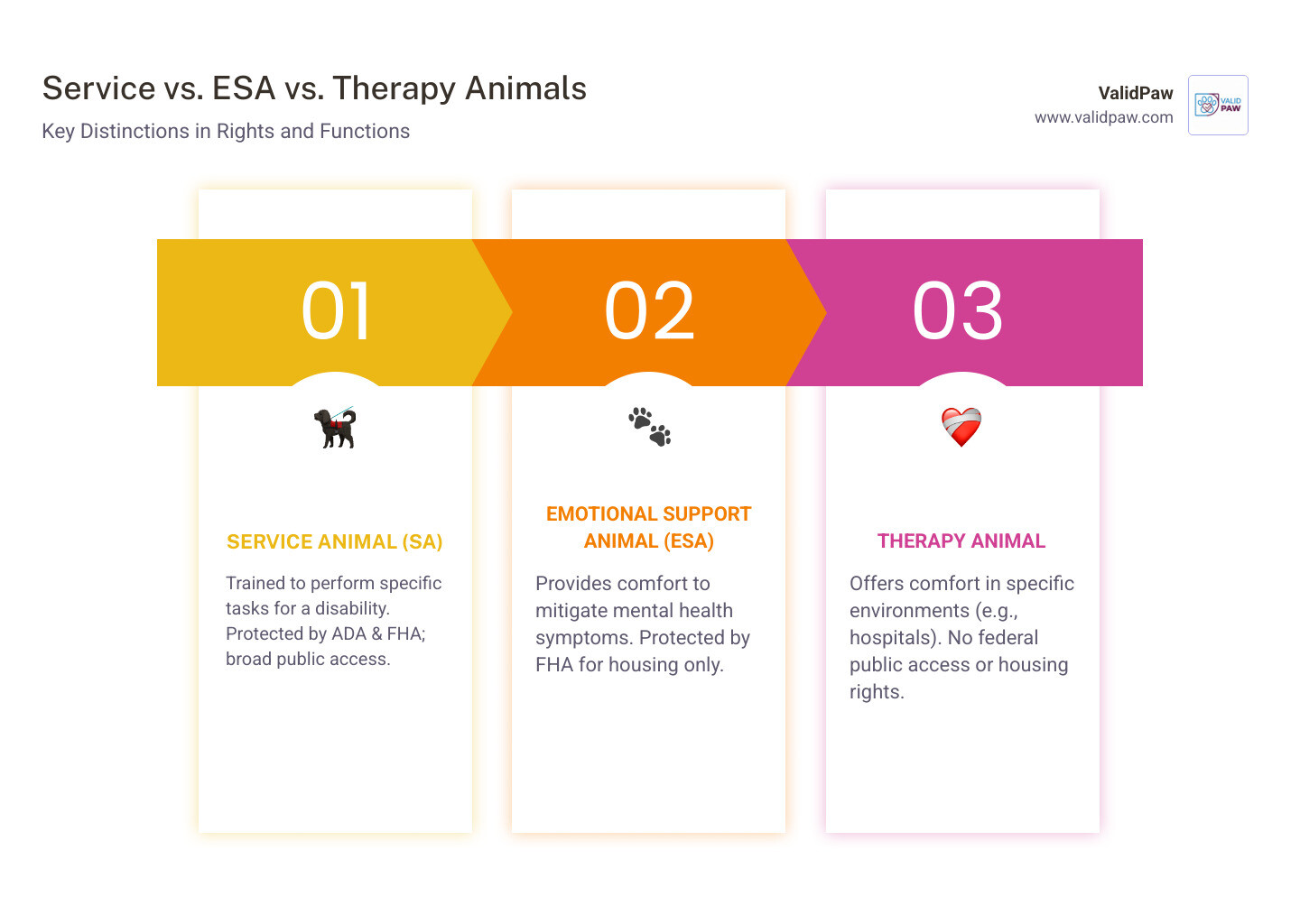
However, it is important to remember that an ESA is not a Service Animal. The legal protections differ significantly.
| Feature | Service Animal (SA) | Emotional Support Animal (ESA) | Therapy Animal | |---|---|---|---| | Legal Protection | ADA & FHA | FHA Only | None (usually) | | Training Required | Yes (Specific Tasks) | No | No | | Public Access | Yes (Restaurants, Stores) | No | No | | Housing Rights | Yes | Yes | No | | Species | Dogs & Mini Horses | Any common household animal | Varies |
While landlords have to follow these rules, they also have verification rights. They can ask to see your emotional support verification letter and, in some cases, verify the provider's credentials. They cannot, however, ask for your specific medical records or demand that the animal perform a "trick" or task to prove its worth.
Limitations of an Emotional Support Verification Letter
One of the biggest misconceptions we see is the idea that an ESA letter is a "golden ticket" for everywhere you go. This is simply not true. It is vital to understand what an ESA letter cannot do:
- Public Access: Unlike Service Animals, ESAs do not have the right to enter restaurants, grocery stores, or shopping malls under the Americans with Disabilities Act (ADA).
- Airline Travel: As of 2021, the Department of Transportation changed its rules. Most airlines now treat ESAs as regular pets, meaning you may have to pay a fee and keep them in a carrier under the seat. If you need a dog for travel, you may need to look into Psychiatric Service Dog (PSD) qualifications.
- Workplace Accommodations: While some employers are "pet-friendly," they are not legally required by the ADA to allow ESAs in the office, though they may consider it as a "reasonable accommodation" on a case-by-case basis.
- Private Clubs and Small Owner-Occupied Buildings: The FHA has a few exceptions. For example, if a building has four or fewer units and the owner lives in one of them, they may be exempt from ESA requirements.
If you are a student, you might find that universities have their own specific processes for support letters - UF Counseling and Wellness Center (CWC) or similar campus departments. Always check with your school's disability resource center to ensure your housing on campus is protected.
Essential Components of a Compliant Emotional Support Verification Letter
When a landlord receives your letter, they are looking for specific markers of legitimacy. If these markers are missing, it's a red flag. A professional document should always be printed on the provider's official letterhead, which includes their practice name and contact details.

Every compliant emotional support verification letter must contain:
- The Provider's License Information: This includes the license number, the state of licensure, and the type of license (e.g., LCSW #12345).
- Issuance Date: The letter should be fresh. Most landlords require it to be dated within the last 12 months.
- A Therapeutic Relationship Statement: The provider must state that they have evaluated you and have personal knowledge of your condition.
- Confirmation of Disability: While they shouldn't name your diagnosis (like "Major Depressive Disorder"), they must confirm you meet the FHA definition of being disabled.
- The "Nexus": This is the most important part. It explains the connection (the nexus) between your disability and the relief the animal provides.
To help landlords feel secure, ValidPaw provides an easy way to Verify Letter status. This instant verification system allows housing providers to confirm the document was actually issued by our licensed experts, reducing friction and building trust.
Red Flags and Scams to Avoid
The internet is full of "ESA Registries" and "Certification Sites." Be very careful. Most of these are scams that provide worthless pieces of paper. Here are the biggest red flags:
- "Instant" Approvals: If you can get a letter in 5 minutes without talking to a human, it's likely a scam. A legitimate how to get an ESA letter in all 50 U.S. states: a complete guide emphasizes the need for a real clinical evaluation.
- Lifetime Validity: No legitimate therapist will write a letter that "never expires." Mental health conditions change, and HUD guidelines suggest annual renewals.
- ID Cards and Vests: There is no such thing as an "Official ESA Registry." Any site selling you a badge or a vest as "proof" of ESA status is selling you a costume, not a legal right.
- Missing Credentials: If the letter doesn't have a verifiable license number or the provider isn't licensed in your state, the landlord can legally reject it.
The Process of Obtaining Legitimate Documentation
Getting a legitimate emotional support verification letter doesn't have to be a headache. At ValidPaw, we've streamlined the process to be as stress-free as possible while maintaining the highest clinical standards.

The process typically follows these steps:
- Initial Assessment: You start by filling out our Application Form. This helps us understand your history and your current mental health needs.
- Clinical Evaluation: You will meet with one of Our Experts via a secure, HIPAA-compliant telehealth video call. This is where the "therapeutic relationship" is established.
- Informed Consent: We ensure you understand the process, including how your information is used and the limitations of an ESA letter.
- Letter Delivery: If the therapist determines that an ESA is a necessary part of your treatment, you'll receive your FHA-compliant letter within 24 to 48 hours.
Once you have your letter, you are set for the year. However, clinical needs can evolve. We recommend an annual renewal to ensure your documentation remains current and that your treatment plan is still serving you well. If you have more questions about the specifics, our FAQ section covers everything from multi-animal requests to state-specific rules.
Frequently Asked Questions about ESA Verification
How long is an ESA letter valid?
Generally, an emotional support verification letter is considered valid for one year (12 months) from the date of issuance. As of April 2026, most housing providers strictly follow the HUD guidance that documentation should be current. A lot can change in a year! A clinical re-evaluation ensures that the animal is still providing the necessary support and that your mental health needs are being met.
Can a landlord deny my ESA?
Yes, but only in very specific circumstances. A landlord can deny an ESA if:
- Direct Threat: The specific animal has a documented history of aggression or poses a direct threat to the safety of others.
- Financial/Administrative Burden: The accommodation would cause an "undue financial or administrative burden" on the landlord (this is a very high bar to meet).
- Property Damage: The animal is causing significant physical damage to the property that cannot be mitigated.
- Documentation Errors: The letter is fake, expired, or from someone not licensed in the tenant's state.
They cannot deny you just because they "don't like dogs" or because of the animal's breed.
Do I need to register my animal?
Absolutely not. In fact, "registering" your animal on a website often makes you look less legitimate to savvy landlords. HUD guidelines are clear: the only thing required is a letter from a licensed professional. Certificates, "official" stickers, and registry entries have no legal weight in the United States.
Conclusion
Navigating housing with an emotional support animal can feel like a maze, but it doesn't have to be. By focusing on ethical documentation and ensuring you have a legitimate emotional support verification letter, you protect both your rights and your peace of mind.
At ValidPaw, we are committed to helping you find that security. We believe that mental health support should be accessible, professional, and grounded in real clinical care. Whether you are in Houston, Dallas, Chicago, or anywhere in the 50 states, our team is here to ensure you and your animal can stay together.
Don't let a "no pets" policy stand in the way of your well-being. Start your journey toward housing security today by visiting https://validpaw.com/.

