
Get a Real Example ESA Letter for Apartment Requests
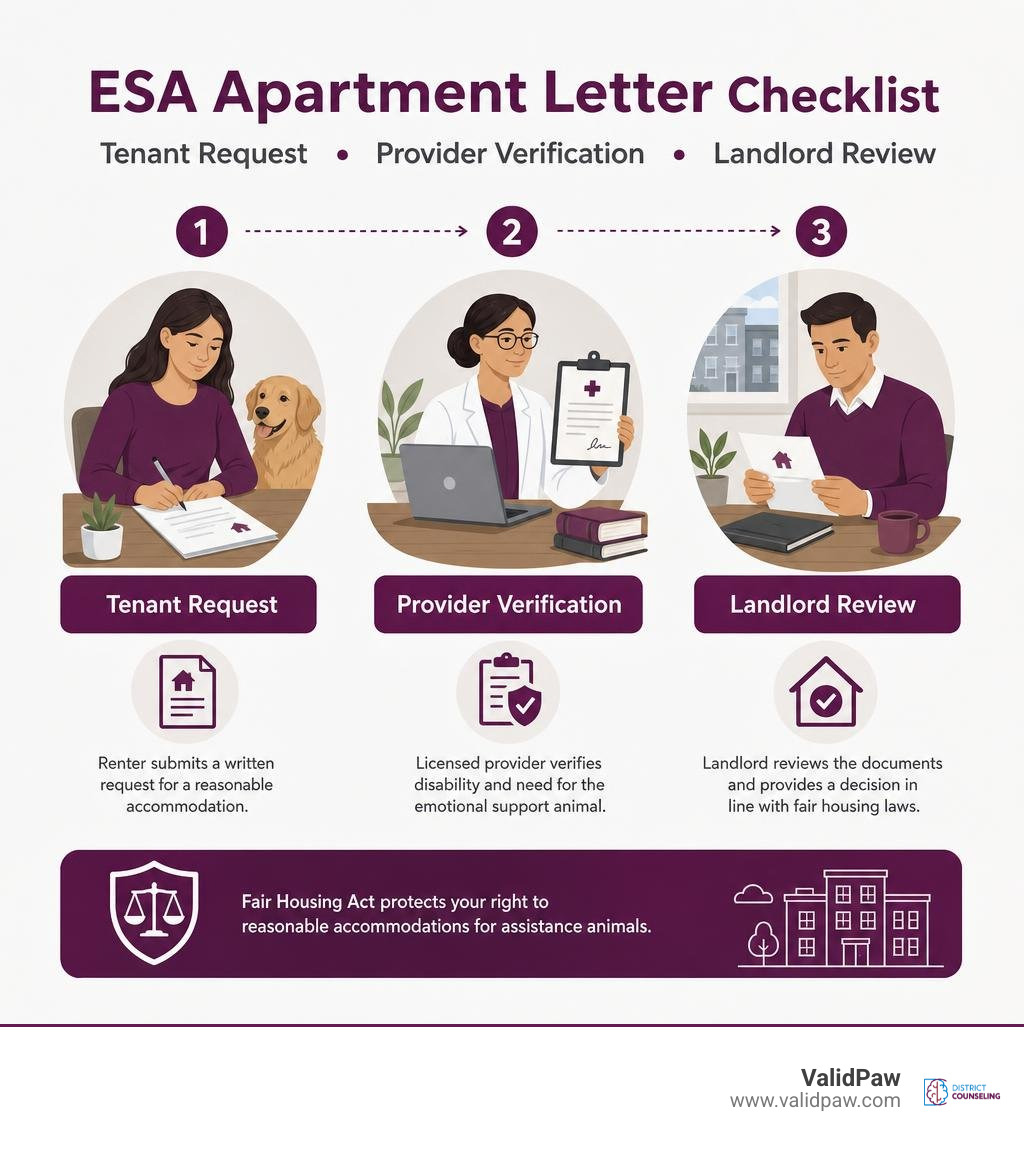
A example esa letter for apartment request usually includes two documents: a written reasonable-accommodation request from the renter and a letter from a licensed healthcare professional.
| Document | What it should say | |---|---| | Tenant request | You are requesting an exception to a housing rule, such as a no-pets policy, pet rent, or a breed restriction. | | Provider ESA letter | You have a disability under fair housing law and your emotional support animal helps with a disability-related need. |
A valid letter does not need to reveal your diagnosis or include a registry number. It should be current, signed by a qualified provider licensed in your state, and explain the connection between your disability-related limitations and the support the animal provides.
For covered housing, the Fair Housing Act can require landlords to make reasonable accommodations for assistance animals. That may mean waiving pet rules and pet fees. But an ESA letter is for housing - it does not give an animal public-access rights or guarantee airline travel accommodations.
I am Francisco Ortiz, a Certified Forensic Mental Health Evaluator and behavioral health director who conducts clinically rigorous ESA and disability evaluations across six states. In this guide, I will break down what a credible example esa letter for apartment looks like and what renters need to know before submitting one.
Fair Housing Act Rights and Assistance Animal Rules for Renters

When you rent an apartment, federal civil rights legislation protects your right to live with an assistance animal. Under The Ultimate Guide to Fair Housing Act ESA Letters and federal statute (specifically 42 U.S.C. § 3604(f)(3)(B)), housing providers are prohibited from discriminating against tenants with physical or mental impairments.
The Fair Housing Act (FHA) mandates that property managers and landlords provide a "reasonable accommodation." This means modifying administrative rules, policies, or lease terms so a person with a disability has an equal opportunity to use and enjoy their home. The U.S. Department of Housing and Urban Development (HUD) oversees these housing regulations and defines assistance animals broadly, recognizing both individually trained service dogs and emotional support animals (ESAs) as vital aids for daily living.
Differences Between Emotional Support Animals and Service Dogs
A frequent source of confusion for both landlords and tenants is the distinction between an emotional support animal, a service animal, and a therapy animal. These categories carry entirely different legal protections across federal law.
| Animal Classification | Primary Legal Governing Body | Public Access Rights (Stores, Restaurants) | Airline Cabin Travel Exemption | Housing Protection (FHA) | Specialized Task Training Required | | :--- | :--- | :--- | :--- | :--- | :--- | | Service Animal (Dogs & Miniature Horses) | Americans with Disabilities Act (ADA) | Yes, full public access | Yes (under ACAA) | Yes, fully exempt from pet rules | Yes, individually trained to perform specific disability tasks | | Emotional Support Animal (ESA) | Fair Housing Act (FHA) | No public access rights | No (treated as standard pets by airlines) | Yes, exempt from pet rules & pet rent | No specific specialized training required | | Therapy Animal | None (Facility-dependent guest policies) | No public access rights | No | No housing exemptions | Yes, basic obedience and temperament screening |
Under the ADA, a service dog is trained to perform active, concrete tasks—such as alerting a handler with diabetes to low blood sugar, guiding a visually impaired individual, or interrupting a panic attack. In contrast, an emotional support animal provides therapeutic comfort, companionship, and emotional stability simply through its presence. To dive deeper into species criteria, check out our Ultimate Guide to ESA Dog Requirements.
Therapy animals visit settings like hospitals, schools, or nursing homes to comfort groups of people; they have no statutory housing exemptions.
Exemption from Pet Deposits, Pet Rent, and Breed Bans
Under HUD guidelines, emotional support animals are not classified as pets. Because of this legal classification, standard pet rules do not apply:
- No-Pet Policies: A building with a strict ban on domestic animals must grant an exception for a verified ESA. No Pets Allowed? Not With a Valid ESA Letter explains this core FHA protection.
- Pet Rent & Pet Fees: Landlords cannot charge upfront pet fees, recurring monthly pet rent, or dedicated pet security deposits for an ESA.
- Breed, Size, and Weight Restrictions: Even if an apartment complex prohibits dogs over 40 pounds or bans certain breeds (such as Pit Bulls, Rottweilers, or German Shepherds), assistance animals are exempt from generic breed-specific policies.
However, an ESA exemption is not a blank check for property destruction. Tenants remain financially responsible for any actual property damage caused by the animal, just as any renter would be for broken fixtures or damaged flooring.
Essential Requirements for a Legally Compliant Housing Letter
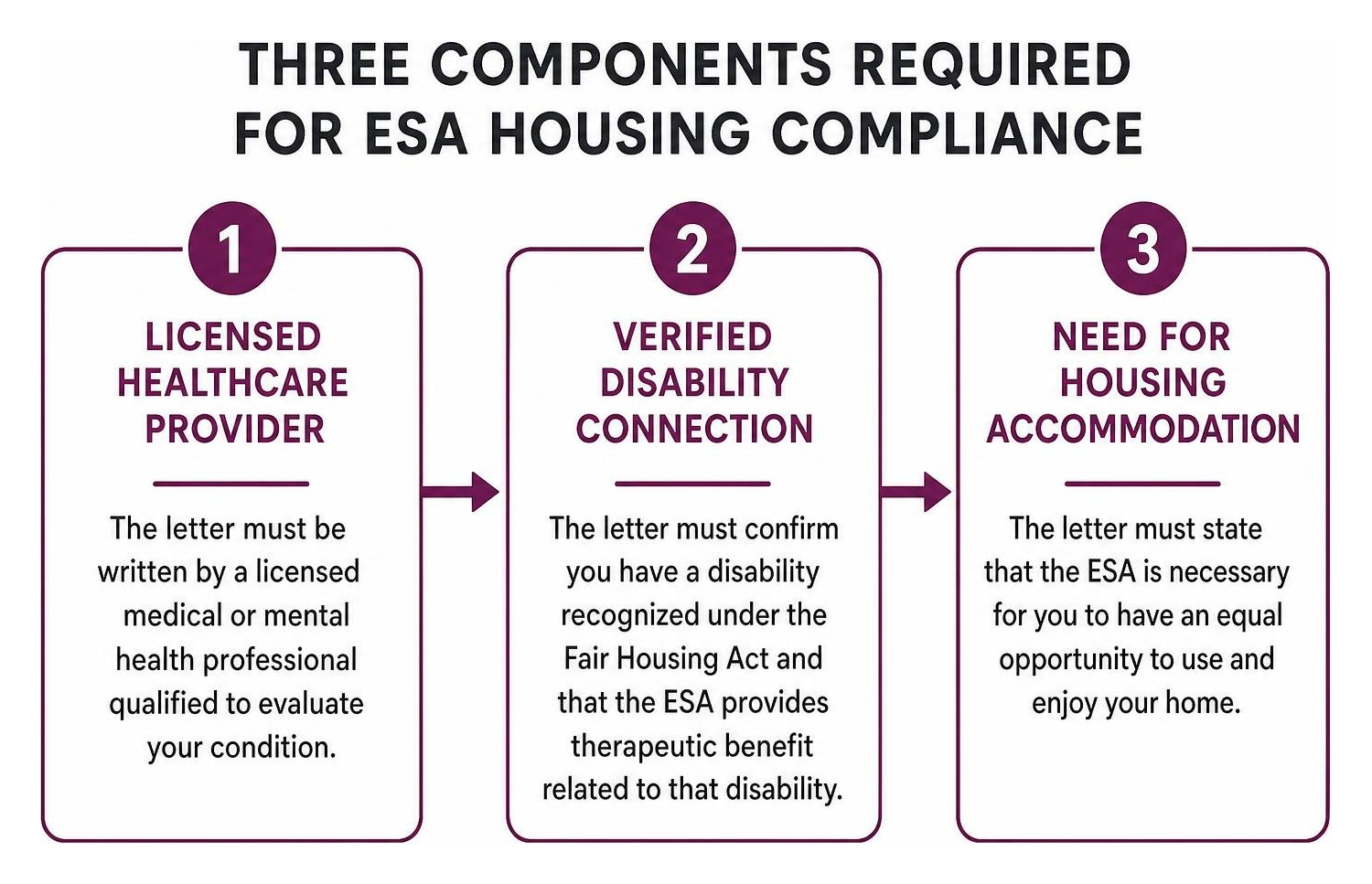
A property manager is not required to take a verbal declaration at face value. To secure a housing accommodation, you must supply formal clinical documentation written by an authorized professional. Reviewing our guide on Emotional Support Verification Letter: What Every Landlord Needs to See provides a practical overview of these legal essentials.
Licensed Healthcare Provider Qualifications and State Licensure
Under federal HUD guidance, only licensed medical and mental health professionals who are qualified to evaluate your condition can write a valid ESA letter. These professionals include:
- Licensed Professional Counselors (LPC)
- Licensed Clinical Social Workers (LCSW)
- Licensed Marriage and Family Therapists (LMFT)
- Clinical Psychologists (PsyD, PhD)
- Psychiatrists (MD, DO)
- Psychiatric-Mental Health Nurse Practitioners (PMHNP)
- Primary Care Physicians (MD, DO)
The clinician must hold an active, verifiable license in the state where the tenant resides. A letter signed by an unlicensed coach or an out-of-state provider with no jurisdiction in your state will be rejected.
Ethical telehealth consultations are fully recognized under HUD rules, provided the provider conducts a clinical assessment, establishes a legitimate therapeutic relationship, and practices within their state-approved geographic boundary.
Necessary Documentation Elements vs Unnecessary Medical Disclosures
Federal disability law and the Health Insurance Portability and Accountability Act (HIPAA) strictly protect your medical privacy. A common misconception among landlords is that a tenant must turn over medical records or reveal a clinical DSM diagnosis (such as Major Depressive Disorder, Generalized Anxiety Disorder, or PTSD).
As explained in Everything You Need to Know About Your ESA Landlord Letter, a legally compliant letter must establish a clear functional nexus without oversharing personal health data:
Real Example ESA Letter for Apartment Housing Requests
A successful reasonable accommodation packet combines clinical verification with clear tenant communication. For additional reference formats, you can review Sample ESA Letters That Actually Work alongside external resources such as EMOTIONAL SUPPORT ANIMAL (“ESA”) SAMPLE VERIFICATION LETTERS.
Clinical Example ESA Letter for Apartment Housing Approval
Below is an authentic, compliant example esa letter for apartment approval written on formal clinician letterhead.
Tenant Example ESA Letter for Apartment Reasonable Accommodation Request
Tenants should submit their own formal cover letter alongside the clinical verification. You can consult the Emotional Support Animal Reasonable Accommodation Request | Free PDF & Word Template or review Everything You Need in a Tenancy Confirmation Letter to structure your request.
Step-by-Step Guide to Requesting an Apartment Accommodation
Requesting an ESA accommodation does not have to be stressful. By taking organized, proactive steps, you can avoid unnecessary disputes. Learn more in our breakdown on How to Get Landlord Approval for an Emotional Support Animal Letter.
When and How to Submit Your ESA Documentation
A frequent dilemma for apartment hunters is timing: should you disclose your assistance animal on your initial rental application, or wait until after the lease is signed?
Strategically, the best approach depends on your situation. Our detailed guide on When to Tell Your Landlord About an Emotional Support Animal Without Getting Rejected outlines your options.
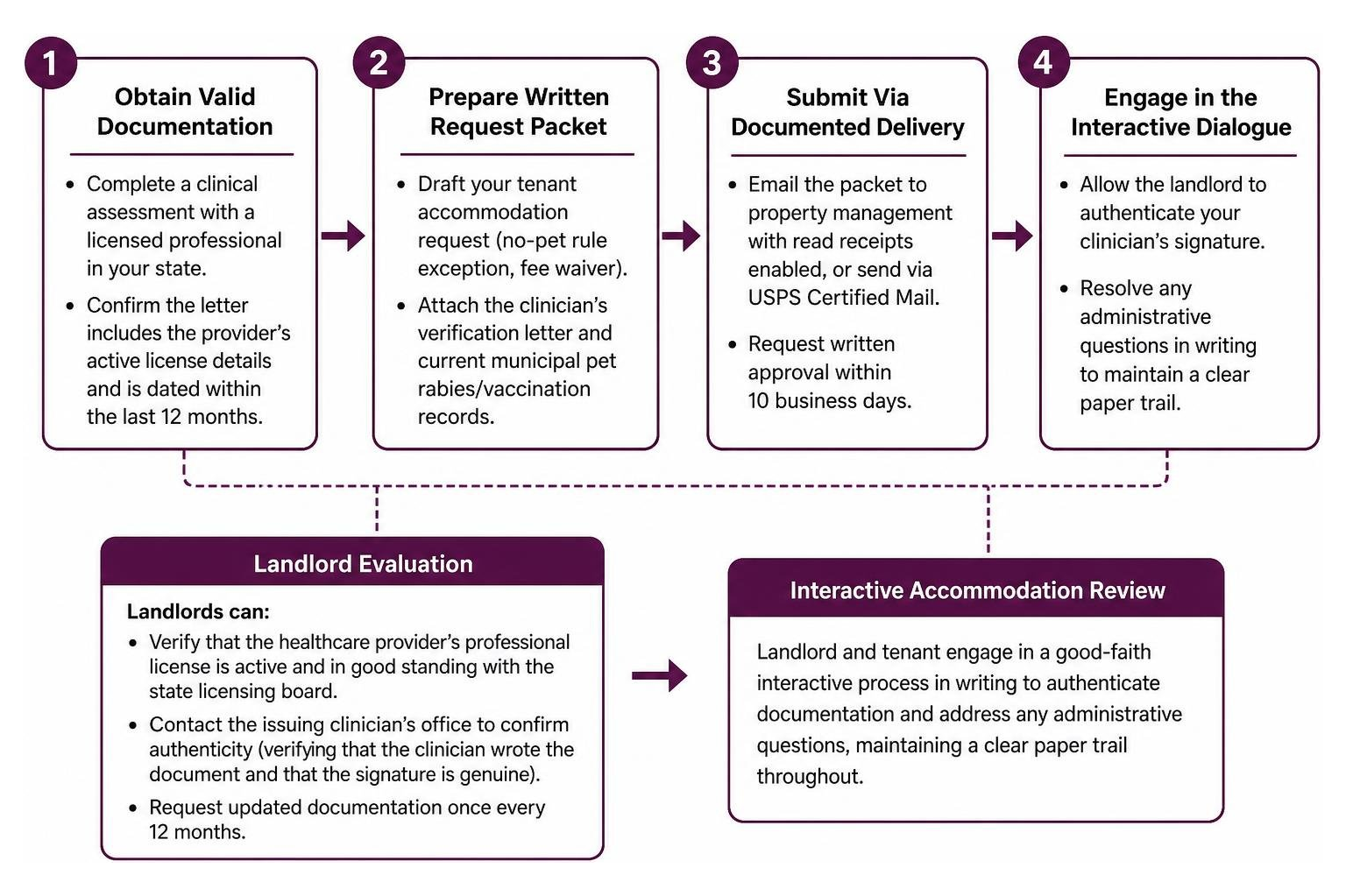
Under the FHA, you are legally entitled to request an accommodation at any point—before moving in, during lease signing, or after you have lived in the unit for months. However, notifying your landlord in writing before bringing the animal onto the property prevents lease violation notices.
Always keep an unedited digital trail of emails, confirmation receipts, and scanned letters. If delivering in person, have the property manager sign an acknowledgment receipt.
Landlord Verification Protocols and Legitimate Grounds for Denial
When a housing provider receives your accommodation request, they have a legal obligation to respond promptly. For practical tips, see How to Give Your Landlord ESA Proof That Actually Sticks.
What Landlords CAN Do:
- Verify that the healthcare provider's professional license is active and in good standing with the state licensing board.
- Contact the issuing clinician's office to confirm authenticity (verifying that the clinician wrote the document and that the signature is genuine).
- Request updated documentation once every 12 months.
What Landlords CANNOT Do:
- Demand your complete medical files or psychiatric session notes.
- Inquire into the specific symptoms, history, or clinical diagnosis of your disability.
- Require an in-person physical examination of an animal or demand obedience training certifications.
- Insist that your provider use a specific proprietary landlord form if your submitted letter already satisfies all FHA legal standards.
Legitimate Grounds for Denial:
While FHA protections are robust, they are not unlimited. A landlord may legally deny an ESA request under specific statutory exceptions:
- Direct Threat to Health and Safety: If an animal exhibits severe aggression, bites, or creates an immediate danger to other residents that cannot be mitigated by reasonable measures.
- Substantial Physical Property Damage: If the animal causes severe structural destruction beyond normal wear.
- Fundamental Alteration or Undue Financial Burden: If accommodating the animal would impose an extreme administrative or financial hardship on the housing provider.
- FHA Exempt Properties: Small owner-occupied buildings with four or fewer units, and single-family houses sold or rented without a broker (where the owner owns no more than three single-family homes).
Note on HUD Enforcement Guidance: HUD's May 22, 2026 enforcement memorandum states that untrained emotional support animal requests are not presumptively reasonable in HUD's administrative enforcement. However, this administrative memorandum does not eliminate a renter's private right of action in court or rights established under state or local law. Landlords must still evaluate each case individually.
Frequently Asked Questions About ESA Letters for Rental Housing
How long is an emotional support animal letter valid for an apartment?
An ESA letter for housing is valid for 12 months from the date it is signed. Landlords and property management companies are legally permitted to ask for an annual documentation update to confirm your ongoing clinical need for the accommodation.
Can a landlord demand medical records or contact my doctor directly?
No. Under the Fair Housing Act and HIPAA privacy regulations, housing providers are strictly prohibited from demanding confidential medical records, diagnostic test results, or comprehensive therapy notes.
If a landlord calls your healthcare provider, the clinician can only confirm that they authored the letter and verified the need for an accommodation.
Do online ESA registrations and certificates work for rental housing?
No. Commercial websites that sell instant downloadable registration numbers, ID cards, metallic badges, or federal registry certificates are not recognized by HUD or the Department of Justice.
Federal law does not maintain an official animal registry. Submitting commercial registration badges without a legitimate clinical evaluation will result in immediate rejection by educated property managers.
Conclusion
Securing fair housing accommodations for your emotional support animal should be straightforward and transparent. When you have an authentic example esa letter for apartment approval written by an authorized, state-licensed professional, you can protect your tenancy rights, eliminate illegal pet charges, and live comfortably alongside your animal.
At ValidPaw, we connect renters directly with licensed therapists who conduct thorough telehealth evaluations across Texas (including Houston, Austin, Dallas, San Antonio, and Fort Worth), Chicago, IL, and all 50 states. We provide fast 24–48 hour FHA-compliant letters with built-in landlord verification and zero office visits.
Ready to secure your housing accommodation? Apply for a legitimate ESA letter with ValidPaw today.

