
Emotional Support Animal Deposit Rules: The Quick Answer
In most rental housing covered by the Fair Housing Act, a landlord cannot charge a pet deposit, pet fee, or monthly pet rent just because you have a legitimate emotional support animal (ESA). An ESA is an assistance animal requested as a reasonable accommodation for a disability, not simply a pet under a lease policy.
A landlord may still charge:
- A regular security deposit charged to all tenants
- The actual cost of damage your ESA causes beyond normal wear and tear
- Fees for other non-assistance pets, if the lease allows them
You should make the accommodation request in writing, provide reliable documentation if your disability-related need is not apparent, and keep copies of every email, letter, and fee request. State and local rules can add protections or affect the process, so the details matter.
I am Francisco Ortiz, a Lead Forensic Mental Health Evaluator and Director of Behavioral Health who conducts clinically rigorous disability and ESA evaluations in Texas, California, Florida, and other states. My work with emotional support animal deposit issues focuses on clear, ethical documentation that helps renters and housing providers understand legitimate accommodation requests.
Understanding Federal Rules on Emotional Support Animal Deposit Policies
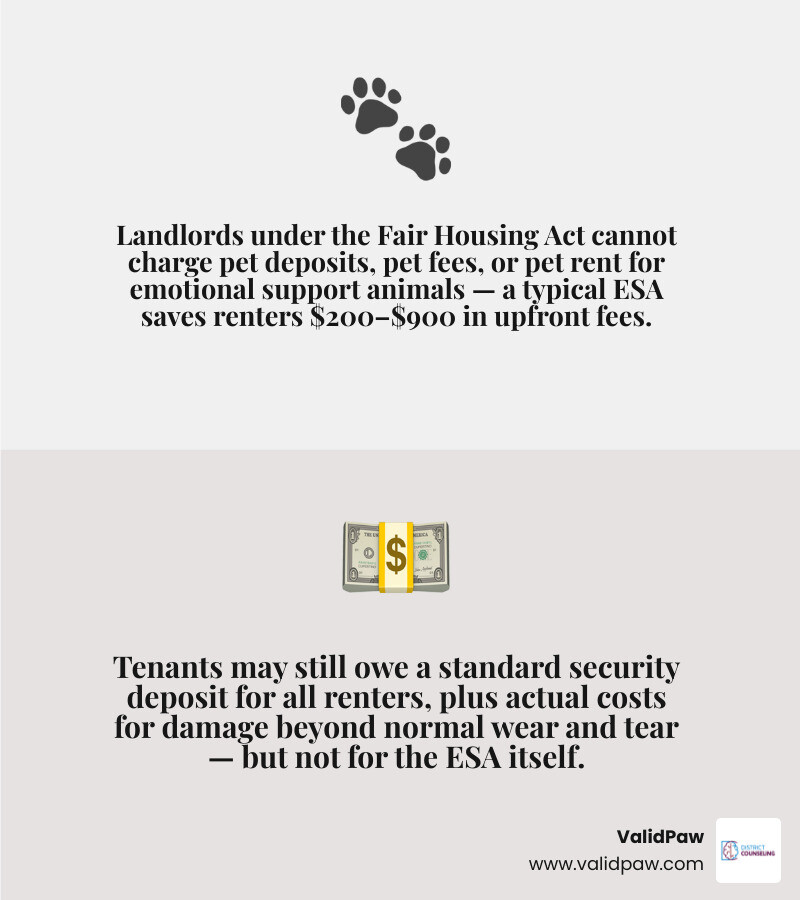
Finding the perfect rental can be stressful, especially when upfront moving expenses start piling up. Many property managers routinely attach hefty upfront pet deposits ranging from $200 to $900 alongside recurring monthly pet fees between $25 and $50. However, when you require an emotional support animal to alleviate mental health symptoms, standard pet rules do not apply.
Under the federal Fair Housing Act (FHA), housing providers are legally required to grant reasonable accommodations to individuals with disabilities. This includes permitting assistance animals in residential properties and waiving all pet-related financial obligations. Understanding the Fair Housing Act assistance animal rules allows renters to stand up for their rights while educating property managers on their statutory duties.

The primary reason landlords cannot demand an emotional support animal deposit stems from the core legal definition of the animal itself. In the eyes of federal law, assistance animals provide necessary support that mitigates symptoms of mental health conditions such as generalized anxiety, major depressive disorder, or PTSD. Requiring a tenant to pay extra fees to live with an accommodation is considered unlawful discrimination under federal service and assistance animal guidelines.
Assistance Animals vs Pets: Why You Cannot Be Charged an Emotional Support Animal Deposit
To grasp why assistance animals live deposit-free, it is vital to distinguish between regular pets, emotional support animals, and service animals under federal statutes:
| Category | Legal Classification | Governing Law | Specialized Training Required? | Pet Deposits & Pet Rent Allowed? | Public Access Rights? | | :--- | :--- | :--- | :--- | :--- | :--- | | Standard Pet | Companion / Personal Property | Local Lease Contract | No | Yes (Standard pet deposits, fees, and pet rent apply) | No | | Emotional Support Animal (ESA) | Assistance Animal / Reasonable Accommodation | Fair Housing Act (FHA) | No (Provides comfort via companionship) | No (All pet fees and deposits strictly prohibited) | No (Housing only) | | Service Animal | Working Service Animal | Americans with Disabilities Act (ADA) & FHA | Yes (Individually trained to perform specific tasks) | No (All pet fees and deposits strictly prohibited) | Yes (Full public access) |
While the Americans with Disabilities Act (ADA) only grants public access rights to trained service dogs and miniature horses, the Fair Housing Act covers a broader scope for residential housing. Under the FHA, both trained service animals and emotional support animals are categorized as assistance animals. Attempting to charge additional fees or forcing an assistance animal into a standard pet tier constitutes unlawful landlord actions against ESA owners.
Security Deposits vs Pet Fees: Understanding Your Financial Liability
A common misunderstanding among renters involves confusing standard security deposits with pet deposits. Landlords are fully entitled to collect a standard, uniform security deposit from every tenant to cover potential lease defaults or property destruction.
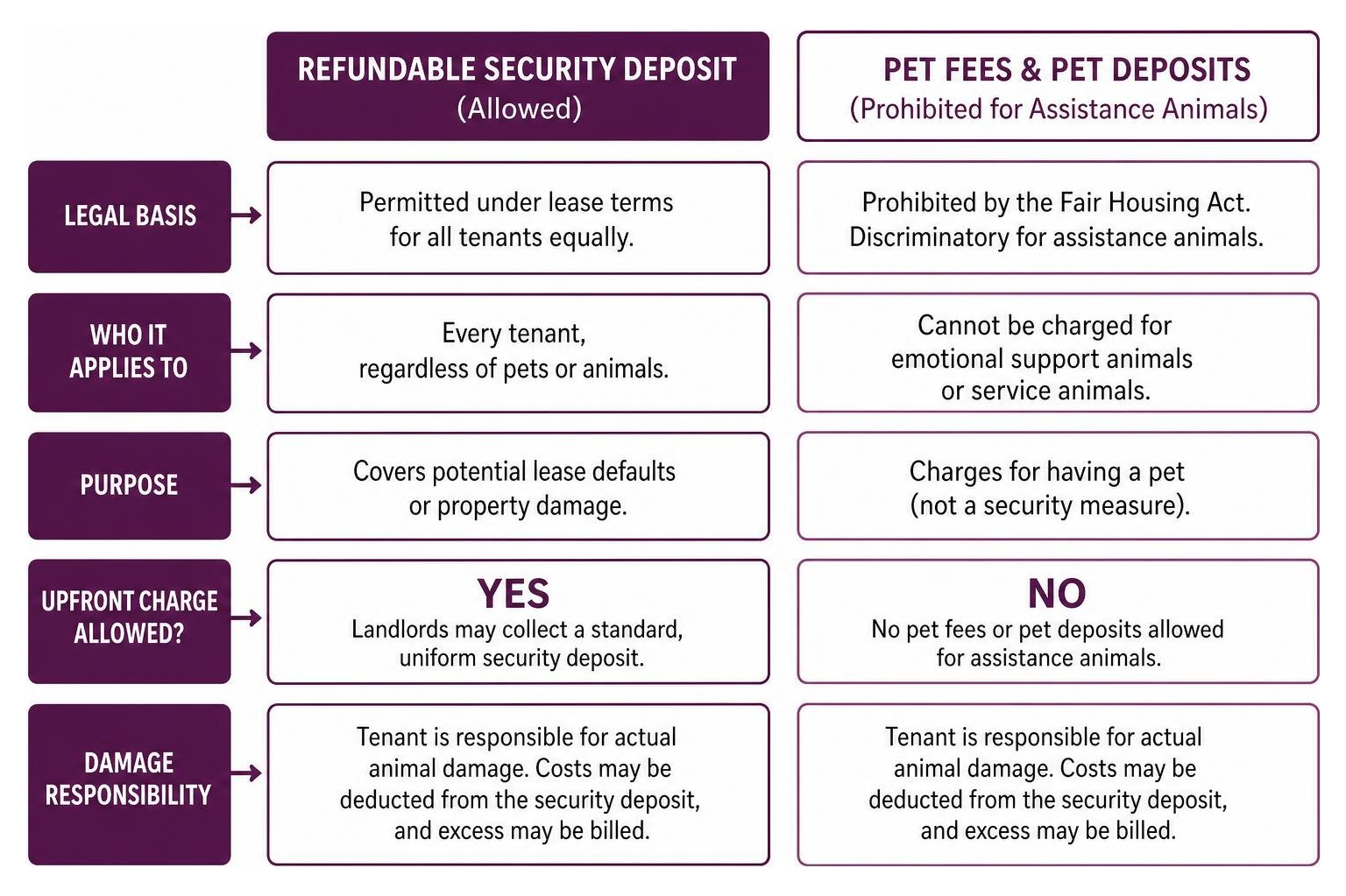
While a housing provider cannot charge a dedicated pet fee or an extra deposit in advance, you remain legally responsible for any damage your animal causes during your tenancy:
- Routine wear and tear: Minor carpet matting, normal paint fading, and everyday cleaning costs cannot be deducted from your security deposit.
- Actual animal damage: Chewed baseboards, stained carpets, or scratched door frames caused by your ESA can be deducted from your standard security deposit upon move-out.
- Excess repair costs: If the repair costs exceed your general security deposit, your landlord has the right to issue an itemized bill for the remaining balance.
State Laws and 2026 Policy Updates on Assistance Animal Fees
The landscape surrounding assistance animal enforcement continues to evolve across federal and state jurisdictions. In May 2026, the U.S. Department of Housing and Urban Development (HUD) issued updated internal enforcement guidance regarding assistance animals in rental housing. The shift narrowed federal administrative complaint priorities regarding untrained comfort animals while directing greater reliance on state-level fair housing commissions.
Despite shifting federal enforcement priorities, the underlying Fair Housing Act statute remains unchanged. State and municipal fair housing statutes continue to reinforce protections against discriminatory fees. Landlords who rely on misunderstandings of recent HUD assistance animal policy shifts risk substantial legal liabilities under state laws.

State-by-State Rules: California, Texas, Louisiana, and Beyond
State-level fair housing regulations provide robust protections against unlawful animal charges across the country:
- Texas: Under the Texas Property Code and the Texas Fair Housing Act, landlords must provide reasonable accommodations for assistance animals without imposing pet deposits or extra monthly charges. For a detailed breakdown of state precedents, review the Texas service and assistance animal laws maintained by the state law library.
- Illinois (including Chicago): Illinois enforces strict non-discrimination statutes through the Illinois Human Rights Act, requiring landlords to waive all pet fees upon presentation of a legitimate clinical evaluation.
- California: Assembly Bill 468 sets clear requirements for healthcare providers issuing documentation while maintaining strict bans on ESA pet deposits, pet rent, and arbitrary size limits.
- Florida: Florida statutes recognize telehealth documentation from licensed practitioners and prohibit landlords from charging pet fees, while establishing civil penalties for fraudulent claims.
- Louisiana: While state statutes contain unique language regarding pet deposits, the overarching federal Fair Housing Act continues to protect tenants requesting legitimate reasonable accommodations, as highlighted in Louisiana assistance animal statutes.
- Ohio & Washington: Municipal codes across cities like Columbus and Seattle enforce strict local civil rights ordinances that protect tenants from discriminatory animal deposits.
How to Secure an Emotional Support Animal Deposit Exemption from Your Landlord
Securing a fee waiver requires following a structured reasonable accommodation process. To maintain clear communication, always submit a formal written request alongside your clinical documentation before or upon signing your lease.
Following comprehensive ESA housing guidelines ensures you avoid unnecessary friction with management. You can review our step-by-step framework to establish bulletproof documentation for landlords that satisfies all legal requirements.
Legitimate Documentation vs Online Certificate Scams
The most common reason landlords reject an emotional support animal deposit waiver is the submission of fraudulent online certificates. The internet is flooded with websites selling "instant registrations," ID cards, badges, and certificates that claim to register your pet on an "official federal database."
There is no federal or state registry for emotional support animals. HUD and state fair housing agencies explicitly recognize that generic registration certificates downloaded from registry mills carry zero legal weight.
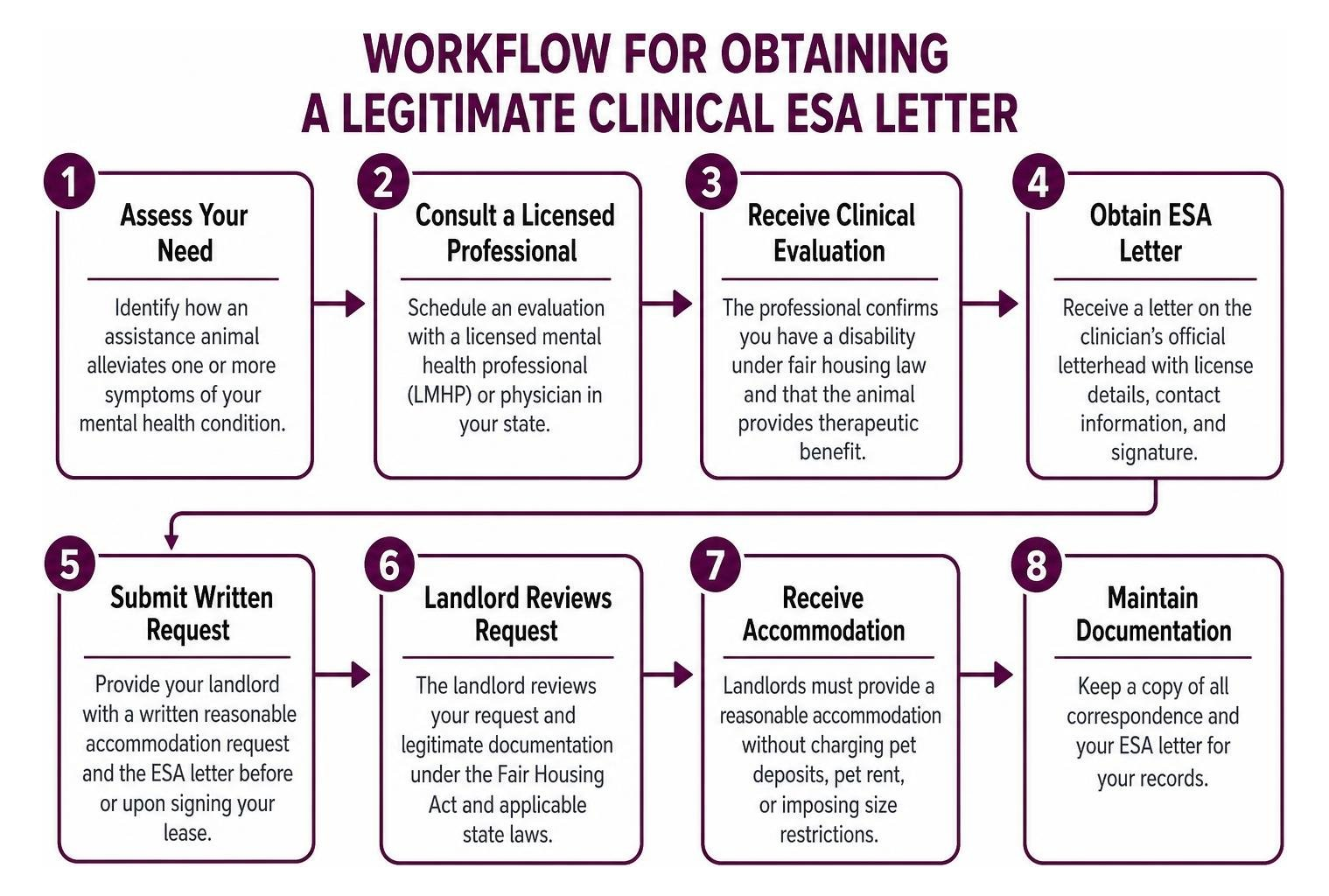
To qualify for housing protections, your documentation must come from a licensed mental health professional (LMHP) or physician who has clinically evaluated your needs. Understanding the essential elements of an ESA verification letter will keep you protected. Legitimate documentation must include:
- The clinician's full name, professional license type, license number, and state of issuance.
- The clinician's official letterhead, contact details, and signature.
- Confirmation that you meet the definition of having a disability under fair housing law.
- A clear professional determination that the assistance animal alleviates one or more identified symptoms of your condition.
Several states have enacted strict consumer protection laws penalizing the misrepresentation of assistance animals with civil fines up to $500 for initial offenses and $2,500 for repeat infractions. Working with licensed clinicians ensures full legal compliance.
Breed Restrictions, Weight Limits, and Landlord Denial Grounds
Standard pet rules regarding breed bans, weight limits, and species caps do not apply to assistance animals. A property manager cannot refuse your accommodation simply because an ESA is a German Shepherd, Pit Bull, or weighs over 50 pounds. For a deeper look at your rights, check out our guide on ESA breed restrictions and landlord limits.
Similarly, property managers operating "no-pet" buildings must waive their pet exclusion policies for verified assistance animals. You can learn more about overcoming no-pet lease policies through the reasonable accommodation process.
Landlords can only legally deny an ESA accommodation under very narrow statutory exceptions:
- Direct Threat to Safety: If a specific animal demonstrates documented aggression or vicious behavior toward other residents or staff.
- Substantial Property Damage: If the animal has a proven history of causing severe structural property damage that cannot be mitigated.
- Undue Financial or Administrative Hardship: If accommodating the animal would impose an unreasonable operational burden.
- Insurance Cancellation: If the landlord's property insurance company would cancel the building's coverage or impose significant rate hikes specifically due to that individual animal's presence, provided the landlord demonstrates no equivalent alternative policy is available.
Frequently Asked Questions About Emotional Support Animals and Rental Fees
How Should Tenants Respond When Charged an Unlawful Emotional Support Animal Deposit?
If a leasing office insists on collecting an emotional support animal deposit or pet rent after you have submitted valid documentation, remain calm and handle all communications in writing:
- Submit a Formal Written Response: Send a professional letter or email explaining that assistance animals are classified as reasonable accommodations under the Fair Housing Act and state law. We cover every detail of drafting an ESA letter for your landlord to help you outline your rights.
- Provide Official HUD & State Guidance: Attach standard fair housing educational materials detailing why assistance animals are exempt from pet fees. You can follow our guide on securing landlord approval for an ESA to navigate this dialogue smoothly.
- Engage in the Interactive Process: Offer to answer reasonable procedural questions regarding vaccination records or general animal care without disclosing private medical records.
- File a Fair Housing Complaint: If the landlord continues to demand illegal fees, refuse your accommodation, or threaten eviction, you can file a formal complaint with the HUD Office of Fair Housing and Equal Opportunity (FHEO) or your state's civil rights commission.
Do Short-Term Rentals Like Airbnb Have to Waive Pet Fees for ESAs?
No. The Fair Housing Act applies to residential housing designed for long-term living. Short-term vacation rentals, hotels, and transient lodging platforms operate under Title III of the Americans with Disabilities Act (ADA).
Under the ADA, hosts are legally required to accommodate trained service dogs without charging pet fees, but they are not required to accommodate emotional support animals. Short-term rental hosts retain full legal discretion to enforce pet fees, size restrictions, or no-pet rules for ESAs unless local municipal laws state otherwise.
Can a Landlord Ask for Medical Records or Force Specific Accommodation Forms?
No. Housing providers are strictly prohibited from demanding access to your private medical history, clinical charts, therapy notes, or detailed diagnoses. A landlord may only verify that you have a disability-related need for the animal as certified by your licensed clinician.
Furthermore, landlords cannot reject your request simply because your healthcare provider did not fill out a proprietary landlord questionnaire or custom internal form. As long as your clinical verification letter satisfies all statutory requirements, it serves as complete legal proof. Learn more about asserting tenant rights under no-pet rules to protect your medical privacy.
Conclusion
Living with an emotional support animal provides essential mental health support, and federal and state laws exist to ensure you can access safe, affordable housing without unfair financial penalties. Landlords are legally prohibited from charging pet deposits, application surcharges, or monthly pet rent for verified assistance animals.
At ValidPaw, we connect renters across Texas and all 50 states—including major metro areas like Houston, Austin, Dallas, San Antonio, Fort Worth, and Chicago—with state-licensed mental health professionals. Our telehealth consultations are fast, fully compliant with the Fair Housing Act, and include instant landlord verification to keep your housing process smooth and stress-free.
Ready to protect your rights and keep your hard-earned money where it belongs? You can apply for a legitimate ESA letter online today and complete your evaluation with a licensed clinical professional in just minutes.

