
What You Need to Know About Texas Emotional Support Animal Laws
Texas emotional support animal laws give renters with mental health conditions the right to live with their ESA — even in "no pets allowed" housing — without paying pet fees or deposits.
Here's a quick summary of how ESA protections work in Texas:
| Area | ESA Protection | Key Law | |---|---|---| | Housing | Yes — no pet fees, no breed restrictions | Fair Housing Act / Texas Fair Housing Act | | Public places | No — businesses can deny entry | ADA (does not cover ESAs) | | Air travel | No — treated as pets since 2021 | Air Carrier Access Act (updated 2020) | | Workplace | No legal requirement — employer discretion | ADA Title I | | Documentation needed | ESA letter from a Texas-licensed mental health professional | HUD guidelines |
The rules are straightforward once you know them. But a lot of Texas renters don't — and that leads to unnecessary housing denials, confusion with landlords, and sometimes even legal trouble.
If you're dealing with anxiety, depression, PTSD, or another mental health condition, your ESA may be your most important source of daily support. The law is on your side in housing — but only if you have the right documentation.
This guide breaks down exactly what Texas law requires, what your rights are, and how to get a valid ESA letter that holds up.
Understanding Texas Emotional Support Animal Laws in Housing
Navigating the rental market in cities like Houston, Austin, or Dallas can be stressful enough without worrying about whether your animal companion will be accepted. In Texas, the legal framework for ESAs is primarily built on two pillars: the federal Fair Housing Act (FHA) and the Texas Fair Housing Act.
Under these laws, an emotional support animal is not considered a "pet." Instead, they are classified as assistance animals. This is a vital distinction. While a landlord can legally ban pets or charge "pet rent," they generally cannot do the same for an assistance animal that provides necessary support for a person with a disability.

When you request to live with an ESA, you are asking for a "reasonable accommodation." This means the landlord must adjust their usual rules to ensure you have an equal opportunity to use and enjoy your dwelling. According to Emotional Support Animals vs Pets in Texas Housing, the difference between these two categories boils down to legal protection and therapeutic necessity.
Rights of Tenants Under Texas Emotional Support Animal Laws
If you have a valid ESA letter, you are entitled to several specific protections under texas emotional support animal laws:
- No Pet Fees or Deposits: Landlords cannot charge you an upfront pet deposit or monthly pet rent for your ESA.
- Exemption from Breed Restrictions: Even if an apartment complex has a "no Pitbull" or "no Rottweiler" policy, they cannot apply this to a valid ESA unless the specific animal poses a documented direct threat.
- No Weight or Size Limits: Your Great Dane is just as protected as a Chihuahua, provided they are well-behaved and your housing unit can safely accommodate them.
- Liability for Damages: While you don't pay pet fees, you are still financially responsible if your ESA causes damage to the property beyond "normal wear and tear."
We often see tenants surprised by that last point. Just because the animal is an ESA doesn't mean you have a "get out of jail free" card for a chewed-up door frame!
Landlord Exemptions and Verification Rights
It’s important to remember that landlords have rights too. Not every single property in Texas is covered by the FHA. For example, owner-occupied buildings with four or fewer units (like a small four-plex where the landlord lives in one unit) are often exempt. Single-family homes rented without the use of a real estate agent can also be exempt in certain cases.
When you submit a request, the landlord is allowed to engage in an "interactive process." They can verify your documentation and ensure it comes from a legitimate Texas-licensed professional. However, they cannot ask for your specific medical records or demand that your animal perform a "trick" or task to prove its worth.
A landlord can only deny your request if:
- The animal poses a direct threat to the health or safety of others.
- The animal would cause substantial physical damage to the property of others.
- The accommodation would result in an undue financial or administrative burden on the landlord.
ESA vs. Service Animal: Key Differences Under Texas Law
One of the biggest points of confusion we encounter is the difference between an ESA and a service animal. In Texas, these are governed by different sets of rules.

A service animal, as defined by the Americans with Disabilities Act (ADA) and the Texas Human Resources Code 121.002, is a dog (or sometimes a miniature horse) that has been individually trained to do work or perform tasks for the benefit of an individual with a disability. These tasks might include guiding someone who is blind, alerting a person to a seizure, or pulling a wheelchair.
As noted in Texas Laws on Service Dogs and Emotional Support Animals, psychiatric service dogs (PSDs) are a sub-category of service animals. They are trained to perform specific tasks, such as interrupting a panic attack or checking a room for someone with PTSD. Because they are task-trained, PSDs have the same public access rights as guide dogs.
Training and Species Requirements
The requirements for ESAs are much broader but offer fewer public access rights:
- Species: While service animals are limited to dogs and miniature horses, an ESA can be almost any common household animal—cats, rabbits, birds, or even the occasional lizard.
- Training: ESAs do not require specialized training. Their "work" is their therapeutic presence. They provide comfort that alleviates symptoms of a mental health condition simply by being there.
- Auditory and Physical Assistance: Service animals are trained for these specific needs; ESAs are not.
In short: Service animals are "working animals" with high-level training and broad access to stores and restaurants. ESAs are "support animals" that provide comfort and have protected rights primarily in housing.
How to Legally Obtain a Valid ESA Letter in Texas
In April 2026, the standard for a "valid" ESA letter is stricter than it used to be. You can't just download a "registration certificate" from a random website and expect a Texas landlord to accept it. In fact, official-looking vests, ID cards, and registry entries carry zero legal weight in Texas.
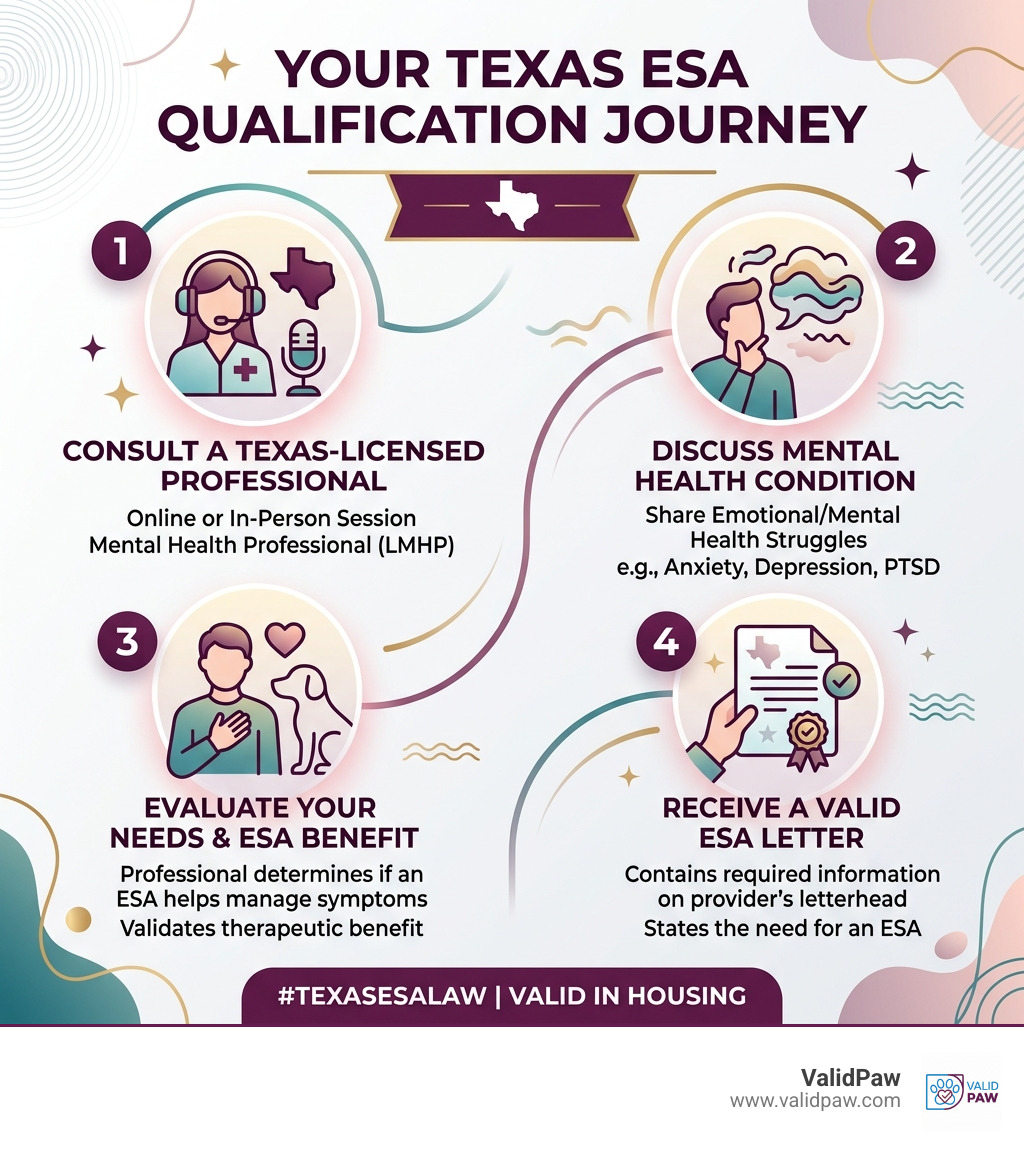
To legally qualify for an ESA in Texas, you must have an ESA letter from a Licensed Mental Health Professional (LMHP). This letter acts as a prescription for your support animal. It must establish a "nexus"—a clear connection—between your disability and the assistance the animal provides.
At ValidPaw, we facilitate this process through telehealth evaluations. A Texas-licensed therapist will meet with you to discuss your mental health history and how an animal helps manage your symptoms. This creates the "therapeutic relationship" required by HUD and Texas state guidelines.
Who Can Write a Letter Under Texas Emotional Support Animal Laws?
Not just anyone can sign off on your ESA. To be compliant with texas emotional support animal laws, the letter should come from a professional licensed to practice in the state of Texas. This includes:
- Licensed Clinical Social Workers (LCSW)
- Licensed Professional Counselors (LPC)
- Psychiatrists
- Licensed Psychologists
- Licensed Marriage and Family Therapists (LMFT)
Your letter must be written on the professional’s official letterhead and include their license type, license number, and the state where they are licensed. It should also include an expiration date (usually one year from the date of issuance) to show that your need for the accommodation is current.
Public Access, Travel, and Workplace Rules for ESAs
This is where things get a bit tricky for Texas ESA owners. While your housing rights are strong, your rights in public and in the air have changed significantly in recent years.
ESAs in the Texas Workplace and Public Spaces
Unlike service animals, ESAs do not have a "right" to enter restaurants, grocery stores, or shopping malls. Under the ADA, these businesses can legally ask you to leave if you bring a non-service animal inside. Some businesses in pet-friendly cities like Austin or San Antonio may choose to allow your ESA, but they are not legally required to do so.
In the workplace, the rules fall under ADA Title I. Employers are required to provide reasonable accommodations for employees with disabilities, but this does not automatically include ESAs. It is usually up to the employer's discretion. If you want to bring your ESA to work, we recommend having a flexible conversation with your HR department, focusing on how the animal helps you stay productive and manage work-related stress.
Travel and the Air Carrier Access Act (ACAA)
If you're planning to fly out of George Bush Intercontinental or Dallas/Fort Worth International, be prepared: ESAs are no longer allowed to fly in the cabin for free. Following a 2020 update to the Air Carrier Access Act, the Department of Transportation (DOT) now treats ESAs as pets. This means you will likely have to pay a pet fee, and your animal must fit in a carrier under the seat.
The only exception is for Psychiatric Service Dogs (PSDs). Because PSDs are trained to perform tasks, they are still protected under the ACAA and can fly in the cabin at no extra cost. If your dog is trained to help with your mental health condition, you may want to look into PSD requirements instead. For more on general service animal travel, you can review the Rights and Responsibilities of People Using Service Animals.
Penalties for Misrepresenting an ESA in Texas
Texas takes the integrity of assistance animal laws very seriously. With the passage of HB 4164, the state has cracked down on people who try to pass off their pets as trained service animals.
Under Texas Human Resources Code 121.006, misrepresenting an animal as a trained service animal is a misdemeanor. If caught, you could face:
- A fine of up to $1,000.
- Up to 30 hours of community service.
While the harshest penalties are reserved for those faking a "service animal" (like putting a fake vest on a dog to get into a restaurant), using fraudulent ESA documentation to bypass housing rules can also lead to lease terminations and legal headaches. This is why it is so important to get a legitimate letter from a licensed Texas professional rather than a "scam" registry site.
Frequently Asked Questions about Texas ESA Laws
Can a Texas landlord deny my ESA if they have a "no-pets" policy?
Generally, no. If you have a valid ESA letter from a licensed professional, the landlord must make a reasonable accommodation. The "no-pets" policy applies to pets, and legally, your ESA is an assistance animal, not a pet.
Do I need to register my ESA in a Texas state database?
No. There is no such thing as an "official" state or federal ESA registry. Any website claiming to "register" your dog or cat in a national database is likely a scam. The only document that matters is your ESA letter from a licensed therapist.
Can I have more than one emotional support animal in my Texas apartment?
Yes, you can. However, your ESA letter must justify the need for each animal. For example, if you have two cats, the therapist must explain how each animal provides a unique therapeutic benefit that one animal alone could not provide.
Conclusion
Understanding texas emotional support animal laws is the first step toward living a more stable and supported life with your animal companion. Whether you are moving into a new high-rise in Dallas or trying to keep your cat in an Austin apartment, the law protects your right to emotional support.
The key to a smooth experience with your landlord is having an FHA-compliant letter that meets all April 2026 legal standards. At ValidPaw, we specialize in helping Texans secure these protections quickly and legally. Our telehealth evaluations connect you with licensed Texas therapists who understand the "nexus" requirement and can provide the documentation you need within 24–48 hours.
Don't let a "no pets" sign stand between you and your mental well-being. Get your Texas ESA letter today and ensure your housing rights are fully protected.

