What Is an ESA Landlord Letter (and Why It Matters for Your Housing Rights)

An esa landlord letter is a written document from a licensed mental health professional that gives you the legal right to live with your emotional support animal — even in a no-pets building.
Here's what you need to know at a glance:
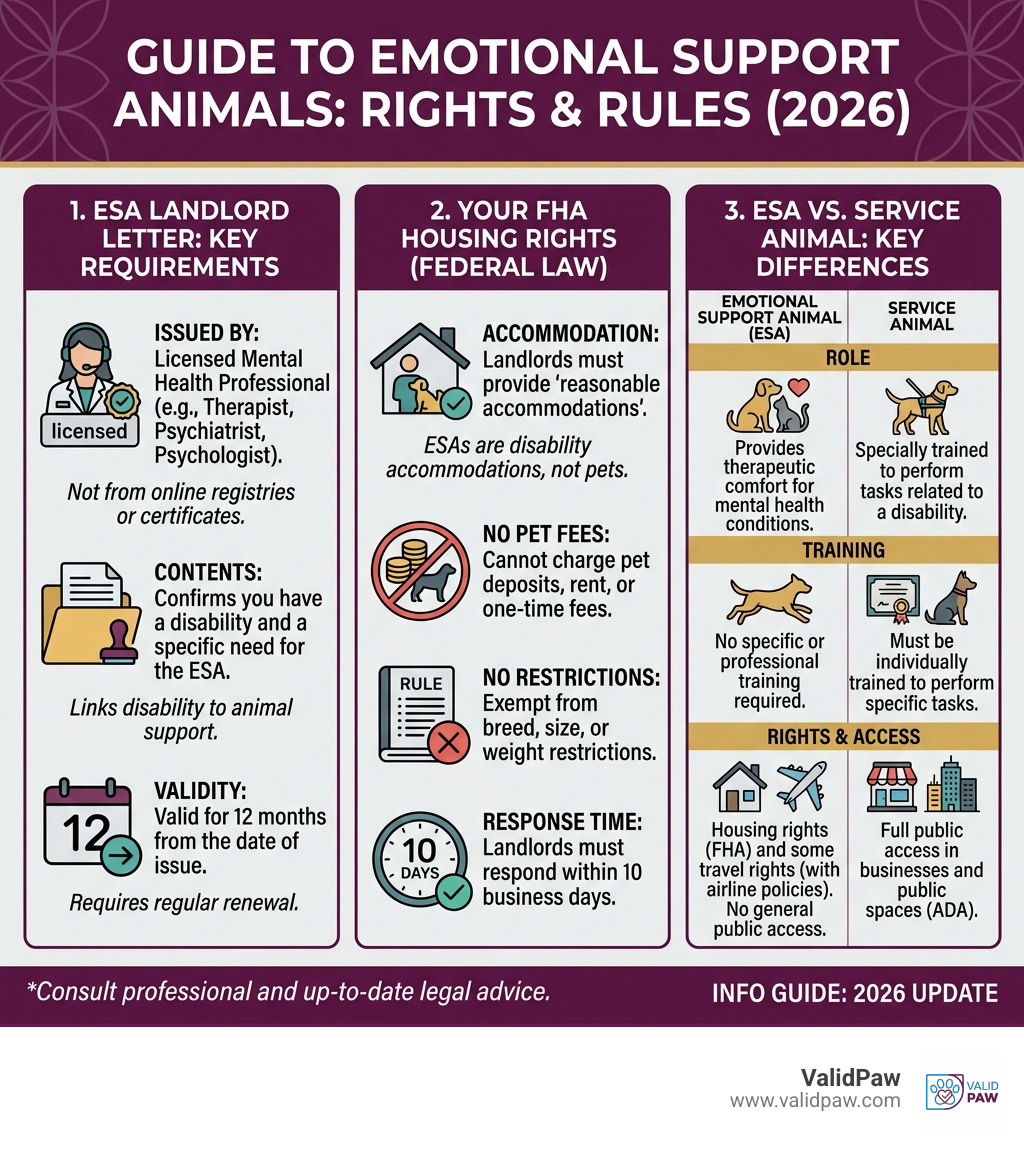
- What it is: A letter from a licensed therapist, psychologist, or psychiatrist confirming you have a disability-related need for your ESA
- What it does: Protects you under the Fair Housing Act (FHA), so landlords cannot deny your animal, charge pet fees, or enforce breed/size restrictions
- Who issues it: Only state-licensed mental health professionals — not online registries or certification websites
- How long it lasts: 12 months from the date of issue, then it needs to be renewed
- What it costs: Typically $149–$199 for an initial evaluation; renewals are usually less
- Response time: Landlords are expected to respond to your request within 10 business days
Under the FHA, your ESA is classified as a disability accommodation — not a pet. That distinction is everything.
It means your landlord cannot treat your animal the same way they treat a tenant's regular dog or cat. No pet deposit. No monthly pet rent. No breed ban. As long as your letter is legitimate and your housing isn't one of the narrow exemptions, you have federal protections on your side.
Many renters dealing with anxiety, depression, PTSD, or other mental health conditions don't realize how straightforward this process can be — or how strong their rights actually are.
Legal Requirements for a Valid ESA Landlord Letter
Navigating housing laws can feel like trying to solve a Rubik's Cube in the dark. However, the core of your rights rests on the Fair Housing Act (FHA). This federal law requires housing providers to make "reasonable accommodations" for people with disabilities. Since an emotional support animal provides therapeutic relief for symptoms of mental health conditions, they are considered a necessary accommodation rather than a luxury or a pet.
As of April 2026, the Department of Housing and Urban Development (HUD) continues to enforce strict guidelines to ensure both tenants and landlords are protected. While HUD withdrew certain specific guidance documents in late 2025, the underlying FHA statute remains the "law of the land." This means your right to an ESA is firmly rooted in federal law and court precedents. To ensure your request is granted, you must provide a legitimate esa landlord letter that establishes a clear "nexus," or connection, between your disability and the support your animal provides.
If you are curious about how these rules might vary slightly depending on where you live, you can learn about ESA requirements by state or find more info about ESA requirements to stay fully informed.
Essential Components of an ESA Landlord Letter
A landlord isn't required to accept a sticky note or a vague email. To be legally binding, your esa landlord letter must be a professional document. Think of it as a prescription for your housing. If it doesn't meet the following criteria, a landlord may legally delay or deny your request.
A valid letter must include:
- Official Letterhead: The document should clearly display the licensed mental health professional’s (LMHP) practice name and contact information.
- Provider Credentials: It must state the provider's name, their license type (e.g., LCSW, LPC, Psychologist), and their license number.
- Jurisdiction: The provider must be licensed to practice in your state.
- Issuance Date: The letter should be dated within the last 12 months.
- Patient Identification: Your full legal name must be included.
- Disability Nexus: A statement confirming that you have a mental or emotional disability that substantially limits at least one major life activity and that the animal provides support that alleviates at least one symptom of that disability.
Legitimate Letter vs. Fake Certificate
| Feature | Legitimate ESA Letter | Fake Online Certificate | | :--- | :--- | :--- | | Source | Licensed Mental Health Professional | "Registry" or "Certification" site | | Evaluation | Live telehealth or in-person consultation | Quick online quiz with no talk | | Legal Standing | Recognized by FHA and HUD | Not legally recognized by HUD | | Verification | Landlord can verify license status | Often uses "official-looking" but meaningless seals | | Cost | Covers professional clinical time | Sells a piece of paper or a "badge" |
Housing Exemptions and FHA Limitations
While the FHA is broad, it isn't universal. There are a few "small-scale" housing types that are exempt from these federal requirements. It is important to check if your housing falls into these categories before submitting your esa landlord letter:
- Owner-Occupied Buildings: Buildings with four or fewer units where the owner lives in one of the units (often called the "Mrs. Murphy" exemption).
- Single-Family Homes: Homes sold or rented by the owner without the use of a real estate agent (provided the owner doesn't own more than three such homes).
- Private Clubs/Religious Organizations: Housing operated by these groups for their members may have different rules.
If you live in a standard apartment complex, a high-rise, or a home managed by a property management company, the FHA almost certainly applies to you. For more specific details on whether your home qualifies, check out more info about housing types.
How to Submit Your ESA Request to a Landlord

Once you have your valid esa landlord letter, the next step is delivery. We always recommend doing this in writing. While you can mention it over the phone or in person, having a "paper trail" is your best defense if a dispute arises later.
The best method is to send a polite email with your letter attached as a PDF. In the body of the email, simply state that you are requesting a reasonable accommodation under the Fair Housing Act for your emotional support animal. If your landlord is particularly old-school, sending it via USPS Certified Mail with a Return Receipt is the gold standard for legal documentation.
Once submitted, HUD guidelines suggest that landlords should respond within 10 business days. If you haven't started the process yet, you can start your application today with us to get evaluated by a licensed professional.
When to Submit Your ESA Landlord Letter
Timing can impact your relationship with your landlord. While you have the legal right to request an accommodation at any time—even after moving in—honesty is usually the best policy.
- Pre-Lease/Application: You can submit your letter during the application process. A landlord cannot legally reject your application just because you have an ESA.
- Current Tenants: If you develop a need for an ESA while already living in a unit, submit your request as soon as you receive your letter.
- Lease Renewal: This is a common time to update your documentation.
- 30-Day Notice: If you are planning to bring an animal home, giving your landlord 10 to 30 days of lead time is considered a "good faith" move, though not strictly required by law.
How to Renew Your ESA Landlord Letter
An esa landlord letter isn't a "lifetime pass." Most housing providers and HUD guidance view these letters as valid for one year. This ensures that the therapeutic relationship is ongoing and the need for the animal still exists.
To stay compliant:
- Track Your Date: Check the issuance date on your current letter.
- Schedule an Update: Contact your provider about 11 months into your term.
- Submit the New Letter: Provide the updated version to your landlord to ensure continuous coverage.
For our clients, you can easily access your tenant dashboard to manage your renewals and keep your documents organized.
Landlord Rights: Verification and Legal Denials

It is a common myth that landlords have no rights when it comes to ESAs. In reality, landlords have a responsibility to protect their property and other tenants. They are allowed to verify that your esa landlord letter is legitimate.
What a landlord CAN do:
- Verify the therapist's license on a state database.
- Confirm the letter was actually written by the professional listed.
- Ask two specific questions: 1) Does the person have a disability? and 2) Does the animal provide support related to that disability?
What a landlord CANNOT do:
- Ask for your specific medical diagnosis.
- Request your detailed medical records.
- Contact your therapist to discuss your history (this would violate HIPAA).
- Require the animal to have "special training" or "certification."
Landlords can verify a letter instantly through our secure portal if you use our services.
Red Flags of Fraudulent Documentation
Landlords are becoming increasingly savvy at spotting "fake" letters. If a landlord sees these red flags, they may be legally justified in questioning or denying the request:
- Instant Approvals: Letters issued minutes after a quiz with no professional interaction.
- Lifetime Letters: Any letter claiming it never expires (HUD typically expects annual updates).
- Missing License Info: No license number or state of jurisdiction.
- Generic Certificates: A "ID badge" or "certificate" with a gold seal instead of a clinical letter.
To avoid these issues, always get a legitimate licensed evaluation from a provider who actually speaks with you.
Permissible Landlord Requests
While they can't charge you pet rent, landlords can still require you to follow standard "good neighbor" rules. They can legally ask for:
- Vaccination Records: Proof that the animal is up-to-date on shots as required by local law.
- Local Licensing: Many cities require all dogs to be registered with the county.
- Animal Behavior: If the animal is aggressive, destructive, or a nuisance (like constant barking), the landlord may have grounds to revoke the accommodation.
- Damage Liability: You are still financially responsible for any physical damage the animal causes to the apartment.
For more deep dives into what a landlord can and cannot ask for, see more info about landlord rights.
Handling Disputes and Illegal Pet Fees
One of the biggest perks of a legitimate esa landlord letter is the financial relief. Under the FHA, emotional support animals are not pets, so "pet rules" do not apply.
- Pet Rent: Landlords cannot charge monthly fees for an ESA.
- Security Deposits: You cannot be charged an extra "pet deposit."
- Breed/Weight Limits: Even if the building has a "no Pitbulls" or "no dogs over 50 lbs" rule, your ESA is exempt.
Landlords who ignore these rules face steep consequences. A first-time violation can carry a penalty of up to $16,000, while a third violation within seven years can skyrocket to $70,000. If you find yourself in a situation where your rights are being ignored, check out what to do if your ESA is denied.
Remedies for Unlawful Denial
If a landlord denies your request without a valid reason (like a direct safety threat), they are required to engage in an "interactive process." This means they must talk to you and try to find a solution before just saying "no."
If they refuse to budge, you have several options:
- File a HUD Complaint: This is free and can be done online.
- Fair Housing Lawsuit: In extreme cases, tenants have been awarded compensatory damages and attorney fees.
- Local Agencies: Contact your city or state’s Fair Housing office.
You can find more info about legal remedies to help you decide on your next steps.
Frequently Asked Questions about ESA Letters
Can a landlord charge pet rent for an ESA?
No. Because the FHA classifies an ESA as an assistance animal and not a pet, all pet-related fees—including monthly pet rent and one-time pet deposits—are prohibited. You are, however, still responsible for any actual damage the animal causes to the property.
Do I need to show my medical records to my landlord?
Absolutely not. Your landlord is entitled to know that you have a disability-related need, but they are not entitled to your private medical history, your specific diagnosis, or your treatment records. Your esa landlord letter provides all the legal proof required.
Can my landlord deny my ESA because of its breed?
Generally, no. HUD is very clear that breed, size, and weight restrictions cannot be applied to assistance animals. A landlord can only deny a specific animal if it poses a "direct threat" to the health and safety of others based on that specific animal's behavior, not its breed.
Conclusion
Securing your housing rights shouldn't be a source of more stress. A legitimate esa landlord letter is your key to a peaceful home with your animal companion. At ValidPaw, we specialize in helping you navigate this process with ease. Our team of licensed Texas therapists provides telehealth evaluations for residents in Texas and all 50 states, ensuring you get a compliant letter within 24–48 hours.
With our instant landlord verification and 100% FHA-compliant documentation, you can move forward with confidence. Ready to protect your rights and your peace of mind? Get your official ESA letter now.

