Why Valid Landlord ESA Proof Can Make or Break Your Housing Situation
Valid landlord ESA proof comes down to one core document: a letter from a licensed mental health professional (LMHP) that meets specific HUD and Fair Housing Act (FHA) requirements.
Here's what makes ESA proof valid at a glance:
| Requirement | Valid | Not Valid | |---|---|---| | Issued by | Licensed therapist, psychologist, psychiatrist, LCSW, LPC, or LMFT | Vets, life coaches, online "instant" services | | Format | Official letterhead, dated, signed | Handwritten, generic template, no letterhead | | Content | Confirms disability-related need and therapeutic nexus | Missing license number, no disability link | | Consultation | Real evaluation (in-person or telehealth) | No consultation, instant download | | Validity | Typically 12 months | Lifetime claims are a red flag | | Extras required | Nothing beyond the letter | No vest, no registration, no certification needed |
Living with anxiety, depression, PTSD, or another mental health condition is hard enough. Then you find an apartment, fall in love with it — and hit a wall because of a "no pets" policy.
That wall doesn't have to stop you.
The Fair Housing Act classifies emotional support animals as assistance animals, not pets. That means landlords in most housing situations are legally required to make reasonable accommodations — but only when your documentation holds up to scrutiny.
The problem? A flood of fake online "certificates" and instant approval websites has made landlords more skeptical than ever. Even tenants with genuine needs get denied simply because their paperwork has gaps or red flags.
Getting it right from the start — with documentation that is airtight, FHA-compliant, and issued by a verifiable licensed professional — is the difference between moving in with your ESA and starting the apartment search all over again.
What Constitutes Valid Landlord ESA Proof?
In April 2026, the standard for what landlords consider acceptable proof is higher than ever. To be legally recognized, your documentation must follow the guidelines set by the Department of Housing and Urban Development (HUD). Under the Fair Housing Act, an emotional support animal is a necessity for a person with a disability, much like a wheelchair or a prescription medication.
The "proof" isn't a badge, a vest, or a fancy ID card you bought on a random website. It is a formal letter that establishes a "therapeutic nexus"—a fancy legal way of saying there is a clear connection between your mental health condition and the support your animal provides. Without this connection, a landlord can legally argue that the animal is just a pet, not an assistance animal.
To ensure your rights are protected, especially in states with specific regulations like Texas or Illinois, you should consult a State-by-State ESA Guide to see if your local laws have additional nuances. Once you have your documents, keeping them organized in a Tenant Dashboard ensures you’re always ready for a lease renewal or a surprise inspection.

Essential Elements of a Legitimate Letter
A letter that "sticks" must look and act like a professional medical document. If it looks like it was typed in a basement in five minutes, a savvy property manager will spot it immediately. Every valid ESA letter must include:
- Official Letterhead: The document must feature the provider's name, practice name, address, and contact information.
- Provider License Details: This is the big one. It must list the type of license (e.g., LCSW, LPC, LMFT), the license number, and the state where the license was issued.
- Issuance Date: The letter should be current, ideally issued within the last 12 months.
- Disability Statement: While they don't need to list your specific diagnosis (like "Major Depressive Disorder"), the letter must state that you meet the FHA definition of having a mental or emotional disability.
- The Recommendation: A clear statement that the animal is necessary to alleviate one or more symptoms of the disability.
- Signature: A real or legally binding digital signature from the healthcare professional.
If you're unsure if your current letter hits these marks, check our FAQ for a deeper breakdown of compliant language.
Who is Qualified to Provide Valid Landlord ESA Proof?
Not just anyone with a "Dr." in front of their name can write an ESA letter. For the proof to be valid, the person signing it must be a licensed healthcare professional who has evaluated you. This includes:
- Psychiatrists and Psychologists
- Licensed Clinical Social Workers (LCSW)
- Licensed Professional Counselors (LPC)
- Licensed Marriage and Family Therapists (LMFT)
- Other licensed mental health professionals
In 2026, telehealth is a perfectly valid way to receive an evaluation. In fact, many people in major hubs like Houston, Austin, or Chicago prefer the convenience of online consultations. However, the professional must be licensed to practice in the state where you reside. Professionals can manage their credentials and client interactions through tools like a Provider Dashboard to ensure they are meeting all state-specific standards.
How Landlords Verify Your Documentation
Landlords aren't just taking your word for it anymore. They have "skin in the game"—property damage and insurance liabilities are real concerns. Therefore, they have the legal right to verify the authenticity of your valid landlord esa proof.
Most landlords will start by checking the license number provided in the letter against state board portals. If a therapist is licensed in Texas, the landlord can go to the Texas Behavioral Health Executive Council website and verify that the license is active and in good standing.
| Feature | Legitimate ESA Letter | Fraudulent "Certificate" | | :--- | :--- | :--- | | Issuer | Licensed Mental Health Professional | "Registry" or "Certification Body" | | Evaluation | Real clinical consultation | Instant "pay-and-print" | | Legal Basis | Fair Housing Act (FHA) | No legal standing | | Price | Covers professional time/expertise | Often "cheap" or "lifetime" deals | | Verification | Can be verified via state licensing | Only "verified" by the scam site itself |
If a landlord wants to be 100% sure, they can use tools like Verify Letter to confirm the document was issued through a legitimate system.
Spotting Red Flags in Invalid Landlord ESA Proof
If you submit a letter that contains any of the following, expect a denial letter in your inbox shortly after. Landlords are trained to look for these "red flags":
- Instant Downloads: If a site promises a letter in 60 seconds without talking to a human, it’s a scam.
- "Registration" Numbers: There is no federal or state registry for ESAs. Any letter that relies on a "registration ID" instead of a therapist's license is a fake.
- Lifetime Validity: Mental health needs change. A letter that claims to never expire is a major warning sign.
- Interchangeable Terms: If the letter uses "Service Animal" and "Emotional Support Animal" as if they are the same thing, the writer doesn't know the law.
- Out-of-State Providers: If you live in Dallas but your therapist is only licensed in Maine, the landlord can legally question the validity of the professional relationship.
If you’re worried your current documentation might be flagged, you can start a fresh, compliant Application Form to get a letter that meets 2026 standards.
The Role of Direct Verification Calls
Can a landlord call your therapist? Yes, but they can't ask whatever they want. Due to HIPAA (Health Insurance Portability and Accountability Act) and FHA privacy rules, the conversation is very limited.
A landlord can call to:
- Confirm that the professional actually wrote the letter.
- Verify that the person is a current patient.
- Confirm that the professional recommended an ESA.
A landlord cannot ask:
- What your specific diagnosis is.
- How severe your disability is.
- For your medical records or treatment history.
We always recommend that tenants provide written consent to their therapist to speak with the landlord for this limited purpose. For more on how to handle these interactions, visit our FAQES section.
Understanding Your Rights Under the Fair Housing Act
The Fair Housing Act is your shield. It applies to most types of housing, including apartments, condos, and even HOAs. In 2026, the law is clear: if you have a disability and a disability-related need for an animal, the landlord must provide a "reasonable accommodation."
This means:
- No Pet Rent: You cannot be charged monthly fees for your ESA.
- No Pet Deposits: Even if everyone else pays a $500 pet deposit, you don't have to.
- No Breed Restrictions: If your ESA is a Pitbull or a German Shepherd, "restricted breed" lists do not apply.
- No Size/Weight Limits: Your Great Dane is just as protected as a Chihuahua.
For residents in the Lone Star State, our Texas ESA Compliance Guide provides specific details on how these federal rules interact with local property codes.

Prohibited Landlord Inquiries
Knowledge is power. If a landlord asks for any of the following, they are likely violating the FHA:
- "Can you show me what the dog does to help you?" (ESAs don't need to perform tasks).
- "I need to see your medical records from the last three years."
- "Please have your doctor sign this notarized affidavit under penalty of perjury."
- "What is your exact diagnosis?"
If a landlord insists on these, you have the right to politely decline and point them toward HUD's FHA guidelines.
Legal Grounds for ESA Denial
While the FHA is strong, it isn't absolute. A landlord can legally deny your valid landlord esa proof under specific, narrow circumstances:
- Direct Threat: If the specific animal has a documented history of biting or aggressive behavior that threatens the safety of others.
- Substantial Property Damage: If the animal has already caused significant damage to the unit that cannot be covered by a standard security deposit.
- Undue Financial Burden: If the animal's presence would cause the landlord's insurance to be canceled or premiums to skyrocket (though the landlord must prove they tried to find alternative insurance first).
- Exempt Housing: Small owner-occupied buildings (the "Mrs. Murphy" exemption) and some private clubs or religious organizations may be exempt from FHA rules.
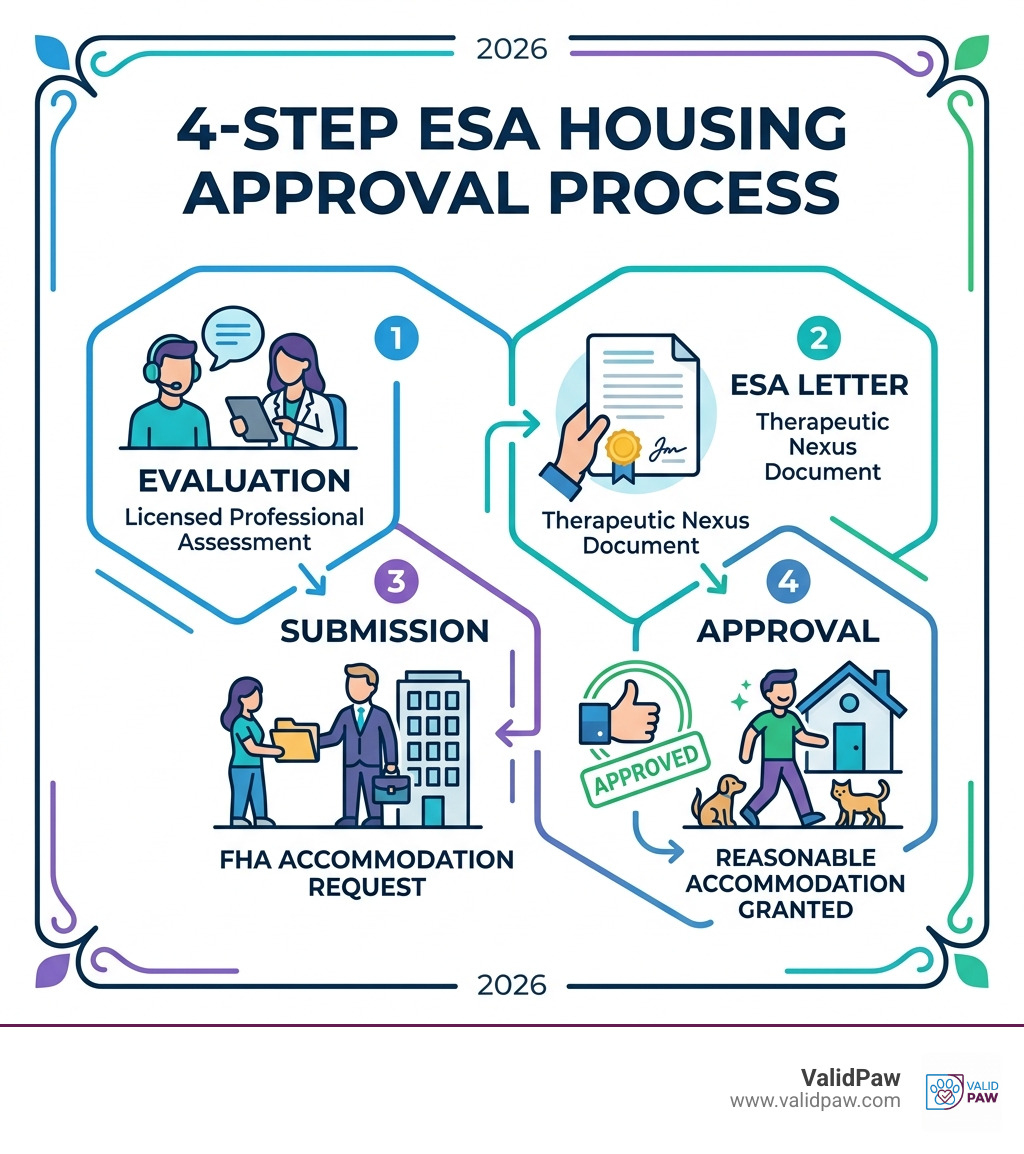
Step-by-Step: How to Submit Your ESA Proof
Submission is just as important as the document itself. Don't just drop the letter on the counter and walk away. Follow this professional process to create a paper trail:
- Write a Formal Request: Send an email or letter stating: "I am requesting a reasonable accommodation for my emotional support animal under the Fair Housing Act."
- Attach Your Letter: Include your valid landlord esa proof as a PDF.
- Use Trackable Delivery: If sending via email, use a "read receipt." If sending via mail, use certified mail.
- Give Them Time: HUD suggests that landlords should respond within 10 business days.
Handling Landlord Objections
If the landlord says "No," don't panic. Many landlords simply don't understand the law.
- If they cite a "No Pets" policy: Remind them that an ESA is an assistance animal, not a pet, and therefore exempt.
- If they ask for a "Certification": Explain that federal law does not recognize ESA registries and that your LMHP letter is the only legal requirement.
- If they don't respond: Follow up in writing. If they still ignore you, you can file a formal complaint with the HUD Office of Fair Housing and Equal Opportunity (FHEO).
Annual Renewals and Updates
In 2026 housing, "stale" documentation is a common reason for disputes. While the FHA doesn't explicitly state that a letter expires, most property managers consider a letter "valid" only if it was issued within the last year.
Proactive renewal shows that you are still under professional care and that your need for the ESA is ongoing. We recommend setting a calendar reminder for 11 months after your letter’s issuance to get an update. This ensures you never have a gap in your valid landlord esa proof.
Frequently Asked Questions about ESA Proof
Do ESAs need special training, vests, or registration?
No. Unlike service dogs (who are trained to guide the blind or detect seizures), ESAs provide therapeutic support just by being present. They do not need to "do" anything specific. Vests and ID cards are optional accessories and hold zero legal weight with a landlord.
Can a landlord charge a pet deposit or monthly pet rent for an ESA?
Absolutely not. Charging a "processing fee" or "pet rent" for an ESA is considered discrimination. However, you are still responsible for any damage the animal causes. If your ESA destroys the carpet, the landlord can deduct the repair costs from your standard security deposit when you move out.
How many emotional support animals can one tenant have?
You can have more than one, but the bar for proof is higher. Your LMHP must explain why each animal is necessary. For example, one dog might help with social anxiety while a cat helps with nighttime PTSD symptoms. As long as the request is "reasonable" (e.g., you aren't trying to keep five Great Danes in a studio apartment), the landlord must consider it.
Conclusion
Navigating rental housing with an emotional support animal doesn't have to be a battle. By ensuring you have valid landlord esa proof—a high-quality, FHA-compliant letter from a licensed professional—you remove the landlord's ability to say "no" based on technicalities.
At ValidPaw, we specialize in helping tenants in Texas, Illinois, and across all 50 states secure their housing rights. Our licensed therapists provide telehealth evaluations that result in legitimate letters within 24-48 hours. Best of all, our documents include instant landlord verification to stop disputes before they start.
Don't let a "no pets" sign stand between you and your mental well-being. Get your valid landlord esa proof today and move into your new home with confidence and your best friend by your side.