Why Getting Your Emotional Support Animal Documentation Right Matters
Emotional support animal documentation requirements come down to one essential document: a valid ESA letter written and signed by a licensed mental health professional (LMHP).
Here's what that letter must include to be legally recognized under the Fair Housing Act:
- Licensed professional's name and credentials (psychiatrist, psychologist, LCSW, LMFT, LPC, or similar)
- License number and issuing state
- Professional letterhead
- Date of issuance (letters are typically valid for 12 months)
- Confirmation that you have a disability-related need for an emotional support animal
- Clinician's signature
That's it. No registry. No vest. No federal certification. Just a letter from a real, licensed clinician who has evaluated you.
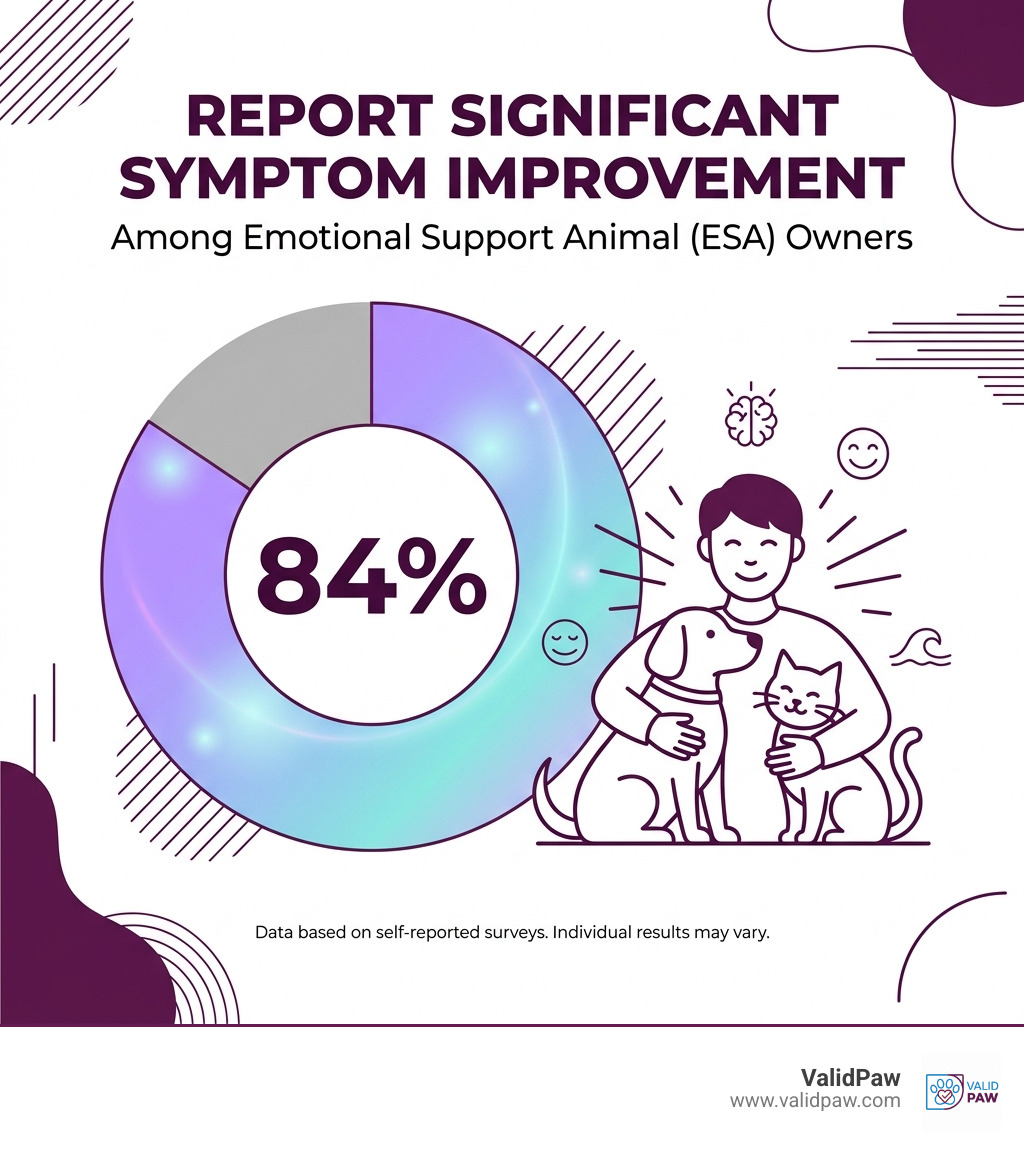
Millions of renters dealing with anxiety, depression, PTSD, and other mental health conditions rely on their animals for daily stability. But when a landlord hands you a no-pets policy, the line between "beloved pet" and "protected accommodation" comes down entirely to your paperwork.
The problem? The internet is packed with fake ESA registries, instant-approval websites, and official-looking certificates that carry zero legal weight. If you hand your landlord a document from one of those services, you're not protected — and you could even face lease violations.
A valid ESA letter is essentially a clinical recommendation, similar to a prescription. It tells your housing provider that a licensed professional has evaluated you, confirmed a qualifying mental health condition, and determined that an emotional support animal may help alleviate your symptoms. Under the Fair Housing Act (FHA), that letter triggers your right to a reasonable accommodation — even in buildings with strict no-pets rules, breed restrictions, or pet deposit requirements.
This guide walks you through exactly what makes documentation legitimate, how to get it, and how to protect yourself from the scams that could leave you and your animal without a home.
Understanding Emotional Support Animal Documentation Requirements
Navigating the legal landscape of assistance animals can feel like a game of fetch that never ends. However, the Assistance Animals | HUD.gov guidelines are quite specific. Under the Fair Housing Act, an emotional support animal is not a "pet." It is a reasonable accommodation for an individual with a disability.
To qualify, a person must have a disability—which, in the context of the FHA, is a physical or mental impairment that substantially limits one or more major life activities. The documentation must establish a "disability-related need" for the animal. This means the animal provides support that alleviates at least one identified symptom or effect of the existing disability.
Housing providers are required to grant these accommodations unless they can prove the request creates an undue financial or administrative burden, fundamentally alters the nature of the housing provider's operations, or if the specific animal poses a direct threat to the health and safety of others.

Essential Elements of a Valid Letter
What does a "real" letter look like? According to the Emotional Support Animals: Considerations for Documentation | AAFP, clinicians must follow strict professional standards. A landlord is well within their rights to reject a letter that looks like it was generated by an AI bot in five seconds.
A legitimate letter must be on the professional’s official letterhead. It needs to state clearly that the provider is licensed to practice in your state (or that they are providing services under a valid telehealth exemption). It must include their license type, license number, and the date the letter was issued. Most importantly, it must confirm that the patient is under their care for a mental or emotional disability and that the animal is a necessary part of the treatment plan.
Verifying Your Emotional Support Animal Documentation Requirements
Once you submit your letter, the landlord can perform basic due diligence. They can verify that the clinician's license is active and valid in the state where the letter was issued. They may also contact the clinician to confirm that the letter is authentic, though they cannot legally ask for your specific diagnosis, medical records, or a detailed history of your condition.
We recommend keeping a digital and physical folder of your documentation. This should include your current ESA letter, any vaccination records for your animal, and a copy of your written request for accommodation. While the FHA doesn't explicitly state that letters expire, most housing providers expect an annual renewal to ensure the disability-related need is still present. This "interactive process" between you and your landlord should be handled with transparency and good faith.
ESA vs. Service Animals: Knowing the Difference
One of the biggest points of confusion in 2026 remains the difference between an ESA and a Service Animal. This distinction is vital because it determines where your animal is allowed to go.
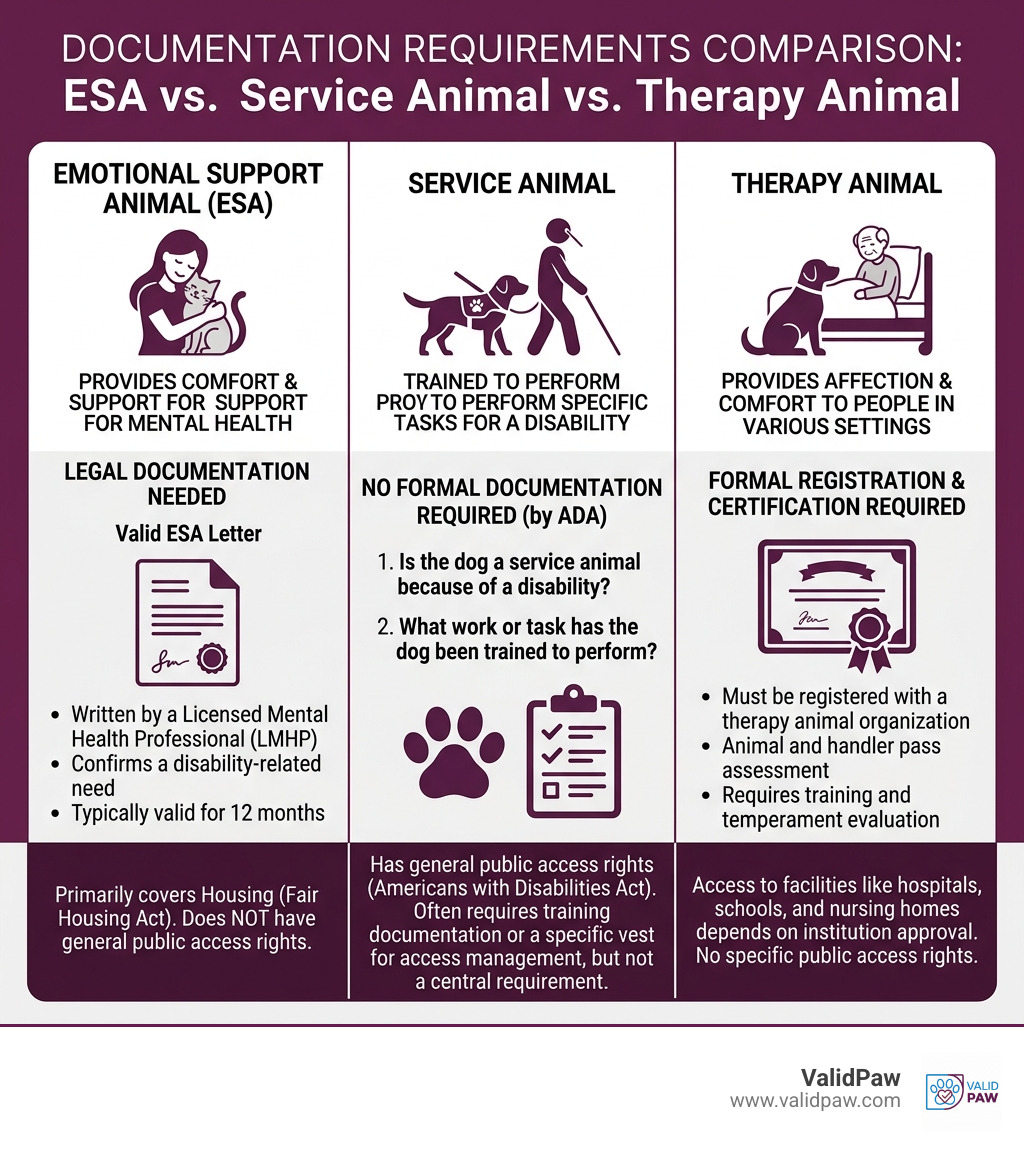
Service Animals are defined by the Americans with Disabilities Act (ADA) Titles II and III. These are almost exclusively dogs (and occasionally miniature horses) that have been individually trained to do work or perform tasks for the benefit of an individual with a disability. Think of a guide dog for the blind or a psychiatric service dog (PSD) trained to interrupt a panic attack.
Emotional Support Animals, on the other hand, do not require any specific task training. Their mere presence provides the therapeutic benefit. Because they aren't trained for public "work," they do not have the same "go-anywhere" rights as service dogs.
| Feature | Emotional Support Animal (ESA) | Service Animal (e.g., Guide Dog, PSD) | Therapy Animal | | :--- | :--- | :--- | :--- | | Legal Protection | Fair Housing Act (FHA) | Americans with Disabilities Act (ADA) | None (usually) | | Training Required | None | Individualized Task Training | Obedience & Temperament | | Public Access | No (Housing only) | Yes (Restaurants, Stores, etc.) | Only where invited | | Documentation | Licensed Professional Letter | None (for public access) | Registration/Certification | | Pet Fees | Exempt in Housing | Exempt Everywhere | Not Exempt |

Public Access and Travel Limitations
If you were hoping to take your ESA to dinner or on a cross-country flight, the rules have changed significantly in recent years. Following the Department of Transportation (DOT) changes in 2021, the Air Carrier Access Act no longer requires airlines to treat ESAs as service animals.
Today, most airlines treat ESAs as standard pets. This means you may have to pay a pet fee, and your animal might have to stay in a carrier under the seat. Only trained service animals (including PSDs) are guaranteed cabin access without fees. Similarly, restaurants and stores are not legally required to admit ESAs, though some "pet-friendly" establishments may choose to do so.
Navigating State-Specific Rules and the 30-Day Requirement
While federal law provides the baseline, many states have added their own layers to emotional support animal documentation requirements. As of April 2026, at least 19 states have passed laws specifically targeting the misrepresentation of pets as service or support animals.
Texas, for instance, has clear guidelines regarding how these animals are handled in housing. According to Understanding Emotional Support Animals in Texas, while Texas follows the FHA, state-level consumer protection laws are often used to crack down on fraudulent letter mills.
Meeting State-Specific Emotional Support Animal Documentation Requirements
The most significant shift in recent years is the "30-day relationship" rule. To combat "instant" letters, states like California, Arkansas, Iowa, Louisiana, and Montana now require that a provider-patient relationship be established for at least 30 days before an ESA letter can be issued.
This usually involves:
- An initial consultation.
- A clinical evaluation period.
- A follow-up or final determination after the 30-day mark.
In these states, a letter issued after a five-minute phone call is not only clinically questionable—it’s legally invalid. At ValidPaw, our Texas-based therapists are well-versed in these nuances, ensuring that your documentation meets both federal and state-specific standards.
How to Spot ESA Scams and Fake Registries
The "registry" scam is the most common pitfall for new ESA owners. You’ve likely seen the ads: "Register your dog as an ESA for $50! Includes official badge and ID card!"
Here is the truth: There is no such thing as a legally recognized ESA registry. HUD notice FHEO-2020-01 explicitly states that "certificates, registrations, and other documents purchased over the internet to certify an animal as an assistance animal" are generally not sufficient on their own to establish a disability-related need.
Red Flags to Watch Out For:
- Instant Approvals: If you get a letter without speaking to a licensed professional, it's a scam.
- Lifetime Letters: Legitimate clinicians rarely issue letters that never expire; your mental health needs should be reassessed periodically.
- "Official" Vests or IDs: These are purely decorative and hold no legal weight under the FHA or ADA.
- Extremely Low Prices: A real clinical evaluation takes time and expertise. If it costs less than a pizza, be wary.
Risks of Illegitimate Documentation
Using fake paperwork isn't just a "white lie"—it carries real risks. If a landlord discovers your documentation is fraudulent, they can deny your accommodation, charge you back-dated pet fees, or even initiate eviction proceedings for a lease violation. Furthermore, in many states, misrepresenting an animal as a service or support animal is a misdemeanor punishable by fines and community service.
Frequently Asked Questions about ESA Documentation
Do I need to register my ESA on a federal database?
No. There is no federal database or registry for emotional support animals. Anyone claiming to "register" your animal is likely selling you a piece of paper with no legal standing. The only document that matters is your ESA letter from a licensed healthcare professional.
Can a landlord deny my ESA if they have a "no-pets" policy?
Generally, no. Under the Fair Housing Act, an ESA is a "reasonable accommodation," not a pet. A "no-pets" policy does not apply to assistance animals. However, a landlord can deny the request if the animal is a direct threat to safety, causes substantial property damage, or if you fail to provide valid documentation.
How often do I need to renew my ESA letter?
Most ESA letters are considered valid for one year. Because your mental health status and the therapeutic need for the animal can change, landlords typically require an updated letter annually to confirm that the accommodation is still necessary.
Conclusion: Securing Your Rights in 2026
Getting your emotional support animal documentation requirements right shouldn't feel like a high-stakes hurdle. It’s about ensuring that your right to a supportive living environment is backed by clinical integrity and legal compliance.
At ValidPaw, we specialize in connecting you with licensed Texas therapists who understand the deep bond between humans and their animals. Whether you are in Houston, Austin, Dallas, San Antonio, Fort Worth, or anywhere across the 50 states, we provide a path to legitimate, FHA-compliant documentation.
Our process is designed for the modern world:
- Telehealth Evaluations: Speak with a real, licensed professional from the comfort of your home.
- Fast Turnaround: Receive your letter in as little as 24-48 hours after your determination.
- Landlord Support: We provide instant verification for housing providers, making the approval process smooth for everyone involved.
- Fully Compliant: Our letters meet all HUD and state-specific requirements, including the 30-day relationship rules where applicable.
Don't let "paperwork zoomies" get in the way of your mental health. Get your legitimate ESA letter today and ensure your animal stays by your side, exactly where they belong.