
Why an Emotional Support Dog Letter Example Matters for Your Housing Rights
An emotional support dog letter example shows you exactly what a valid, legally compliant ESA letter looks like -- so you know what to ask for and what to expect before presenting one to your landlord.
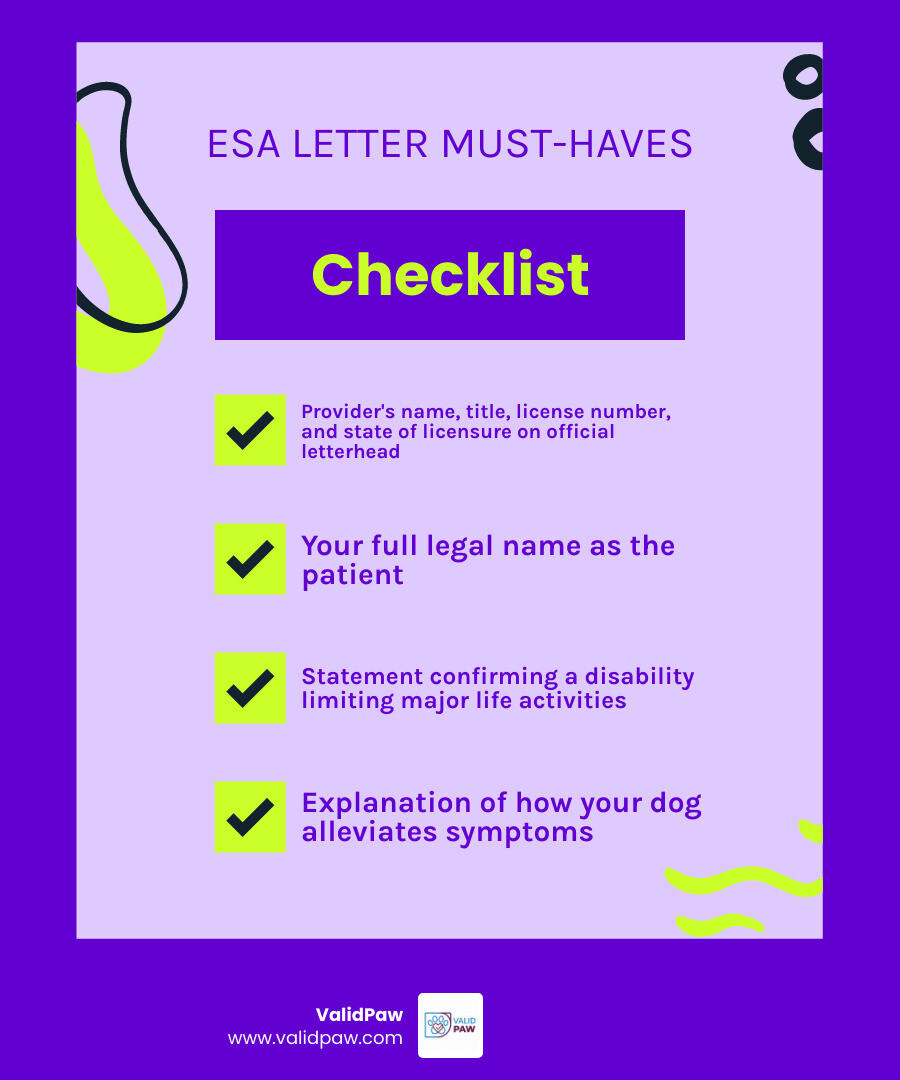
Here is what a legitimate emotional support dog letter must include:
- Provider's name, title, license number, and state of licensure on official letterhead
- Your full legal name as the patient
- A statement confirming you have a disability that limits at least one major life activity (no specific diagnosis required)
- A clear explanation of how your dog alleviates your symptoms
- The date of issuance (valid for 12 months from that date)
- The provider's signature and direct contact information for landlord verification
A letter missing any of these elements can be rejected -- even if the rest looks professional.
Mental health challenges are more common than most people realize. According to the Centers for Disease Control and Prevention, 1 in 4 adults lives with a disability, and many of those disabilities are invisible ones like anxiety, depression, and PTSD. For renters in that situation, an emotional support dog can be a genuine part of treatment -- and the right letter is what makes housing protections under the Fair Housing Act (FHA) real and enforceable.
But not every letter you find online is legitimate. Some are templates with no clinical evaluation behind them. Others come from "registries" that hold no legal weight whatsoever. Knowing what a valid letter actually looks like is the first step to protecting yourself.
I'm Francisco Ortiz, Lead Forensic Mental Health Evaluator and Director of Behavioral Health at District Counseling PLLC, and I've conducted clinically rigorous emotional support dog letter example evaluations across six states using forensic-grade psychological assessment protocols. In this guide, I'll walk you through exactly what makes an ESA letter work -- and what gets it rejected.
What is an Emotional Support Animal (ESA) Letter?
An Emotional Support Animal (ESA) letter is more than just a note from a doctor; it is a legal prescription for a "reasonable accommodation" under the Fair Housing Act (FHA). In the eyes of the law, an ESA is not a "pet." Instead, it is a tool used by an individual with a disability to help mitigate the symptoms of their condition.
The FHA protects individuals with disabilities from discrimination in housing. This means that even if a building has a "no-pets" policy, a landlord must make an exception for a tenant who provides a valid ESA letter. These protections also mean you are exempt from paying pet deposits, monthly pet rent, or pet application fees. Over a year, this can save you anywhere from $300 to $1,200 or more in housing costs.
To qualify, a person must meet the legal definition of a disability: a physical or mental impairment that substantially limits one or more major life activities (such as sleeping, concentrating, or interacting with others). You can find more details on how these laws apply to your specific situation in our ValidPaw ESA Letter Guide.
These rights are specific to housing. While your dog provides vital support, an ESA letter does not grant you the right to bring your dog into grocery stores or restaurants. For a deeper dive into the specific rules, you can learn more about ESA regulations.
Emotional Support Dog Letter Example and Templates
When you look at an emotional support dog letter example, you’ll notice it follows a very specific professional structure. It should always be written on the official letterhead of the Licensed Mental Health Professional (LMHP) or physician who evaluated you.
A high-quality letter doesn't need to be five pages long. In fact, most landlords prefer a concise, one-page document that clearly states the facts. The letter should confirm that the provider has a professional relationship with the patient and that the animal is a necessary part of the patient's treatment plan.
If you are curious about how different providers phrase these documents, we have compiled a Sample Emotional Support Dog Letter Example that reflects current April 2026 standards. You can also view our latest blog posts on ESA documentation to stay updated on any changes to federal or state guidelines.
Key Components of an Emotional Support Dog Letter Example
To ensure your letter is ironclad, check for these specific details. If any are missing, the document may not be considered legally sufficient by a housing provider’s legal team:
- Professional Letterhead: Must include the provider’s name, practice name, address, and phone number.
- License Information: The type of license (e.g., LCSW, LPC, Psychologist), the license number, and the state where the license was issued.
- Issuance Date: The letter must be dated. Most landlords require the letter to be less than one year old.
- Patient Identification: Your full legal name.
- Disability Confirmation: A statement that the patient has a mental health disability as defined by the DSM-5.
- The "Nexus" (Connection): A clear statement explaining that the dog provides support that alleviates at least one symptom of the disability.
- Signature: A physical or verified digital signature from the provider.
Laws can vary slightly depending on where you live. For instance, some states have specific rules about how long you must be a client before a letter can be issued. Check the ESA Requirements by State to see if your area has unique mandates.
How to Use an Emotional Support Dog Letter Example with Landlords
Once you have your letter, the next step is submitting it to your landlord or property manager. We recommend doing this in writing (via email or certified mail) so you have a record of the request. You do not need to provide your full medical records or a detailed history of your symptoms—your privacy is protected by law.
Landlords are allowed to verify that the letter is authentic. They may contact the provider to ask, "Did you write this letter?" and "Is your license active?" They are not allowed to ask for specific details about your diagnosis. To make this easier, we offer a way to verify your letter authenticity instantly, which helps build trust with housing providers.
One of the best parts of a valid ESA letter is that it bypasses breed and size restrictions. Even if a building bans "aggressive breeds" like Pit Bulls or has a 25-pound weight limit, they cannot apply those rules to a legitimate ESA unless the specific dog has a documented history of dangerous behavior.
Who Can Legally Issue an ESA Letter?
Not just anyone can sign an ESA letter. For the document to hold weight under the FHA, it must be issued by a Licensed Mental Health Professional (LMHP) or a medical doctor who is familiar with your condition.
Valid issuers include:
- Psychologists and Psychiatrists
- Licensed Clinical Social Workers (LCSW)
- Licensed Professional Counselors (LPC/LMHC)
- Licensed Marriage and Family Therapists (LMFT)
- Primary Care Physicians or Nurse Practitioners
In April 2026, many states—including California and Montana—have implemented a "30-day rule." This means you must have an established therapeutic relationship with the provider for at least 30 days before they can legally issue an ESA letter. At ValidPaw, we ensure all our evaluations meet these State-Specific ESA Rules to protect our clients from legal headaches.
Ethical documentation is key. A provider should only issue a letter after a thorough evaluation. This ensures that those who truly need support animals are protected, while maintaining the integrity of the law for everyone.
How to Get a Legitimate ESA Letter Online
Getting an ESA letter doesn't always require an in-person office visit. Telehealth has become a standard and legitimate way to receive mental health evaluations. However, you must be careful to avoid "scam" sites that offer instant certificates without a therapist consultation.

Our process at ValidPaw is designed to be both fast and legally compliant:
- Screening: You complete a brief assessment to determine if you are a good candidate for an ESA.
- Consultation: You meet with a licensed therapist (for example, a Texas-licensed professional if you are in Houston or Dallas) via a secure platform.
- Delivery: If approved, you receive your FHA-compliant letter within 24–48 hours.
You can start your application today to begin the process. "Registration" on a website or a "vest" does not give you legal rights. Only a letter from a licensed professional does. To learn more about how to spot a fake service, read our guide on the Legitimate ESA Documentation Process.
ESA vs. Service Animals: Key Differences
It is a common mistake to use the terms "service dog" and "emotional support dog" interchangeably. However, they are governed by different laws and have different levels of access.
| Feature | Service Animal (PSD/Guide) | Emotional Support Animal (ESA) | Therapy Animal | | :--- | :--- | :--- | :--- | | Primary Law | ADA (Americans with Disabilities Act) | FHA (Fair Housing Act) | None (Volunteer based) | | Training | Individually trained for tasks | No specialized training required | Basic obedience/socialization | | Public Access | Allowed in all public places | Housing only | Permitted facilities only | | Species | Dogs & Miniature Horses | Any common household animal | Usually dogs | | Air Travel | Allowed in cabin (free) | Treated as pets (fees apply) | Fees apply |
As of the current regulations in April 2026, airlines are no longer required to recognize ESAs as service animals. This means if you fly, your ESA will likely be subject to the airline's standard pet policies and fees. If your dog is trained to perform a specific task (like deep pressure therapy during a panic attack), they may qualify as a Psychiatric Service Dog (PSD), which still has travel protections. For our Spanish-speaking community, you can read our FAQ in Spanish for more details on these distinctions.
Frequently Asked Questions about ESA Letters
What should I do if a landlord denies my valid ESA letter?
If a landlord denies a legitimate, FHA-compliant letter, they may be in violation of federal law. First, ensure your letter meets all the requirements mentioned in our emotional support dog letter example. If it does, you can provide the landlord with HUD (Department of Housing and Urban Development) educational materials. If they still refuse, you have the right to file a formal complaint with HUD. We take your data security seriously during this process; you can review our Privacy Policy to see how your information is handled.
How often must an emotional support dog letter example be renewed?
Most housing providers consider an ESA letter valid for 12 months. Since mental health conditions can change over time, an annual re-evaluation ensures that the animal is still a necessary part of your treatment plan. Staying up to date prevents any lapses in your housing protections. To help you stay informed, explore our Spanish blog for articles on renewal and maintenance.
Can any dog breed qualify as an emotional support animal?
Yes. The Fair Housing Act is breed-neutral. This means a landlord cannot deny your request solely because your dog is a "restricted breed" like a German Shepherd or a Rottweiler. The only exception is if the specific animal poses a direct threat to the safety of others or would cause substantial physical damage to the property that cannot be mitigated.
Conclusion
Navigating emotional support animals can feel overwhelming, but having a clear emotional support dog letter example makes the journey much simpler. At ValidPaw, we are proud to be trusted by 300,000+ customers who have given us 4.9 stars across 1,049 reviews.
Whether you are in Houston, Austin, Chicago, or anywhere else in the United States, we provide fast, 24-48 hour FHA-compliant letters with instant landlord verification. We believe that everyone deserves the comfort and stability that a support animal provides without the stress of "no-pet" policies or expensive fees.
Are you ready to secure your housing rights and live peacefully with your companion? Get your official ESA letter now and join the thousands of pet parents who have found relief through our professional telehealth services.

