What Is an Emotional Support Animal Evaluation — and Do You Need One?
An emotional support animal evaluation is a clinical assessment conducted by a licensed mental health professional (LMHP) to determine whether you have a qualifying mental health disability and whether an ESA would help manage your symptoms.
Here is what the process covers, at a glance:
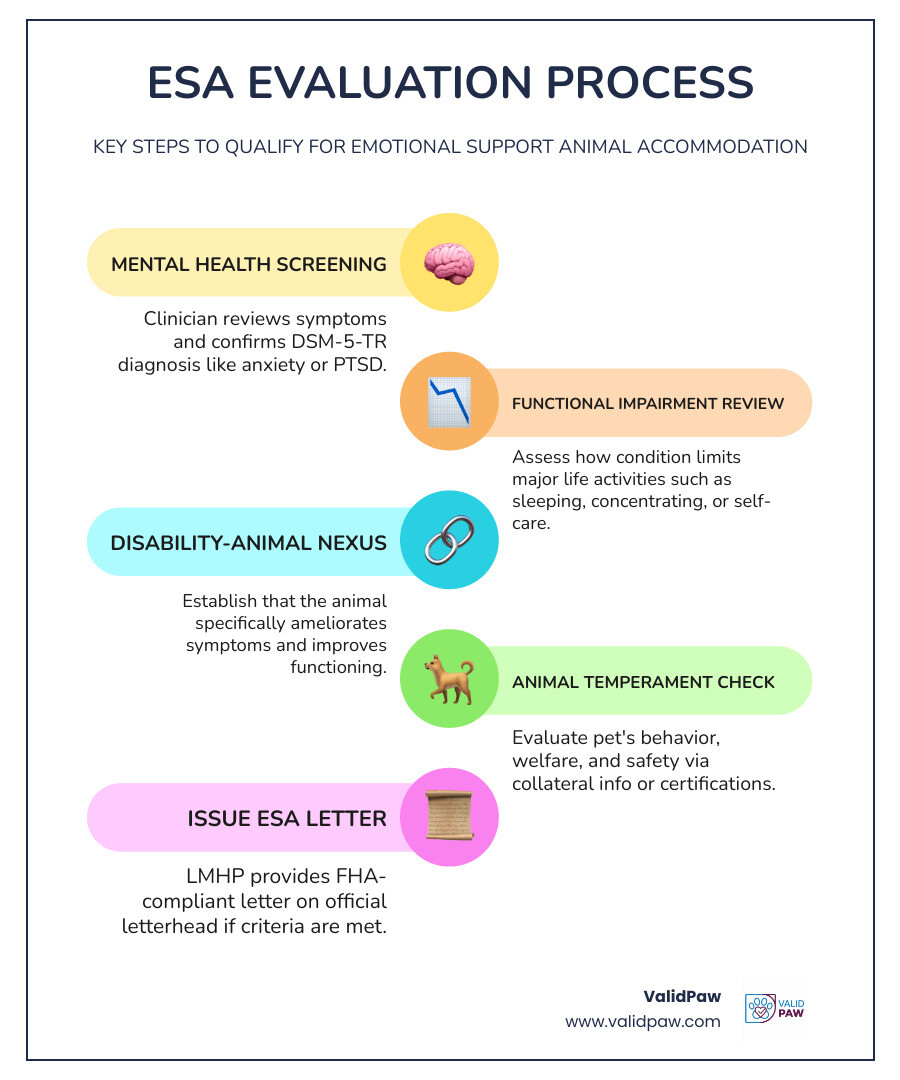
| Step | What Happens | |---|---| | 1. Mental health screening | Clinician reviews your symptoms and diagnoses | | 2. Functional impairment review | Evaluator confirms your condition limits one or more major life activities | | 3. Disability-animal nexus | Clinician establishes that the animal specifically helps reduce your symptoms | | 4. ESA letter issued | If you qualify, a signed letter on official letterhead is provided |
If you already have a diagnosed mental health condition — such as anxiety, depression, or PTSD — and your pet meaningfully helps you cope, there is a good chance you qualify.
Getting this evaluation right matters. Under the Fair Housing Act (FHA), a valid ESA letter from a licensed professional can protect your right to live with your animal even in no-pet housing — without paying pet deposits or extra rent. But the letter is only as strong as the evaluation behind it.
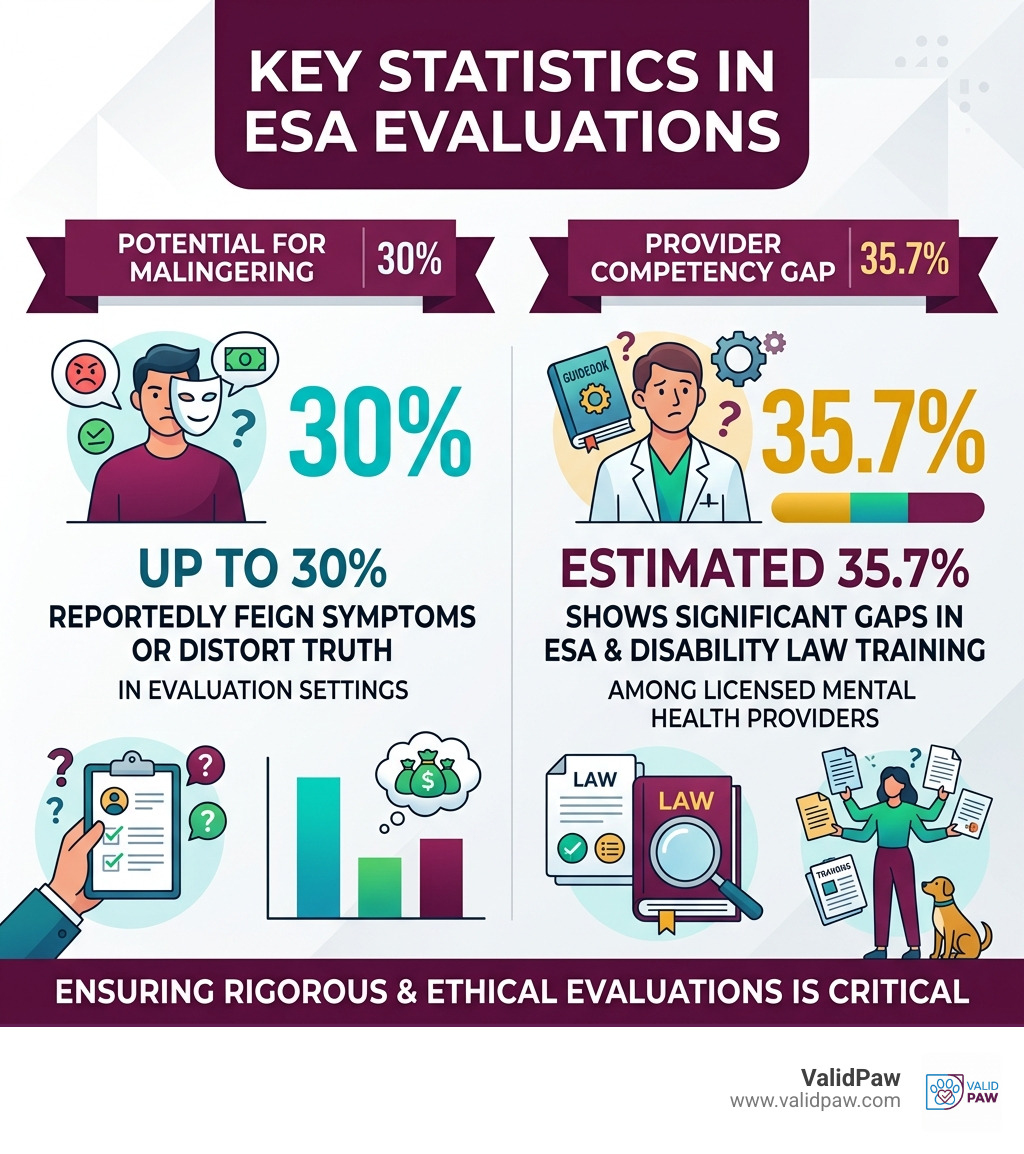
That is the challenge many people run into. A surprising number of clinicians — 35.7% — report they do not feel qualified to make an ESA determination, according to research by Boness et al. (2017). And letters issued without a proper assessment can be challenged or rejected by housing providers.
This guide walks you through every part of the process: what a legitimate evaluation looks like, who can conduct one, what the law requires, and how to get documentation that actually holds up.
I'm Francisco Ortiz, Lead Forensic Mental Health Evaluator and Director of Behavioral Health at District Counseling PLLC, where I specialize in emotional support animal evaluations using clinically rigorous, forensic-grade assessment protocols across six states. With advanced training in disability assessment, forensic case formulation, and conditions like anxiety and PTSD that most commonly qualify for ESA support, I bring both the clinical depth and legal grounding this process requires.
Understanding the Emotional Support Animal Evaluation Process
When we talk about an emotional support animal evaluation, we aren't just talking about a quick chat or a "yes/no" form. A legitimate assessment is a clinical process designed to bridge the gap between a mental health diagnosis and a specific housing accommodation. It is grounded in the DSM-5-TR (the diagnostic manual used by professionals) and focuses heavily on "functional limitations."
A functional limitation refers to how a mental health condition—like Generalized Anxiety Disorder or Major Depressive Disorder—substantially limits one or more major life activities. These activities include things most people take for granted: sleeping, concentrating, interacting with others, working, or even basic self-care.
The core of the evaluation is establishing the "disability-animal nexus." This is a fancy way of saying the clinician must prove that the animal's presence actually ameliorates (improves) your symptoms. For example, if a patient has PTSD and suffers from nighttime hypervigilance, the clinician might document how the dog's presence allows the patient to feel safe enough to sleep.
At ValidPaw, we take this responsibility seriously. Whether you are seeking an Emotional Support Animal Evaluation in Austin or anywhere else in the country, we ensure the process is thorough and legally sound. You can learn more info about our experts who handle these sensitive cases daily.

What happens during an emotional support animal evaluation?
So, what does the day-of actually look like? Most evaluations begin with a clinical interview, which can be done in person or via a secure telehealth platform. We often use standardized tools like the WHODAS 2.0 (World Health Organization Disability Assessment Schedule) to objectively measure how much your symptoms interfere with your daily life.
The evaluator will ask about your psychiatric history, any medications you are taking, and how you currently cope with stressors. A critical part of the conversation is the "disability-nexus"—we need to hear, in your own words, how your animal helps you function. Does your cat provide a grounding distraction during a panic attack? Does your dog give you a reason to get out of bed during a depressive episode?
We also look at your ability to care for the animal. An ESA is meant to support you, but the clinician must ensure that the responsibility of pet ownership isn't adding more stress than it relieves. You can read more on our blog about specific scenarios where ESAs have successfully helped individuals regain their independence.
Who is qualified to conduct an emotional support animal evaluation?
Not just anyone can write an ESA letter. To be legally valid under federal and state laws, the evaluation must be performed by a Licensed Mental Health Professional (LMHP). This includes:
- Licensed Clinical Social Workers (LCSW)
- Licensed Professional Counselors (LPC)
- Psychologists (PhD or PsyD)
- Psychiatrists (MD or DO)
The professional must be licensed in the state where the client resides at the time of the evaluation. This is a crucial detail—landlords often check the license number on the letter to ensure the clinician has the authority to practice in that state. Beyond just having a license, the clinician should have clinical competency in disability assessment. Many general therapists avoid these evaluations because they require a "forensic" mindset—balancing the needs of the patient with the legal requirements of the housing provider.
For a deep dive into what we look for, check out this Emotional Support Animal Assessment Letter Checklist.
Legal Framework: FHA, ADA, and State Regulations
Navigating the laws surrounding ESAs can feel like walking through a maze. The most important law to remember is the Fair Housing Act (FHA). This federal law prohibits discrimination against individuals with disabilities in housing. Under the FHA, an ESA is not considered a "pet"—it is a "reasonable accommodation."
It is vital to distinguish ESAs from service animals, which are covered by the Americans with Disabilities Act (ADA). While service animals (specifically dogs) have the right to enter restaurants, stores, and hospitals, ESAs generally do not. Their legal protection is almost exclusively tied to the home.

ESA Housing Rights vs. Service Animal Public Access
| Feature | Emotional Support Animal (ESA) | Service Animal (Dog/Mini Horse) | |---|---|---| | Primary Law | Fair Housing Act (FHA) | Americans with Disabilities Act (ADA) | | Training Required | None | Must perform specific tasks | | Public Access | No (Housing only) | Yes (Everywhere) | | No Pet Fees | Yes | Yes | | Species | Any common domestic animal | Dogs only (usually) |
Whether you are looking for ESA Letters in Houston or Dallas, these federal rules apply. However, state laws can add extra layers of protection—or extra requirements for clinicians.
Recent Legislation and California AB 468
As of April 2026, we are seeing more states follow the lead of California’s AB 468. This law was designed to curb "ESA mills"—websites that sell letters without a real clinical relationship. In California, and increasingly in other states, a clinician must have a 30-day established relationship with a client before issuing an ESA letter for a dog. They must also provide a specific notice to the client that the animal does not have the same public access rights as a service dog.
These laws are a win for legitimacy. They ensure that when you present a letter to a landlord, it carries the weight of a real, ongoing clinical relationship. We stay updated on all state-level compliance to ensure our letters meet the strictest local standards.
Clinical Standards and Ethical Challenges in ESA Assessments
The 35.7% competency gap we mentioned earlier is a major issue in the mental health field. Many therapists feel that writing an ESA letter "takes a side" and might damage the therapeutic relationship if they have to say no. This is why many university health centers and counseling services flatly decline to provide ESA documentation. They prefer to refer students to specialized evaluators like us to avoid "dual relationship" conflicts.
When a treating therapist acts as an evaluator, they are switching from a "supportive" role to a "forensic" or "evaluative" role. This can be tricky. If a therapist determines a client doesn't qualify, it could end the therapy. By using an independent evaluator, you ensure a neutral, objective assessment.
For those interested in the "why" behind these animals, there is significant scientific research on ESA clinical benefits. Studies have shown that ESAs can reduce feelings of loneliness, lower blood pressure, and provide a sense of purpose for individuals with chronic mental health challenges.
Assessing for Malingering and Liability
One of the harder parts of our job is assessing for malingering—the intentional feigning of symptoms for a secondary gain (like avoiding a pet fee). Research suggests that in disability and worker’s compensation cases, the probable malingering rate can be over 30%.
Evaluators must maintain an objective stance. We look for consistency between your reported symptoms and your clinical history. If someone has no history of anxiety but suddenly claims severe panic attacks only when their lease is up for renewal, it raises a red flag. Clinicians face significant liability if they write fraudulent letters, including potential board discipline or lawsuits if an improperly vetted animal causes harm.
Evaluating Animal Temperament and Interaction
While the evaluation focuses on the human, we cannot ignore the animal. An ESA must be a "reasonable" accommodation. If an animal is aggressive, unhygienic, or destructive, a landlord can legally deny the request, regardless of your disability.
We often look for collateral information—statements from veterinarians or trainers—to confirm the animal is well-behaved. While an ESA doesn't need the rigorous training of a service dog, having a Canine Good Citizen certification is a great way to show a landlord that your dog is a "good neighbor." Public safety and animal welfare are part of the ethical equation.
How to Obtain Legitimate Documentation
If you believe you qualify, the path forward is straightforward but requires diligence. Avoid "instant" websites that promise a letter in five minutes without a consultation—these are almost always scams and are easily spotted by landlords.
At ValidPaw, we provide telehealth evaluations that are both convenient and clinically rigorous. Our process connects you with a licensed therapist in your state for a real-time consultation. If you qualify, we provide FHA-compliant letters with a fast 24-48 hour turnaround. You can start your Application Form today to begin the process.
What an ESA Letter Must Include
To protect your privacy while meeting legal standards, a valid letter should include:
- Official Letterhead: The clinician’s name, practice name, and contact info.
- License Information: The type of license, the state of licensure, and the license number.
- Issuance Date: Letters generally need to be renewed annually.
- Disability Confirmation: A statement that you have a mental health disability (the specific diagnosis is usually not required to be named for privacy reasons).
- The "Nexus": A clear explanation of how the animal helps alleviate your symptoms.
If you have more questions about the specifics, check out our FAQ.
Frequently Asked Questions about Emotional Support Animal Evaluations
Can a university counseling center provide an ESA letter?
Most university counseling centers have policies against writing ESA letters. This is usually due to institutional liability and the fact that their staff may not have specialized training in disability law. They typically refer students to outside providers. You can find more Article Detail on campus ESAs on our site.
Do I need to register my ESA on a national database?
No. There is no such thing as a "legally recognized" national ESA registry. Any website asking you to pay for a "lifetime registration" or a "badge" is selling you a product with no legal standing. The only document that matters is your letter from a licensed professional.
Are ESAs allowed on airplanes in 2026?
As of current DOT regulations in April 2026, ESAs are no longer required to be accommodated for free on domestic flights. Most airlines treat them as regular pets, meaning you may have to pay a fee and keep them in a carrier. If your disability requires an animal to perform tasks during the flight, you may want to look into the requirements for a Psychiatric Service Dog (PSD).
Conclusion
An emotional support animal evaluation is more than a hurdle; it is a vital tool for protecting your disability rights. By ensuring your documentation is ethical, legitimate, and clinically sound, you can enjoy the companionship of your animal without the stress of housing disputes.
If you are ready to take the next step with a team that understands the nuances of state and federal law, we are here to help. Once you receive your documentation, you can always Verify your ESA Letter through our secure portal to give your landlord peace of mind.