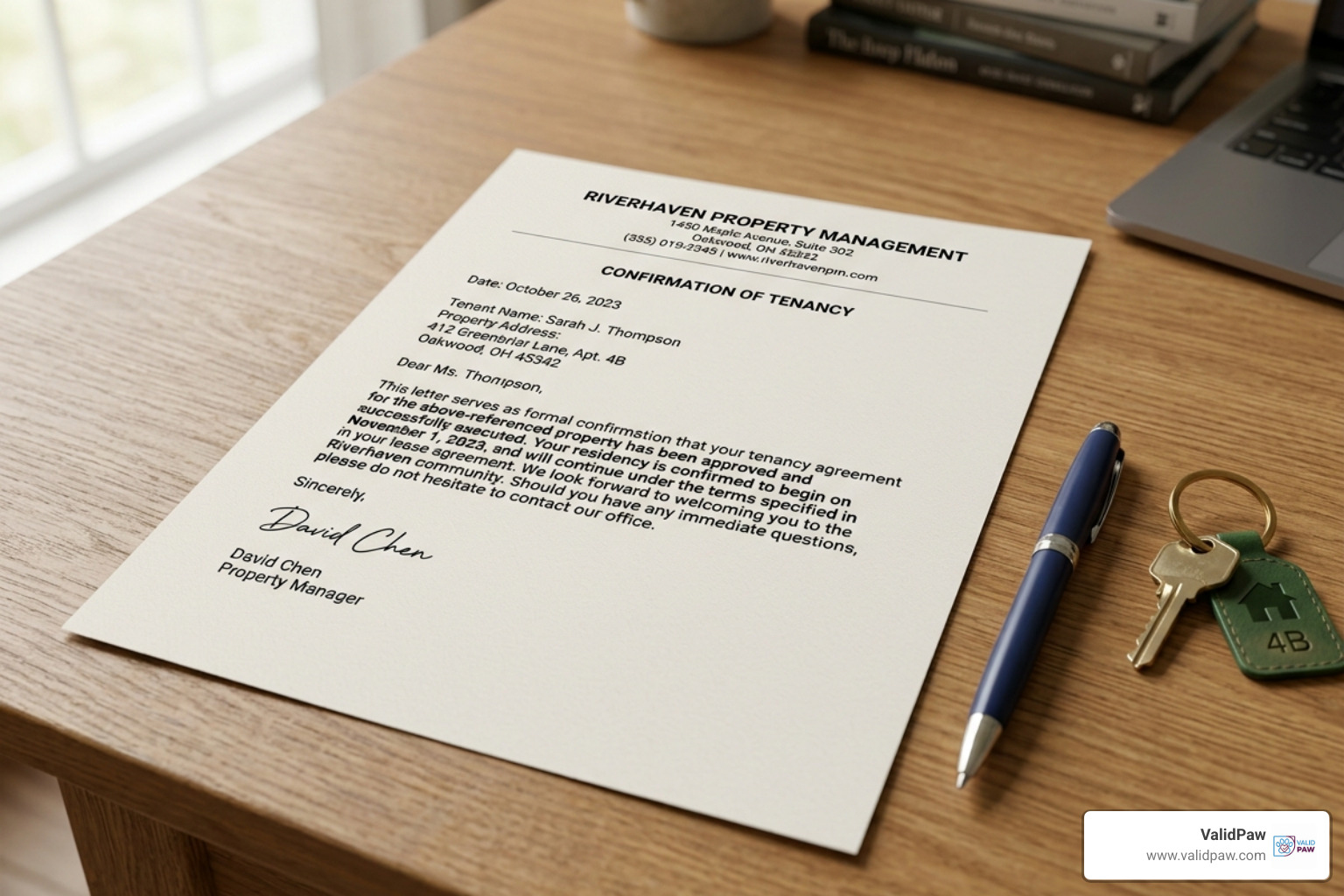
What a Confirmation of Tenancy Letter Is (And Why It Matters)
A confirmation of tenancy letter is a formal document issued by a landlord or property manager that verifies a tenant's current residency at a specific address.
Here's what it typically confirms at a glance:
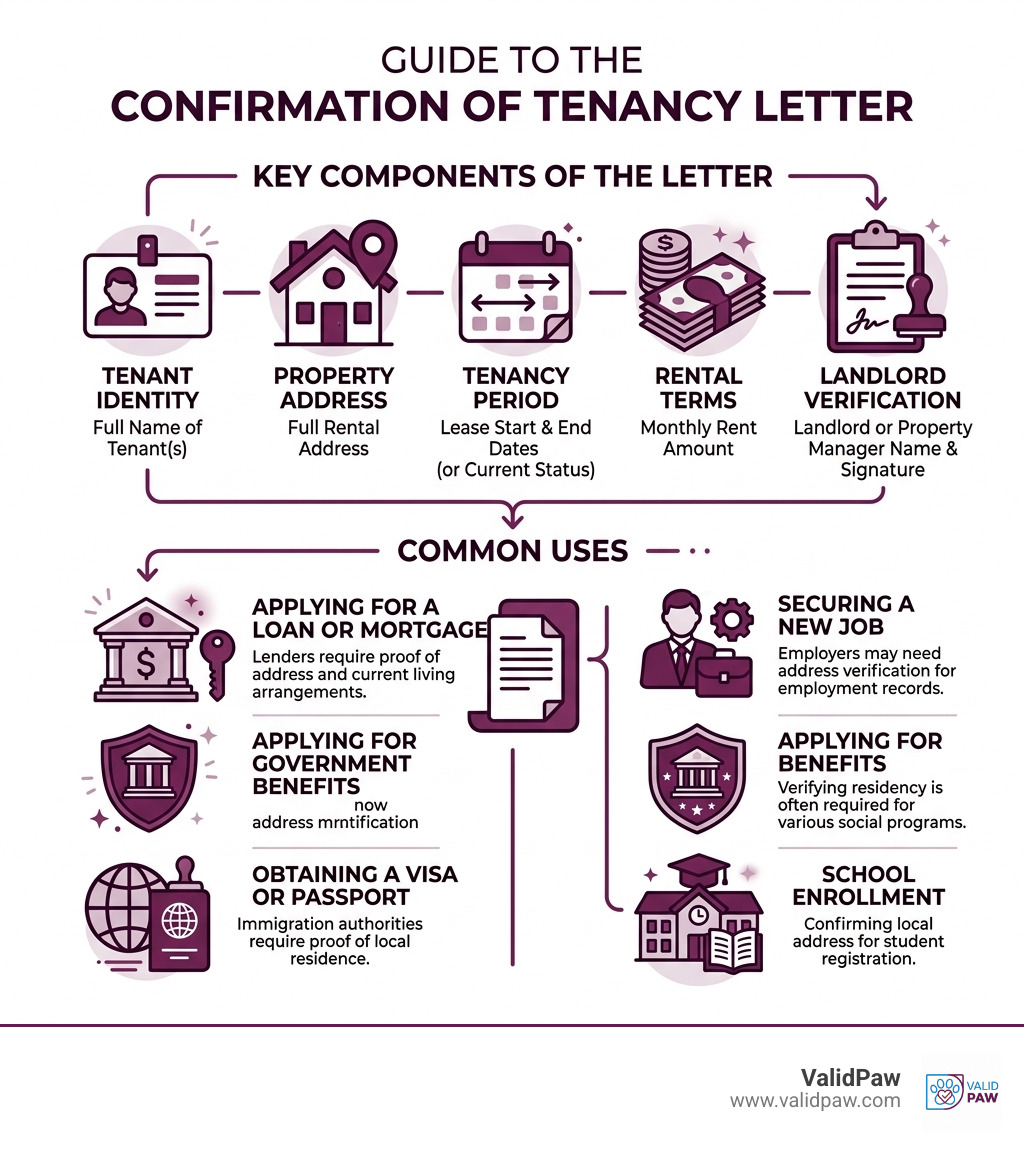
| What It Covers | Details Included | |---|---| | Who lives there | Tenant's full name | | Where they live | Full property address | | When they started | Lease start date | | What they pay | Monthly rent amount | | Who issued it | Landlord or property manager name and signature |
This letter is not the same as a lease agreement. A lease is the full legal contract. A confirmation letter is a short, focused summary — written for a third party like a bank, employer, visa office, or school.
It's one of the most commonly requested rental documents, and yet many tenants don't know they can ask for one — or what it needs to include to actually be accepted.
Whether you need it for a loan, a visa, government benefits, or a new job, getting this letter right matters. A missing detail or informal format can mean a rejection from the agency reviewing it.
I'm Francisco Ortiz, a Certified Forensic Mental Health Evaluator and Director of Behavioral Health at District Counseling PLLC, and my work across six states with housing documentation — including the intersection of mental health, Fair Housing Act compliance, and confirmation of tenancy letter requirements — gives me a clear view of exactly what these letters need to contain. In the sections below, I'll walk you through everything step by step.
When and Why You Need a confirmation of tenancy letter
In our experience helping residents across Texas and the rest of the country, we’ve seen that life often requires more than just a "take my word for it" regarding where you live. While a full lease agreement is a heavy legal document, a confirmation of tenancy letter is a streamlined "passport" to various services.

There are several common scenarios in May 2026 where this document becomes essential:
- Visa and Immigration Applications: If you are traveling abroad or sponsoring someone, consulates often require a Letter From Landlord Confirming Tenancy to prove you have a stable residence.
- Loan and Mortgage Approvals: Banks aren't just looking at your income; they want to see your housing stability. A letter confirming your rent and on-time payment history can be a deciding factor in creditworthiness.
- School Enrollment: Many school districts in cities like Houston, Austin, or Chicago require rigorous proof of residency to ensure students live within the district boundaries.
- Employment Background Checks: New employers often verify your past two to five years of addresses. A formal letter from a landlord is more professional than a handwritten note.
- Government Benefits: To qualify for certain state or federal programs, you must provide proof of your monthly housing expenses.
- Utility Connections: Sometimes, utility companies require a confirmation of tenancy if there is a dispute over who is responsible for a previous balance at an address.
By providing this letter, a landlord acts as a "character witness" for your physical presence and financial reliability.
Essential Components of a Professional Landlord Letter
To be effective, the letter must look the part. It’s not just about the words; it’s about the specific data points that third-party verifiers look for. If you are a landlord drafting this, or a tenant checking one over, ensure these elements are present:
- Full Property Address: This must include the unit number, city, state, and zip code.
- Tenant Names: All legal adults listed on the lease should be mentioned.
- Lease Dates: Specifically, the start date and the current expiration date (or a note if it is a month-to-month arrangement).
- Financial Details: The exact monthly rent amount and when it is due.
- Payment History: A brief statement confirming if the tenant pays on time is incredibly helpful for loan applications.
- Utility Responsibilities: Clarifying which utilities are included in the rent versus paid by the tenant.
It is also important to distinguish this letter from other common rental documents. We've put together a quick comparison table to help you keep them straight:
| Feature | Confirmation of Tenancy Letter | Lease Agreement | Proof of Residency Letter | | :--- | :--- | :--- | :--- | | Primary Purpose | Verify current status/rent | Define legal terms/rules | Prove physical address | | Length | 1 page | 5–20+ pages | 1 page | | Includes Rent? | Usually yes | Always | Not always | | Includes Rules? | No | Yes | No | | Third-Party Use? | High | Low (too private) | High |
For those looking for a standard starting point, you can find a Letter from Landlord Confirming Tenancy and Monthly Rent – Document Template to ensure no key fields are missed.
How to Write a Professional Letter: Step-by-Step
Writing a confirmation of tenancy letter doesn't require a law degree, but it does require a professional touch. If the letter looks sloppy, the person receiving it might question its authenticity.

Follow these steps to create a high-quality document:
Step 1: Use Professional Letterhead
If you are a property manager or a landlord with a business name, use your official letterhead. If you’re a private landlord, include your name, phone number, and email address clearly at the top.
Step 2: Use a Formal Greeting
Avoid "Hey there." Use "To Whom It May Concern" if the recipient is unknown, or "Dear [Name of Bank/Agency]" if the tenant provided a specific contact.
Step 3: State the Facts Clearly
The opening paragraph should get straight to the point: "This letter is to confirm that [Tenant Name] is currently a resident at [Address] and has been since [Start Date]."
Step 4: Include the Financials
State the rent amount clearly. For example: "The current monthly rent is $1,800, which is paid on the first of each month. As of May 2026, the tenant is current on all payments."
Step 5: Provide Contact Information for Verification
Include a line stating that you are available to verify the information via phone or email. This adds a layer of trust.
Step 6: Sign and Date
A physical signature is always preferred, though digital signatures (like DocuSign) are becoming standard in 2026. You can see various styles of these in this Tenancy Confirmation Letter Example: 4 Templates.
Legal Considerations and Privacy Protections
As experts in housing documentation, we must emphasize that these letters carry legal weight. Landlords should be careful not to overshare.
- Tenant Consent: Before a landlord sends this letter directly to a third party, they should ideally have written consent from the tenant. This protects the landlord from privacy law violations.
- The Fair Housing Act (FHA): When writing these letters, landlords must ensure they aren't including discriminatory language or treating certain tenants differently based on protected classes.
- Accuracy is Mandatory: Never "fudge" the numbers to help a tenant get a loan. If a bank discovers the information is false, the landlord could potentially face fraud-related legal issues.
- Emotional Support Animals (ESAs): Sometimes, a confirmation of tenancy is needed alongside an ESA request. It's important to understand the difference between a residency verification and the legal requirements for an ESA Landlord Letter, which requires a licensed mental health professional's evaluation.
A note on Notarization: While not always required, having the letter notarized can significantly boost its credibility. A notary acts as a third-party witness to the landlord's signature, which is often required for government-level applications or international visas.
Frequently Asked Questions about Tenancy Confirmation Letters
Who is authorized to issue a confirmation of tenancy letter?
Generally, the property owner (landlord) or the authorized property manager is the only person who can issue this. If you live in a large apartment complex in a city like Dallas or San Antonio, the leasing office staff usually has the authority to generate these from their property management software. If you are sub-leasing, the primary tenant might write one, but most agencies will want to see a letter from the actual owner.
Should a confirmation of tenancy letter be notarized?
It depends on who is asking for it. For a simple job application, a signature is usually enough. However, for "sworn statements" used in court, visa applications, or some mortgage lenders, notarization is a "credibility boost" that prevents fraud. It proves that the person signing the letter is truly who they say they are.
What if my landlord refuses to provide the letter?
While most landlords are happy to help a good tenant, they aren't always legally obligated to provide a custom letter unless specified in the lease. If they refuse, don't panic. You can often use:
- Your original signed lease agreement.
- Canceled checks or bank statements showing rent transfers.
- Utility bills in your name at that address.
- A "Landlord Verification Form" (some agencies provide their own form that just requires a quick signature).
Polite negotiation usually works best. Explain exactly why you need it—most landlords will help if they know it’s for something positive like a mortgage or a child’s school.
Conclusion
A confirmation of tenancy letter is a small document that can open big doors. Whether you're moving your career forward in Austin, securing a home for your family in Chicago, or applying for a loan in San Antonio, having an accurate, professional letter makes all the difference.
At ValidPaw, we understand how important professional documentation is for your housing needs. While we specialize in providing FHA-compliant ESA letters through telehealth evaluations with licensed Texas therapists, we know that a stable home is the foundation of mental well-being. If you are a tenant looking to ensure your housing rights are protected or need a legitimate ESA evaluation, we serve Texas and all 50 states with fast, 24-48 hour turnaround times.
For more information on housing rights and professional documentation, visit us at https://validpaw.com/.