
What It Actually Means to Register My Animal as an ESA
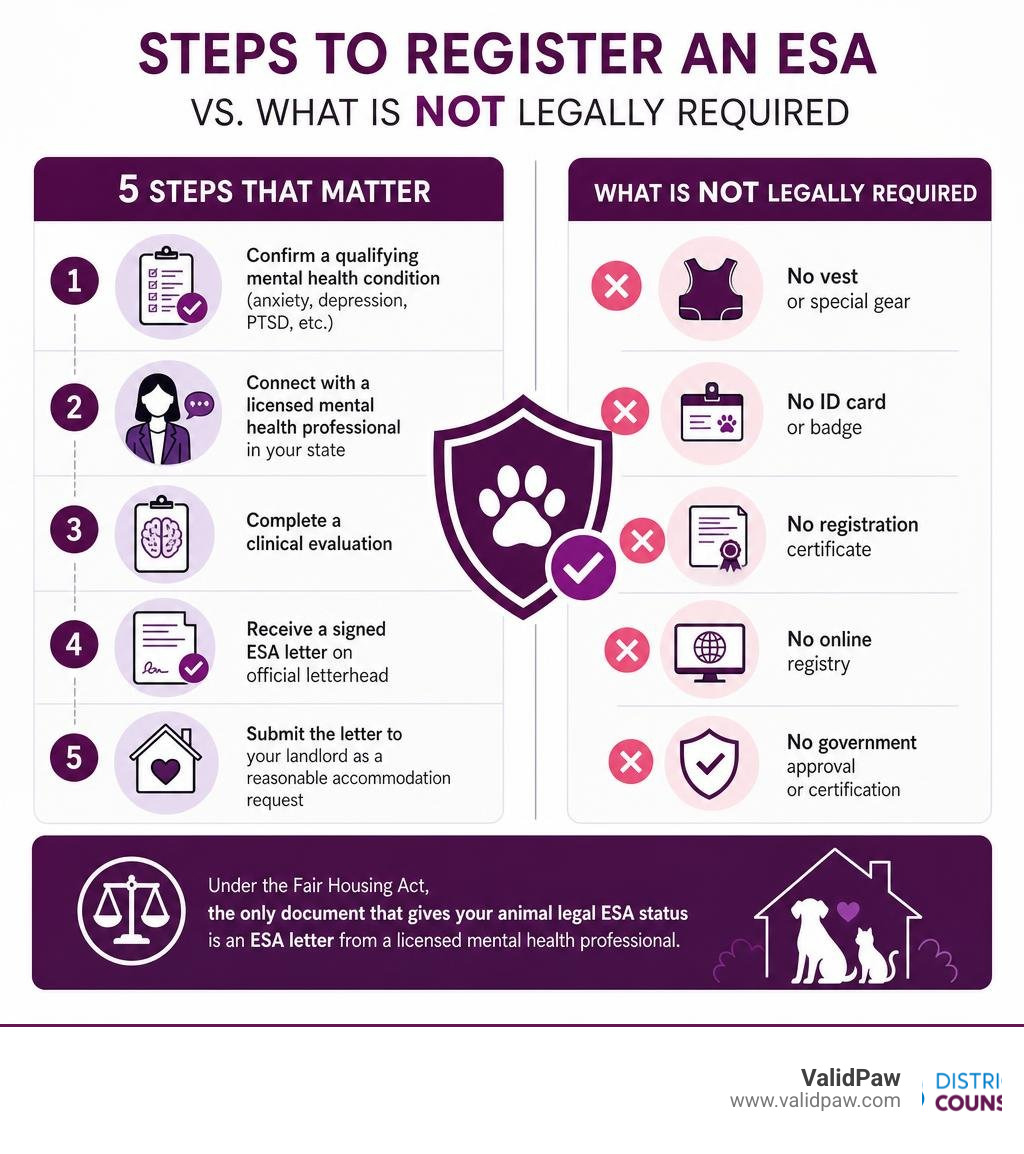
If you want to register my animal as an ESA, here's the short answer: there is no official government registry. The only document that gives your animal legal ESA status is an ESA letter from a licensed mental health professional.
Here's what you actually need to do:
- Confirm you have a qualifying mental health condition (anxiety, depression, PTSD, etc.)
- Connect with a licensed mental health professional in your state
- Complete a clinical evaluation
- Receive a signed ESA letter on official letterhead
- Submit the letter to your landlord as a reasonable accommodation request
No vest, ID card, registration certificate, or online database is legally required — or legally recognized — under the Fair Housing Act.
Many people searching for ESA registration end up on websites selling badges, ID cards, and certificates. These products feel official, but they carry no legal weight for housing protections. What landlords must honor under federal law is an ESA letter from a licensed clinician — nothing more, nothing less.
If you're a renter dealing with a "no pets" policy while managing a mental health condition, getting a legitimate ESA letter is the one step that actually protects you.
I'm Francisco Ortiz, Lead Forensic Mental Health Evaluator and Director of Behavioral Health at District Counseling PLLC, and I've conducted clinically rigorous ESA evaluations across six states — helping individuals navigate the exact process of how to register my animal as an ESA through proper, legally sound documentation. In the steps below, I'll walk you through everything you need to do it right.
The Truth About How to Register My Animal as an ESA
Let’s clear up the single biggest myth in the pet world: there is no such thing as a "legally certified" or "government-approved" emotional support animal registry.
If you search the internet for how to register my animal as an ESA, you will be flooded with websites offering "official" registration packages, shiny plastic ID cards, and custom vests. However, buying a certificate from an online database does not grant your pet any legal rights. Under the Fair Housing Act (FHA), landlords are not required to accept a registration number or a badge as proof of your need for an ESA.

The only document that holds legal power is a legitimate ESA letter written by a licensed mental health professional (LMHP) who is actively practicing in your state. To learn how to tell the difference between real legal documentation and useless online certificates, take a look at our guide on Is Your ESA Letter Legitimate? How to Spot the Real Deal.
To understand why registration alone isn't enough, it helps to look at how emotional support animals differ from other working animals:
| Animal Type | Legal Protections | Training Required | Official Registry? | Primary Document Needed | | :--- | :--- | :--- | :--- | :--- | | Emotional Support Animal (ESA) | Housing only (FHA) | None | No | ESA Letter from a licensed professional | | Service Dog (including PSD) | Housing, Public Access, Travel | Yes (Task-specific) | No | None (Self-certification/behavior) | | Therapy Animal | None (Requires invitation) | Yes (Socialization) | No | Organization credentials |
While some handlers choose to use voluntary identification tools to streamline daily interactions, a landlord can legally ignore any ID card if you do not have a signed clinician's letter.
How to Register Animal as ESA in 5 Simple Steps
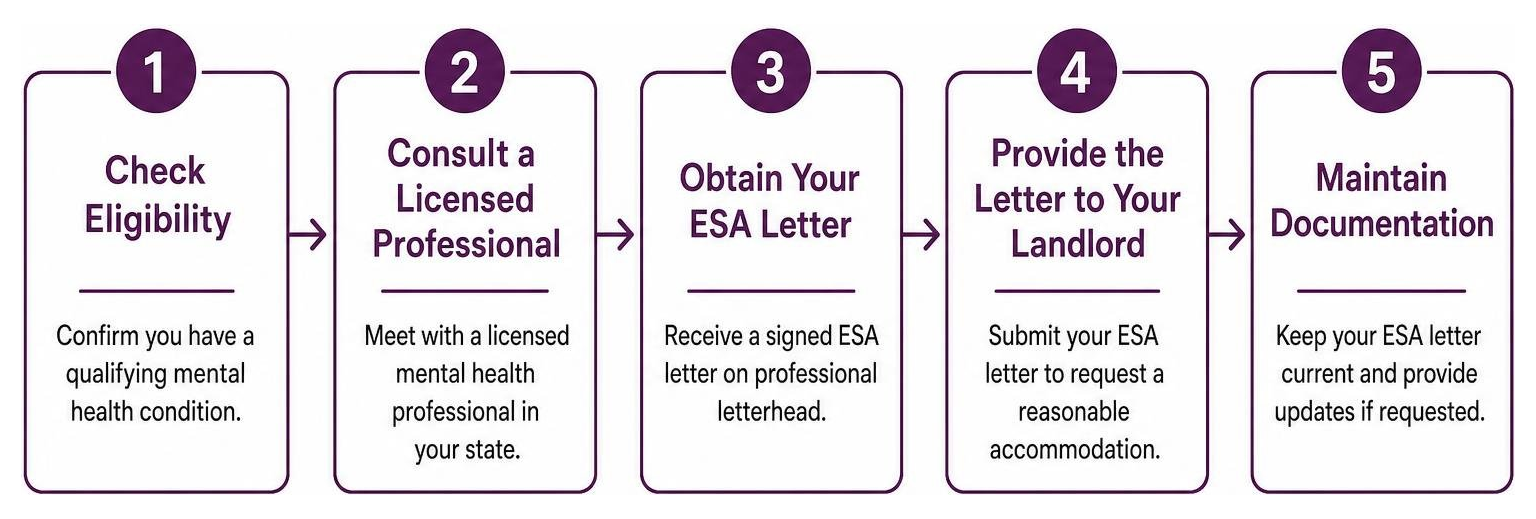
Now that we've cleared away the myths, let's look at the actual clinical and legal process. We have broken down the journey of how to register my animal as an ESA into five straightforward steps.

Step 1: Determine If You Qualify to Register My Animal as an ESA
The first step is evaluating your mental health needs. Emotional support animals are not just beloved pets; they are recognized as therapeutic tools for individuals living with DSM-5 qualifying conditions.
Statistics show how powerful these animals can be: 74% of pet owners report noticeable mental health improvements from their animals. Furthermore, data indicates that 90.8% of ESA owners manage anxiety disorders, while 72.4% live with depressive disorders. Overall, 84% of ESA owners report significant improvements in their daily symptoms and general quality of life.
To qualify, you must experience a mental or emotional disability—such as generalized anxiety, major depressive disorder, PTSD, panic disorders, severe phobias, or chronic stress—that substantially limits at least one major life activity.
Step 2: Connect with a Licensed Mental Health Professional
Once you establish that your animal provides critical therapeutic support, you must speak with a licensed clinician. This could be your personal therapist, psychiatrist, clinical social worker, or a licensed telehealth provider.
The professional must be licensed in your specific state. For instance, if you live in Chicago, your therapist must be licensed in Illinois; if you reside in Houston, Austin, or Dallas, they must hold a license in Texas.
When choosing a telehealth platform, make sure the service establishes a genuine, compliant clinical relationship. To make sure you meet all criteria, check out our guide on Everything You Need to Know About Requirements for ESA Letter Success.
Step 3: Complete Your ESA Evaluation
During your consultation, the clinician will evaluate your mental health history and discuss how your pet helps alleviate your symptoms.
This is not a "pay-and-go" transaction. A legitimate evaluation involves a professional interview to establish medical necessity. The therapist must verify that your animal’s presence directly mitigates the negative symptoms of your mental health condition.
If you are a resident of the Lone Star State, you can read our detailed breakdown on How to Register Your Emotional Support Animal in Texas the Right Way.
Step 4: Receive Your Official ESA Letter
If the clinician approves your request, they will write and sign an official ESA letter. To be legally compliant under HUD and FHA guidelines, this letter must include:
- The therapist's official letterhead, contact information, and signature.
- The therapist's license type, license number, and the state of issuance.
- The date the letter was issued (ESA letters are typically valid for one year and must be renewed annually).
- A clear statement confirming that you have a diagnosed mental health disability and that your animal provides necessary therapeutic support.
With ValidPaw, this process is incredibly fast. We connect you to licensed professionals in your state to deliver FHA-compliant letters within 24-48 hours. For Texas residents, you can read The Texan’s Guide to Getting a Real Emotional Support Animal Letter for more localized tips.
Step 5: Submit the Documentation to Your Landlord to Register My Animal as an ESA
The final step is submitting your completed ESA letter to your landlord or property manager alongside a written reasonable accommodation request.
Once your landlord receives this letter, they are legally required to review it under the Fair Housing Act. They cannot charge you pet rent, pet application fees, or pet deposits. ValidPaw provides built-in instant landlord verification support to help handle any follow-up questions your property manager might have.
Legal Rights and Housing Protections for ESA Owners
The Fair Housing Act (FHA) is the federal shield that protects emotional support animal handlers. Managed by the Department of Housing and Urban Development (HUD), these regulations ensure that individuals with disabilities have equal access to housing. For official federal guidance, HUD explains how housing providers should evaluate requests for assistance animals as reasonable accommodations.
Under the FHA, an ESA is legally classified as an assistance animal, not a pet. This distinction grants you several crucial protections:
- No Pet Fees or Deposits: Landlords cannot charge you one-time pet deposits or monthly pet rent, saving you hundreds of dollars.
- Exemption from "No Pets" Policies: Even if an apartment complex has a strict "no pets allowed" rule, they must make a reasonable accommodation to let your ESA live with you.
- No Breed or Weight Restrictions: Landlords cannot deny your ESA simply because of its breed or size. A Great Dane has the same housing rights as a Chihuahua if it is a documented ESA.
However, housing laws can have state-specific nuances. While the Fair Housing Act is a federal law that applies nationwide, some states have additional regulations regarding documentation, verification, or penalties for misrepresentation. Whether you live in Texas, Illinois, California, Georgia, Louisiana, or New Hampshire, it is crucial to ensure your documentation complies with both federal guidelines and local state statutes to guarantee your housing rights are fully protected.
Frequently Asked Questions About ESA Registration
Can any animal be an emotional support animal?
Yes, almost any common, domesticated animal can serve as an ESA. While dogs and cats are the most popular choices, rabbits, birds, hamsters, and even miniature pigs can qualify.
There are no formal training requirements, but your animal must be housebroken and well-behaved. Landlords can legally reject an ESA if the specific animal poses a direct threat to the safety of others or causes substantial physical damage to the property. For a complete look at what is expected of your dog, check out our Ultimate Guide to ESA Dog Requirements.
Are emotional support animals allowed on airplanes?
No, not anymore. In January 2021, the U.S. Department of Transportation (DOT) updated its Air Carrier Access Act (ACAA) rules. Major U.S. airlines—including American, Delta, United, JetBlue, Frontier, and Alaska—no longer recognize emotional support animals as service animals.
Today, ESAs are treated as regular pets during air travel. If you want to fly with your ESA, you must pay the airline's standard pet fees, and your animal must fit inside an approved under-seat carrier unless they qualify as a trained Psychiatric Service Dog (PSD).
What should I do if my landlord denies my ESA?
If your landlord denies your accommodation request despite you presenting a legitimate ESA letter, you have legal recourse.
First, remain calm and ask for the denial in writing. Remind them that under the Fair Housing Act, they cannot reject a valid medical recommendation without proving "undue financial or administrative burden," which is very difficult to do. If they refuse to cooperate, you can file an official discrimination complaint directly with HUD. Our team at ValidPaw also provides landlord verification support to help resolve these disputes smoothly.
Conclusion
Trying to register my animal as an ESA doesn't have to be a confusing process filled with misleading registry websites. By bypassing the useless certificates and focusing on what the law actually requires—a real ESA letter—you protect both your mental health and your housing rights.
At ValidPaw, we make getting legitimate, FHA-compliant documentation simple, secure, and stress-free. Through our convenient telehealth platform, we connect you with licensed therapists in your state to deliver your official ESA letter within 24 to 48 hours.
Don't let "no pet" policies stand in the way of your mental well-being. Apply for your legitimate ESA letter today and take the first real step toward securing a safe, pet-friendly home.

