
What You Need to Know Before Getting an Emotional Support Animal Letter in Texas
Getting an emotional support animal letter in Texas is the key step that protects your right to live with your pet — even in a no-pet building — without paying extra deposits or fees.
Here's the short answer if you're in a hurry:
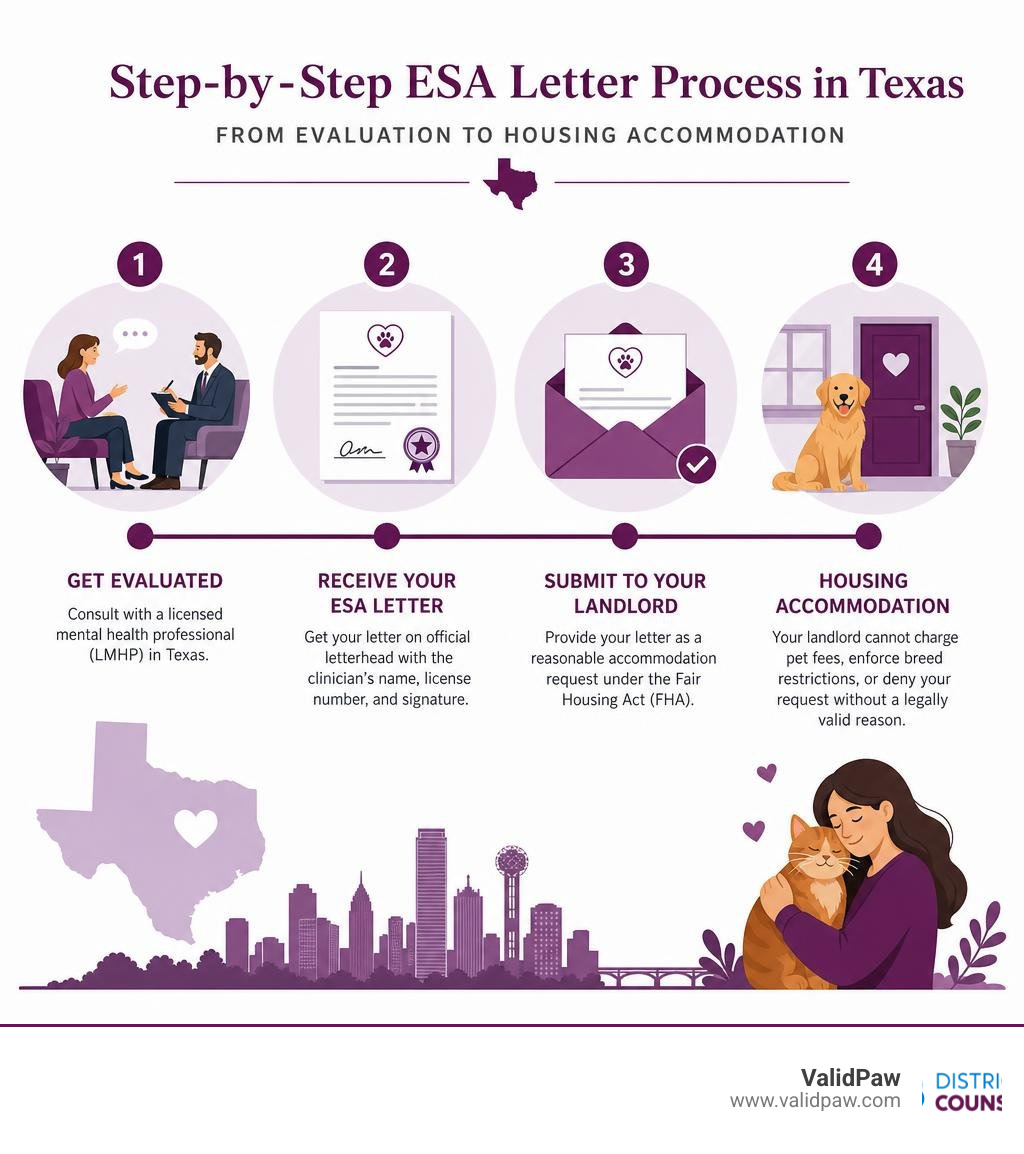
- Get evaluated by a licensed mental health professional (LMHP) who holds an active Texas license.
- Receive your ESA letter on official letterhead with the clinician's name, license number, and signature.
- Submit the letter to your landlord as a reasonable accommodation request under the Fair Housing Act (FHA).
- Your landlord cannot charge pet fees, enforce breed restrictions, or deny your request without a legally valid reason.
That's the core process. But there are real traps to avoid — from fake online registries to letters that won't hold up with a landlord.
Texas renters with anxiety, depression, PTSD, and other mental health conditions rely on their animals for daily stability. Losing housing over a no-pet policy — or paying hundreds in pet deposits — can make an already difficult situation worse. The right documentation changes that.
What makes this more complicated than it sounds: not every ESA letter is legally valid in Texas. A letter from an out-of-state provider, a website that sells "certifications," or a template downloaded online will likely be rejected — and in Texas, misrepresenting an ESA can carry civil penalties.
I'm Francisco Ortiz, Lead Forensic Mental Health Evaluator and Director of Behavioral Health at District Counseling PLLC, with multi-state licensure including Texas and specialized training in forensic ESA evaluations for housing accommodations — making me well-positioned to walk you through exactly what a legitimate emotional support animal letter in Texas requires. Let's cover everything you need to know to get this right.
Understanding the Emotional Support Animal Letter Texas Requirements

To understand how an emotional support animal letter in Texas works, we must first look at the legal definitions. An Emotional Support Animal (ESA) is not considered a standard "pet" under federal and state housing laws. Instead, an ESA is classified as an assistance animal that provides therapeutic comfort to an individual with a mental or emotional disability.
This distinction is crucial because it triggers federal protections under the Fair Housing Act (FHA), which is overseen by the U.S. Department of Housing and Urban Development (HUD). HUD provides official guidance on assistance animals and reasonable accommodations in housing. Under the FHA, housing providers are required to make "reasonable accommodations" for individuals who rely on these animals.
When you present a legitimate ESA letter to your landlord, several key legal protections take effect:
- No Pet Fees or Deposits: Landlords are strictly prohibited from charging you pet rent, one-time pet fees, or security deposits for your ESA.
- Exemption from No-Pet Policies: Even if your apartment complex or rental home has a strict "no pets allowed" policy, they must accommodate your ESA.
- Bypass of Breed and Weight Restrictions: Many rental properties in cities like Houston, Dallas, and Austin enforce weight limits or ban specific dog breeds (such as Pit Bulls or Rottweilers). Under the FHA, these restrictions do not apply to ESAs, provided the specific animal does not pose a direct threat to the safety of others.
The legal backbone of these rights is the documented connection between your mental health condition and the companionship of your animal. For a deeper dive into how these rules protect you, check out our guide on Everything You Need to Know About Texas ESA Letter Requirements.
It is important to remember that these protections apply to almost all housing types, including traditional apartments, single-family rental homes, condominiums, and university dormitories. However, to unlock these rights, your documentation must meet very specific legal standards.
Legal Requirements: Who Can Issue a Valid Texas ESA Letter?
To ensure your accommodation request is accepted, your letter must be written by a qualified professional. In Texas, only a currently licensed mental health professional (LMHP) or a licensed medical doctor who is actively treating you can legally issue an emotional support animal letter in Texas.
Qualified professionals include:
- Licensed Professional Counselors (LPCs)
- Licensed Clinical Social Workers (LCSWs)
- Licensed Marriage and Family Therapists (LMFTs)
- Licensed Psychologists or Psychiatrists
- Licensed Medical Doctors (MDs) or Nurse Practitioners (NPs)
The clinician must be licensed in the state of Texas. Landlords are legally permitted to verify the credentials of the professional who signed your letter. If your letter comes from an out-of-state clinician with whom you have no established therapeutic relationship, your landlord has grounds to deny the request.
To understand the difference between how Texas housing laws treat standard pets versus legitimate emotional support animals, refer to the comparison table below:
| Feature | Standard Pet | Emotional Support Animal (ESA) | | :--- | :--- | :--- | | Legal Classification | Personal Property / Pet | Assistance Animal | | Protected by FHA? | No | Yes | | Subject to Pet Rent/Fees? | Yes | No (Strictly Prohibited) | | Subject to Breed/Weight Limits? | Yes | No (Unless animal is a direct threat) | | Requires Special Training? | No | No (Provides comfort by its presence) | | Required Documentation | None / Standard Vet Records | Valid ESA Letter from a Licensed TX LMHP |
For your letter to be considered valid, it must include specific elements. It cannot simply say you love your pet. The document must be printed on the professional's official letterhead and include:
- The clinician's full name, signature, and date of the evaluation.
- Their active license type, license number, and the state of licensure (which must be Texas).
- A statement confirming that you meet the criteria for a mental health disability under the DSM-5.
- A clear explanation of the "nexus" — meaning how the animal specifically alleviates one or more symptoms of your mental health condition.
To prepare yourself for the evaluation and ensure your documentation is flawless, read our detailed breakdown on Everything You Need to Know About Requirements for ESA Letter Success and explore what happens during a clinical consultation in The Ultimate Guide to Emotional Support Animal Assessments. For a complete checklist of what your letter must contain to avoid landlord rejection, refer to Don't Get Hounded: Everything Your ESA Letter Must Include.
Texas ESA Laws vs. Federal and Other State Regulations

While federal laws like the Fair Housing Act provide the baseline for ESA protections across the country, Texas has implemented its own strict regulations to prevent fraud and misrepresentation.
The most critical state-specific law you must be aware of is Texas House Bill 4164 (HB 4164). Enacted to curb the abuse of assistance animal accommodations, this law makes it a punishable offense to misrepresent an animal as a service animal or assistance animal. Under the Texas Human Resources Code, if you present fraudulent documentation or falsely claim your pet is a trained service dog or a prescribed ESA, you can face:
- A civil penalty of up to $1,000 per violation.
- Up to 30 hours of mandatory community service for an organization that serves persons with disabilities.
This makes using "fake" online letters incredibly risky in the Lone Star State. Landlords are increasingly savvy and will check the validity of your clinician's license.
It is also helpful to understand how Texas laws compare to federal baselines and other states. For example, some states, like California, require a mandatory 30-day clinical relationship before an LMHP can write an ESA letter. Texas does not have a "30-day rule," meaning you can complete your clinical evaluation and receive your letter quickly, provided a thorough and legitimate telehealth assessment takes place.
Additionally, we can look at other states to see how regional laws differ. For instance, Illinois has its own specific provisions regarding landlord verification, but all states share the federal FHA foundation.
Another important distinction is the difference between an ESA and a Psychiatric Service Dog (PSD). While an ESA provides therapeutic comfort just by existing and is only protected in housing, a PSD is trained to perform specific tasks (like deep pressure therapy during a panic attack) and has full public access rights under the Americans with Disabilities Act (ADA).
To ensure you are navigating these state and federal boundaries correctly, read our guide on How to Register Your Emotional Support Animal in Texas the Right Way.
Step-by-Step Guide: How to Get a Legitimate ESA Letter in Texas
If you are struggling with a mental health condition and believe an emotional support animal would help, getting your letter does not have to be a stressful or drawn-out process. At ValidPaw, we connect you with licensed Texas therapists who understand the legal and clinical frameworks.
Here is our simple, step-by-step process to secure your legitimate emotional support animal letter in Texas:
Step 1: Complete an Online Clinical Assessment
The process begins with a confidential online intake questionnaire. You will answer questions about your mental health challenges, your history of anxiety, depression, or PTSD, and how your animal helps alleviate these symptoms. This helps establish the clinical "nexus" required by law.
Step 2: Consult with a Licensed Texas Clinician
Next, you will schedule a telehealth consultation with a therapist licensed in Texas. During this session, the professional will evaluate your therapeutic needs. This is a real, legitimate clinical interaction — we do not use automated generators or "instant" approvals without therapist oversight.
Step 3: Receive and Submit Your Letter
If the clinician determines that an ESA is a necessary part of your treatment plan, they will write your official letter. At ValidPaw, we provide FHA-compliant letters within 24 to 48 hours of your approval. You can then download the letter and submit it to your landlord via email to keep a written record.
Avoiding Scams and Red Flags
Because the demand for ESA letters is high, the internet is flooded with predatory websites. When looking for a provider, watch out for these major red flags:
- "Instant" Letters with No Therapist Contact: If a site promises a letter in 5 minutes without a live consultation, it is a scam.
- Selling "Registrations," "Certificates," or "ID Badges": Neither the federal government nor the state of Texas recognizes any official ESA registry. Landlords will reject these certificates immediately.
- Extremely Cheap Rates: A legitimate clinical evaluation has real professional costs. If a service is offering letters for $20, they are likely selling counterfeit documents.
To understand the actual costs involved in securing a legally compliant letter, read The Real Price of a Legitimate Texas ESA Letter. If you are looking for local guidance in major Texas hubs, we have tailored guides for you. Check out How to Get ESA Letter in Houston in 7 Days and our Dallas ESA Guide: Turning Your Best Friend Into a Support System.
To learn how to protect yourself from fraudulent providers, read The Fastest Ways to Get a Legitimate Mental Health Support Letter and Is Your ESA Letter Legitimate? How to Spot the Real Deal. ValidPaw focuses on direct, local telehealth compliance to ensure your letter stands up to any landlord challenge in Texas.
Frequently Asked Questions about Texas ESA Letters
Navigating housing accommodations can raise many questions. Here are the answers to the most common concerns Texas renters have.
Can a Landlord Deny a Legitimate Emotional Support Animal Letter Texas?
Yes, but only under very specific, legally defined circumstances. Under the Fair Housing Act, a landlord can only deny your request if:
- The animal is too large or wild to be considered a reasonable accommodation (e.g., a horse in a high-rise apartment).
- The specific animal has a documented history of aggressive behavior, biting, or causing severe property damage.
- Accommodating the animal would impose an "undue financial and administrative burden" on the housing provider.
- The rental property is exempt from the FHA (such as owner-occupied buildings with four or fewer units, or single-family homes rented directly by the owner without a real estate agent).
A landlord cannot deny your request simply because they don't like the breed of your dog, or because they have a general "no-pets" policy. If a landlord attempts to deny your legitimate letter, they must engage in what HUD calls an "interactive process" to discuss alternative solutions before issuing a final rejection.
How Long Is an Emotional Support Animal Letter Texas Valid?
An emotional support animal letter in Texas is generally considered valid for 12 months from the date it was issued. While federal law does not explicitly state an expiration date, HUD guidelines and most housing providers require documentation that reflects your current mental health status.
To ensure you remain compliant and protected, we recommend renewing your clinical assessment and obtaining an updated letter annually. This shows your landlord that you have an ongoing therapeutic need for your support animal.
Do I Need to Register My ESA in Texas?
No. There is no official or legally recognized registry for emotional support animals in Texas or anywhere in the United States.
Any website that charges you to "register" your dog in a database, or sells you "official" ESA certificates, vests, and ID cards, is a scam. Landlords are well aware of these registries and will not accept them as proof of a disability. The only document that has legal weight under the Fair Housing Act is a signed, valid ESA letter from a licensed mental health professional.
Conclusion
Securing an emotional support animal letter in Texas is a straightforward, legally protected process when handled correctly. By working with a licensed Texas therapist, you can protect your rights as a tenant, avoid costly pet fees, and ensure your beloved animal can live by your side.
At ValidPaw, we specialize in providing fast, FHA-compliant telehealth evaluations. Our licensed Texas clinicians deliver your official letter within 24 to 48 hours, backed by our instant landlord verification system to give you peace of mind.
Don't let rental restrictions stand in the way of your mental well-being. Get Your Legitimate ESA Letter Today and take the first step toward a stress-free home with your support animal.

