
What the Requirements for an ESA Letter Actually Are (And Why They Matter)
Understanding the requirements for an ESA letter can be the difference between keeping your pet and losing your housing accommodation. Here is a quick-reference summary of what a valid ESA letter must include:
Core requirements for a valid ESA letter:
- Licensed professional: Written by a licensed mental health professional (LCSW, LPC, LMFT, psychologist, or psychiatrist) who holds an active license in your state
- Professional letterhead: Includes the provider's practice name, address, and contact information
- Provider credentials: Full name, license type, license number, and state of licensure
- Patient information: Your full name and identifying information
- Disability statement: Confirms you have a mental health condition that substantially limits a major life activity
- Therapeutic necessity: States that an emotional support animal alleviates symptoms of that condition
- Date of issuance: The letter must be current — most housing providers treat letters older than 12 months as expired
- Signature: A genuine signature from the licensed provider
The letter does not need to name your specific diagnosis, include registration numbers, or be notarized.
Getting this documentation right matters more than most people realize. An incomplete or improperly issued letter can be legally rejected by your landlord — leaving you with no protection under the Fair Housing Act, even if you genuinely need your animal.
I'm Francisco Ortiz, Lead Forensic Mental Health Evaluator and Director of Behavioral Health at District Counseling PLLC, with multi-state licensure across Texas, Florida, California, and three additional states — and I specialize in clinically rigorous evaluations that meet the exact requirements for an ESA letter under current HUD and FHA standards. In the sections below, I'll walk you through everything you need to know to get documentation that holds up.
What is an ESA Letter and How Does It Differ from Other Animals?
To set yourself up for housing success, we must first clear up the common confusion surrounding assistance animals. In the eyes of federal law, not all supportive animals are created equal. An Emotional Support Animal (ESA) is not a service animal, nor is it a therapy animal or a standard pet.

Understanding these legal boundaries is crucial when reviewing The Essential Guide to ESA Documentation Requirements. Here is how the law distinguishes these categories:
- Service Animals: Protected under the Americans with Disabilities Act (ADA), service animals are almost exclusively dogs (and occasionally miniature horses) that have been individually trained to perform specific tasks to assist a person with a physical, sensory, psychiatric, or intellectual disability. Because they perform active tasks—like guiding the visually impaired or pulling a wheelchair—they are granted public access rights to restaurants, stores, and flights.
- Emotional Support Animals (ESAs): Protected under the Fair Housing Act (FHA), ESAs can be any domesticated species (dogs, cats, rabbits, etc.). They do not require specialized task training. Instead, their mere presence provides therapeutic comfort that alleviates symptoms of a mental or emotional disability. They do not have automatic public access rights to restaurants or workplaces, but they are legally protected in residential housing.
- Therapy Animals: These are well-trained animals that visit clinical settings like hospitals, nursing homes, or schools to provide comfort to multiple people. They have no special housing rights under the FHA or public access rights under the ADA.
- Pets: Domesticated animals kept for companionship. They do not have legal protections and are subject to all landlord-imposed pet fees, breed bans, and weight restrictions.
| Animal Classification | Primary Legal Protection | Special Training Required? | Waives Housing Pet Fees? | Public Access Rights? | | :--- | :--- | :--- | :--- | :--- | | Service Dog | Americans with Disabilities Act (ADA) | Yes (individual tasks) | Yes | Yes (full public access) | | Emotional Support Animal (ESA) | Fair Housing Act (FHA) | No | Yes | No (housing only) | | Therapy Animal | None (clinical permission) | Yes (socialization) | No | No (by invitation only) | | Standard Pet | None | No | No | No |
By securing a legitimate ESA letter, you legally transition your companion from a "pet" to an "assistance animal" under the FHA, allowing you to live together peacefully.
Legal Requirements for ESA Letter Documentation in 2026
As we navigate housing applications in May 2026, landlords and property managers are scrutinizing accommodation requests more strictly than ever. The Department of Housing and Urban Development (HUD) has established clear guidelines to protect both the rights of tenants with disabilities and the interests of housing providers.
To ensure your request is approved, your documentation must establish a clear "therapeutic nexus"—meaning a direct connection between your mental health condition and the support your animal provides. To prepare, make sure you understand the guidelines outlined in Don't Get Hounded: Everything Your ESA Letter Must Include and Everything You Need to Know About Your ESA Landlord Letter.
Essential Elements of a Compliant Letter
For an ESA letter to be legally binding under the FHA, it must be drafted as a formal professional prescription. Landlords will look for these specific elements:
- Professional Letterhead: The document must display the licensed professional's practice name, physical address, and contact details.
- Verifiable License Details: The clinician’s full name, credential type (e.g., LCSW, LPC, LMFT, Psy.D.), license number, and state of licensure must be clearly visible.
- Active Date & Validity: The letter must be dated and show that it was issued within the last 12 months.
- The Disability Connection: A statement confirming that you meet the FHA definition of having a mental or emotional impairment that substantially limits one or more major life activities (such as sleeping, working, or socializing).
- The Prescription: A clear clinical recommendation stating that the animal is necessary to alleviate one or more of your symptoms.
- Signature: A valid digital or wet signature from the practicing clinician.
You can review what a compliant document looks like by exploring Sample ESA Letters That Actually Work.
What Should NOT Be Included in Your Letter
Equally important is knowing what to leave out. A legitimate ESA letter is a medical recommendation, not an invasion of your privacy. To protect your rights and maintain professional boundaries under HIPAA, your letter should NOT include:
- Your Specific Diagnosis: Your landlord has no legal right to know if you have PTSD, major depressive disorder, or generalized anxiety. The letter only needs to state that you have a qualifying mental health condition.
- Detailed Medical History: Your clinical files, therapy session notes, and treatment histories are strictly confidential.
- Official Registration Numbers: Since there is no government-recognized registry for ESAs, adding a "registration number" or "certification ID" from an online registry is a major red flag that indicates a scam.
- Notarization: True medical prescriptions are signed, not notarized. A landlord demanding notarization is operating outside HUD guidelines.
Who Can Legally Write an ESA Letter?
Under HUD regulations, only a licensed healthcare professional can write a valid ESA letter. This professional must have direct knowledge of your mental health condition through an established clinical relationship.

Legitimate professionals who can evaluate you and issue your documentation include:
- Licensed Clinical Social Workers (LCSWs)
- Licensed Professional Counselors (LPCs) / Licensed Mental Health Counselors (LMHCs)
- Licensed Marriage and Family Therapists (LMFTs)
- Clinical Psychologists (Ph.D. or Psy.D.)
- Psychiatrists (M.D. or D.O.)
- Licensed Nurse Practitioners (NPs) or Physician Assistants (PAs) practicing in mental health
If you are trying to verify if your provider's documentation is real, check out our guide on Is Your ESA Letter Legitimate? How to Spot the Real Deal.
State-Specific Requirements for ESA Letter Compliance
While federal FHA guidelines apply nationwide, individual states have passed legislation to combat fraudulent "letter mills" that sell instant certificates without a real clinical relationship.
If you are a resident of Texas, you must follow the state's specific guidelines. You can read up on these in Everything You Need to Know About Texas ESA Letter Requirements for a deeper look at local protections.
For those living in or moving to other states, keep in mind that state-specific laws vary widely:
- California (AB 468): Requires a licensed professional to establish a clinical relationship with the client for at least 30 days before issuing an ESA letter.
- Florida (Statute 760.27): Imposes strict penalties for misrepresenting an animal as an ESA and requires a comprehensive personal assessment, which may include live or in-person consultations.
- To see how other jurisdictions compare, review the Emotional Support Animal Laws by State Explained - Leaders in Law .
Telehealth and Online Requirements for ESA Letter Verification
Can you get a valid ESA letter online? Yes, absolutely. Telehealth is a fully recognized and legal method for receiving mental health care under both federal and state laws. However, online services must adhere to strict verification standards to be considered valid by housing providers:
- In-State Licensure: The clinician evaluating you must be actively licensed in the state where you reside. If you live in Chicago, IL, your therapist must hold an active Illinois license.
- Live Consultation: Legitimate platforms require a live video or phone consultation. Services that offer "instant approval" based solely on an online multiple-choice quiz are fraudulent and will be rejected by landlords.
- NPI and License Verification: Landlords have the right to look up your clinician's National Provider Identifier (NPI) or check their credentials on state licensing board websites.
- No Fake Registrations: Legitimate telehealth providers will never sell you "registration badges," "ID cards," or "vests." Under laws like the Illinois ESA registration rules, these items hold no legal weight.
Just as professional organizations require candidates to carefully Prepare Your Application Materials to verify credentials, we ensure that every telehealth evaluation we perform is backed by rigorous clinical documentation and verifiable licensing. If you are seeking local care in Texas, you can consult with qualified local professionals to guide you through the process.
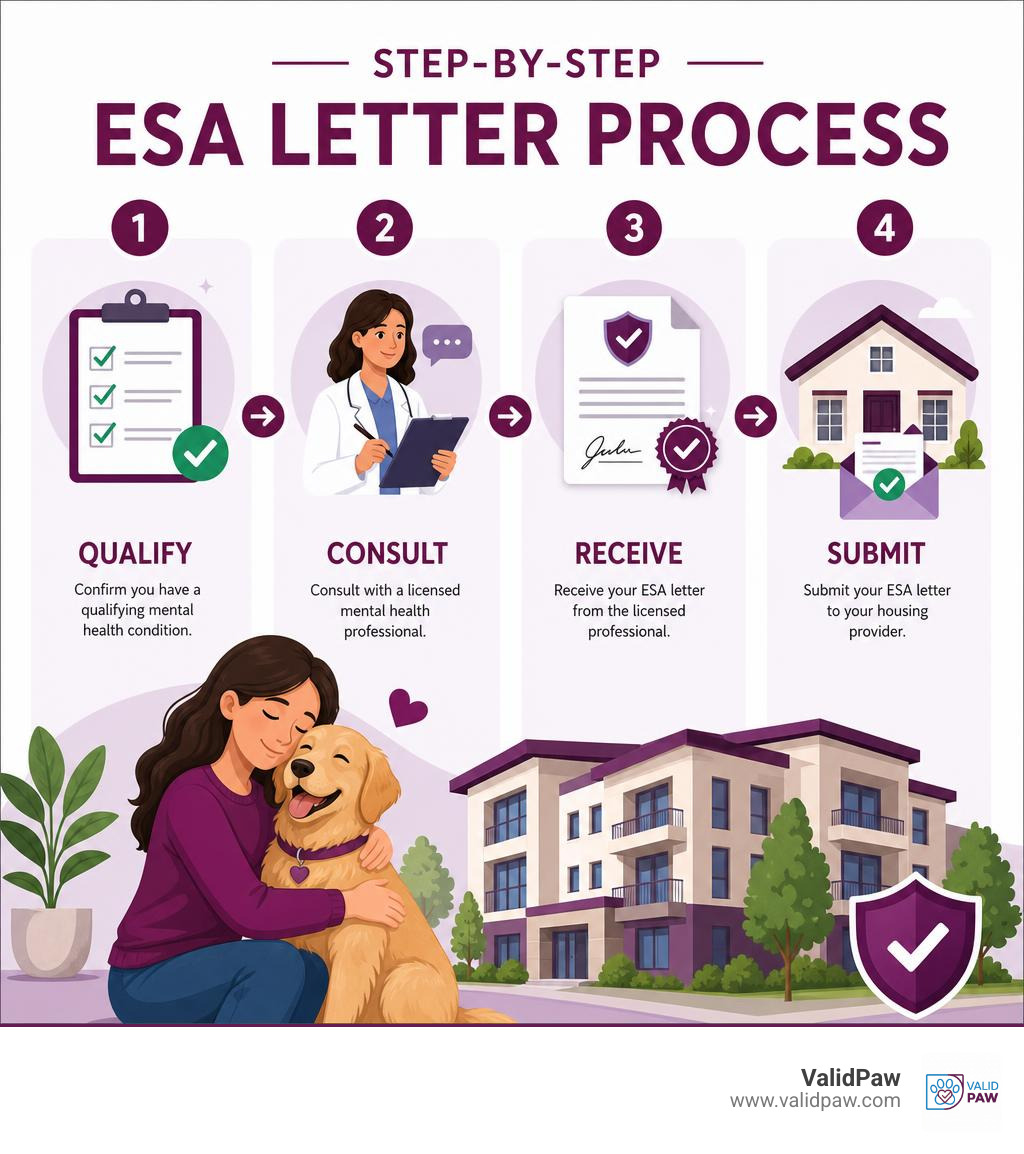
The Clinical Evaluation Process and Validity Period
When you request an ESA letter from a licensed clinical professional, you are initiating a formal medical evaluation. It is not an administrative form-filling exercise.
During this evaluation, the clinician will assess:
- Your Mental Health History: Discussing your symptoms, day-to-day challenges, and any existing diagnoses.
- Functional Impairment: Determining if your condition significantly limits your ability to perform major life activities (such as working, sleeping, or managing stress).
- Therapeutic Necessity: Evaluating how an animal directly helps mitigate those symptoms (e.g., a dog helping you establish a routine to combat depression, or a cat's presence calming panic attacks).
Once approved, your letter is typically valid for one year from the date of issuance. While the FHA does not explicitly state that letters expire, HUD guidelines allow housing providers to request updated documentation annually to confirm your ongoing need for an accommodation. Keeping your letter updated ensures you always have the Emotional Support Verification Letter: What Every Landlord Needs to See.
What Happens If Your ESA Letter is Rejected or Fraudulent?
Submitting a fake, templated, or non-compliant ESA letter can have serious consequences. If a landlord suspects your letter is invalid—for instance, if it lacks a license number or comes from an unlicenced online generator—they can legally deny your accommodation request.
In many states, including Texas and Illinois, knowingly misrepresenting a pet as an assistance animal or submitting fraudulent medical documentation is a misdemeanor offense that carries steep fines and potential legal penalties.
If a landlord rejects a legitimate letter, they cannot simply say "no" and close the case. Under HUD guidelines, they must engage in an interactive process with you. This is a collaborative dialogue to resolve any documentation doubts before making a final decision. If you find yourself facing pushback, our guide No Pets Allowed? Not With a Valid ESA Letter can help you navigate the dispute.
Frequently Asked Questions about ESA Letters
Do I need to register my emotional support animal on an official database?
No. There is no official, government-run, or legally recognized registry for emotional support animals. Any website claiming to "register" or "certify" your pet in an official database is a scam. Under the FHA, the only document that legally establishes your animal as an ESA is a valid, signed letter from a licensed mental health professional.
Can a landlord charge pet fees or enforce breed restrictions for an ESA?
No. Under the Fair Housing Act, an emotional support animal is classified as an assistance animal, not a pet. Therefore, landlords must waive all pet-related fees, including pet deposits, monthly pet rent, and application fees. Additionally, standard breed, weight, and size restrictions do not apply to ESAs. However, you remain financially responsible for any physical damage your animal causes to the property.
How long does it take to get a valid ESA letter?
While fraudulent sites promise instant PDF downloads in minutes, a legitimate clinical evaluation takes a bit more care. With ValidPaw, our streamlined telehealth process connects you with licensed therapists in your state, delivering fully compliant ESA letters within 24 to 48 hours of your successful evaluation.
Conclusion
Securing your housing rights shouldn't be a stressful ordeal. By understanding the strict legal requirements for an ESA letter, you can avoid costly scams and ensure your documentation is 100% compliant with HUD and FHA guidelines.
At ValidPaw, we make the process simple, legal, and stress-free. We connect you with state-licensed therapists—including local professionals in Texas and across all 50 states—to conduct legitimate telehealth evaluations. Within 24 to 48 hours of approval, you'll receive a fully compliant, verifiable ESA letter with instant landlord verification.
Ready to protect your peace of mind and live comfortably with your supportive companion? Get Your Legitimate ESA Letter Today.

