
Emotional Support Dogs vs. Service Dogs vs. Therapy Dogs
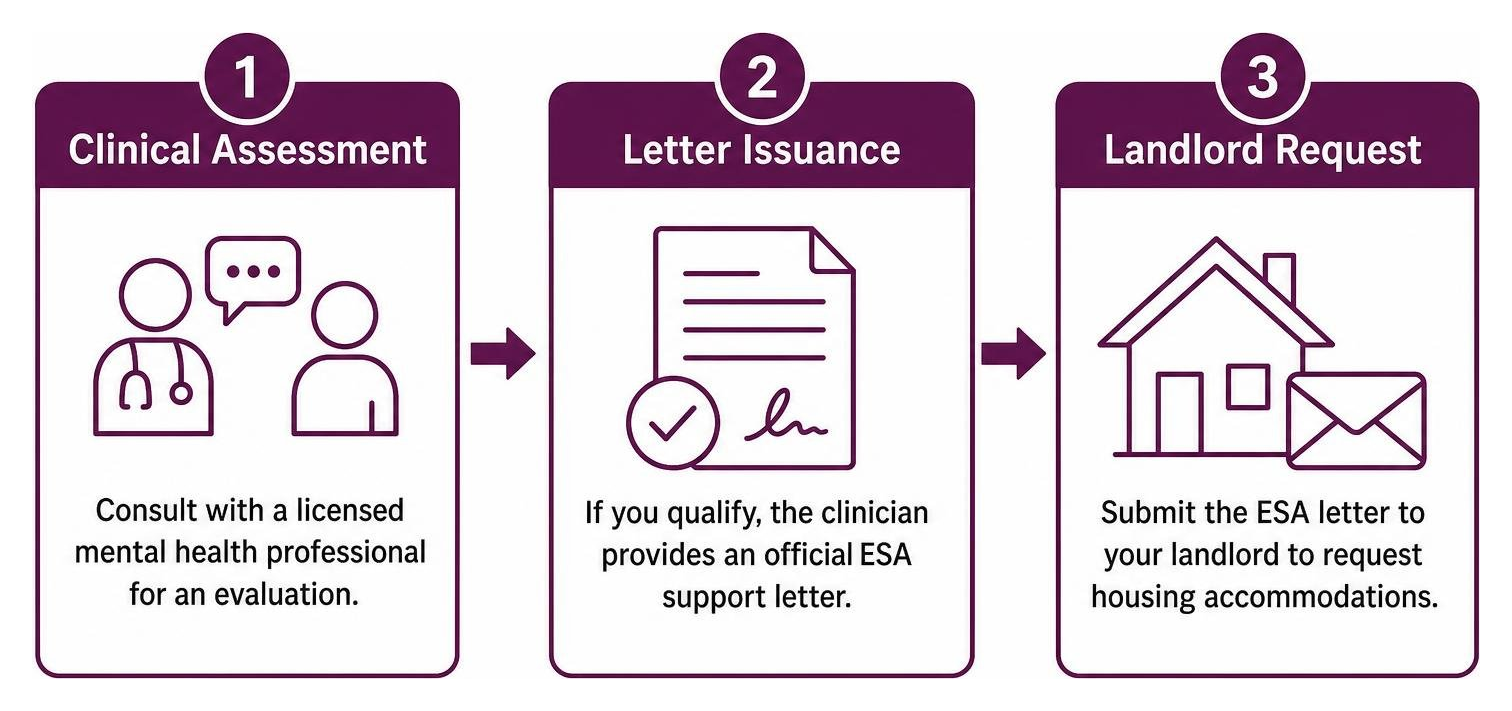
To legally certify your dog as an emotional support dog, you do not register it on a website or government database. Instead, you must consult a licensed mental health professional who can evaluate your condition and issue an official ESA recommendation letter. This letter is what grants housing protections under the Fair Housing Act.
When people research assistance animals, it is easy to mix up the different roles dogs play in our lives. Legally and practically, emotional support dogs, service dogs, and therapy dogs serve distinct purposes under federal law. Understanding these differences ensures you know your rights, follow proper regulations, and meet all assistance animal criteria.
A standard domestic dog provides companionship, but assistance animals have specific legal roles:
- Emotional Support Dogs (ESDs / ESAs): These dogs provide therapeutic companionship, comfort, and stability to individuals managing diagnosed mental or emotional health conditions. Under the Fair Housing Act (FHA), emotional support dogs are granted housing protections, meaning they can live in no-pet housing without pet rent or deposits. However, they do not require specialized task training and do not have public access rights under the Americans with Disabilities Act (ADA).
- Service Dogs (including Psychiatric Service Dogs): Under the ADA, a service dog is individually trained to perform specific tasks directly related to a person's physical, sensory, psychiatric, or intellectual disability. Examples include guiding a visually impaired individual, alerting someone to an oncoming seizure, or performing deep pressure therapy during a panic attack. Service dogs have full public access rights, allowing them to accompany their handlers into restaurants, stores, and airplane cabins.
- Therapy Dogs: Therapy dogs are trained and evaluated to provide comfort and affection to people in clinical or community settings, such as hospitals, retirement homes, schools, and disaster areas. Unlike ESAs or service dogs, therapy dogs do not have special housing or public access rights; their access is limited to facilities where they are invited.
| Category | Legal Protection | Primary Purpose | Specialized Task Training Required? | Public Access Rights (Stores, Restaurants)? | | :--- | :--- | :--- | :--- | :--- | | Emotional Support Dog | Fair Housing Act (FHA) | Alleviates emotional or psychological distress through companionship | No | No | | Service Dog | Americans with Disabilities Act (ADA), Air Carrier Access Act (ACAA), FHA | Performs specific tasks directly related to a disability | Yes | Yes | | Therapy Dog | None (Facility-dependent) | Provides comfort to multiple people in structured environments | Yes (Behavioral/obedience testing) | No |
How to Certify My Dog as an Emotional Support Dog Legally
The most critical truth about qualifying an emotional support animal is simple: there is no government registry, centralized database, or official certificate. When people wonder how to legally qualify their dog, the process involves obtaining an official medical recommendation, not registering the animal. Following practical documentation requirements protects your rights under federal law.
Step 1: Schedule an Evaluation with a Licensed Provider
The legal path to qualifying an ESA begins with a personal clinical evaluation. You must consult with a Licensed Mental Health Professional (LMHP) licensed in your jurisdiction—such as a licensed clinical social worker (LCSW), licensed professional counselor (LPC), psychologist, psychiatrist, or medical doctor.
During this consultation, the clinician evaluates your mental and emotional health. Qualifying conditions often include:
- Generalized anxiety disorder
- Major depressive disorder
- Post-traumatic stress disorder (PTSD)
- Panic disorder
- Social phobias
- Bipolar disorder
- Chronic stress and adjustment disorders
Nearly one in five Americans experiences mental health challenges where an animal's presence provides measurable relief. You can complete this evaluation through an in-person office visit or a compliant telehealth consultation. Reviewing how to register your animal with a licensed professional helps you prepare your medical history for this assessment.
Step 2: Obtain an Official, FHA-Compliant ESA Letter
If your clinician determines that your dog mitigates symptoms of your diagnosed condition, they will issue an official ESA letter. A legally binding ESA letter must meet clear federal standards:
- Written on the clinician's official professional letterhead.
- Contain the clinician's full name, professional license type, license number, state of licensure, and date of issue.
- State clearly that you have an impairment that substantially limits one or more major life activities.
- Confirm that the animal provides therapeutic support that alleviates one or more identified symptoms of your condition.
When seeking an evaluator, use trusted resources for finding a licensed mental health professional who complies with your state's telehealth and licensing guidelines.
Step 3: Present Your Documentation for Housing Accommodations
Once you receive your signed ESA letter, provide a copy to your landlord or property management company alongside a written request for reasonable accommodation under the Fair Housing Act.
Under federal guidelines:
- Landlords must accommodate your ESA even in buildings with strict "no pets" policies.
- Landlords cannot charge pet deposits, initial pet fees, or monthly "pet rent" for an emotional support animal.
- Breed, weight, and size restrictions do not apply to legitimate assistance animals.
Tenants can also reference official state platforms, such as state housing protection resources, to understand local civil rights enforcement alongside federal standards.
Avoiding Scams When Learning How to Certify My Dog as an Emotional Support Dog

The emotional support animal space contains numerous predatory websites offering "instant registration," "official holographic certificates," and "lifetime national registry ID cards."
Complaints to the Department of Justice about ESA fraud surged by 40% between 2020 and 2023. Commercial websites sell meaningless registration kits for $50 to $200, taking advantage of pet owners who are unfamiliar with federal rules.
Key red flags to watch for include:
- Instant Registries and Databases: Any service claiming to enter your dog into an "Official US Government Registry" is fraudulent. The federal government does not operate or recognize any ESA database.
- Approval Without Clinician Contact: Instant approvals based solely on an automated 2-minute quiz without live or asynchronous clinical review by a licensed practitioner are invalid.
- Mandatory Accessory Bundles: Vests, badges, digital ID tags, and holographic cards carry zero legal weight under the Fair Housing Act. Landlords are fully entitled to reject these items if not accompanied by a valid clinician's letter.
Learning how to evaluate providers and spotting legitimate documentation protects you from housing disputes and invalid paperwork.
Qualifying for an ESA Letter Before Adopting a Dog
You do not need to own a dog before speaking with a mental health provider. Clinicians can evaluate your mental health needs and provide an ESA recommendation letter that allows you to adopt or rescue an animal specifically for therapeutic support.
When selecting a companion, prioritize temperament, energy levels, and lifestyle compatibility over breed labels:
- Labrador & Golden Retrievers: Known for their stable temperaments, gentle dispositions, and eager-to-please nature.
- Cavalier King Charles Spaniels: Highly affectionate, naturally attentive lap dogs well-suited for smaller living spaces.
- Poodles & Doodles: Intelligent and responsive, with low-shedding coats ideal for individuals with pet allergies.
- Rescue and Mixed-Breed Dogs: Many shelter dogs exhibit calm, deeply loyal personalities that provide exceptional comfort.
Do I Need Official Training When Learning How to Certify My Dog as an Emotional Support Dog?
By law, emotional support dogs do not require specialized task training or professional certification. Unlike service dogs, an ESA's primary therapeutic value comes from its presence, companionship, and affection.
However, basic obedience and house training are essential. Under the Fair Housing Act, landlords can legally deny or revoke accommodation if an animal creates an unsanitary environment, causes persistent disruption (such as non-stop barking), or displays aggression toward other residents. Enrolling your dog in foundational obedience classes or pursuing an AKC Canine Good Citizen (CGC) title demonstrates responsible ownership and ensures your dog remains an asset to your home and community.
Housing Rights, Airline Travel Rules, and Mental Health Benefits

Living with an emotional support animal offers measurable psychological and physiological benefits. Clinical studies show that 74% of ESA owners report lower stress levels within three months of acquiring their companion, with positive human-animal interaction lowering cortisol levels by up to 28% while boosting oxytocin and dopamine production.
Housing Protections Under the Fair Housing Act
The primary legal protection for an ESA owner is the Fair Housing Act, enforced by the U.S. Department of Housing and Urban Development (HUD). HUD has successfully prosecuted landlords for ESA discrimination in over 1,200 cases since 2011. Landlords are required to make reasonable accommodations for individuals with legitimate documentation. If a housing provider refuses a valid letter, delays the accommodation unreasonably, or attempts to assess illegal fees, tenants have the right to file a formal housing discrimination complaint directly with HUD.
Airline Travel Regulations
Travel regulations changed significantly in early 2021 when the U.S. Department of Transportation revised the Air Carrier Access Act (ACAA). Airlines are no longer legally required to recognize emotional support animals as service animals.
- ESAs are treated as standard domestic pets when traveling by air.
- To fly in the passenger cabin, dogs must meet the airline's specific pet travel policies, fit inside an approved under-seat carrier, and are subject to standard pet carry-on fees.
- Only individually trained Psychiatric Service Dogs (PSDs) and physical service animals retain mandatory, fee-free cabin access under the ACAA.
Frequently Asked Questions About Emotional Support Dogs
Can a Landlord Reject My Emotional Support Dog?
Yes, but only under specific legal exemptions. A landlord can legally reject an ESA accommodation request if the animal poses a direct health or safety threat to other residents that cannot be mitigated, causes substantial physical damage to the property, or places an undue financial and administrative burden on the housing provider. Landlords of owner-occupied buildings with four or fewer units, or single-family homes sold/rented without a broker, may also be exempt from Fair Housing Act mandates.
Can I Bring My Emotional Support Dog Into Restaurants and Grocery Stores?
No. Emotional support animals do not have public access rights under Title III of the Americans with Disabilities Act (ADA). Public establishments—including grocery stores, restaurants, shopping malls, and private businesses—are only legally required to admit trained service dogs. Bringing an ESA into pet-restricted businesses violates local health codes and business policies unless the specific venue is explicitly pet-friendly.
How Much Does a Legitimate ESA Letter Cost?
A legitimate ESA evaluation through a qualified telehealth practice or private mental health provider typically ranges from $100 to $200. This fee covers the clinician's professional assessment, license verification, document preparation, and follow-up landlord verification requests. Beware of services that charge recurring monthly subscription fees or offer unusually cheap, instant documents without professional oversight.
Conclusion
Securing legal protection for your emotional support animal is straightforward once you know the real rules: bypass misleading online registries, work with a licensed clinician, and obtain an official letter that meets all Fair Housing Act standards.
When you're ready to complete your evaluation, qualify for your legitimate ESA letter with ValidPaw. Our licensed mental health professionals provide thorough, convenient telehealth assessments, ensuring you receive fully compliant documentation to keep your companion by your side.

