Federal Protections for Emotional Support Animals in No Pet Housing
Navigating rental housing when you rely on an animal for mental health support can feel intimidating, especially when apartment listings explicitly state "no pets allowed." Federal civil rights legislation creates clear protections that ensure individuals with disabilities have an equal opportunity to use and enjoy their living spaces. Under the law, emotional support animals (ESAs) are not pets; they are recognized as assistance animals that provide therapeutic relief for disabling mental or emotional conditions.
The primary framework protecting your right to keep an assistance animal is the Fair Housing Act (FHA), enforced by the U.S. Department of Housing and Urban Development (HUD). Under federal law, housing providers must grant a "reasonable accommodation"—which means making changes to standard rules, policies, or lease terms—so a tenant with a disability can live with their support animal. You can explore how Fair Housing Act rules are explained for tenants to better understand these core legal principles.
When a tenant makes a formal accommodation request, landlords are legally required to engage in an interactive process rather than issuing an immediate rejection. Because the animal serves a medical function similar to prescribed medication or medical equipment, standard building rules barring animals do not apply.
The Fair Housing Act Assistance Animal Classification
Under HUD guidance, emotional support animals are assistance animals that provide therapeutic support related to a person’s disability. They do not require specialized task training; instead, their presence may alleviate symptoms associated with conditions such as generalized anxiety disorder, major depressive disorder, post-traumatic stress disorder (PTSD), and panic disorders.
Because of this therapeutic function, a standard no-pet lease cannot stop your emotional support animal from living with you, provided you have established a legitimate disability-related need. The federal standards set forth in official HUD Guidelines on Assistance Animals in Housing clarify that housing providers cannot bypass federal rules through custom lease clauses or internal property restrictions.
Emotional Support Animals Under Federal Housing Law
For housing purposes, an emotional support animal may qualify for a reasonable accommodation under the Fair Housing Act when a tenant has a disability-related need for the animal. The accommodation applies to housing and does not create general public-access rights.
Emotional support animals provide comfort through companionship and do not require task training. While ESAs do not have public access rights to enter grocery stores or private businesses, they are protected in residential housing under the FHA.
| Feature | Emotional Support Animal (ESA) | Standard Pet | | :--- | :--- | :--- | | Housing Framework | Fair Housing Act reasonable-accommodation rules may apply | Lease terms generally apply | | Task Training | No specialized task training required | Not required for pet status | | Public Access | Housing accommodation only; no general public-access right | Limited to pet-friendly venues | | Housing Fees | Pet rent and pet deposits generally do not apply | Subject to standard pet fees | | Individual Review | Housing provider evaluates the disability-related need and the specific animal | Landlord policies control |
Landlord Limits: Fees, Pet Rent, and Rules for Assistance Animals
When reviewing reasonable accommodation requests, landlords must follow clear statutory boundaries. Understanding the actions landlords legally cannot take against ESA owners protects you from unlawful charges, privacy violations, or arbitrary rejections.
Exemption from Pet Rent, Security Deposits, and Fees
One of the most significant protections under the FHA is financial relief from pet charges:
- No Monthly Pet Rent: Landlords cannot add a monthly animal fee or pet surcharge to your rent balance.
- No Pet Security Deposits: Housing providers cannot require an upfront pet deposit, non-refundable pet fee, or application surcharge.
- Standard Security Deposit Unaltered: A landlord may only collect the standard general security deposit charged to all tenants residing in the building.
If a property manager attempts to disguise a pet charge as an "administrative processing fee" for your accommodation request, they are in violation of federal law.
Breed, Weight, and Species Rules for Emotional Support Animals in No Pet Housing
Property managers often maintain restrictive rules regarding dog breeds or maximum weight thresholds (e.g., barring dogs over 40 pounds or specific breeds like Pit Bulls, German Shepherds, or Rottweilers). Under HUD guidance, blanket apartment weight limits and breed restrictions do not apply to assistance animals.
A housing provider cannot reject an ESA based on generalizations about a breed's temperament or size. Instead, HUD requires an individualized assessment based on the specific animal's actual conduct and behavioral history.
Landlords sometimes claim their property insurance policy excludes specific breeds. However, under HUD guidance, a landlord cannot simply state that their insurance carrier restricts a breed; the housing provider must prove that accommodating the specific animal would impose an unreasonable financial burden, such as causing their policy to be canceled without alternative coverage options.
Medical Privacy: Diagnosis Questions and Health Records
Your medical history is private. When submitting an accommodation request, a landlord is legally entitled to verify that you have a qualifying disability and a disability-related need for the animal, but their inquiry stops there.
Landlords cannot:
- Ask for your specific medical diagnosis or treatment notes.
- Demand access to your comprehensive medical records.
- Require your healthcare provider to disclose detailed histories or testify regarding your condition.
- Force you to undergo an independent medical examination.
As detailed in state-level frameworks like the California Civil Rights Department Fair Housing FAQ, verification requires only reliable third-party documentation confirming your condition substantially limits a major life activity and that the requested animal provides support alleviating those symptoms.
Documentation Standards for Valid ESA Housing Accommodations

Presenting sound, verifiable clinical paperwork is the foundation of navigating no-pet policies with a valid ESA letter. Because housing providers have become more vigilant regarding documentation, submitting an authentic clinical letter ensures a seamless approval process.
What a Compliant ESA Letter Must Contain
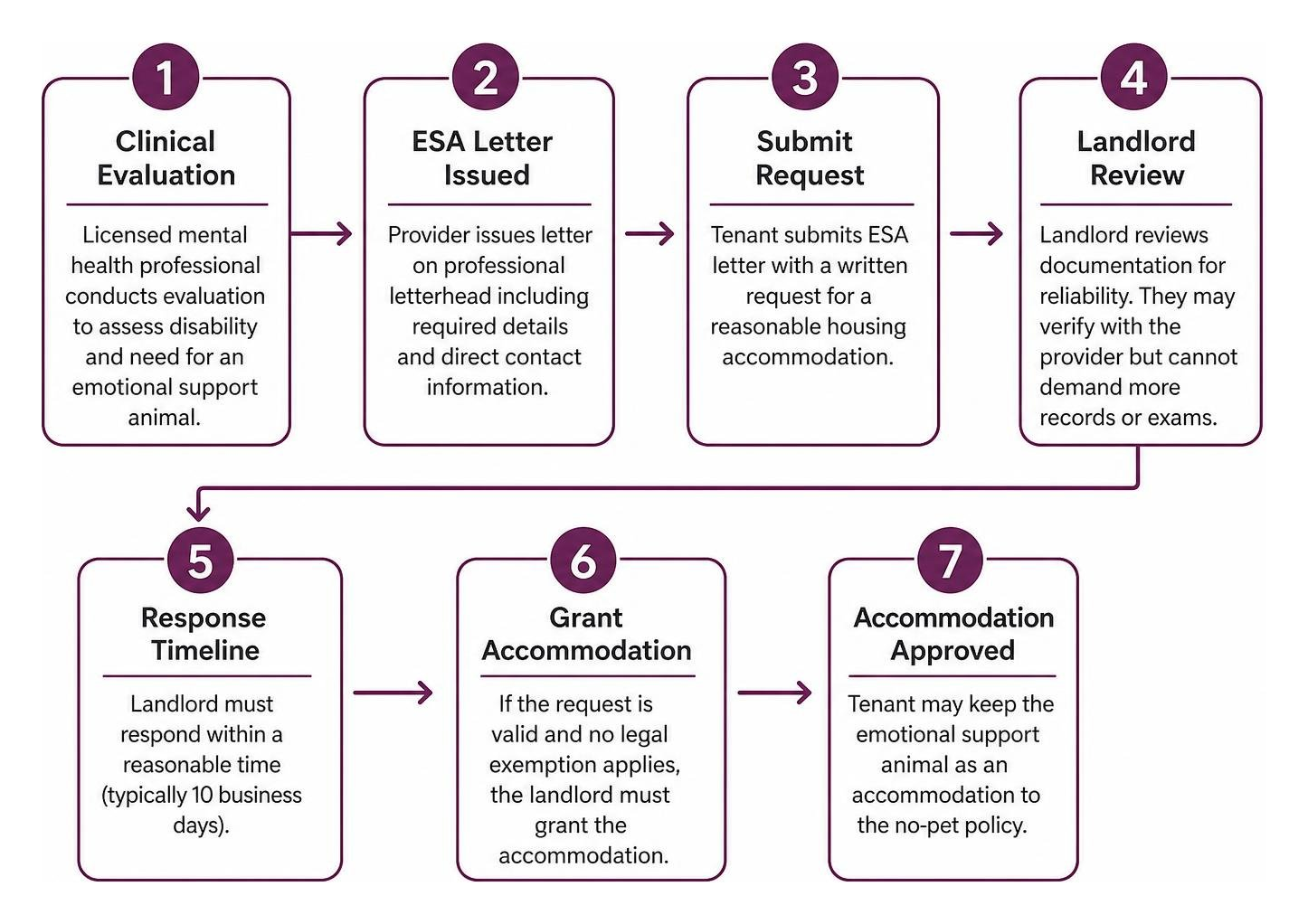
To satisfy federal standards and withstand property manager review, a legitimate ESA letter must be printed on your healthcare provider's professional letterhead and contain:
- Provider Details: The licensed mental health professional's full legal name, clinical credential, license number, and state of jurisdiction.
- Issue Date: The date the letter was issued (valid for 12 months from issuance).
- Disability Nexus: A formal statement confirming the patient meets the definition of a disability under the Fair Housing Act and that the animal provides therapeutic support alleviating one or more symptoms.
- Direct Contact Info: The clinician's practice address, phone number, and professional email for direct verification.
Several states have enacted consumer protection legislation establishing a mandatory 30-day clinical evaluation period before a mental health provider can issue an ESA letter. Working with providers who conduct thorough clinical intake evaluations ensures full compliance with local and federal rules.
Clinical Evaluation and Housing Documentation
Online marketplaces frequently advertise instant digital certificates, downloadable registration badges, and ID tags claiming to "register" an ESA in an official government registry. These registries are scams—no official federal or state ESA registry exists.
HUD's assistance animal notices explicitly state that automated instant certificates purchased online without an individualized assessment from a licensed health professional are insufficient to establish a disability-related need. Legitimate documentation requires a direct clinical evaluation with a licensed provider.
Legal Grounds for Denials and Fair Housing Act Exemptions
While the Fair Housing Act offers broad protections, assistance animal accommodations are not absolute. Landlords can deny a request under specific, legally defined circumstances. Reviewing a comprehensive guide to ESA housing rights can help clarify where these statutory boundaries lie.
Direct Threats, Property Damage, and Tenant Responsibilities
A housing provider can lawfully reject an ESA or revoke an approved accommodation if:
- Direct Threat to Health or Safety: The specific animal demonstrates documented aggression (such as unprovoked biting, lunging, or threatening behaviors) that cannot be eliminated by reasonable administrative measures.
- Substantial Property Damage: The animal causes significant, ongoing physical destruction to the rental unit or common spaces.
- Undue Burden or Fundamental Alteration: Accommodating the animal would impose an unreasonable financial or administrative burden on property operations.
Tenants remain fully liable for any damage their animal causes. While landlords cannot charge pet deposits upfront, they may deduct the cost of necessary repairs or deep cleaning from your standard security deposit when you move out.
Housing Types Exempt from Allowing Emotional Support Animals in No Pet Housing
Not all residential properties fall under the jurisdiction of the Fair Housing Act. Exempt properties include:
- The "Mrs. Murphy" Exemption: Owner-occupied buildings containing four or fewer independent rental units.
- Single-Family Housing Sold or Rented Without a Broker: Private single-family homes rented directly by an owner who owns no more than three single-family homes at one time, provided no real estate agent is used.
- Private Clubs and Religious Organizations: Housing operated by private clubs or religious entities that limit occupancy to members for non-commercial purposes.
How to Request Accommodation and Address Unlawful Denials
Knowing when to notify your landlord about an assistance animal helps avoid unnecessary disputes during the leasing process. You are legally permitted to submit your reasonable accommodation request before signing a lease, during your tenancy, or after adopting an animal.
Submitting Your Written Request and Documentation
When you are ready to submit your request:
- Prepare a Written Request: Draft a professional letter stating that you are requesting a reasonable accommodation under the Fair Housing Act for an emotional support animal.
- Attach Your ESA Letter: Include a current clinical letter from your licensed mental health professional.
- Submit via Verifiable Channels: Deliver your request via certified mail, tracked email, or your tenant management portal.
- Maintain Documentation: Keep dated copies of all letters, delivery receipts, and written replies. Following our guide on securing landlord approval for an ESA letter provides additional templates and submission best practices.
Handling Denials and Filing a HUD Complaint
If your landlord rejects your accommodation request without a valid legal exemption:
- Request a Written Explanation: Ask the housing provider to state their exact legal reason for the denial in writing.
- Engage in the Interactive Process: Clarify misunderstandings regarding breed restrictions or letter authenticity by citing HUD guidance.
- File a Formal Discrimination Complaint: You have up to one year from the date of the discriminatory incident to submit an administrative complaint with HUD's Office of Fair Housing and Equal Opportunity (FHEO).
HUD is required by federal statute to complete an investigation within 100 days of filing. Housing providers found guilty of unlawful Fair Housing Act violations face civil penalties of up to $23,011 for an initial violation, increasing up to $57,527 for subsequent violations occurring within a seven-year period.
Frequently Asked Questions About Emotional Support Animals in No Pet Housing
Can my landlord evict me if I get an ESA after signing a no-pet lease?
No. A housing provider cannot evict you simply for requesting an accommodation or bringing an emotional support animal into your home mid-lease, provided you have submitted valid documentation. Retaliatory evictions following a good-faith disability accommodation request violate federal fair housing laws.
How long does a landlord have to respond to an ESA accommodation request?
While the Fair Housing Act does not specify an exact statutory day count, HUD guidelines require housing providers to respond promptly without unreasonable delay. In standard practice, housing authorities consider 10 to 14 business days an appropriate window for a landlord to review documentation and complete the interactive process.
Am I financially responsible if my emotional support animal damages the rental unit?
Yes. While landlords cannot collect pet fees or pet deposits upfront, tenants are legally and financially responsible for any actual physical damage caused by their assistance animal. The cost of repairing scratched baseboards, chewed doors, or stained carpets may be deducted from your standard security deposit upon move-out.
Conclusion
Securing your legal rights under the Fair Housing Act ensures you can live comfortably alongside the animal that supports your mental and emotional wellbeing. At ValidPaw, we provide telehealth clinical assessments conducted by fully licensed therapists serving Texas and all 50 states. We issue HUD-compliant documentation within 24 to 48 hours, complete with instant landlord verification services.
Ready to protect your housing rights? You can apply for an FHA-compliant ESA letter today.