
Independent Contractor vs. W-2 Employee Verification: Core Differences
An employment verification letter for an independent contractor should include the contractor's legal and business identification, the client's business details, engagement dates, a factual scope of work, compensation terms and billing frequency, and an explicit statement that the worker is an independent contractor without employee benefits. Proving your income when you work for yourself requires a completely different approach than asking human resources for a standard paycheck stub. Traditional W-2 employees rely on their employers to handle statutory tax withholding, track hourly schedules, and supply formal employment letters upon request. Independent contractors, however, operate as distinct business entities. When third parties request verification, the resulting documentation must reflect this business-to-business dynamic accurately to prevent administrative and legal confusion.
| Verification Feature | W-2 Employee Letter | 1099 Independent Contractor Letter | | :--- | :--- | :--- | | Worker Classification | Direct employee on company payroll | Self-employed vendor, consultant, or freelancer | | Tax Treatment | Employer withholds income, Social Security, and Medicare taxes | Contractor pays the full 15.3% self-employment tax directly | | Compensation Language | Annual salary, hourly wage, payroll schedule | Project milestone fees, retainer rates, hourly contractor fees | | Benefit Disclosures | Mentions health insurance, PTO, or retirement participation | Explicitly disclaims company-provided employee benefits | | Work Terms | Full-time, part-time, permanent, or at-will employment | Engagement start date, statement of work (SOW), project completion date | | Issuing Authority | Internal HR department or direct payroll manager | Hiring client, procurement officer, or primary account manager |
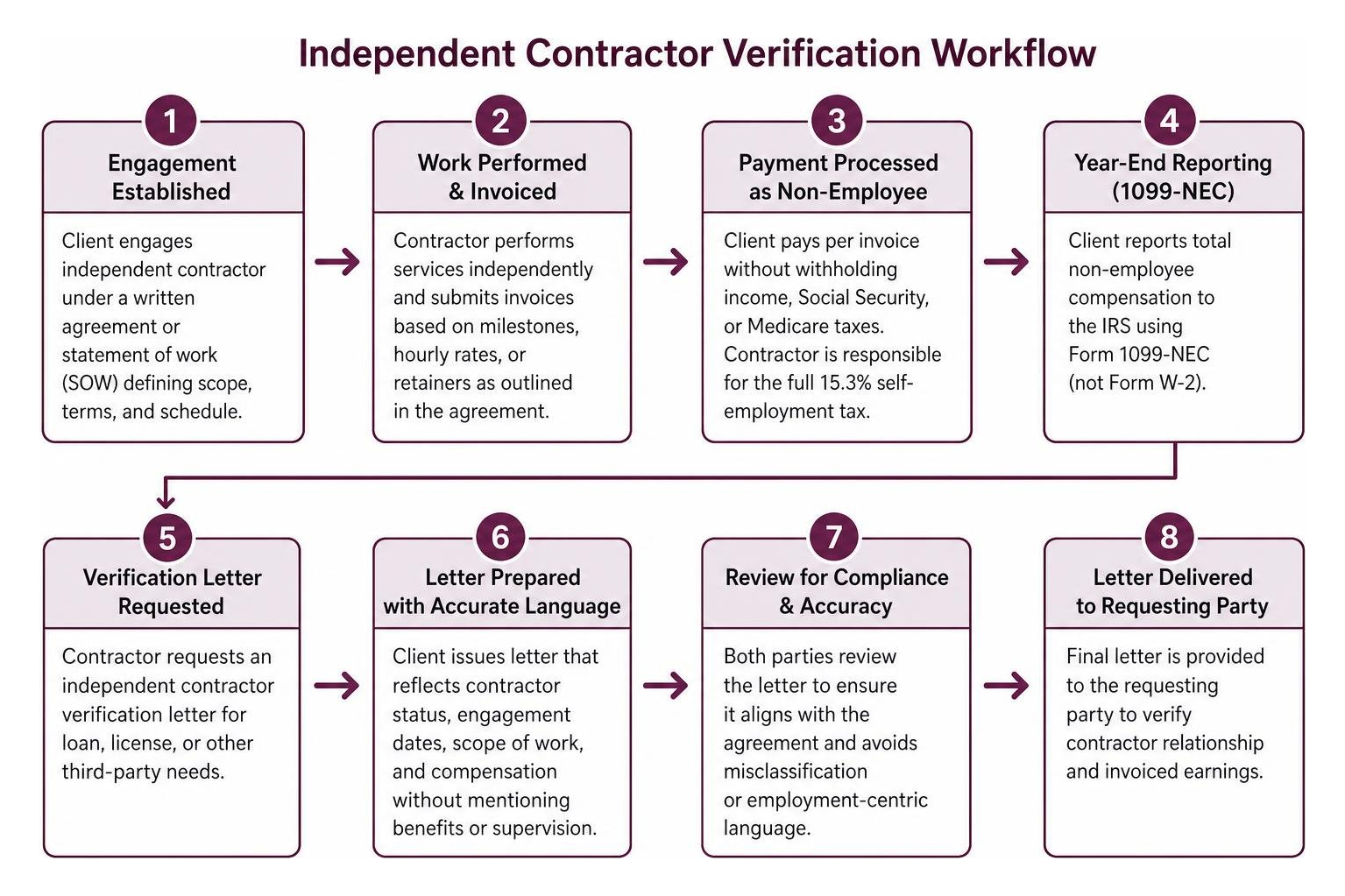
Rather than splitting Social Security and Medicare taxes with an employer, contractors pay the full 15.3% self-employment tax themselves—12.4% for Social Security and 2.9% for Medicare. Because there is no employer-paid tax contribution or internal payroll file, an independent contractor verification letter focuses squarely on commercial agreements, professional deliverables, and invoiced earnings rather than continuous employment status.
Understanding 1099 Status vs. Traditional Payroll
When an enterprise hires a freelancer or consultant, the relationship is governed by commercial contract law rather than standard employment law. Payments are distributed based on submitted invoices, milestone achievements, or predetermined hourly consulting rates. At the end of the tax year, the business reports non-employee compensation to the government using Form 1099-NEC rather than a Form W-2.
Understanding these structural distinctions is crucial when preparing documentation. State agencies, such as the Texas Workforce Commission, maintain strict guidelines on classifying employees and independent contractors based on direction, financial control, and the core relationship between the parties. When a letter misstates a contractor as an "employee," it blurs these lines and risks triggering regulatory scrutiny for both parties.
Legal Compliance and Misclassification Risks
Hiring organizations are often cautious about issuing paperwork that uses employment-centric phrasing. Federal and state authorities enforce strict worker classification standards through several legal frameworks:
- The IRS Common Law Test: Evaluates behavioral control, financial control, and the overall type of relationship between the parties.
- The Department of Labor (DOL) Economic Reality Test: Analyzes whether the worker is economically dependent on the employer or genuinely in business for themselves.
- State-Level ABC Tests: Many jurisdictions presume a worker is an employee unless the hiring entity proves the worker is free from control, performs work outside the entity's core business, and is customarily engaged in an independent trade.
A poorly worded letter that references "supervision," "company benefits," or "salaried positions" can inadvertently expose the hiring client to wage-and-hour claims, back taxes, and misclassification penalties.
Accuracy is just as vital for the contractor. Under federal law (including 18 U.S.C. § 1014), making a false statement to influence a federally related mortgage lender carries severe criminal penalties, including fines up to $1,000,000 and up to 30 years in prison. Maintaining precise language protects everyone involved.
Key Information Required in an Employment Verification Letter for Independent Contractor

To satisfy underwriters, landlords, and government auditors, a verification letter must clearly outline the professional engagement while adhering to everything required in a valid letter to prove employment. Presenting the document on official client letterhead with valid corporate credentials establishes immediate authenticity.
Essential Contact, Business, and Identification Details
The letter must unambiguously identify both parties. Relying on vague trade names or missing contact details will often lead to processing delays or outright rejection. Ensure the letter incorporates:
- Contractor Legal Identification: Full legal name, formal business entity name, any registered Doing Business As (DBA) designations, and your Employer Identification Number (EIN) or Social Security Number (SSN).
- Client Identification: Full legal name of the hiring entity, corporate headquarters address, official website, and industry category.
- Authorized Signatory Credentials: The direct name, corporate title, professional email address, and direct phone extension of the individual signing the document.
- Date of Issuance: A clearly stated date, ensuring the verification reflects current terms within accepted underwriting windows (often required within 30 to 45 days of application, reflecting strict regulatory standards for identity and person verification).
Scope of Work, Project Terms, and Payment Structures
The body of the letter should summarize the commercial terms of the arrangement without using internal payroll jargon:
- Engagement Timeline: The exact date the professional relationship began, the current status of the agreement (active, renewable, or completed), and any anticipated end dates for fixed-term projects.
- Description of Services: A factual summary of the contractor's duties, scope of work, or specialized consulting services provided.
- Compensation Specifics: Clear statements detailing payment rates (e.g., $75 per hour, $5,000 monthly retainer, or $15,000 per completed project milestone).
- Billing Frequency: How often invoices are submitted and paid (e.g., bi-weekly, Net-30, or upon deliverable approval).
- Explicit Independent Status Disclaimer: An affirmative statement confirming that the individual provides services as an independent contractor and does not receive employee benefits, paid time off, or company-sponsored insurance.
How to Request and Draft the Documentation
Clients are often busy running their own organizations, so asking them to write a verification letter from scratch can lead to delays. The most efficient approach is to draft a clean, professional template yourself and submit it to your primary client contact, procurement lead, or accounting manager for their review and formal signature.
Using pre-formatted employment verification letter templates can dramatically reduce turnaround times, often turning a multi-week administrative wait into a straightforward same-day sign-off.
Why Lenders and Landlords Request an Employment Verification Letter for Independent Contractor
Third parties require documented proof of earnings to calculate risk. When you apply for financing, underwriters evaluate your historical cash flow and debt-to-income (DTI) ratio. Lenders navigating the mortgage employment verification process use client letters to confirm that your self-employment income is stable, recurring, and likely to continue into the foreseeable future.
Similarly, property managers processing an apartment rental verification letter want assurance that an applicant has reliable commercial contracts to support ongoing monthly lease obligations. In employment screening settings, these letters confirm professional credentials while keeping hiring teams compliant with state regulations; as of February 2025, 21 states and the District of Columbia have implemented salary history bans that prevent employers from asking applicants about historical compensation levels.
Step-by-Step Guide to Drafting an Employment Verification Letter for Independent Contractor
When assembling a draft for your client to sign, structure the letter using this clear format:
- Format on Official Letterhead: Place the hiring company's official logo, legal corporate name, and contact details at the top of the page.
- Add Date and Recipient Information: Address the specific lender, leasing office, or institution requesting the document, or use "To Whom It May Concern" if the letter must serve multiple verification purposes.
- Draft the Statement of Relationship: Open with a clear declaration of independent contractor status: "This letter serves to confirm that Jane Doe (doing business as Doe Creative Services LLC) has been engaged as an independent contractor by Pinnacle Media Group since January 15, 2024."
- Detail the Project Scope: Provide a brief summary of the services performed under the underlying contract.
- State the Financial Terms: Clearly record the contracted payment rate, billing cadence, and cumulative or average monthly earnings.
- Include the Authorized Sign-Off: Conclude with the signatory's formal name, professional title, direct contact details, and signature line.
Alternative Documentation for Proving Self-Employed Income

An independent contractor verification letter is often just one component of a broader income verification package. Because contractor engagements can fluctuate, financial institutions, landlords, and reviewing agencies routinely look for redundant, cross-verifiable paperwork to validate ongoing earnings.
Tax Returns, Form 1099-NEC, and Bank Statements
The foundational baseline for independent contractor income proof rests on official federal tax filings. Under standard Fannie Mae underwriting guidelines, self-employed borrowers must provide two full years of signed federal income tax returns (including Form 1040 with attached Schedule C, Schedule SE, and any corporate returns such as Form 1120-S or 1065).
In addition to tax returns, you should organize your annual informational returns. For payments made in 2026, a hiring entity must file a Form 1099-NEC only if it pays a contractor $2,000 or more during the calendar year—a threshold that jumped from $600 under prior rules.
Pair these tax records with 6 to 12 months of consecutive business bank statements showing deposits that correspond directly to your submitted invoices.
CPA Comfort Letters and Invoicing Records
If a primary client cannot provide a letter, a third-party verification letter from a Certified Public Accountant (CPA) can serve as an authoritative alternative. A CPA reviews your tax filings, profit and loss (P&L) statements, and banking records to verify self-employment stability.
Expect to pay $150 to $500 for a straightforward CPA comfort letter, though complex income situations involving multiple business entities, holding companies, or multi-member partnerships will push costs higher.
Combining a detailed ledger of paid invoices, itemized accounts receivable reports, and rental verification documentation creates an airtight verification package that satisfies the most demanding underwriting standards.
Handling Past Contracts and Refusal to Sign
Independent contractors frequently transition between clients, complete short-term project sprints, or find themselves dealing with former clients whose internal policies prohibit issuing verification letters. Encountering these hurdles does not mean your income verification process has to stall.
Verifying Terminated and Milestone-Based Projects
When documenting past earnings for loans, credit checks, or historical audits, a verification letter can still confirm completed engagements. For concluded contracts:
- Use Past-Tense Phrasing: The letter should explicitly state that the project or fixed-rate engagement reached formal completion on a specific date.
- Reference Milestone Deliverables: Document the total compensation earned across completed project phases.
- Highlight Contract Completion Terms: Clarify that the contract ended successfully according to its original terms, which helps prevent third parties from assuming the engagement was terminated due to performance disputes.
Self-Issued Letters and Client Non-Response Strategies
If a client becomes unresponsive or corporate policy prevents their staff from signing third-party verification forms, take the following steps to document your work history:
- Issue a Self-Employment Letter: Draft a formal verification letter on your own registered business letterhead, signing it as the owner, principal consultant, or managing member.
- Attach Supporting Contracts: Provide copies of the original, countersigned service agreement or statement of work (redacting proprietary client intellectual property if necessary).
- Include Form W-9 and Invoices: Include the Form W-9 submitted at onboarding alongside corresponding outgoing invoices and bank deposit confirmations.
- Provide Context: Include a brief cover memo explaining that the hiring entity’s administrative policy restricts issuing direct contractor letters, pointing the reviewer to the enclosed primary records.
Frequently Asked Questions About Contractor Verification
Can an independent contractor write their own employment verification letter?
Yes. As a sole proprietor, LLC owner, or independent professional, you can write a self-employment verification letter on your own business letterhead.
The letter should detail your business structure, industry, length of operation, and average gross and net earnings. To make the self-issued letter credible to lenders or landlords, always back it up with your business license, recent tax returns, profit and loss statements, and matching bank records.
What is the 2026 Form 1099-NEC threshold for reporting contractor payments?
For payments made in 2026, businesses must issue Form 1099-NEC to non-corporate independent contractors who receive $2,000 or more in non-employee compensation within the calendar year.
If you earned less than $2,000 from a specific client during the year, they are not legally mandated to file Form 1099-NEC, making your direct service contracts, itemized invoices, and bank deposits essential for proving those earnings.
Does a contractor verification letter require official notarization?
Most standard rental and commercial verifications do not require notarization. A signed PDF on corporate letterhead containing direct verifier contact information is typically sufficient.
However, notarization may be requested for certain government program eligibility reviews, legal disputes, international visa processing, or specialized mortgage underwriting programs.
Conclusion
Securing an employment verification letter for independent contractor engagements requires balancing business clarity with legal precision. Because independent contractors are self-employed professionals rather than corporate payroll employees, every document must accurately describe the commercial scope of work, fee structure, and contract terms without using ambiguous employment terminology.
Pairing a well-drafted client letter with supporting tax returns, Form 1099-NEC records, and bank statements helps you navigate underwriting, leasing, and compliance reviews smoothly.
At ValidPaw, we understand that whether you are verifying professional contract income or securing compliant emotional support animal housing letters, clear and verifiable third-party documentation is essential.
Our licensed telehealth professionals provide fast, legally compliant evaluations with reliable verification support. Visit the ValidPaw instant verification portal to learn how our streamlined documentation solutions help clients and housing providers maintain compliance.