Introduction
To verify employment when you are self-employed, draft a formal self-attestation on official business letterhead that states your role, business structure, ownership percentage, operational timeline, and net and gross earnings. Substantiate that letter with supporting records such as IRS tax returns, 1099 forms, and business bank statements. This combination of a written declaration and third-party financial documentation is what lenders, landlords, and government agencies use to confirm your professional standing.
Operating as an independent professional offers immense freedom, but it also means there is no traditional human resources department to generate proof of your work history when paperwork is requested. According to the U.S. Census Bureau’s 2023 nonemployer business data, the United States is home to 30.4 million nonemployer businesses generating $1.8 trillion in receipts. Whether you are a sole proprietor in Houston TX, run an LLC in Austin TX, or manage client contracts across Chicago IL, every independent contractor and business owner eventually faces the challenge of proving their professional standing.
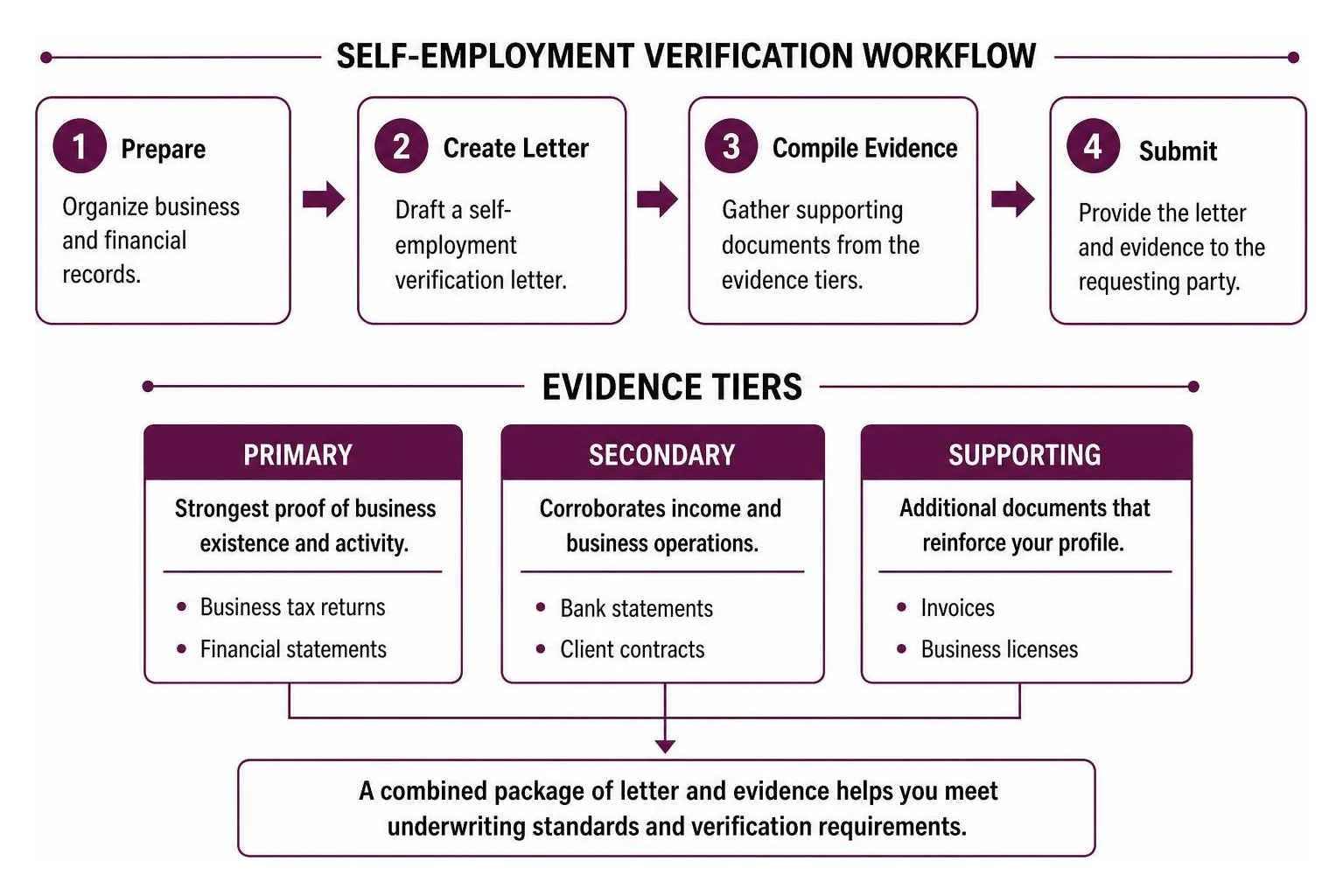
Proving your earnings and professional stability requires a structured approach. An employment verification letter for self employed professionals bridges the gap between your daily operations and the strict underwriting standards of lenders, leasing agents, and government agencies.
What Is a Self-Employment Declaration and When Is It Required?
A self-employment verification letter is a formal document that outlines your role, business entity, ownership percentage, operational timeline, and earnings. Unlike a standard employee confirmation generated by a corporate payroll officer, this document serves as a legally binding self-attestation.
Third-party reviewers need assurance that your enterprise is legitimate, operational, and generating reliable cash flow. Understanding how to provide proof of employment through proper documentation ensures that your submissions satisfy both private and statutory review standards. Reviewing our practical guide to writing a formal confirmation of position letter will help you establish the right professional tone for formal correspondence.
Key Use Cases: Mortgages, Leases, Visas, and Legal Proceedings
Independent workers encounter verification requests across several critical life events:
- Residential Leases: Property managers must confirm that your recurring revenue comfortably covers the monthly rent. Mastering the process for handling apartment employment verification paperwork prevents leasing delays.
- Mortgages and Underwriting: Under 12 C.F.R. § 1026.43(c)(4), mortgage lenders must verify repayment ability using reliable third-party records. Meeting standard mortgage employment verification letter requirements requires aligning your letter with multi-year tax records.
- Immigration and Visas: Consulates require verified proof of active trade and approved leave dates to ensure travel compliance and intent to return.
- Court Proceedings and Family Law: In child support or spousal maintenance cases, presenting employment documentation in court hearings gives the judge a clear, sworn record of your actual financial capacity.
How to Write an Employment Verification Letter for Self Employed Individuals Step-by-Step
Writing a verification letter requires precision, transparency, and a clean professional format. You can adapt proven layouts from our guide to employment verification letter templates to craft a customized document.
Follow these four steps to draft your letter:
- Format the Header: Place your official business name, logo, physical commercial address, professional email, and phone number at the top.
- State Your Role and Entity Structure: Clearly explain whether you operate as a sole proprietorship, single-member LLC, partnership, or S-Corporation, including your percentage of ownership and inception date.
- Detail Net and Gross Earnings: Report both your gross revenue and net profit for the preceding calendar year, alongside your current year-to-date trajectory.
- Sign and Date: Sign the declaration under a formal statement of truth, and ensure the document is dated within 30 to 45 days of submission.
Essential Components of an Employment Verification Letter for Self Employed Workers
To pass administrative screening, make sure your document satisfies all the essential elements of a valid employment verification document. Independent contractors should also review specific independent contractor employment verification details when structuring client agreements.
Include the following core fields:
- Legal identity matching government-issued identification.
- State registration or Employer Identification Number (EIN).
- Detailed breakdown of daily business operations.
- Gross and net earnings, separated cleanly without ambiguous estimates.
- Formal legal attestation confirming the accuracy of all submitted facts.
Self-Written Declarations vs. CPA Letters and Statutory Declarations
Depending on your transaction's complexity, a self-written letter may not be enough. The table below compares the three primary options:
| Verification Type | Author / Signatory | Typical Cost | Best Used For | Third-Party Weight | | :--- | :--- | :--- | :--- | :--- | | Self-Written Letter | Self-employed professional | $0 | Standard residential leases, auto loans, basic trade references | Moderate; requires supporting bank and tax records | | CPA Verification Letter | Licensed Certified Public Accountant | $100 to $500 | Jumbo mortgages, corporate partnerships, strict lenders | High; provides professional review of your books | | Statutory Declaration / Affidavit | Self, signed before a Notary Public / JP | $10 to $25 (Notary fee) | Court filings, immigration applications, international visas | High; carries direct legal penalties for false statements |
When preparing documents for international migration, review official guidelines for statutory declarations and affidavits. Ensure you and your authorized witness sign the document on the exact same day to avoid automatic rejection.
Mandatory Supporting Documents to Validate Self-Employed Income
A self-written letter functions as an introductory summary; your supporting documents provide the actual proof. Government agencies, lenders, and landlords will compare your stated figures directly against your financial records.
Key supporting documents include:
- IRS Form 1040 with Schedule C and Schedule SE: Confirms taxable business profits over prior tax seasons.
- IRS Form 1099-NEC & 1099-K: Documents compensation received from corporate clients and third-party payment processors.
- Year-to-Date (YTD) Profit-and-Loss (P&L) Statements: Reflects gross revenues and operating overhead for the current financial cycle.
- Business Bank Statements: Typically covering the last three to six months to prove steady cash deposits.
When submitting records for state programs, check the specific qualifying income documentation criteria to ensure your profit-and-loss statements are fully compliant.
Multi-Year Tax Records and Financial Stability Requirements
Mortgage underwriters and commercial landlords generally require two full calendar years of tax returns to verify your earnings stability. They calculate your qualifying income by averaging your net business earnings over 24 months, smoothing out seasonal spikes and dips.
Understanding these requirements helps you organize rental verification letters without delays. Always make sure your bank deposits line up with the net profits declared on your tax filings.
Verification Guidelines for Immigration and Schengen Visas
Foreign consulates maintain strict verification standards for self-employed applicants. When seeking travel or business visas, keep these key rules in mind:
- Strict 30-Day Window: Consular authorities often reject verification letters dated more than 30 days before your appointment.
- Trip Details: Your letter must clearly state your travel dates, approved leave of absence, and guaranteed return-to-work date.
- Supporting Evidence: Attach your business registration and recent tax returns as outlined in current immigration employment verification letter guidance.
- Currency Reporting: Always list earnings in U.S. Dollars without converting amounts yourself, following standard Schengen visa employment letter criteria.
Pitfalls to Avoid and Landlord Acceptance Strategies
Incomplete submissions are the leading cause of application rejections for self-employed professionals. Underwriters and leasing teams look closely for discrepancies between your self-reported figures and your official tax filings. Avoid common paperwork headaches by using our guide to securing a permanent employment confirmation.
Common Mistakes When Submitting an Employment Verification Letter for Self Employed Earners
- Gross vs. Net Confusion: Stating top-line gross sales instead of net taxable income creates obvious red flags during underwriting reviews.
- Mismatched Bank Records: Claiming $10,000 in monthly net profit when bank deposits average only $6,000 will quickly derail your application.
- Missing Signatures: Submitting unsigned letters or forms missing notary seals where sworn statements are required.
- Unredacted Sensitive Data: Failing to redact personal Social Security Numbers or private client details from publicly submitted exhibits.
Best Practices for Smooth Tenant and Borrower Approvals
To speed up your review process, follow these practical steps:
- Organize all supporting exhibits in a clear, indexed PDF packet.
- Include active contact details for your accountant, tax preparer, or corporate legal counsel.
- Notarize your declaration letter to reinforce its authenticity.
- Use a standardized template when streamlining tenancy confirmation paperwork.
Frequently Asked Questions About Self-Employed Work Verification
Can I write my own employment verification letter if I am self-employed?
Yes. Sole proprietors, freelancers, and business owners can write and sign their own verification letters. However, you must attach third-party supporting documents—such as IRS Schedule C forms, 1099-NEC statements, and business bank records—to validate your self-attestation.
What is the difference between proof of employment and proof of income?
Proof of employment confirms your active trade, business standing, and role duration. Proof of income shows the exact money you earn. Self-employed individuals typically prove both at once using profit-and-loss ledgers, tax filings, and bank statements.
How far back should financial records go to prove self-employment stability?
Most mortgage lenders and commercial leasing companies require two full years of federal tax returns, along with year-to-date profit-and-loss statements and three to six months of consecutive business bank statements.
Conclusion and Final Checklist
As an independent professional, you do not need a traditional corporate HR department to produce dependable, high-quality verification paperwork. By writing a well-structured declaration letter and pairing it with organized tax records and bank statements, you can navigate lease reviews, mortgage underwriting, and visa applications with confidence.
Before submitting your documents, run through this quick pre-flight checklist:
- [ ] Letter is printed on official company letterhead with complete contact details.
- [ ] Letter is dated within the past 30 days.
- [ ] Net and gross profit figures match your attached IRS tax returns.
- [ ] Business bank statements cover the required continuous period (3–6 months).
- [ ] The document is signed, dated, and notarized if required.
If you are managing housing paperwork, emotional support animal accommodations, or tenant screening compliance across Texas or anywhere nationwide, explore the ValidPaw instant verification platform for fast, reliable verification tools.