
Understanding Employment Verification and Key Use Cases
A valid letter to prove employment—also called an employment verification letter—must be issued by the employer on official corporate letterhead and signed by an authorized representative, such as an HR manager gossip or direct supervisor. The letter should objectively confirm the applicant’s full legal name, current job title, department, original hire date, employment classification (full-time, part-time, temporary, or seasonal), primary work location, and, only with written employee consent, current compensation details.
When an individual applies for credit, an apartment, or a specialized visa, third-party reviewers rarely rely solely on word of mouth or a LinkedIn profile. Third-party institutions require formal, authoritative documentation confirming that the applicant actually holds the position they claim. This is where an employment verification letter serves as the standard instrument for validating an individual's professional standing and earning capacity.
The demand for verifiable workplace credentials spans multiple sectors. Federal bodies, such as those referencing U.S. Department of Labor verification guidelines, rely on formal documentation to ensure programs remain compliant and fraud-free. Similarly, property managers use rental verification letters to screen prospective tenants, ensuring they maintain reliable employment before executing a binding lease agreement.
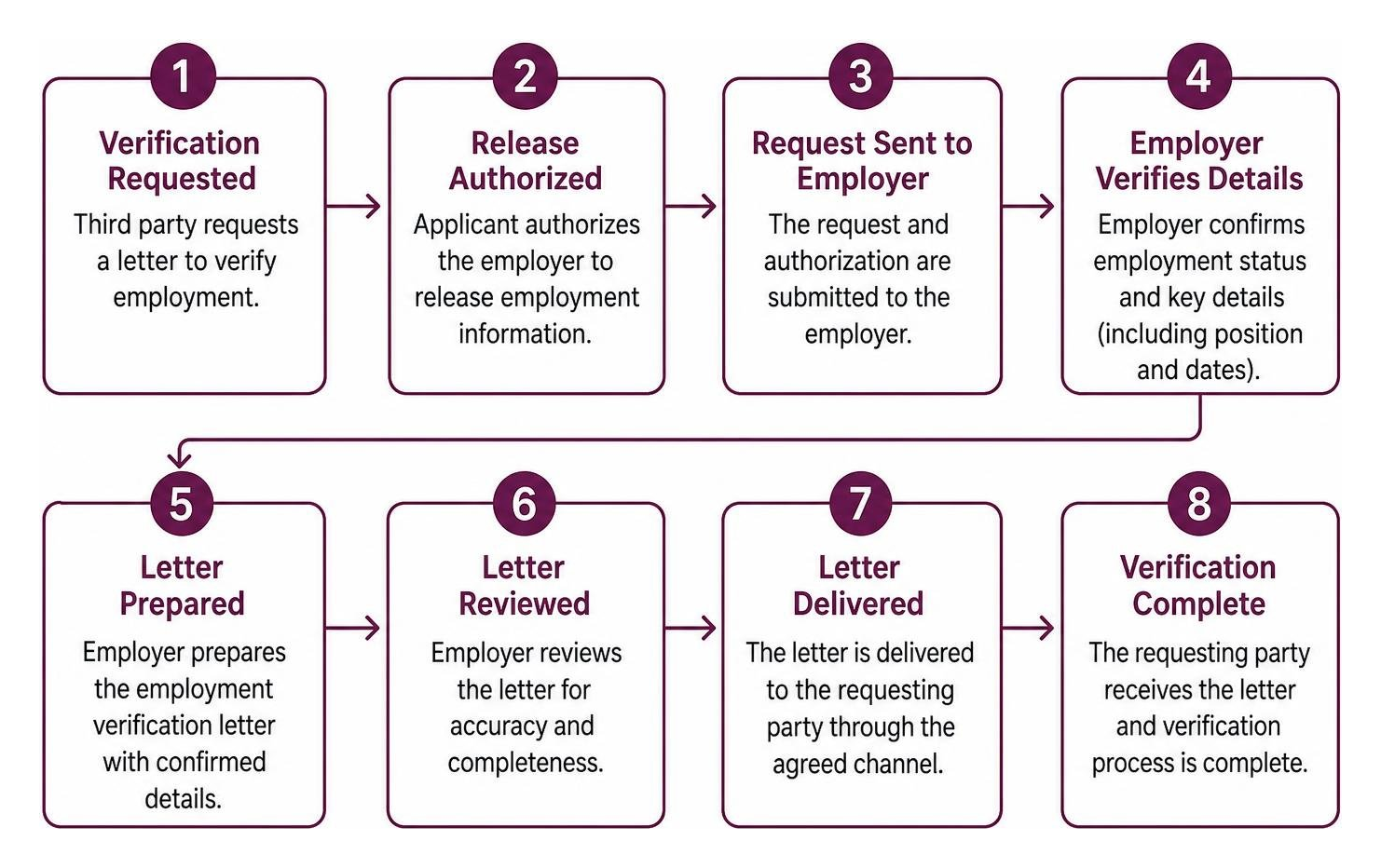
Situations Requiring Formal Verification
Formal confirmation of job status is commonly requested in several routine life milestones:
- Residential Leases: Landlords and leasing agencies routinely request verification to determine if an applicant meets the standard income-to-rent ratio (often requiring monthly gross earnings to be at least three times the monthly rent).
- Mortgage Underwriting: Financial institutions underwriting residential mortgages require concrete proof that the borrower's earnings are consistent, stable, and likely to continue.
- Vehicle Financing and Personal Loans: Lenders evaluate risk by reviewing job longevity, full-time versus part-time status, and ongoing compensation structures.
- Immigration and Visa Petitions: The U.S. Citizenship and Immigration Services (USCIS) and consular offices mandate detailed letters to confirm specialized skill sets, prevailing wage compliance, and continuous lawful employment.
- Public Assistance and State Benefits: State agencies verify employment metrics to calculate eligibility thresholds for healthcare, childcare subsidies, and food assistance programs.
- Prospective Employer Background Checks: During the hiring onboarding process, human resources departments verify past experience by securing a solid confirmation of permanent employment letter from prior organizations.
Employment Verification vs. Proof of Income vs. I-9 Forms
A common point of confusion is conflating an employment verification letter with other formal workplace and tax documents. Each serves a distinct legal and operational purpose.
| Document Type | Primary Purpose | Standard Issuer | Key Information Contained | | :--- | :--- | :--- | :--- | | Employment Verification Letter | Confirms active or past employment status and organizational role | Current or former employer (HR, manager) | Job title, hire date, employment classification (full/part-time), work location, optional compensation | | Proof of Income | Demonstrates historical financial earnings and cash flow | Employer, payroll provider, IRS, or financial institution | Gross/net pay, year-to-date earnings, tax withholdings, bonuses (e.g., pay stubs, W-2s, 1099s, tax returns) | | Form I-9 / EAD | Establishes legal identity and authorization to work in the U.S. | U.S. Federal Government (USCIS / DHS) | Identification numbers, citizenship or immigration status, document expiration dates |
An employment verification letter confirms that you work and what your status is. Proof of income demonstrates what you earned over historical cycles. Form I-9 and Employment Authorization Documents (EAD) establish legal authorization to work under federal immigration law.
Core Components of a Letter to Prove Employment
A legally sound verification letter must balance completeness with data privacy. Providing insufficient detail can delay underwriting or rental approvals, while disclosing excessive personal details creates liability for the issuing organization.
Before releasing sensitive workplace records, organizations should ensure the employee has formally authorized the disclosure by utilizing an authorization letter for employee verification to maintain strict compliance with privacy standards.
Mandatory Information to Include
To ensure acceptance across commercial, financial, and legal institutions, the verification document should consistently include the following baseline data points:
- Official Company Letterhead: The document must display the company's legal name, primary corporate address, registered contact numbers, and corporate logo.
- Date of Issuance: Verifiers evaluate documents based on recency, typically favoring letters generated within the preceding 30 to 60 days.
- Employee Identification Details: The worker's full legal name as recorded in corporate payroll systems.
- Current Job Title and Department: An accurate statement of the employee's role within the organization.
- Employment Dates: The formal hire date and, if applicable for former personnel, the official date of separation.
- Employment Status and Classification: Clear identification of whether the position is full-time, part-time, seasonal, temporary, or permanent.
- Primary Work Location: Specification of whether the employee operates on-site, in a hybrid structure, or fully remote.
- Authorized Signatory Details: The signature, printed name, professional title, direct telephone extension, and corporate email address of the HR representative or manager executing the letter.
- State Agency Compliance Metrics: When responding to public assistance inquiries, aligning entries with regional standards—such as Texas HHS Form H1028 standards—ensures smooth administrative processing.
Critical Details to Exclude for Legal Compliance
Just as important as what goes into the document is what must be left out. HR administrators and supervisors should systematically exclude the following items to mitigate liability:
- Full Social Security Numbers: Disclosing an employee's full SSN introduces identity theft vulnerabilities. If an identifier is mandated by a reviewing entity, use only the last four digits.
- Dates of Birth and Personal Demographics: Age, marital status, race, religion, gender, and national origin are protected characteristics under federal and state equal employment opportunity laws and have no place in a verification document.
- Medical and Health Records: Never disclose health conditions, sick leave usage, disability accommodations, or Family and Medical Leave Act (FMLA) leaves of absence.
- Performance Appraisals and Subjective Commentary: An employment verification letter is a factual record, not a performance evaluation or character reference. Avoid subjective commentary such as "John is our top producer" or "Jane struggles with attendance." Disclosing negative opinions can expose the employer to defamation or tortious interference claims.
- Unrequested Salary History: Never disclose historical compensation figures or current earnings unless the employee has provided explicit, written consent to release that specific financial data.
Step-by-Step Process for Drafting and Requesting Verification
Drafting a verification letter follows a standardized operational protocol. Employers can reference standardized state formats, like the North Carolina DES Employment Verification Letter, to align their corporate records with standard public expectations. Utilizing structured employment verification letter templates prevents administrative delays and standardizes the workflow.
How to Request a Letter to Prove Employment from HR
Employees navigating an upcoming loan application or lease signing can expedite the turnaround process by following these practical steps:
- Submit the Request Early: HR departments typically require between one and three business days to generate custom documentation, though high-volume seasons may extend this timeline.
- Clarify the Recipient's Exact Requirements: Ask the lender, landlord, or agency precisely which fields they require (e.g., base salary, year-to-date bonus, average overtime hours, remote status).
- Provide Recipient Details: Supply the specific name, title, organization, and physical or email address of the party requesting the verification.
- Grant Written Authorization: Provide an explicit, signed release allowing HR to disclose your employment and compensation details to the named third party.
- Follow Internal Channels: Utilize your organization’s designated HR portal or ticketing system. For more specialized request workflows, reviewing guidelines on employee work verification letters can provide clear operational insight.
Structuring and Formatting on Official Letterhead
When preparing the letter, format it as a standard formal business letter. The structure should flow logically from identification to factual confirmation and authorized sign-off. If confirming a specific corporate role, organizations often model their correspondence on a formal confirmation of position letter.
Tailoring Letters for Mortgages, Rentals, and Visas
Different verifying entities prioritize different data points:
- Mortgage Underwriters: Governed by secondary market standards (such as Fannie Mae Form 1005), lenders require precise figures regarding year-to-date earnings, historical bonuses, overtime probability, and continuity of employment. Review our dedicated mortgage employment verification letter guide for details on meeting lender underwriting standards.
- Landlords and Property Managers: Focus primarily on monthly gross stability and tenure. Tailoring a document specifically as an apartment employment letter ensures leasing agents receive clear confirmation of income stability.
- Judicial Proceedings and Government Filings: Courts and administrative law judges evaluating child support, probation compliance, or community standing require comprehensive factual statements. Knowing everything the judge needs to see in your employment verification letter ensures full compliance with legal proceedings.
- USCIS and Immigration Authorities: Demand deep technical specificity, including detailed job descriptions, standard SOC codes, full breakdowns of primary educational and technical requirements, and verification that the role meets prevailing wage thresholds.
Legal Regulations, Compliance, and Employer Obligations
Drafting employment records involves navigating state and federal labor laws, privacy mandates, and civil liability risks. Employers must maintain consistency to avoid allegations of disparate treatment or privacy breaches.
State Salary History Bans and Privacy Protections
As of 2026, over twenty states and numerous major municipalities have enacted salary history bans and pay transparency laws. While these statutes primarily restrict prospective employers from asking job applicants about their historical compensation, they also influence how verification letters are handled.
Key compliance best practices include:
- Obtaining Explicit Employee Consent: Never disclose current or historical compensation figures to any third party without a signed, dated release form from the employee.
- Disclosing Only Current Rates: When authorized, state the employee's current pay rate rather than their historic trajectory across prior years, unless specifically mandated by federal lending guidelines.
- Limiting Responses to Fact-Checking: If an external party contacts HR with a questionnaire containing open-ended performance inquiries, decline to answer subjective questions and limit responses strictly to objective tenure and position data.
- Reference Immunity Protections: Many jurisdictions (including Texas under its labor code) grant statutory immunity to employers who disclose truthful, factual job performance and verification information to prospective employers upon request. However, departing from objective facts negates these statutory protections.
Can an Employer Refuse a Letter to Prove Employment?
Under federal law, private employers generally have no blanket obligation to provide custom employment verification letters for commercial transactions like car loans or apartment leases. Fulfilling these requests is considered a standard professional courtesy.
However, key exceptions exist across state laws:
- State Service Letter Laws: Certain states maintain specific "service letter" statutes. For example, Minnesota law requires employers to provide a truthful reason for termination in writing within ten working days of a formal employee request. Similarly, Missouri statute (§ 290.140) mandates that corporate employers issue a formal service letter stating the nature, character, and true cause of separation within 45 days of a qualifying request.
- Public Record and Regulatory Mandates: Public sector employers and government contractors are often bound by open records laws and administrative mandates requiring timely verification responses.
- Third-Party Automated Databases: Many large enterprise employers no longer draft individual letters. Instead, they direct verifying parties to automated national verification databases (such as The Work Number). In these instances, the employer fulfills its obligation by maintaining updated payroll records within the third-party clearinghouse.
Frequently Asked Questions About Employment Verification Letters
How long is an employment verification letter valid?
Employment verification letters do not carry a formal statutory expiration date, but reviewing institutions impose strict recency requirements:
- Mortgage Lenders: Typically require verification letters to be dated within 30 to 90 days of the loan closing date. In many cases, underwriters conduct a "verbal verification of employment" (VVOE) within 10 days of final closing.
- Landlords: Generally expect documentation dated within the preceding 30 days.
- Immigration Agencies: Visa filings typically require documentation issued within 30 to 60 days of petition submission.
Can I write my own proof of employment letter?
An employee can draft the text of the letter to save time, but they cannot legally sign or issue the document on their own behalf. The letter is only valid if reviewed, approved, and executed by an authorized corporate representative (such as an HR manager, payroll officer, or direct supervisor) on official corporate letterhead.
For self-employed individuals, 1099 independent contractors, or small business owners, an employment letter from an employer does not exist. In these cases, proof of working status and income is established through Form 1040 Schedule C tax returns, annual 1099-NEC statements, corporate bank statements, or a formal confirmation letter from a certified public accountant (CPA).
Are electronic signatures legally accepted on verification letters?
Yes. Under the Electronic Signatures in Global and National Commerce Act (ESIGN) and the Uniform Electronic Transactions Act (UETA), electronic signatures carry the same legal validity as traditional pen-and-ink signatures across commercial, rental, and financial transactions.
However, exceptions remain:
- Consular and Visa Applications: Certain foreign consulates or specific USCIS immigrant visa categories may still mandate wet signatures on original corporate letterhead.
- Court Proceedings: Judicial filings may occasionally require original notarized documentation or formal affidavits of employment.
Conclusion
A well-crafted verification letter provides undeniable, objective proof of an individual's professional role, timeline, and earning power. Whether navigating a mortgage underwriting process, executing a new residential lease, or filing federal immigration petitions, adhering to standard formatting and legal guardrails ensures fast, frictionless approvals.
For human resources departments and supervisors, maintaining standardized templates, excluding private demographic data, and obtaining written employee authorization prior to disclosing compensation protects the organization from compliance liabilities. For workers, requesting documentation early and providing HR with exact recipient specifications prevents unexpected delays during critical life milestones.
At ValidPaw, we understand the importance of legally sound, authenticated documentation. Just as commercial institutions rely on factual workplace letters to make informed decisions, housing providers and individuals across Texas, Chicago, and nationwide require dependable, compliant evaluations for their therapeutic support animal needs. Explore our streamlined online verification platform to discover how our direct, licensed clinical assessments maintain full compliance with federal housing standards.