
Start Your ESA Reasonable Accommodation Request
To request an emotional support animal in housing, submit an ESA reasonable accommodation form or written request to your housing provider. State that you have a disability-related need for the animal, identify the rule you need waived - such as a no-pet policy or pet fee - and attach reliable support documentation if your disability or need is not obvious.
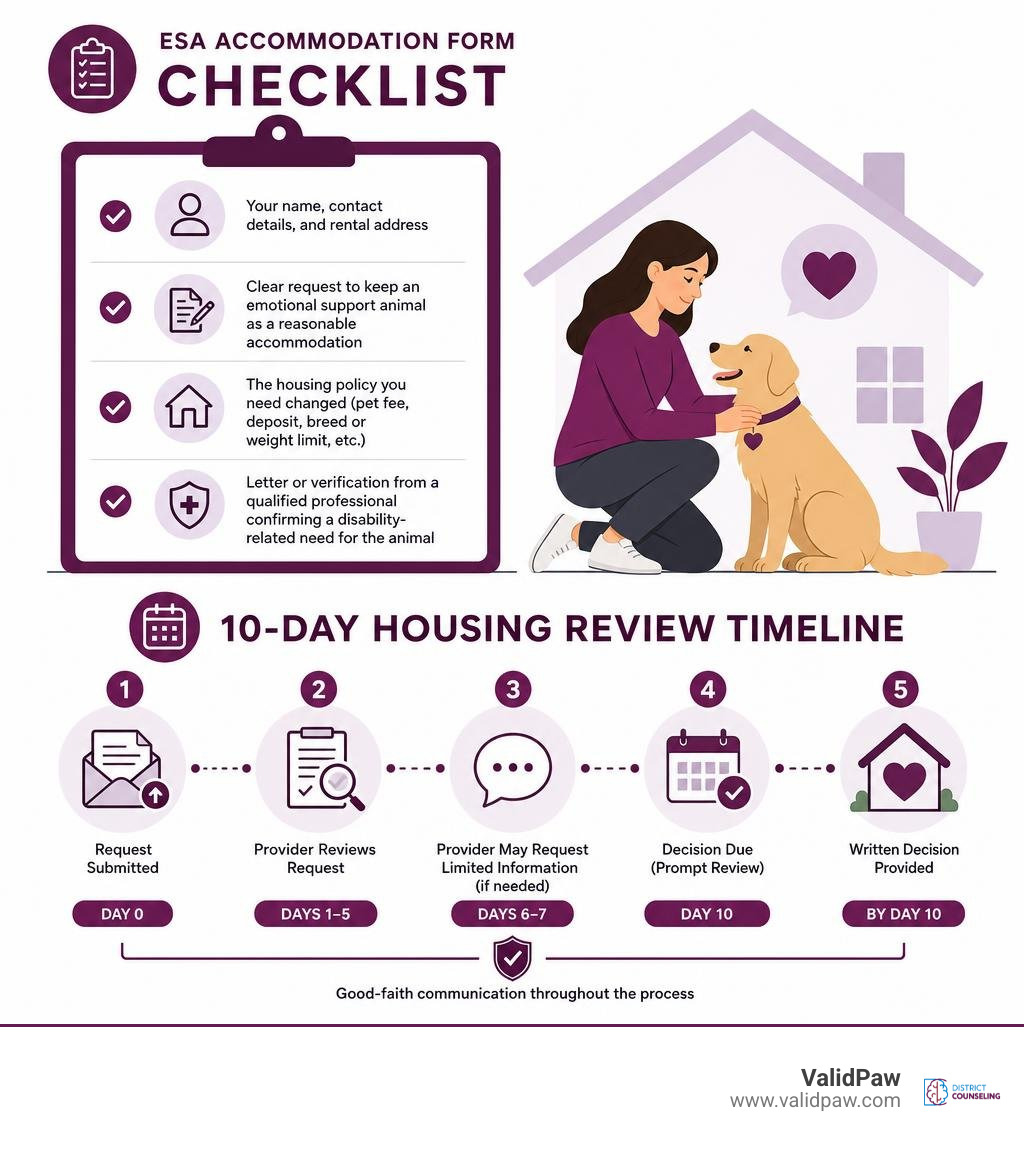
A complete request usually includes:
- Your name, contact details, and rental address.
- A clear request to keep an emotional support animal as a reasonable accommodation.
- The housing policy you need changed, such as pet rent, a deposit, or a breed or weight limit.
- A letter or verification form from a qualified healthcare professional that confirms a disability-related need for the animal - without sharing your full diagnosis or medical records.
Under the Fair Housing Act, an ESA is an assistance animal, not a pet. That means a covered housing provider cannot automatically apply pet fees, pet deposits, breed rules, or weight limits. A provider may ask for limited, reliable documentation when the disability-related need is not apparent, but they should review the request promptly and engage in a good-faith discussion if more information is needed.
I am Francisco Ortiz, a licensed behavioral-health leader and Certified Forensic Mental Health Evaluator with experience conducting clinically rigorous disability and ESA evaluations across several states. In this guide, I will help you understand how to prepare an ESA reasonable accommodation form that clearly documents the housing need while protecting your private health information.
Understanding the Legal Basis for Assistance Animal Housing Requests
Navigating rental housing with an emotional support animal starts with understanding federal civil rights statutes. The primary law safeguarding your right to live with an assistance animal is the federal Fair Housing Act (FHA). Additional protections exist under Section 504 of the Rehabilitation Act of 1973 for housing programs receiving federal financial assistance.
Under the FHA, housing providers are legally required to grant reasonable accommodations to individuals with disabilities. An accommodation is considered a change, exception, or adjustment to a rule, policy, practice, or service that may be necessary for a person with a disability to have an equal opportunity to use and enjoy a dwelling. Our Ultimate Guide to Emotional Support Animal Housing explains how these core federal protections apply across all types of rental properties.
Furthermore, municipal civil rights offices and housing authorities outline these exact duties under Fair Housing Act Accommodation Standards, confirming that assistance animals must be permitted when a legitimate disability-related nexus exists.
Assistance Animals vs Standard Pets in Residential Leases
One of the most critical legal distinctions in housing law is the difference between a pet and an assistance animal. Under federal guidelines, emotional support animals are not considered pets. Instead, they are recognized as therapeutic aids that provide essential support, alleviating one or more identified symptoms or functional limitations of an individual's mental or emotional disability.
Because ESAs are not classified as pets:
- Housing providers cannot charge pet application fees, pet deposits, or monthly pet rent.
- Standard community breed bans, weight limitations, and height caps do not apply to assistance animals.
- Leases containing restrictive pet clauses cannot automatically bar an assistance animal, as detailed in our guide on whether Can a No Pet Lease Stop Your Emotional Support Animal.
While service animals (which are limited to dogs individually trained to perform specific physical tasks under the Americans with Disabilities Act) enjoy broad public access rights, emotional support animals provide emotional comfort and therapeutic companionship within residential settings under the Fair Housing Act.
When an Accommodation Request Is Legally Required
You must formally initiate a reasonable accommodation request whenever keeping your animal would otherwise violate standard residential community rules. This includes properties with strict no-pet clauses, weight ceilings (such as 25-pound limits), or restricted breed policies.
An accommodation request can be made at various stages:
- Pre-Lease Application: Prior to signing a lease or moving in.
- Active Tenancy: During an existing lease when a disability or therapeutic need arises.
- Notice Receipt: Promptly after receiving a pet violation notice from property management.
Legally, an accommodation request is triggered the moment you communicate to your housing provider—either verbally or in writing—that you need an exception to a policy due to a health condition. However, submitting a well-organized written request supported by The Ultimate Guide to Fair Housing Act ESA Letters creates an undeniable paper trail that protects your housing rights.
What Must Be Included in an ESA Reasonable Accommodation Form
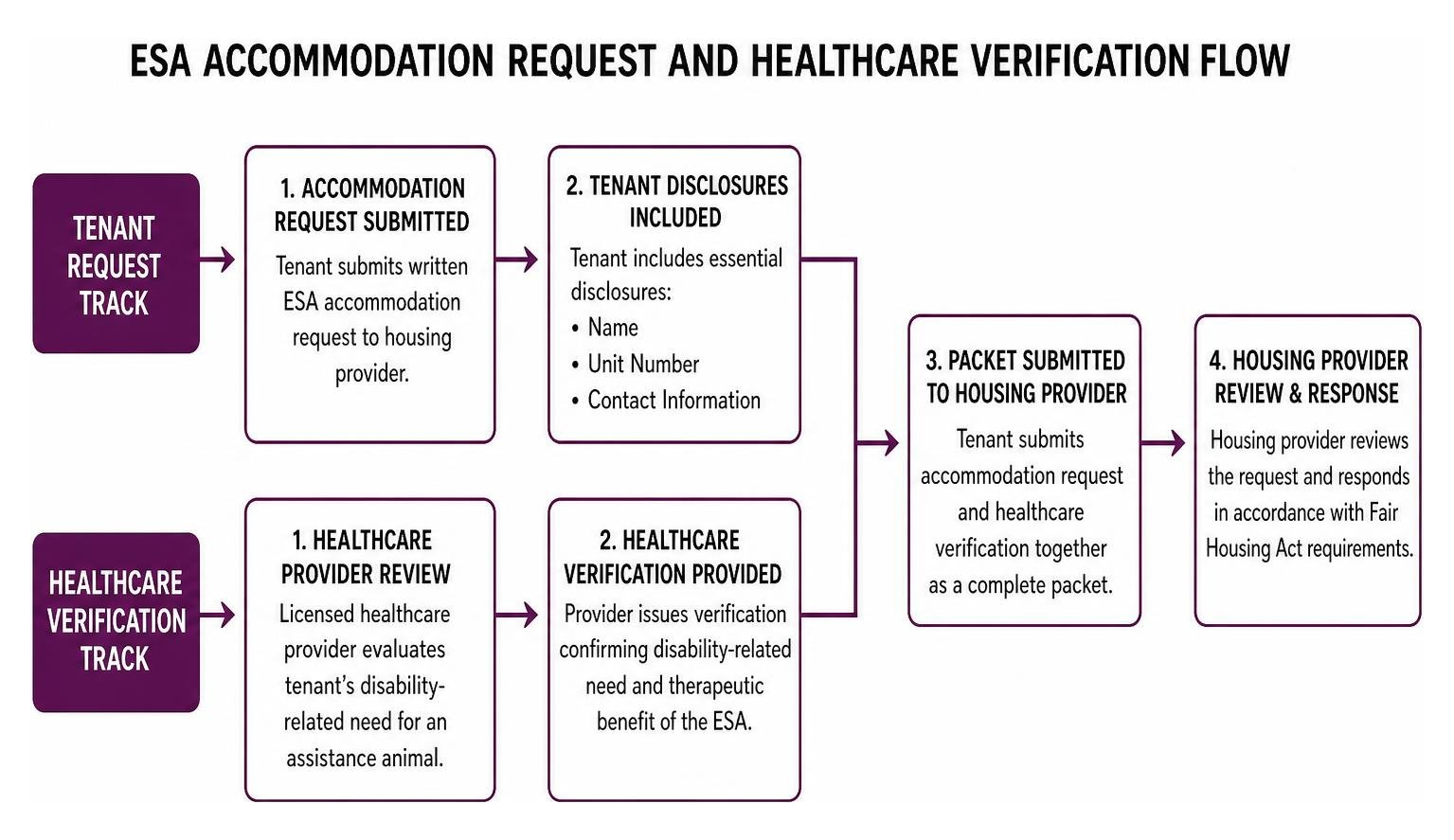
A comprehensive accommodation packet bridges the gap between your housing rights and your landlord's legal obligations. While some landlords provide their own internal paperwork or utilize packages like the US Legal Forms Accommodation Kit, you can draft your own formal written request if your landlord lacks a standardized document.
Essential Tenant Disclosures on the ESA Reasonable Accommodation Form
The tenant disclosure portion of the accommodation request should clearly establish administrative details without oversharing sensitive personal medical records. Consult The Essential Guide to ESA Documentation Requirements to ensure your submission contains these core elements:
- Tenant Details: Full legal name, current apartment or unit number, and updated contact information.
- Formal Accommodation Statement: A direct statement identifying yourself as an individual with a disability under the Fair Housing Act who is requesting a reasonable accommodation.
- Specific Rule Waiver: Explicit mention of the policy requiring modification (e.g., waiver of a no-pets rule, elimination of monthly pet rent, or exemption from breed/weight limits).
- Animal Profile: The animal’s name, species, breed, age, and verification that the animal is housebroken and up to date on required municipal vaccinations.
- Attestation of Responsibility: A statement confirming that you will maintain control of the animal, prevent property damage, and comply with waste disposal rules.
Clinical Verification and Healthcare Provider Requirements
When a disability or disability-related need is not readily apparent, a housing provider has the legal right to request reliable verification from a licensed healthcare professional.
According to institutional standards, such as the EARC Emotional Support Animal Verification Form, legitimate clinical documentation must confirm:
- The professional's credentials, active state license number, and contact details.
- An established, active professional relationship with the individual.
- Confirmation that the individual meets the definition of a disability under fair housing laws.
- An explanation of the identifiable relationship (the clinical nexus) between the individual's functional limitations and the therapeutic support provided by the animal.
Crucially, under federal privacy standards and the Genetic Information Nondiscrimination Act (GINA), healthcare providers should never include specific diagnostic codes, complete psychiatric histories, or family genetic records on verification forms.
Documenting the Need for Multiple Assistance Animals
If you require more than one emotional support animal, landlords are entitled to evaluate each animal individually. You cannot submit a single generic form assuming one letter automatically covers multiple animals.
Your licensed healthcare provider must provide separate clinical justifications detailing the distinct, non-duplicative therapeutic benefit each individual animal provides. For instance, one animal might assist in regulating nocturnal panic attacks, while another provides grounding support for daytime agoraphobia. Each animal must have an established clinical nexus to your functional limitations.
Step-by-Step Guide to Requesting Housing Accommodations
Successfully submitting your documentation requires a calm, organized approach. Timing your request properly avoids unnecessary landlord friction and prevents administrative delays. Review our advice on When to Tell Your Landlord About an Emotional Support Animal Without Getting Rejected before delivering your paperwork.
| Verification Type | Legitimate Clinical Documentation | Invalid Online Registry / "Instant ID" | | :--- | :--- | :--- | | Provider Origin | Licensed Mental Health Professional (LMHP) or Medical Doctor | Unregulated commercial registration database | | Clinical Assessment | Comprehensive telehealth or in-person consultation | 5-minute automated questionnaire | | Disability Nexus | Details how animal alleviates specific functional limitations | Generic certificate with no medical evaluation | | Legal Standing | Full compliance with Fair Housing Act standards | Explicitly rejected by HUD and federal guidance | | Verification Method | Direct professional license lookup on state registry | Fake QR codes or instant digital "ID cards" |
How to Complete the ESA Reasonable Accommodation Form Step by Step
Follow this reliable sequence to submit your paperwork:
- Obtain Your Clinical Letter: Secure a valid, FHA-compliant letter from a licensed mental health professional who is licensed in your state.
- Draft the Accommodation Request: Complete your tenant request statement or fill out your property manager's standardized accommodation form. Learn How to Get Landlord Approval for an Emotional Support Animal Letter to ensure every required field is completed accurately.
- Attach Animal Records: Include up-to-date rabies vaccination certificates and local municipal pet licensing forms if required in your area (such as in Texas cities like Houston, Austin, Dallas, San Antonio, or Fort Worth, as well as Chicago, IL).
- Deliver via Trackable Methods: Submit the packet via certified mail with return receipt requested, or send it via email with delivery/read receipts enabled to preserve proof of delivery.
- Archive All Copies: Keep duplicate digital and physical copies of everything you submit, along with all written landlord responses.
Submitting Verification Without Violating Medical Privacy
Tenants often worry that requesting an accommodation requires forfeiting their private health information. Under the Fair Housing Act and HIPAA privacy principles, housing providers are strictly prohibited from demanding:
- Your comprehensive medical or psychiatric records.
- Specific medical diagnoses (e.g., Major Depressive Disorder, PTSD, Generalized Anxiety Disorder).
- Detailed session notes from your therapy appointments.
- Statements signed under penalty of perjury from your doctor.
The documentation need only confirm that you have an impairment that substantially limits one or more major life activities and that the assistance animal helps alleviate those limitations.
Landlord Obligations and Response Timelines Under Federal Law

Housing providers have an affirmative legal duty to process accommodation requests in good faith and without unnecessary delay. Refusing to process paperwork or dragging out decisions indefinitely can be legally interpreted as a constructive denial under federal housing guidelines and the EEOC Enforcement Guidance on Reasonable Accommodation.
First-time civil penalties for violating the Fair Housing Act can exceed $25,000, with second violations reaching over $62,000, in addition to tenant compensatory damages and attorney fees.
The 10-Day Interactive Review Process
Under standard HUD expectations and state disability agency guidance, housing providers are strongly encouraged to respond to reasonable accommodation requests within 10 business days.
During this window, the housing provider should:
- Review the clinical verification for active licensing and disability nexus.
- Request any reasonable clarifications through an interactive process if details are missing.
- Issue a formal written approval granting the requested policy waiver.
If your property manager needs verification, discover How to Give Your Landlord ESA Proof That Actually Sticks to resolve inquiries without unnecessary delays.
Valid vs Unlawful Reasons for Denial
A housing provider cannot arbitrarily deny an ESA request. Under federal law, legitimate grounds for denial are limited to:
- Direct Threat: The specific animal poses a direct threat to the health or safety of others that cannot be mitigated by another reasonable accommodation (backed by actual objective evidence, such as bite history, not breed generalizations).
- Substantial Physical Damage: The specific animal has a history of causing severe property damage.
- Undue Burden: Granting the request imposes an undue financial and administrative burden on the landlord or fundamentally alters the nature of the housing provider's operations.
- Fraudulent Documentation: The paperwork is fraudulent or obtained from an unverified, unlicensed source.
Rejecting an ESA because an insurance policy has general breed exclusions is generally unlawful; housing providers are expected to seek an insurance waiver or negotiate coverage before issuing a denial.
Common Mistakes and Inadequate Documentation to Avoid
Simple procedural oversights can derail your accommodation request. Watch out for these frequent mistakes:
- Moving an Animal in Prematurely: Bringing an animal into a no-pets building before submitting your paperwork or waiting for the interactive review can trigger legitimate lease violation notices.
- Using Unlicensed Out-of-State Providers: Housing providers frequently check state licensing registries. If you live in Texas, your clinician must be authorized to practice in Texas.
- Failing to Track Deliveries: Delivering paperwork verbally without written records leaves you unprotected if the landlord denies receiving your request.
- Refusing the Interactive Process: If a landlord asks for legitimate clarification regarding a clinician's credentials, refusing to cooperate can justify a denial.
The Risks of Instant Online Registries and Certificates
The internet is flooded with commercial registry websites promising "official lifetime ESA registration," digital badges, and instant PDF certifications for a fee.
Under HUD and federal guidelines, online registration certificates, ID cards, and registry entries convey zero legal rights. Housing providers and courts routinely reject these items as legally insufficient. A valid accommodation request requires a genuine clinical relationship with a licensed professional who evaluates your functional needs.
Addressing Breed, Size, and Fee Restrictions
If your property management office attempts to charge you an animal deposit or claims your dog violates a 30-pound weight cap, calmly remind them in writing of your assistance animal rights:
- Reiterate that assistance animals are exempt from pet fees and weight limits under the Fair Housing Act.
- Provide a copy of HUD assistance animal guidance highlighting that breed restrictions cannot be applied to assistance animals.
- Reaffirm that you will remain personally responsible for any actual physical damage the animal might cause to the apartment flooring or fixtures.
Frequently Asked Questions About ESA Accommodations
Can a landlord require a specific accommodation form or reject verbal requests?
No. While housing providers may offer their own standardized accommodation forms for convenience, they cannot legally reject your accommodation request simply because you did not use their custom form. Under federal law, an accommodation request can be made in writing, by email, or verbally using plain language. A housing provider is legally obligated to initiate the interactive review process upon receiving clear notice of your need.
What can I do if my housing provider ignores or delays my accommodation request?
If your housing provider fails to respond within the standard 10-business-day window, send a polite written follow-up via email or certified mail reminding them of your pending request and federal prompt-response standards. If they continue to ignore or delay your submission without legitimate operational cause, their inaction may constitute an unlawful constructive denial, entitling you to file a fair housing complaint with HUD or your state's civil rights agency.
Does my healthcare provider have to disclose my specific medical diagnosis?
No. Housing providers are strictly barred under fair housing and privacy regulations from requiring your specific medical or psychiatric diagnosis, medical history, or clinical treatment notes. The healthcare provider's verification letter only needs to confirm that you have an impairment that meets the statutory definition of a disability and that the animal provides therapeutic support that alleviates one or more symptoms.
Conclusion
Securing reasonable accommodation for your emotional support animal does not have to be stressful. By submitting a clear written request, providing reliable clinical verification from an active healthcare practitioner, and understanding your rights under the Fair Housing Act, you can protect your living arrangements while maintaining full medical privacy.
At ValidPaw, we specialize in connecting individuals with licensed clinical professionals who conduct thorough, compliant telehealth evaluations across Texas and nationwide. If you need a legitimate, FHA-compliant evaluation from a licensed professional, apply online for an ESA evaluation today and secure the housing documentation you and your support animal need.

