
Navigating ESA No Pets Housing Under the Fair Housing Act
The Fair Housing Act (FHA) prohibits discrimination in residential housing against individuals with disabilities. Central to this civil rights framework is the mandate that housing providers grant reasonable accommodations—adjustments to standard rules, policies, practices, or services—to allow a person with a disability an equal opportunity to use and enjoy a dwelling.
When applied to rental agreements, courts have consistently determined that waiving a standard restrictive animal policy is a mandatory reasonable accommodation for a qualifying tenant. Understanding how federal statutes categorize animals in residential real estate is essential for protecting your tenancy under FHA assistance animal protections.
| Classification | Primary Governing Law | Mandatory Training Required? | Public Access Rights (Stores/Restaurants) | Housing Protection (No-Pet Rules & Fees Waived) | | :--- | :--- | :--- | :--- | :--- | | Service Animal | Americans with Disabilities Act (ADA) & FHA | Yes (Individually task-trained) | Yes | Yes | | Emotional Support Animal (ESA) | Fair Housing Act (FHA) & State Civil Rights Laws | No (Specialized training not required) | No | Yes (In covered residential housing) | | Household Pet | Local Ordinances & Contract/Lease Law | No | No | No (Subject to landlord rules, deposits, and pet rent) |
Legal Definition: Assistance Animals vs. Pets vs. Service Dogs
Under federal civil rights definitions, pets and assistance animals occupy entirely different legal categories. A standard pet is kept for pleasure or companionship and holds no specialized rights under federal anti-discrimination legislation.
Assistance animals, by contrast, are recognized as working entities or therapeutic aids that alleviate symptoms of a physical or mental impairment. This broader category splits into two distinct groups:
- Service Animals: Defined strictly under Titles II and III of the Americans with Disabilities Act (ADA) as dogs (and in specific cases miniature horses) that are individually trained to do work or perform specific physical or psychiatric tasks for the benefit of an individual with a disability. Examples include guiding visually impaired handlers, alerting deaf individuals, or interrupting acute dissociative episodes.
- Emotional Support Animals (ESAs): Any domesticated animal (such as a dog, cat, or bird) that provides therapeutic companionship, comfort, or emotional stability that mitigates one or more identified symptoms of a qualifying mental health condition or psychiatric disability. Unlike service animals, ESAs do not require task-specific behavioral training to qualify for housing protection.
Fee Exemptions: Pet Rent, Pet Deposits, and Breed Restrictions
Because assistance animals are not legally classified as pets, standard pet-related financial charges and physical restrictions cannot be applied to them. When an accommodation request is approved:
- Pet Deposits and Move-in Fees: Landlords cannot charge upfront non-refundable pet fees or additional pet-specific security deposits.
- Monthly Pet Rent: Landlords cannot add surcharges or monthly pet rent to the baseline residential rental amount.
- Breed, Weight, and Size Restrictions: A housing provider cannot deny an ESA simply because it exceeds a weight limit or belongs to a restricted dog breed. Accommodation decisions must evaluate the specific animal's actual behavior rather than generalized breed stereotypes.
For a deeper dive into the specific mechanics of these waivers, review The Ultimate Guide to Fair Housing Act ESA Letters.
Exempt Properties Where ESA No Pets Housing Rules Do Not Apply
While the Fair Housing Act covers the vast majority of multi-family apartments, condominium associations, and residential leasing communities, specific property categories are legally exempt from federal FHA reasonable accommodation requirements:
- The "Mrs. Murphy" Exemption: Owner-occupied residential buildings containing four or fewer independent rental units.
- Single-Family Housing Sold or Rented Without a Broker: Single-family private homes rented directly by a private owner who owns no more than three such single-family properties at one time, provided no real estate agent, broker, or discriminatory advertising is used.
- Private Membership Clubs: Housing operated by private clubs or religious organizations that limit occupancy exclusively to their members for non-commercial purposes.
How HUD's 2026 Policy Update and State Laws Impact ESA Protections
The regulatory environment surrounding assistance animals in residential leasing experienced significant administrative shifts in 2026. Understanding the distinction between internal agency enforcement priorities and statutory fair housing law is critical for tenants asserting their rights.
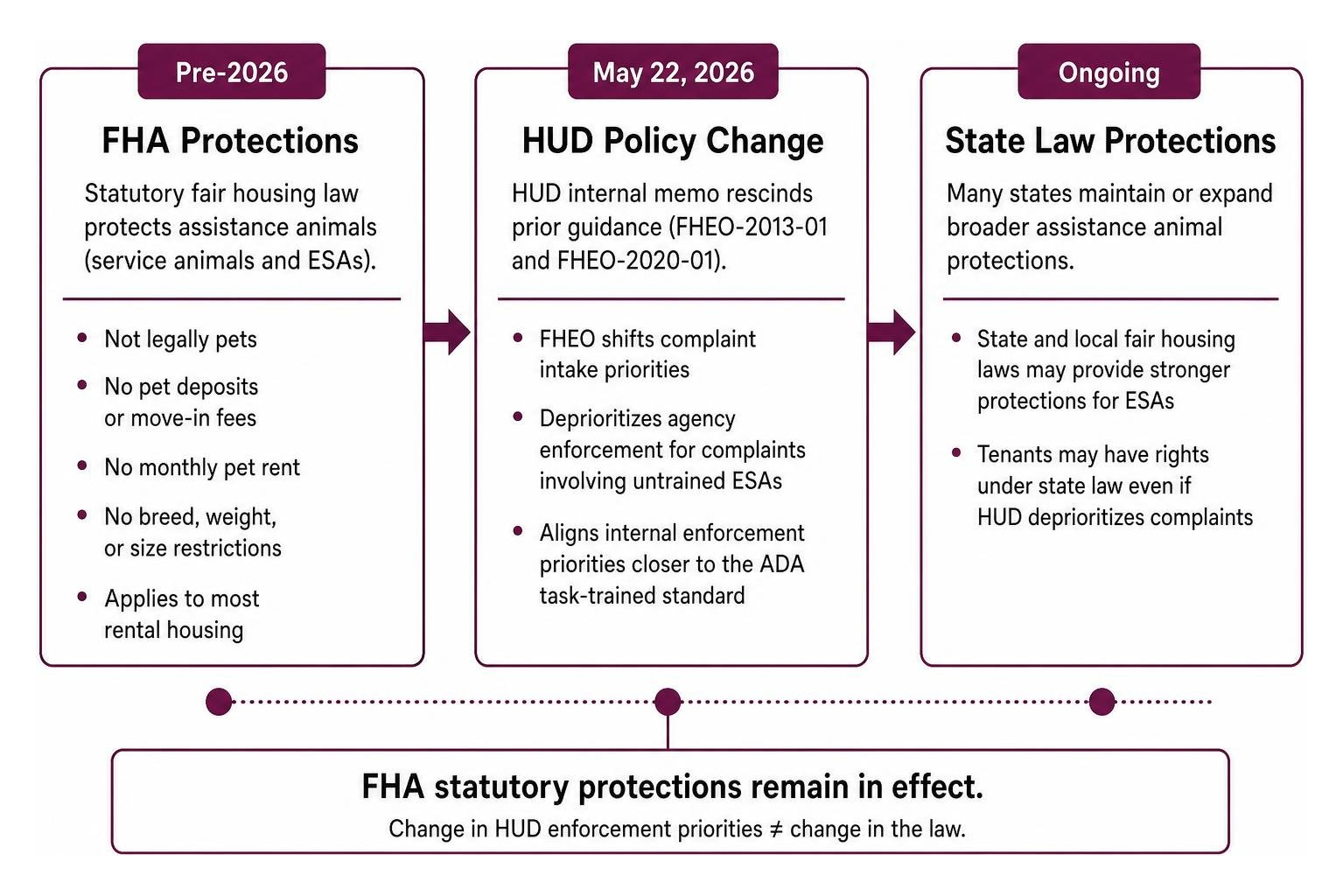
The May 2026 HUD Enforcement Memo and FHA Statutory Protections
On May 22, 2026, the U.S. Department of Housing and Urban Development (HUD) issued an internal administrative memorandum that rescinded its prior agency guidance documents (notably FHEO-2013-01 and FHEO-2020-01).
Under this 2026 administrative memo, HUD's Office of Fair Housing and Equal Opportunity (FHEO) shifted its internal agency complaint intake priorities. Administratively, HUD indicated it would deprioritize agency-level enforcement actions for complaints involving untrained emotional support animals, aligning its internal investigative criteria closer to the ADA's task-trained standard.
However, an internal administrative enforcement shift does not amend the underlying Fair Housing Act statute enacted by Congress:
- Private Right of Action: Under 42 U.S.C. § 3613, individuals retain the legal right to file a private fair housing lawsuit in federal district court or state court within a two-year statute of limitations. Federal judicial precedent continues to recognize that waiving a "no pets" policy for a medically verified ESA constitutes a mandatory reasonable accommodation.
- Section 504 of the Rehabilitation Act: Federally assisted housing programs, public housing authorities, and HUD-subsidized properties remain bound by Section 504 rules prohibiting disability discrimination, independent of administrative FHA memos.
State-Level Housing Protections: California FEHA, Massachusetts, and Texas
State-level fair housing and civil rights laws operate independently of federal administrative memos. Many state statutes provide protections that explicitly shield tenants requiring untrained emotional support animals:
- California: The Fair Employment and Housing Act (FEHA), enforced by the California Civil Rights Department (CRD), explicitly defines assistance animals to include emotional support animals, prohibiting landlords from enforcing pet restrictions or fees regardless of federal administrative changes.
- Massachusetts: The Massachusetts Commission Against Discrimination (MCAD) continues to enforce state anti-discrimination laws protecting tenants who require emotional support animals in housing.
- Texas and Other Jurisdictions: Across major rental markets such as Houston, Dallas, Austin, San Antonio, Fort Worth, and Chicago, local civil rights ordinances and state laws protect tenants with disabilities from discriminatory housing denials. Renters navigating local requirements can reference established Texas assistance animal regulations alongside federal standards.
How to Request a Reasonable Accommodation for an ESA
Securing an accommodation in restricted-pet housing is a formal administrative process. Rather than bringing an animal onto the premises unannounced, you should initiate a documented request with property management.
Legitimate Documentation Needed for ESA No Pets Housing Approval
To establish a legally binding accommodation request, you must provide documentation from a licensed healthcare professional confirming that you meet the definition of a disability and that the animal provides therapeutic support alleviating functional symptoms.
A valid ESA letter must feature:
- The healthcare practitioner's official letterhead, state license type, license number, and issue/expiration dates.
- Confirmation that the professional is actively licensed to practice within your state of residence.
- A clear affirmation that the tenant has an impairment that substantially limits one or more major life activities.
- A clinical statement establishing a direct nexus between the disability and the functional support provided by the animal.
To ensure your submission meets clinical scrutiny, follow the steps in our guide on how to give your landlord ESA proof that actually sticks.
Be aware that several states (such as California, Montana, Arkansas, and Louisiana) have enacted statutory rules requiring an established clinical relationship of at least 30 days before a provider can issue housing documentation. At ValidPaw, our telehealth evaluations are conducted directly by licensed clinicians who satisfy all state and federal statutory requirements.
Written Accommodation Timelines and Disclosure Strategy
Submitting your accommodation request in writing establishes an objective paper trail that protects you if a dispute arises.
Housing providers are expected to review and respond to reasonable accommodation requests within a prompt administrative timeframe—typically within 10 to 30 business days. For tactical timing on when to submit your paperwork during the application process, review when to tell your landlord about an emotional support animal without getting rejected.
What Landlords Can Legally Ask vs. Prohibited Inquiries
Federal housing laws balance a landlord’s right to verify need with a tenant's statutory right to medical privacy:
What a Landlord May Legally Ask:
- Verification that you meet the legal definition of having a disability (if the disability is not readily apparent).
- Documentation establishing the direct disability-related need for the assistance animal from a treating professional.
- Verification of standard public health compliance, such as local municipal pet licensing and up-to-date rabies/vaccination records.
What a Landlord Cannot Legally Request:
- Access to your private medical records, therapy notes, or psychiatric history.
- A specific clinical medical diagnosis or disclosure of the underlying cause of your disability.
- An insistence that the healthcare provider sign overly intrusive liability waivers or disclose protected health information in violation of HIPAA standards.
- Demands for specialized behavioral training certificates, obedience diplomas, or commercial registry IDs.
Landlord Denial Rights, Tenant Responsibilities, and Legal Recourse
Accommodation protections under fair housing laws are robust, but they are not unconditional. Landlords maintain specific legal grounds for refusal, and tenants carry ongoing behavioral obligations.

Lawful Grounds for Landlord ESA Denial
A housing provider can lawfully deny an emotional support animal accommodation request under narrow, fact-specific circumstances:
- Direct Threat to Health and Safety: If the specific animal demonstrates severe aggression, unprovoked biting, or violent behavior toward other residents or staff, and reasonable behavioral mitigation measures cannot eliminate the risk.
- Substantial Physical Property Damage: If the animal causes severe, uncorrected structural damage to the rental property.
- Undue Financial and Administrative Burden: If accommodating the animal imposes extreme, unmanageable operational costs on the property owner.
- Fundamental Alteration of Operations: If housing the animal fundamentally alters the core nature of the housing provider's operations (for example, placing an animal in an allergen-controlled medical clean environment).
- Insurance Cancellation Defense: If the property owner’s insurance carrier threatens to cancel the commercial property policy specifically because of the animal's presence, and no alternative equivalent carrier is available.
Tenant Duties: Noise Control, Sanitation, and Damage Liability
Having an ESA waives pet rent and restrictive pet clauses, but it does not exempt you from standard tenancy and leasehold covenants:
- Sanitation and Waste Removal: Tenants must promptly clean up and dispose of all animal waste in designated exterior receptacles.
- Nuisance and Noise Control: Persistent barking, howling, or aggressive disturbances that violate quiet enjoyment clauses can result in a lease violation. Landlords must treat assistance animal noise issues using the same progressive violation notices applied to regular noise complaints.
- Financial Liability for Actual Damage: While landlords cannot charge upfront pet deposits, tenants remain strictly liable for any physical damage the animal causes (such as chewed trim, damaged doors, or stained carpeting) upon move-out. These repairs can be lawfully deducted from your standard security deposit.
Resolving Unlawful Denials and Retaliation
If a landlord unlawfully rejects your valid documentation, charges illegal fees, or threatens eviction, taking organized steps is vital:
- Request the Denial in Writing: Demand that the housing provider supply a formal written statement explaining the precise factual or legal basis for the rejection.
- Engage in the Interactive Dialogue: If the landlord expresses concerns about documentation authenticity, clarify the issue in writing and provide supplemental provider verification without compromising confidential medical details.
- Assert Anti-Retaliation Protections: The Fair Housing Act strictly prohibits landlords from taking retaliatory action—such as non-renewing a lease, issuing baseless eviction notices, or increasing rent—in response to a reasonable accommodation request.
- File an Administrative Complaint: You can lodge a formal discrimination complaint with your state's civil rights agency (such as the California Civil Rights Department or Massachusetts MCAD) or file a private civil action in court.
Learn more about defending your tenancy rights in our detailed breakdown: No Pets Allowed? Not With a Valid ESA Letter.
Frequently Asked Questions About ESA Housing Laws
Can a landlord evict me for getting an ESA after signing a no-pet lease?
No. A tenant may request a reasonable accommodation at any point during their tenancy—whether applying for an apartment, moving in, or after living in the unit for several months. If you develop or are diagnosed with a disability-related need mid-lease, submitting a formal written request alongside a legitimate healthcare provider letter protects you from eviction under "no-pet" lease provisions. The landlord must evaluate the request as an accommodation rather than an unauthorized pet violation.
Can a housing provider require an ESA to wear a vest or register in an online database?
No. There is no legally recognized federal, state, or municipal registration database, certified registry, or licensing credential for emotional support animals. Commercial websites selling "official" ESA badges, holographic ID cards, registration certificates, and vests are non-binding commercial products. Housing providers cannot mandate these items as conditions of approval, nor do these items substitute for a clinical letter from a licensed mental health professional.
Does a tenant have to disclose their specific medical diagnosis to a landlord?
No. You are never required to disclose your exact psychiatric or medical diagnosis, complete medical records, or treatment history to a housing provider. Under federal fair housing regulations, your documentation only needs to confirm two basic elements: that you have a qualifying impairment under fair housing definitions, and that the assistance animal provides therapeutic support that mitigates one or more functional symptoms of that condition.
Conclusion
A restrictive pet clause in a residential lease does not automatically strip you of your legal right to live with an emotional support animal. Under federal and state fair housing protections, assistance animals serve as essential therapeutic supports rather than standard household pets, granting qualifying tenants exemptions from no-pet policies, breed restrictions, pet deposits, and monthly pet rent.
Successfully navigating an accommodation request requires following established legal steps: securing credible documentation from a treating healthcare practitioner, submitting a clear written request, and maintaining responsible animal handling within your residential community.
If you are ready to secure valid, fully compliant documentation for your housing accommodation, our team is here to assist. You can apply for a legitimate ESA letter with ValidPaw to connect with a licensed mental health professional and protect your tenancy rights today.