
What a Housing ESA Letter Is — and Why It Matters
A housing ESA letter is the single most important document you need to live with your emotional support animal — even in a "no pets" building. Here's what you need to know right away:
Quick answers:
- What it is: A signed letter from a licensed mental health professional confirming you have a disability and that your animal helps manage it
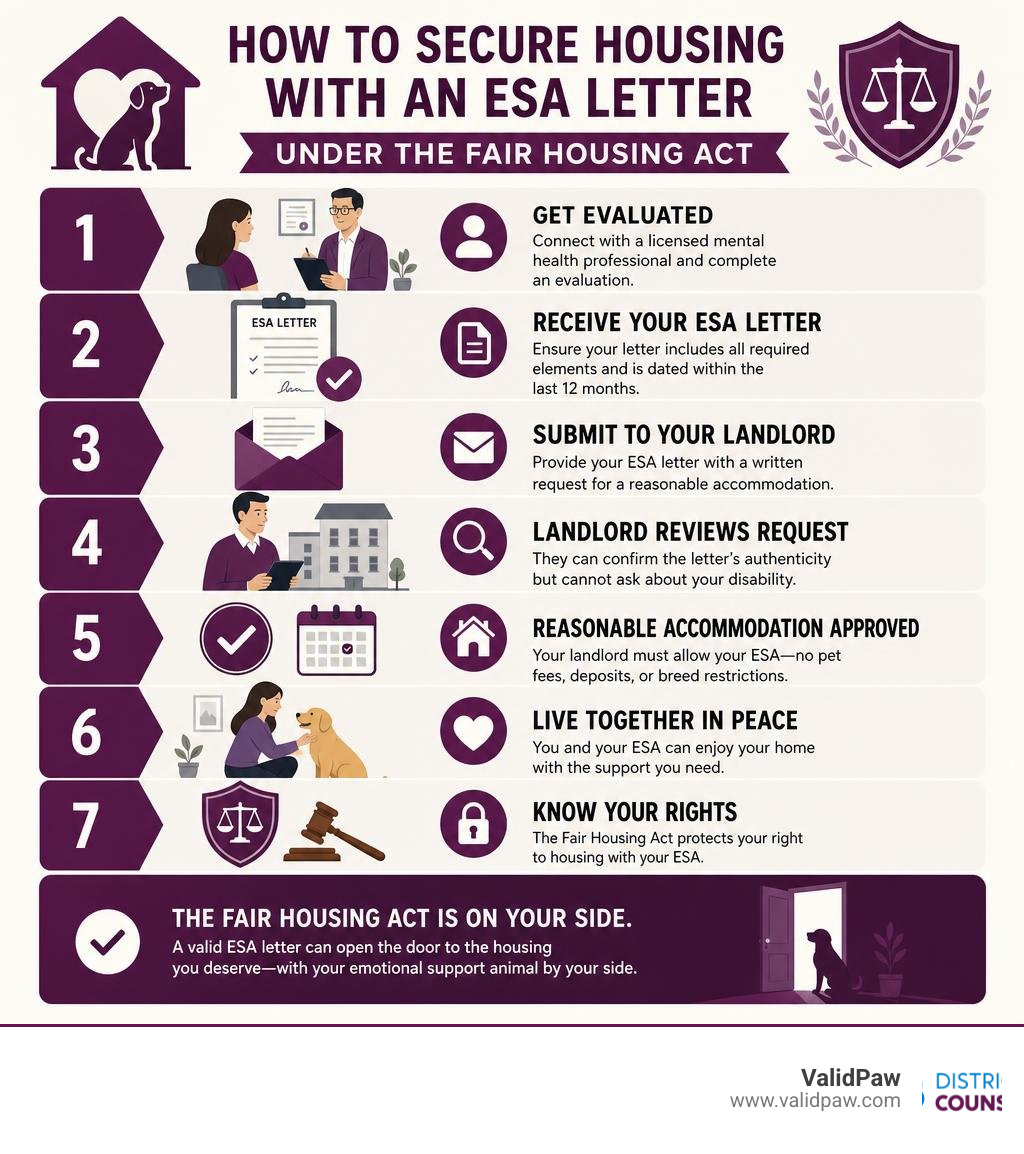
- What it does: Requires your landlord to make a "reasonable accommodation" under the Fair Housing Act (FHA) — meaning they can't refuse your animal, charge pet fees, or enforce breed restrictions
- What it must include: Your name, the clinician's license number and state, a statement of disability-related need, and a date within the last 12 months
- What it is NOT: An online registry, a certificate, an ID card, or an instant approval — none of those hold any legal weight
Imagine staring at a rental application that says "No Pets Allowed" — while your dog has been the one thing keeping your anxiety manageable for the past two years. That's the situation thousands of renters face every day. The good news: federal law is on your side, as long as you have the right documentation.
Under the Fair Housing Act, emotional support animals are classified as assistance animals, not pets. That distinction changes everything — from fees to breed rules to whether a landlord can say no at all. But the protections only kick in when your letter is legitimate and legally compliant.
I'm Francisco Ortiz, Lead Forensic Mental Health Evaluator and Director of Behavioral Health at District Counseling PLLC, with multi-state licensure across Texas, California, Florida, Virginia, Utah, and Idaho — and I've been providing clinically rigorous housing ESA letter evaluations that meet strict FHA and HUD standards for years. Below, I'll walk you through everything you need to know to protect your housing rights.
Understanding ESA Housing Laws and the Fair Housing Act

The legal foundation protecting your right to live with an emotional support animal is the federal Fair Housing Act (FHA). Under the FHA, housing providers are prohibited from discriminating against tenants based on physical or mental disabilities.
To understand your rights, you must first understand how federal agencies define your animal. The Department of Housing and Urban Development (HUD) explicitly states that emotional support animals are not "pets." Instead, they are classified under the broader umbrella of assistance animals.
Because they are assistance animals, standard lease terms, pet bans, and pet-related fees do not apply to them. If you have a documented disability and a disability-related need for the animal, landlords must make a "reasonable accommodation" to allow your animal to live with you. For a deeper look into how these protections function across different types of properties, check out our Ultimate Guide to Emotional Support Animal Housing.
Emotional Support Animals vs. Service Animals
It is incredibly common for landlords—and even some tenants—to confuse emotional support animals with service animals. However, they are governed by different laws and have different operational requirements.
- Service Animals: Governed primarily by the Americans with Disabilities Act (ADA). They are limited to dogs (and in rare cases, miniature horses) that have been individually trained to perform specific tasks to assist an individual with a disability. Examples include guide dogs for the visually impaired or psychiatric service dogs (PSDs) trained to interrupt panic attacks.
- Emotional Support Animals (ESAs): Governed primarily by the FHA in housing. They can be almost any common household species (dogs, cats, rabbits, birds) and do not require any specialized training. Their therapeutic benefit comes from their presence, companionship, and the emotional support they provide to alleviate symptoms of a mental health condition.
Here is a quick look at how the two compare under federal law:
| Feature | Service Animals (including PSDs) | Emotional Support Animals (ESAs) | | :--- | :--- | :--- | | Primary Law | Americans with Disabilities Act (ADA) | Fair Housing Act (FHA) | | Training Required | Yes (must perform specific tasks) | No (comfort via presence alone) | | Permitted Species | Dogs & Miniature Horses | Any common household animal | | Public Access Rights | Yes (restaurants, stores, etc.) | No (limited to housing and select spaces) | | Housing Protection | Yes (exempt from pet rules/fees) | Yes (exempt from pet rules/fees) |
The Impact of HUD’s 2026 Enforcement Guidance
The legal landscape for ESAs shifted significantly following an internal policy memo issued by HUD. This update changed how federal complaints regarding untrained assistance animals are handled.
Under the guidance, HUD aligned its direct federal enforcement standard more closely with the ADA service animal standard. Practically speaking, this means HUD has deprioritized or halted direct federal enforcement of FHA complaints involving untrained emotional support animals.
However, it is vital to know what did not change:
- The Fair Housing Act itself remains completely unchanged. The statutory right to a reasonable accommodation for an untrained ESA is still federal law.
- Private lawsuits remain a fully viable legal path. Tenants still hold the right to file private civil lawsuits in federal or state courts to enforce their FHA rights.
- State-level protections are unaffected. State civil rights departments—such as those in Texas, California, and Illinois—continue to enforce state-level fair housing laws that fully protect untrained ESAs.
Because of this shifting enforcement landscape, having a legally airtight, clinically backed housing ESA letter from a licensed practitioner is more critical than ever to withstand landlord scrutiny.
What Makes a Housing ESA Letter Legally Valid?

With so many websites offering instant documents, landlords have become highly vigilant. To ensure your accommodation request is accepted, your letter must meet strict legal and clinical standards.
First and foremost, a valid ESA letter must be written and signed by a licensed healthcare professional. This includes licensed mental health professionals (LMHPs) such as:
- Licensed Professional Counselors (LPCs)
- Licensed Clinical Social Workers (LCSWs)
- Licensed Marriage and Family Therapists (LMFTs)
- Clinical Psychologists and Psychiatrists
The professional must be actively licensed in your state of residence. If you live in Houston, San Antonio, or Chicago, your clinician must hold an active license in Texas or Illinois, respectively. Additionally, HUD guidelines expect the letter to be current, meaning it should be dated within the last 12 months. For a comprehensive checklist of these requirements, read our guide on Don't Get Hounded: Everything Your ESA Letter Must Include.
To learn more about the specific language HUD expects to see, you can review the What Does an ESA Letter Need to Say? HUD Requirements - LegalClarity .
Essential Elements of a Legitimate Letter
A legally defensible ESA letter must be presented on the professional letterhead of your treating clinician. According to HUD guidelines, it must contain the following specific elements:
- The clinician's full name, contact information, credentials, and signature.
- The clinician's license number, license type, and the state where the license was issued.
- Clear confirmation that you meet the definition of having a disability under the Fair Housing Act.
- A clear description of the "disability-related nexus"—meaning an explanation of how the animal's presence alleviates one or more symptoms of your mental health condition (e.g., improving sleep, regulating mood, or reducing panic).
To ensure your documentation meets these exact standards, you can read about the Emotional Support Verification Letter: What Every Landlord Needs to See.
Red Flags of a Scam Housing ESA Letter
Landlords are legally permitted to reject documentation that comes from illegitimate sources. Knowing how to spot a scam will protect your money and your housing rights.
Here are the major red flags of fraudulent ESA services:
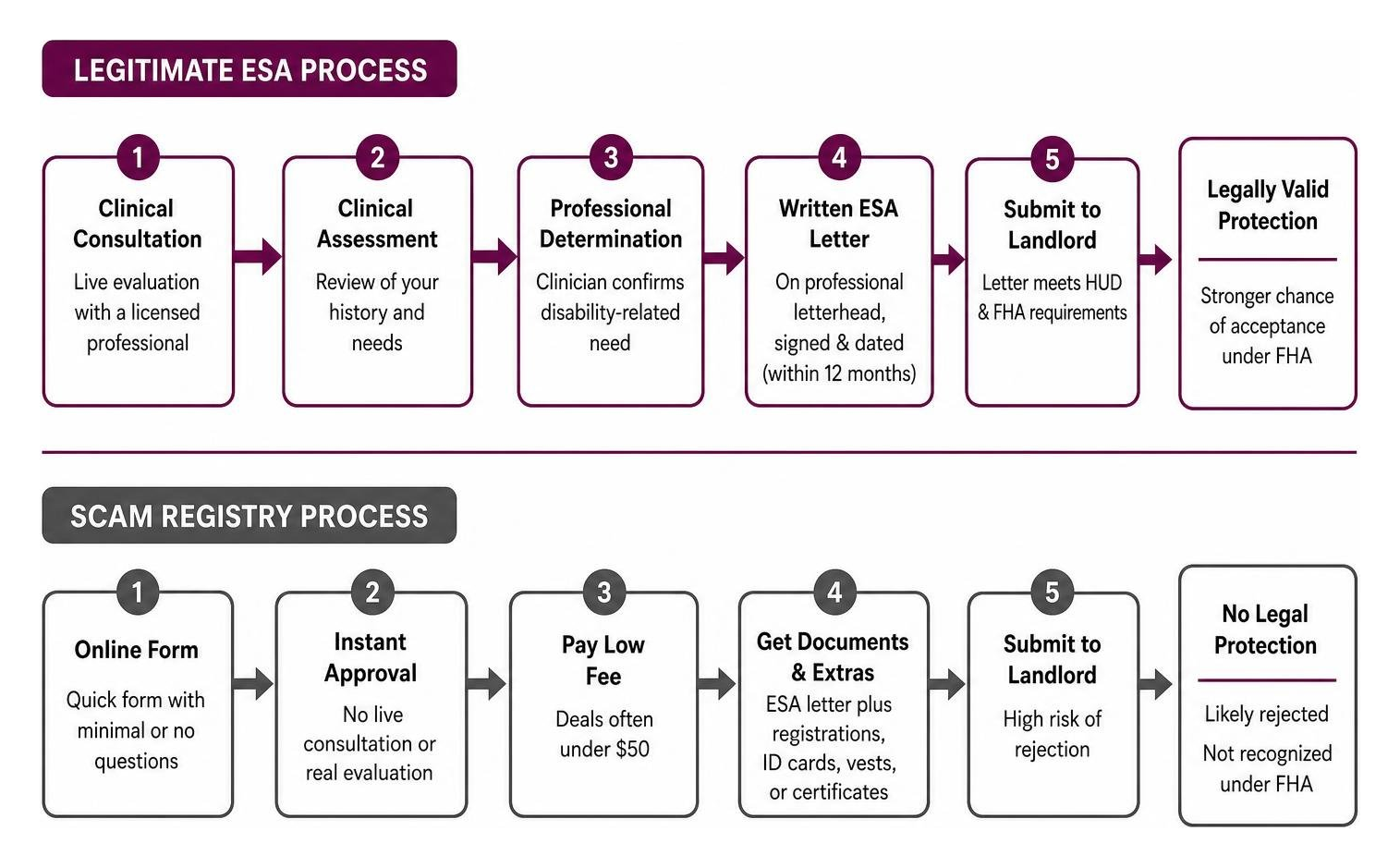
- "Instant" Approvals: Any website promising a letter in minutes without a live clinical consultation is a scam. Legitimate evaluations require a real clinical encounter.
- Selling Registrations or Certificates: There is no official, legally recognized national registry or database for emotional support animals. Vests, ID cards, and "official certificates" hold zero legal weight under the FHA.
- "Lifetime" Letters: Legitimate clinical documents must be updated. Landlords can legally reject letters older than one year, so avoid any service promising a lifetime waiver.
- Deals Under $50: A genuine clinical evaluation requires the time and expertise of a licensed professional. Extremely cheap services are almost always automated form-letter mills.
To avoid these traps and secure a document that actually holds up under legal review, read our guide on Is Your ESA Letter Legitimate? How to Spot the Real Deal.
Landlord Rights and Limitations Under Federal Law
The Fair Housing Act provides robust protections for tenants, but it also outlines clear boundaries for what landlords can and cannot do. Understanding both sides of the coin will help you navigate the process smoothly.
Under federal law, once you present a valid housing ESA letter, your landlord cannot:
- Charge you a pet deposit, pet fee, or monthly pet rent (assistance animals are exempt from all pet-related financial charges).
- Enforce breed, weight, or size restrictions (even if the building has a strict "no large dogs" or "no Pitbulls" policy).
- Deny your accommodation request simply because their lease has a general "no pets" clause.
If you're facing a landlord who insists on a pet-free policy, our article No Pets Allowed? Not With a Valid ESA Letter explains exactly how federal law overrides these standard lease clauses.
What Landlords Can and Cannot Ask
Your medical privacy is protected by federal law, including the FHA and HIPAA guidelines. When verifying your request, a landlord's inquiries are strictly limited.
What landlords CANNOT ask for:
- They cannot demand your specific medical diagnosis (e.g., they cannot force you to disclose that you have Major Depressive Disorder or PTSD).
- They cannot request your detailed medical records or clinical history.
- They cannot require your therapist to fill out highly detailed, intrusive medical questionnaires.
- They cannot demand that your letter be notarized or signed under penalty of perjury.
What landlords CAN do:
- They can verify that your clinician holds an active license in your state.
- They can contact the issuing clinician to authenticate the letter. However, under HIPAA, the clinician can only confirm two things: that they wrote the letter and that the signature is theirs. They cannot discuss your therapy sessions or symptoms.
For practical tips on presenting your proof in a way that respects your privacy while satisfying your landlord, see How to Give Your Landlord ESA Proof That Actually Sticks.
Legal Reasons a Landlord Can Deny an ESA
While FHA protections are strong, they are not absolute. A landlord can legally deny an ESA accommodation request under a few specific, narrow circumstances:
- Direct Threat: If the specific animal poses a direct threat to the health or safety of other tenants, or threatens to cause substantial physical damage to the property. This determination must be based on objective evidence of the individual animal's actual behavior (e.g., a documented history of biting or aggressive lunging), not assumptions based on breed or size.
- Undue Burden: If accommodating the animal would impose an undue financial and administrative burden on the housing provider, or fundamentally alter the nature of their operations.
- FHA Exemptions: The federal FHA does not apply to:
- Owner-occupied buildings with four or fewer units (often called the "Mrs. Murphy" exemption).
- Single-family homes rented or sold directly by the owner without the use of a real estate broker, provided the owner does not own more than three such homes at one time.
How to Request a Reasonable Accommodation
Requesting an accommodation for your ESA is a formal legal process. It should be treated with professionalism and clear documentation.
We highly recommend submitting your request in writing (via email or certified mail) to establish a clear paper trail. While oral requests are technically legal, written communication prevents misunderstandings and provides vital evidence if a dispute arises. Once you submit your request along with your valid ESA letter, HUD expects landlords to respond promptly—typically within 10 business days. Unreasonable delays can be viewed as a constructive denial under the FHA.
To understand the full timeline and what to expect during this period, read our guide on Everything You Need to Know About Your ESA Landlord Letter.
How to Request a Reasonable Accommodation with Your Housing ESA Letter
When drafting your request, keep it polite, brief, and legally precise. You do not need to overshare personal details. State clearly that you are requesting a "reasonable accommodation" under the Fair Housing Act for your assistance animal.
For a collection of templates and examples that have successfully secured housing approvals, you can read our resource on Sample ESA Letters That Actually Work.
Additionally, you can view formal, standardized templates approved by housing advocates by reviewing the EMOTIONAL SUPPORT ANIMAL (“ESA”) SAMPLE VERIFICATION LETTERS . If you need a basic draft to get started, you can also check out this Esa Housing Letter Template - US .
Navigating State-Specific ESA Regulations
While federal FHA rules provide a baseline, several states have passed laws targeting online "letter mills" and establishing stricter clinical standards for telehealth providers.
- Texas: In our home state, telehealth regulations require a genuine clinician-patient relationship. Providers must conduct a live clinical evaluation (via phone or video) and be licensed to practice in Texas. This protects renters in major hubs like Houston, Austin, Dallas, San Antonio, and Fort Worth from having their letters rejected.
- California: Under Assembly Bill 468, clinicians must establish a client-provider relationship for at least 30 days and conduct at least two clinical sessions before issuing an ESA letter.
- Florida: State law mandates a direct clinical encounter and prohibits the use of simple, questionnaire-only websites without live video or phone consultations.
- Virginia: Virginia Code § 36-96.3:1 explicitly requires an established, active "therapeutic relationship" between the tenant and the licensing professional.
Frequently Asked Questions about ESA Housing Rights
Can a landlord charge pet rent or deposits for an ESA?
No. Under the Fair Housing Act, emotional support animals are classified as assistance animals, not pets. Therefore, landlords are strictly prohibited from charging pet deposits, pet application fees, or monthly pet rent. However, you remain fully liable for any actual physical damage your animal causes to the property, which can be deducted from your standard security deposit at the end of your tenancy.
Can I have multiple emotional support animals in one home?
Yes, you can legally have more than one ESA. However, you must have clear documentation for each animal. Your clinician must write a letter explaining the specific "therapeutic nexus" for each animal—meaning they must document how each animal mitigates a different symptom of your disability (e.g., one dog helps with daytime panic attacks, while a cat assists with nighttime insomnia).
What should I do if my landlord illegally denies my ESA?
If your landlord denies your valid request or attempts to charge illegal fees, remain calm and keep all communication in writing. You have several options:
- File a HUD Complaint: You can file a formal housing discrimination complaint online at hud.gov/fairhousing within one year of the discriminatory act.
- Contact State Civil Rights Agencies: If you live in Texas or Illinois, you can file a complaint with your state's civil rights or fair housing department.
- Seek Private Legal Action: You can consult a tenant rights attorney or a local fair housing organization to evaluate filing a private lawsuit under the FHA.
Conclusion
Securing a safe, welcoming home for you and your emotional support animal shouldn't be a source of stress. While federal and state laws protect your right to live with your assistance animal, those protections rely entirely on having a legally compliant, clinically sound housing ESA letter.
At ValidPaw, we make the process simple, secure, and fully compliant. We connect you with state-licensed therapists—including our specialized team in Texas—to conduct thorough telehealth evaluations. We deliver FHA-compliant letters within 24 to 48 hours of approval, complete with instant landlord verification and no office visits required.
To learn more about how we streamline this process to help you secure your housing quickly, check out Fast Track Your ESA: Top Services for Quick Housing Verification.
Don't let rigid pet policies stand in the way of your mental well-being. Apply for your legitimate ESA letter today and take the first step toward stress-free, fee-free living with your companion.

