
When to Tell Your Landlord About an Emotional Support Animal (And Why Timing Matters)
Knowing when to tell your landlord about emotional support animal can be the difference between a smooth approval and an unnecessary conflict. Here is the short answer:
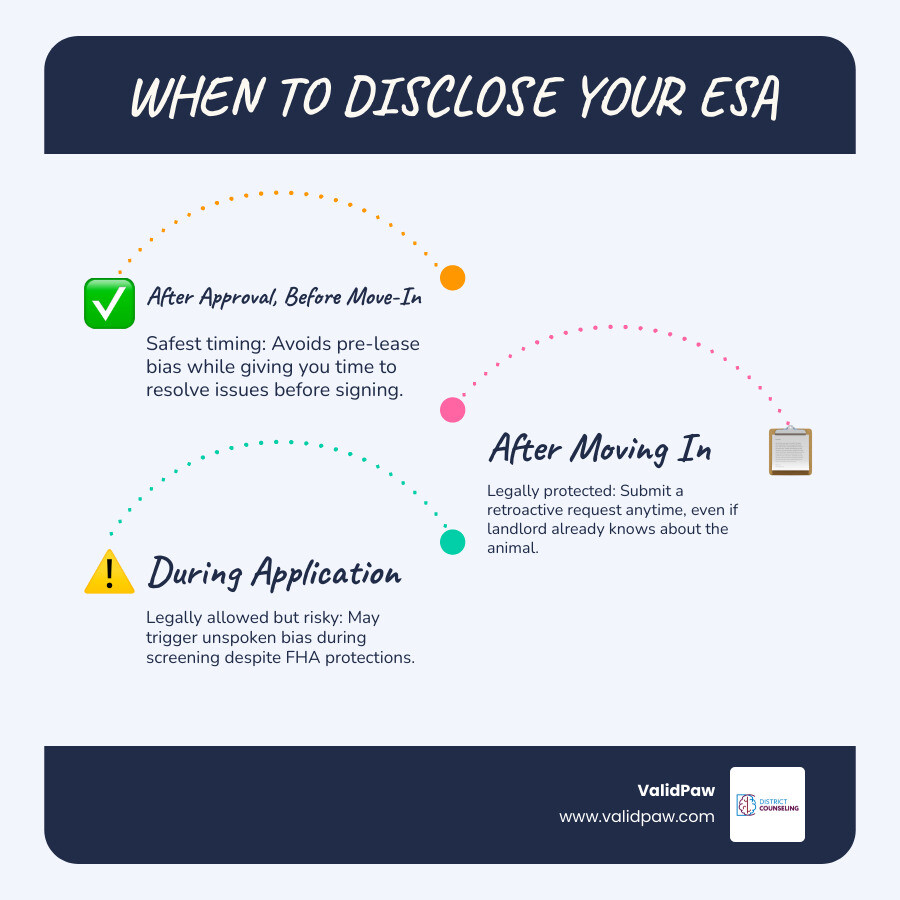
Best times to disclose your ESA to your landlord:
- After your application is approved, but before you move in — This is the safest and most recommended timing. You avoid pre-lease bias and still have time to resolve any issues before signing.
- After you move in — Still legally protected. You can submit a retroactive accommodation request at any point, even if your landlord has already discovered the animal.
- During the application process — Legally allowed, but carries the most risk of unspoken bias during screening.
The bottom line: You are never legally required to disclose your ESA during the rental application process. The Fair Housing Act (FHA) protects your right to request a reasonable accommodation at any stage of your tenancy.
There is no single "perfect" moment — but the timing you choose has real consequences for how your landlord responds and what leverage you have if things go sideways.
I'm Francisco Ortiz, Lead Forensic Mental Health Evaluator and Director of Behavioral Health at District Counseling PLLC, with multi-state licensure and specialized expertise in clinically rigorous ESA evaluations that meet legal housing standards — including guidance on when to tell your landlord about emotional support animal. In this guide, I'll walk you through each timing option, your legal rights under the FHA, and exactly how to submit a request that holds up.
The Strategic Timing: When to Tell Landlord About Emotional Support Animal
As a tenant, navigating the rental market in July 2026 is challenging enough without worrying about whether your assistance animal will get you rejected. The timing of your disclosure is a strategic decision.
While the FHA protects you from discrimination, landlords are human, and unconscious (or conscious) bias exists. If you disclose too early, a landlord might reject your application for an unrelated, seemingly legitimate reason (like credit score or a "more qualified applicant") just to avoid dealing with an animal.
To help you decide, we have broken down the pros and cons of each phase of the disclosure timeline in the table below, based on insights from the When to Tell Your Landlord About an Emotional Support Animal - LegalClarity guide.
Comparison of ESA Disclosure Timings
| Timing Option | Pros | Cons | Risk Level | | :--- | :--- | :--- | :--- | | During Application | Maximum upfront transparency; no surprises. | High risk of unspoken landlord bias and application rejection. | High | | After Approval, Before Move-In | Eliminates application bias; gives landlord time to process paperwork. | Landlord might feel "blindsided," though they cannot legally rescind approval. | Low (Recommended) | | After Move-In (Retroactive) | Zero risk of application rejection; secure in the home. | Can strain the landlord-tenant relationship initially if they have a "no-pets" policy. | Medium |
To visualize how these paths play out, consider this decision-making framework:
Option 1: Disclosing During the Application Process
Disclosing your emotional support animal during the screening phase is the most transparent approach, but it is also the riskiest.
When you declare your ESA on a rental application, you open yourself up to landlord bias. Under the FHA, landlords cannot legally reject you because of an assistance animal. However, proving that an application was denied specifically because of your ESA is incredibly difficult. A landlord can easily claim they chose another applicant because of a slightly higher credit score, better references, or simply because they applied first.
If you choose this route, you do so for the sake of total transparency. If the landlord reacts positively, you know you are moving into a welcoming environment. If they reject you illegally and you suspect it was due to your ESA, you can file a fair housing complaint. However, most renters prefer to avoid the headache of fighting a legal battle before they even have a place to live.
Option 2: Disclosing After Approval but Before Moving In
According to legal experts and housing advocates in the Emotional Support Animal Rights in Rental Housing (2026 Complete Guide) | ReadYourLease guide, this is the "sweet spot."
Once the landlord approves your application and offers you a lease, they have legally established that you are a qualified tenant based on your merits (credit, income, background). If you disclose your ESA at this point—before signing the lease or right after signing but before moving the animal in—the landlord cannot legally back out without exposing themselves to a massive discrimination lawsuit.
This transition period gives your landlord a reasonable window (usually 10 business days is considered appropriate) to process your accommodation request, verify your documentation, and waive any pet fees. It strikes a perfect balance: it protects you from pre-lease discrimination while giving the landlord the professional courtesy of advance notice.
Option 3: Disclosing After Moving In
Can you wait until you are fully moved in and unpacked to tell your landlord about your ESA? Yes, absolutely. Under the FHA, you can submit a retroactive reasonable accommodation request at any time.
This option is highly protective of your housing security. If you already live in the unit and your landlord discovers your animal, or if you decide to get an ESA mid-tenancy, you are fully within your rights to request an accommodation. Even if your lease has a strict "no-pets" policy, a valid ESA letter serves as an immediate defense against lease violations and eviction threats.
For a deeper dive into how housing laws protect you once you are already in your apartment, check out our Ultimate Guide to Emotional Support Animal Housing.
Legal Protections and Risks of Late Disclosure

Many renters worry that waiting to disclose their ESA will make them look "dishonest" or lead to legal trouble. Let’s clear up the legal realities of late disclosure under federal guidelines.
Is It Illegal to Wait to Tell Landlord About Emotional Support Animal?
No, it is entirely legal. The Fair Housing Act and the Department of Housing and Urban Development (HUD) are very clear on this: tenants have no legal obligation to disclose their need for an assistance animal during the application process.
Because landlords are legally barred from considering an assistance animal as a factor in their screening process, you are not "lying" or "hiding" anything by remaining silent. You are simply exercising your right to a fair, unbiased application process.
If a landlord attempts to evict you or charge you with a lease violation because you brought an undisclosed ESA into a "no-pets" building, they are on thin ice. Once you present a legitimate ESA letter, the landlord must halt any eviction proceedings related to the animal and evaluate your accommodation request. To ensure your documentation is ironclad from day one, read our guide on How to Give Your Landlord ESA Proof That Actually Sticks.
How State Laws Impact When to Tell Landlord About Emotional Support Animal
While the FHA is a federal law that applies nationwide, several states have passed laws to curb fraudulent ESA claims. For example, in Texas—where we operate and evaluate many clients—about a dozen states have enacted laws that penalize misrepresenting a pet as an ESA. Penalties can include steep fines ranging from a few hundred to over a thousand dollars, and even misdemeanor charges.
These laws do not take away your right to have an ESA, nor do they change when to tell landlord about emotional support animal. Instead, they enforce the integrity of the documentation. As long as you have a legitimate letter from a licensed healthcare professional, you are fully protected.
To learn more about the distinction between real documentation and online scams, you can read Do I Have to Disclose My Emotional Support Animal? - LegalClarity .
How to Submit a Formal ESA Accommodation Request

Once you decide when to disclose, you need to know how to do it professionally. You should always make your request in writing to establish a clear paper trail.
What Documentation Do You Need to Provide?
To request a reasonable accommodation, you must provide your landlord with an official ESA letter. This letter must come from a licensed mental health professional (LMHP) or healthcare provider.
According to HUD guidelines, a legitimate ESA letter must establish that:
- You have a physical or mental impairment that substantially limits one or more major life activities.
- You have a disability-related need for the animal (the animal provides emotional support that alleviates one or more symptoms of your condition).
Your landlord cannot legally demand to see your medical records, ask for your specific diagnosis, or require the animal to wear a special vest or be registered on a public database.
We have written several comprehensive resources to help you understand these requirements:
- For a breakdown of what the letter must contain, see Everything You Need to Know About Your ESA Landlord Letter and Don't Get Hounded Everything Your ESA Letter Must Include.
- To understand the legal framework, read The Ultimate Guide to Fair Housing Act ESA Letters and Everything You Need to Know About Requirements for ESA Letter Success.
- To see what landlords look for during verification, check out Emotional Support Verification Letter What Every Landlord Needs to See and Everything You Need in a Tenancy Confirmation Letter.
Step-by-Step Guide to Requesting Accommodation
Follow these steps to submit your request seamlessly:
- Obtain Your Letter First: Never request an accommodation before you have your letter in hand. If you need a fast, legally compliant letter, we can help. Learn more about verifying legitimacy in our guide: Is Your ESA Letter Legitimate How to Spot the Real Deal.
- Submit Your Request in Writing: Send an email to your landlord or property manager. State clearly that you are requesting a "reasonable accommodation under the Fair Housing Act for my emotional support animal." Attach your ESA letter.
- Keep a Paper Trail: If you submit the request via physical mail, use certified mail with a return receipt. If using email, save the thread.
- Allow Time to Respond: While there is no strict federal deadline, HUD guidelines state that landlords must respond to accommodation requests promptly. Generally, 10 business days is considered the standard for a reasonable response time.
Landlord Rights, Limitations, and Legal Grounds for Denial
While the law heavily favors tenants with legitimate needs, landlords do have rights. Understanding these boundaries will help you avoid a rejection.
When Can a Landlord Legally Deny an ESA?
A landlord cannot simply say "no" because they don't want animals in their building. However, they can legally deny your request under the following narrow circumstances:
- Direct Threat to Health or Safety: If your specific animal has a documented history of aggressive behavior, biting, or causing substantial property damage, the landlord can reject it. They cannot, however, deny an animal based on assumptions about its breed or size.
- Undue Financial or Administrative Burden: If accommodating the animal would cause the landlord severe financial hardship (e.g., if their building's insurance policy would be canceled because of the animal's breed, though this is rare and must be proven).
- The "Mrs. Murphy" Exemption: The FHA does not apply to owner-occupied buildings with four or fewer units (e.g., a duplex where the landlord lives in one of the units) or single-family homes rented directly by the owner without a real estate agent.
- Fraudulent Documentation: If you present a fake certificate purchased from a registry mill rather than a letter from a licensed professional, the landlord can legally reject it.
What to Do If Your Landlord Denies or Ignores Your Request
If your landlord unlawfully rejects your valid letter or simply ignores your emails, you have options:
- Get the Denial in Writing: Always ask the landlord to state their reasons for denial in writing.
- Educate Them on the Law: Send a polite follow-up email referencing HUD’s guidelines and the FHA. Often, landlords are simply misinformed. You can share our article, No Pets Allowed Not With a Valid ESA Letter, to help them understand their obligations.
- Engage in the Interactive Process: The law requires landlords to engage in a dialogue with you to find a solution before issuing a flat denial.
- File a Complaint: If they remain obstinate, you can file a housing discrimination complaint with the Texas Civil Rights Department (or your local state agency) or directly with HUD. In 2020, almost 73% of all fair housing discrimination complaints involved rentals, and just under 55% of all complaints involved alleged discrimination based on disability—HUD takes these complaints very seriously.
Frequently Asked Questions About ESA Housing Rights
Can a landlord charge pet rent or deposits for an ESA?
No. Under the Fair Housing Act, emotional support animals are classified as assistance devices, not pets—much like a wheelchair. Therefore, landlords are strictly prohibited from charging pet deposits, one-time pet fees, or monthly pet rent. However, you remain financially liable for any physical damage your animal causes to the property (such as scratched floors or chewed blinds).
Do breed or weight restrictions apply to emotional support animals?
No. Blanket breed, size, or weight restrictions established by a building or HOA do not apply to ESAs. A landlord cannot deny a Great Dane or a Pit Bull simply because of its breed or size. They can only deny a specific animal if that individual animal poses a direct, documented threat to the safety of others.
Does the Fair Housing Act cover all types of housing?
The FHA covers most housing, including traditional apartments, condominiums, and college dormitories. However, as mentioned earlier, it exempts small owner-occupied buildings of two to four units (the "Mrs. Murphy" exemption) and single-family homes rented out directly by the owner without a broker.
Conclusion
Deciding when to tell landlord about emotional support animal is all about protecting your peace of mind and your housing security. For most renters, disclosing your ESA after your application is approved but before you move in provides the perfect balance of legal safety and professional courtesy.
No matter which timing you choose, the key to a successful, stress-free approval is having an ironclad, legally compliant ESA letter.
At ValidPaw, we make this process simple, fast, and completely stress-free. We connect you with licensed Texas therapists (and licensed professionals across all 50 states) for secure telehealth evaluations. Within 24 to 48 hours, you will receive an FHA-compliant ESA letter featuring instant landlord verification—no office visits required.
Don't leave your housing security to chance. Get your legitimate, legally binding ESA letter today.