What a Judge Needs in an Employment Verification Letter for Court
An employment verification letter for court should be a short, factual document from an authorized employer representative. It should confirm only the details the case requires, such as the employee's job title, dates of employment, current status, pay, usual work hours, and the writer's direct contact information.
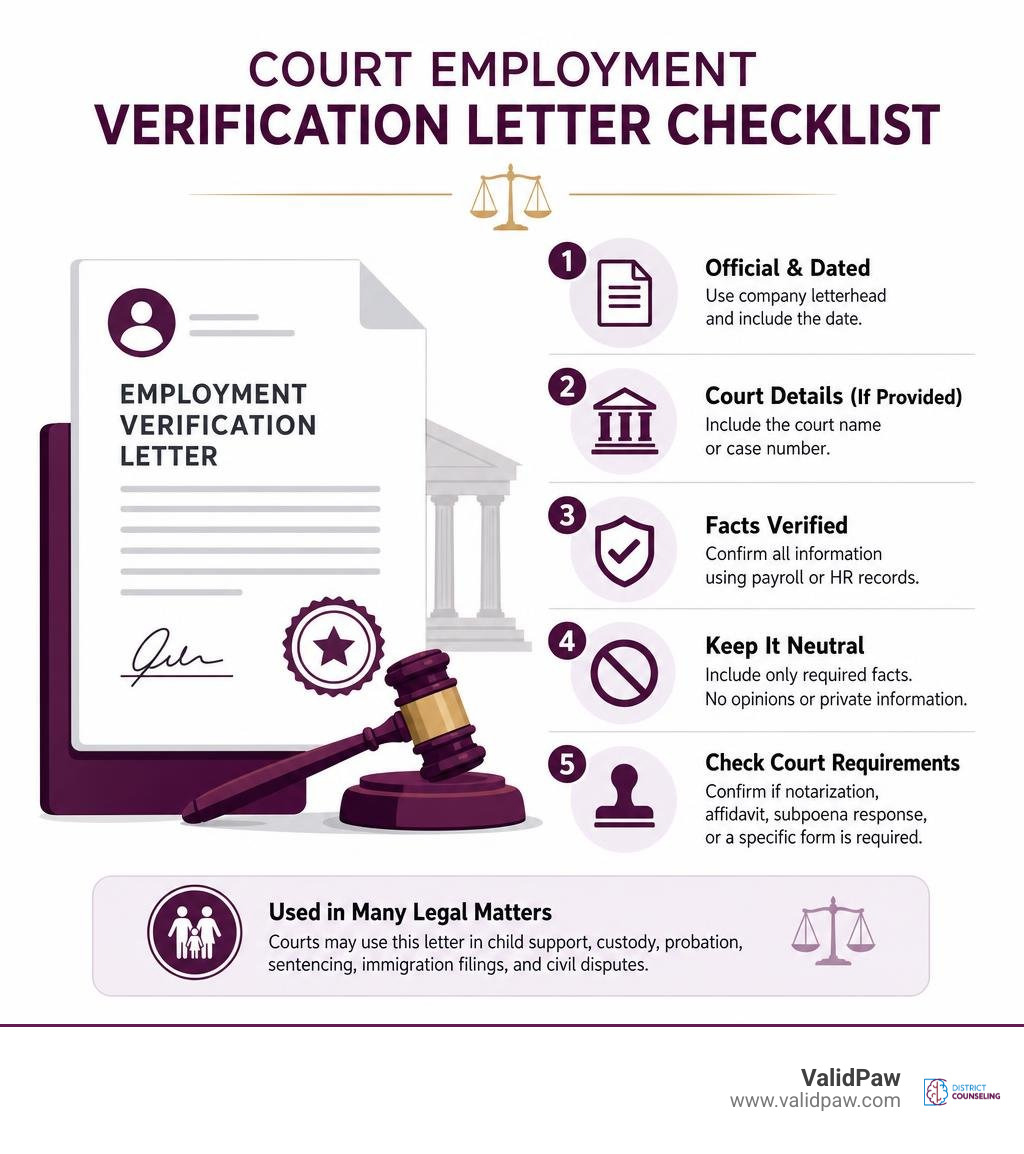
To make it useful in court:
- Put it on official company letterhead and date it.
- Include the court name or case number if the requester provides one.
- Verify every fact against payroll or HR records before signing.
- Keep the language neutral. Do not add medical information, discipline, opinions, or private identifiers such as a Social Security number.
- Check whether the court requires a notarized statement, affidavit, subpoena response, or a specific form before delivery.
Courts may use this letter in child support or custody matters, probation cases, sentencing, immigration filings, and civil disputes. A clear letter can help confirm income, work stability, or a schedule. But it is not a character reference unless the court or attorney specifically asks for one.
I am Francisco Ortiz, a forensic mental health evaluator and behavioral health director with experience preparing clear, evidence-based documentation for legal and disability-related matters across several states. In this guide, I will explain how an employment verification letter for court can present reliable work facts while protecting privacy and avoiding unsupported claims. For ValidPaw readers, the same documentation principles matter when landlords, courts, agencies, or housing providers need clear verification connected to legitimate telehealth evaluations, ESA letters, or official document checks.
What Is an Employment Verification Letter for Court and When Is It Required?
An employment verification letter for legal proceedings serves as sworn or formal documentary evidence. Unlike informal notes, a judge, magistrate, or probation officer relies on this document to make decisions that impact personal freedom, parental rights, and financial obligations.
Judges routinely require verified employment details across several legal settings:
- Child Support and Alimony Calculations: Family courts need an accurate baseline of gross earnings, hourly rates, and standard overtime to determine equitable support orders under official state child support verification requirements.
- Child Custody and Visitation Schedules: Judges examine exact work shifts and travel commitments to build realistic parenting time arrangements.
- Probation and Parole Compliance: Maintaining steady, verifiable employment is frequently a mandatory condition of supervised release.
- Bail and Sentencing Hearings: Demonstrating strong community ties through stable employment helps defense counsel argue for lower bail, work-release programs, or mitigated sentencing.
- Civil Litigation and Wage-Loss Claims: In personal injury or contract disputes, verified earnings establish financial loss.
- Immigration Proceedings: Verifying continuous employment helps demonstrate self-sufficiency and community stability before immigration tribunals.
| Feature | Standard Verification Letter | Court Employment Verification Letter | | :--- | :--- | :--- | | Primary Audience | Landlords, mortgage lenders, background check firms | Judges, attorneys, probation officers, hearing officers | | Evidentiary Weight | Commercial qualification document | Admissible legal evidence; subject to cross-examination | | Specific Details Needed | Basic dates of tenure and standard salary | Exact hours, shifts, overtime patterns, bonus structures | | Case Identification | Rarely required | Needs case caption, docket number, or court division | | Authentication Form | Standard business letter or digital sign-off | Official letterhead, declaration of truth, notarization |
Essential Components Judges and Court Officials Require

When a judge reviews an employment verification letter, they look for clarity, authenticity, and precise figures. Omitting basic identifiers can delay a hearing or result in the document being ruled inadmissible.
To satisfy standard rules of evidence and align with U.S. Department of Labor employment verification standards, make sure the letter includes:
- Official Company Letterhead: Full legal business name, physical street address (our teams in Texas hubs like Houston, Austin, Dallas, Fort Worth, San Antonio, as well as Chicago and all 50 states always verify local entity registration), corporate phone number, and official website.
- Date of Issuance: A clear timestamp showing the document is current.
- Court and Case Identifiers: The court name, presiding judge (if known), and formal case/docket number.
- Employee Identification: Full legal name and employee identification number (do not use full Social Security numbers).
- Employment Dates and Status: Exact start date, current standing (active, on leave, or separated), and classification (full-time, part-time, seasonal, W-2, or 1099 contractor).
- Detailed Compensation Breakdown: Base hourly wage or gross annual salary, pay frequency, guaranteed bonuses, commissions, and predictable overtime availability.
- Work Schedule and Shift Patterns: Specific days, shift hours, and typical weekly duration.
- Authorized Signatory Details: Printed name, professional title, direct phone extension, official work email, and a physical wet or secure digital signature.
Formatting Standards for an Employment Verification Letter for Court
A court document must maintain an objective, respectful, and professional tone throughout. Address the letter directly to the presiding court or officer (such as "The Honorable Presiding Judge" or "To the Office of Probation and Parole") rather than using a casual greeting.
When drafting legal documentation, securing a signed authorization letter for employee verification protects the organization before sharing financial or scheduling details. Conclude the body of the letter with a formal declaration: "I declare under penalty of perjury under the laws of this jurisdiction that the foregoing employment information is true and correct based on official corporate payroll and personnel records."
What to Exclude to Protect Employee Privacy and Avoid Legal Liability
Employers must balance transparency for the court with state and federal privacy obligations. Including unnecessary commentary creates serious legal exposure for defamation, wrongful disclosure, or violations of privacy statutes.
- Do Not Include:
- Full Social Security numbers (use the last four digits only if explicitly demanded).
- Medical histories, disability accommodations, or leaves of absence under FMLA or ADA.
- Subjective performance criticisms or workplace disciplinary write-ups.
- Speculative reasons for future termination or personal relationship opinions.
- Subjective eligibility-for-rehire remarks that could invite defamation claims.
Step-by-Step Guide to Requesting and Drafting the Letter
Navigating legal requests requires a structured process to ensure deadlines are met without disrupting standard operations.
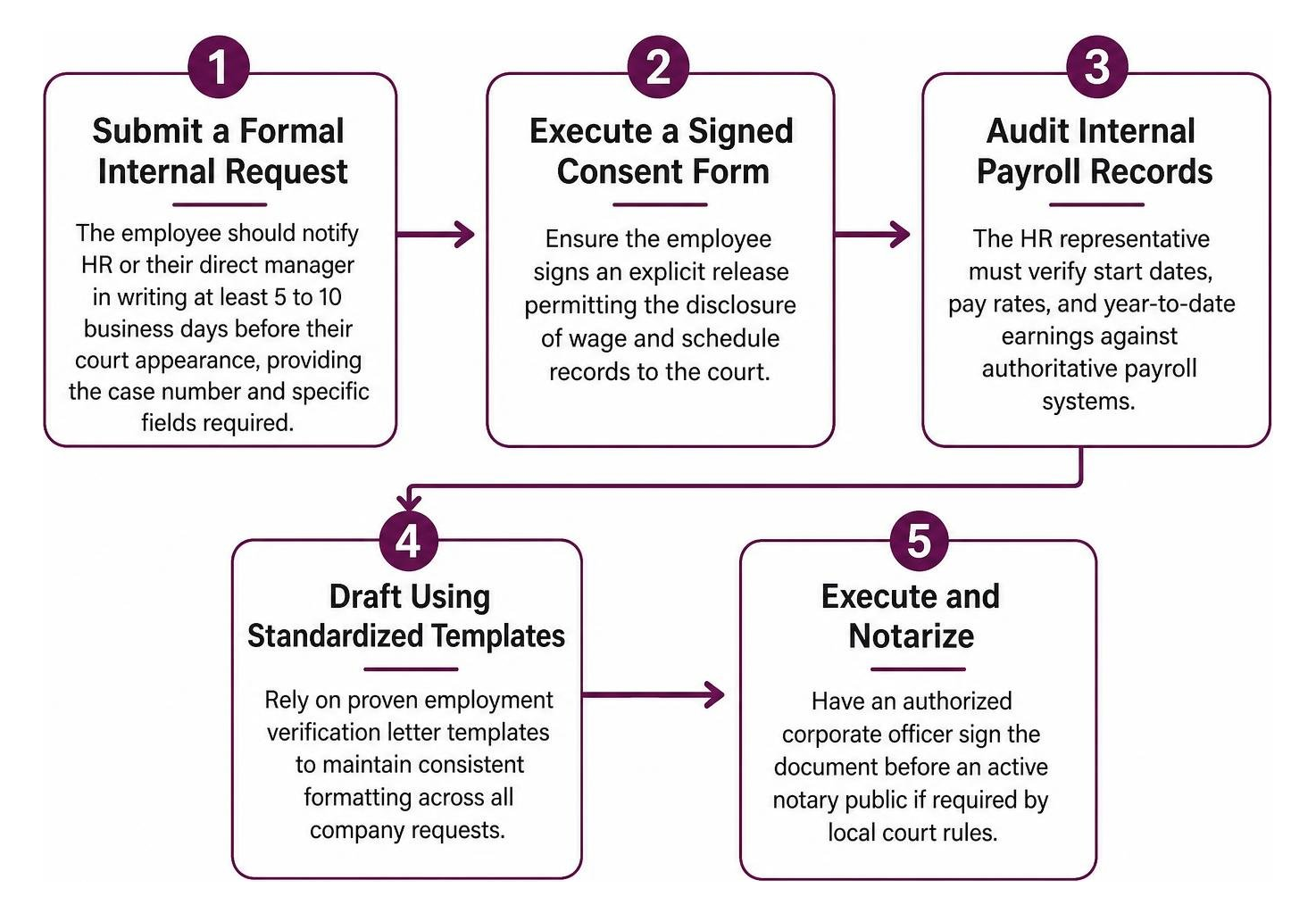
- Submit a Formal Internal Request: The employee should notify HR or their direct manager in writing at least 5 to 10 business days before their court appearance, providing the case number and specific fields required.
- Execute a Signed Consent Form: Ensure the employee signs an explicit release permitting the disclosure of wage and schedule records to the court.
- Audit Internal Payroll Records: The HR representative must verify start dates, pay rates, and year-to-date earnings against authoritative payroll systems.
- Draft Using Standardized Templates: Rely on proven employment verification letter templates that actually work to maintain consistent formatting across all company requests.
- Execute and Notarize: Have an authorized corporate officer sign the document before an active notary public if required by local court rules.
- Retain Permanent Records: Archive a stamped copy of the letter and the employee's written consent in their confidential personnel file.
Best Practices for Writing an Employment Verification Letter for Court
Accuracy is everything in a judicial setting. Conflicting figures between an employer's letter and submitted tax documents (like W-2s or 1040s) can undermine an employee's credibility in front of the judge.
Keep your statements strictly factual. If you are drafting employee work verification letters, stick strictly to measurable metrics: hours logged, established shifts, base wage rates, and official job descriptions. Avoid editorializing on personal character unless defense counsel has formally requested an independent character mitigation statement.
Customizable Templates for Specific Legal Scenarios
The examples below are template language only. Replace each bracketed field with the employee, employer, court, compensation, and contact details that apply to the specific case before using the letter.
1. Child Custody & Family Court (Work Schedule & Income Verification)
To: The Honorable Presiding Judge / Clerk of the Court
In re: Employee legal name
Case No.: Case or cause number
Date: Date of issuance
This letter serves as formal employment verification for the employee named above in connection with the referenced proceeding.
- Employment Details: The employee has been employed with the company since the verified start date in the role of their current job title as a full-time or part-time employee, as applicable.
- Compensation: Base compensation should be listed as the verified hourly rate or annual salary, paid on the correct weekly, bi-weekly, semi-monthly, or monthly schedule. Year-to-date gross earnings should match payroll records.
- Work Schedule: The standard shift schedule should list the regular days worked, start and end times, total weekly hours, and whether mandatory overtime or weekend travel is required.
I declare under penalty of perjury that the foregoing employment and wage records are true and correct based on verified corporate payroll data.
Authorized Signatory:
Signature: ___________________________
Printed Name: Authorized signatory name
Title: Human Resources Director, Payroll Manager, or other authorized title
Direct Phone: Direct business line | Email: Work email address
Company: Company legal name
2. Probation or Parole Officer Verification
To: Office of Probation and Parole
Re: Employment Verification for the employee named in the supervision file
Supervision / Client ID: Supervision or client identification number
Date: Date of issuance
This letter confirms that the employee named above is actively employed with the company at the verified physical worksite address.
- Position Title: Current job title
- Start Date: Verified employment start date
- Current Status: Active, full-time or part-time
- Standard Working Hours: Regular workdays and shift hours
- Average Weekly Hours: Verified average weekly hours
- Rate of Pay: Verified hourly wage or salary
Please contact the undersigned directly if you require periodic attendance or schedule updates.
Authorized Signatory:
Signature: ___________________________
Printed Name: Authorized signatory name
Title: HR Representative, Department Supervisor, or other authorized title
Direct Phone: Direct business line | Email: Work email address
Company: Company legal name
3. General Legal & Income Verification (Civil or Bail Proceedings)
This template serves general litigation matters where simple proof of earnings is required, similar to what you might use when preparing a mortgage employment verification letter or resolving an apartment employment letter dispute.
To: The Presiding Court / Officer of the Court
Re: Employment and Wage Statement for the employee named in the case file
Docket / Cause No.: Docket number, if applicable
Date: Date of issuance
This document certifies that the employee named above is currently employed with the company in the verified position listed in payroll or HR records.
- Hire Date: Verified hire date
- Employment Classification: Full-time, part-time, or regular W-2 classification
- Gross Pay: Verified hourly wage or annualized salary
- Pay Frequency: Bi-weekly, semi-monthly, monthly, or other verified pay cycle
- Average Weekly Hours: Verified average weekly hours
This information is provided solely for official legal record purposes based on verified internal human resources and payroll files.
Authorized Signatory:
Signature: ___________________________
Printed Name: Authorized signatory name
Title: Corporate Officer, HR Administrator, or other authorized title
Direct Phone: Direct business line | Email: Work email address
Company: Company legal name
Frequently Asked Questions About Court Employment Letters
Can an employer legally refuse to provide a verification letter for court?
Under general federal employment standards, private employers are not automatically mandated to draft custom verification letters upon an employee's informal request. However, if an employer is served with a formal judicial subpoena, court order, or statutory agency directive (such as a mandatory state child support enforcement notice), compliance is legally required. Refusing a formal subpoena can result in civil contempt of court sanctions, fines, and legal penalties for the company.
Does an employment verification letter for court need to be notarized?
Whether an employment verification letter must be notarized depends on local court rules and the specific legal proceeding. For uncontested child support adjustments or routine probation check-ins, a standard signed letter on official company letterhead often suffices. However, in contested evidentiary hearings, custody trials, or civil lawsuits, judges frequently require a sworn affidavit or a notarized verification of authenticity to admit the document into evidence without requiring the HR director to testify in person.
How recent must the employment verification letter be for legal proceedings?
Courts generally enforce a strict freshness standard: documents must typically be dated within 30 days of the scheduled hearing or filing deadline. Submitting documentation older than 60 days risks judicial rejection, as earnings, hours, and employment statuses can change quickly.
Conclusion
A well-prepared employment verification letter provides the court with the factual baseline needed to make informed decisions. By maintaining neutral language, confirming all compensation figures against official payroll data, using formal company letterhead, and securing necessary employee consents, employers and workers can fulfill legal duties smoothly and protect against unwanted liability.
ValidPaw readers often need documents that are clear, verifiable, and appropriate for formal review. If you need a legitimate ESA letter through a licensed telehealth evaluation, or if a landlord or housing provider needs to confirm an existing document, ValidPaw provides fast professional evaluations and official document verification services for Texas, Chicago, and all 50 states.