What You Need to Know About ADA Service Dog Laws
ADA service dog laws require businesses, nonprofits, and state and local governments to allow trained service animals to accompany people with disabilities in most public spaces — even if a "no pets" policy exists.
Here is a quick summary of the key rules:
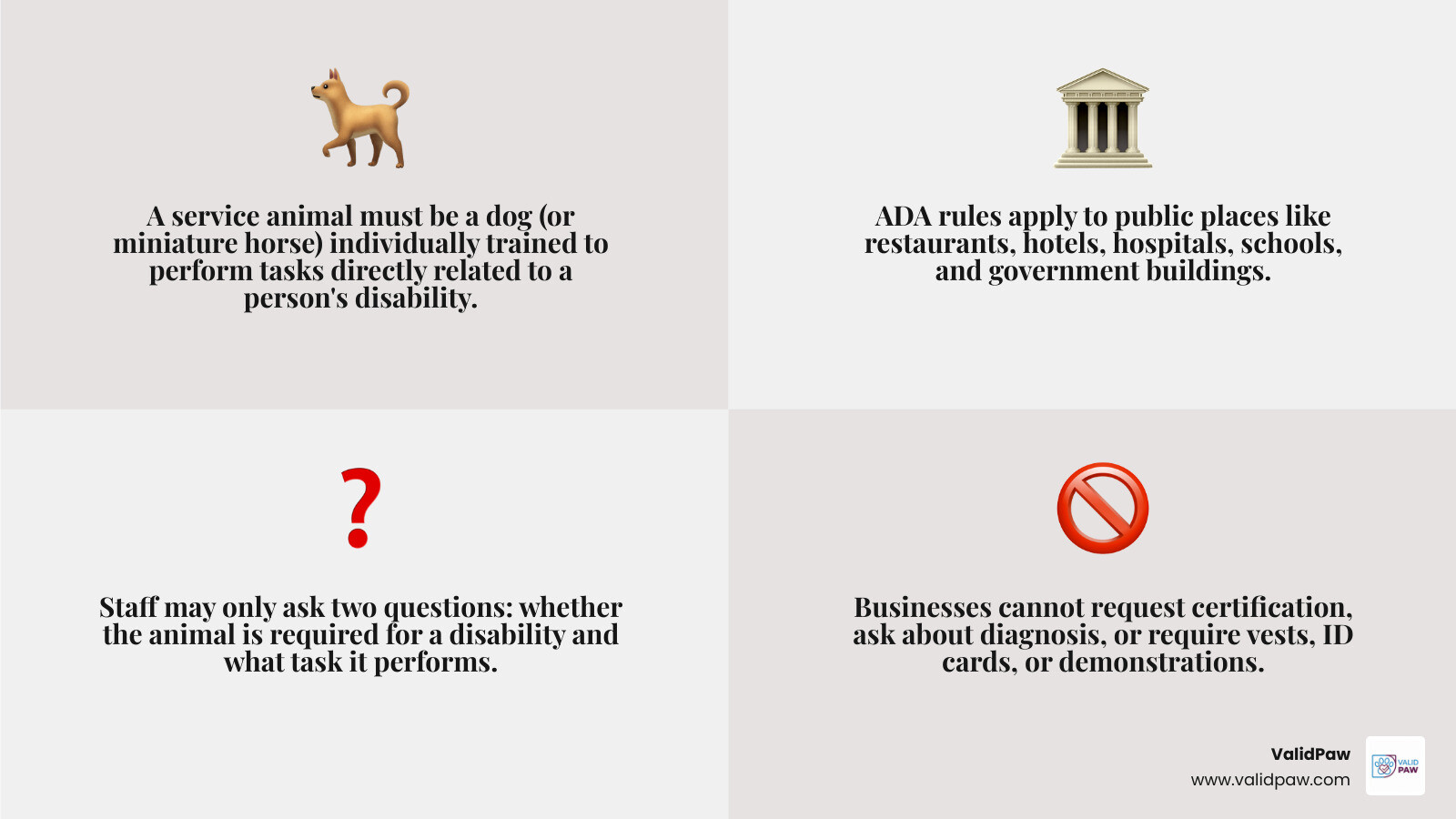
- What qualifies: A dog individually trained to perform a specific task directly related to a person's disability
- Where they're allowed: Restaurants, hotels, hospitals, schools, government buildings, and most other public spaces
- Two questions staff may ask: (1) Is the dog a service animal required because of a disability? (2) What work or task has the dog been trained to perform?
- What staff cannot do: Request certification, ask about your diagnosis, or require a vest or ID
- When a service animal can be removed: Only if it is out of control or not housebroken
- Emotional support animals (ESAs): Not covered under the ADA — but they do have protections under the Fair Housing Act (FHA)
Understanding these rules matters whether you are a person with a disability, a renter seeking housing accommodations, or a business owner trying to stay compliant.
I'm Francisco Ortiz, Lead Forensic Mental Health Evaluator and Director of Behavioral Health at District Counseling PLLC, with multi-state licensure and specialized expertise in disability documentation — including evaluations directly relevant to ADA service dog laws and emotional support animal assessments. My forensic background gives me a grounded, evidence-based perspective on how these federal protections work in real life, which I'll draw on throughout this guide.
Understanding ADA Service Dog Laws and Definitions
At the federal level, the Americans with Disabilities Act, or ADA, is the main law that governs service animals in public settings. The law itself and DOJ regulations make one point very clear: under the ADA, a service animal is usually a dog that has been individually trained to do work or perform tasks for a person with a disability. You can review the statutory framework at Americans with Disabilities Act of 1990, As Amended | ADA.gov and the practical guidance at Service Animals | ADA.gov.
That definition matters because a lot of confusion starts right there. A service dog is not defined by a vest, a badge, a registration card, or a very serious facial expression. It is defined by training and function.
To qualify under the ADA, the dog must:
- Be a dog, with limited separate rules for miniature horses
- Be individually trained
- Perform work or tasks directly related to the handler's disability
The disability can be physical, sensory, psychiatric, intellectual, or another qualifying disability under the ADA. The key is the connection between the disability and the trained task.
The ADA also makes clear that service dogs can be any breed or size. Businesses generally cannot exclude a service dog just because of breed stereotypes. That is especially important for people in large metro areas like Houston, Austin, Dallas, San Antonio, Fort Worth, and Chicago, where local pet rules can vary but still cannot override federal ADA access rights.
That said, state and local laws can still apply in some limited ways. For example, service dogs may still need to follow generally applicable dog rules such as licensing and vaccination requirements if those rules apply to all dogs. In Texas, state guidance also recognizes public access rights while allowing routine animal control rules that apply across the board. See Texas Disability Law - Service Animals.

Defining Tasks and Work (ADA Service Dog Laws)
This is where many people mix up service animals with emotional support animals.
Under the ADA, the dog must be trained to do a specific job related to the person's disability. The task cannot be just general comfort from the animal's presence. The work has to be active, trained, and disability-related.
Examples of qualifying tasks include:
- Guiding a person who is blind or has low vision
- Alerting a person who is deaf or hard of hearing to sounds
- Pulling a wheelchair
- Retrieving dropped items
- Opening doors or pressing accessible buttons
- Alerting to blood sugar changes
- Detecting or responding to seizures
- Reminding a person to take medication
- Interrupting self-harm behavior
- Alerting to an oncoming panic attack and taking trained action
- Providing trained deep pressure therapy during a psychiatric episode
- Creating space in a crowd or leading a handler to an exit
Psychiatric service dogs are real service dogs under the ADA when they are trained to perform these kinds of disability-related tasks. That is different from an ESA, which may provide comfort simply by being present.
For official examples and FAQs, see Service Animals | ADA.gov and Frequently Asked Questions about Service Animals and the ADA | ADA.gov.
Miniature Horses as Service Animals (ADA Service Dog Laws)
The ADA's general definition focuses on dogs, but there is a separate rule for miniature horses. In some cases, public entities and businesses must make reasonable modifications to allow a trained miniature horse.
Whether a miniature horse can be accommodated depends on factors such as:
- Its type, size, and weight
- Whether the facility can handle those characteristics
- Whether the miniature horse is under the handler's control
- Whether it is housebroken
- Whether its presence compromises legitimate safety requirements
So, are miniature horses automatically admitted everywhere? No. They are considered case by case. A spacious government building may be able to accommodate one more easily than a cramped coffee shop during the lunch rush.
The governing federal regulation is § 35.136 Service animals., and DOJ guidance also discusses miniature horse accommodations in public settings.
Public Access Rights and Limitations
In general, service dogs are allowed in areas where members of the public are allowed to go. That includes most:
- Restaurants
- Hotels
- Retail stores
- Hospitals and clinics
- Schools and universities
- Government buildings
- Public transportation areas
- Theaters and entertainment venues
This is true even when the business has a no-pets policy. Under the ADA, a service dog is not treated as a pet.

A few common examples help:
- A restaurant cannot require a person with a service dog to sit outside instead of indoors.
- A hotel cannot limit guests with service dogs to "pet-friendly" rooms only.
- A hospital generally must allow service dogs in patient rooms, waiting areas, and cafeterias.
- A hospital may exclude a service dog from an operating room or burn unit if the animal's presence would create a legitimate safety issue.
- A school should generally allow the service dog and then address allergies or fear of dogs through separate accommodations rather than excluding the animal.
The ADA also applies to food service settings. Health codes do not override ADA access requirements for service dogs in areas open to customers. So yes, the dog can be in the restaurant dining room. No, the dog should not be riding in the shopping cart like royalty.
There are, however, real exceptions. A service animal can be excluded when:
- The dog is out of control and the handler does not take effective action to regain control
- The dog is not housebroken
- The animal's presence would fundamentally alter the nature of the service or program
- In very limited settings, legitimate safety requirements cannot be met with the animal present
"Fundamental alteration" is a legal term, not a magic phrase. It does not mean "this is inconvenient." It means the animal's presence would change the essential nature of what is being provided. For example, dogs are not allowed in swimming pools under public health rules, though they may be allowed on pool decks.
If a service dog is properly excluded, the business or agency still has to offer the person the opportunity to receive goods or services without the animal present, if that is possible.
For official access guidance, see ADA Requirements: Service Animals | ADA.gov and Frequently Asked Questions about Service Animals and the ADA | ADA.gov .
Handler Responsibilities and Verification Rules
The ADA gives strong public access rights, but handlers also have responsibilities.
A handler is responsible for the service animal's:
- Care
- Supervision
- Feeding
- Veterinary care
- Toileting
- Cleanup
- Behavior and control
Public entities and businesses are not required to supervise or care for the dog. Their job is access, not dog-sitting.
In most situations, the service dog must be harnessed, leashed, or tethered. If those devices interfere with the dog's work or the person's disability prevents their use, the handler must still control the dog through voice, signal, or other effective means.
A service dog does not need to be silent at all times, but it does need to be under control. Occasional barking in direct response to a trained task may be different from repeated disruptive barking at every spoon in the room.
Just as important are the verification rules. When it is not obvious that a dog is a service animal, staff may ask only two questions:
- Is the dog a service animal required because of a disability?
- What work or task has the dog been trained to perform?
That is it. No pop quiz, no medical interrogation, no demand for a diploma.
Staff may not:
- Ask about the nature or extent of the person's disability
- Require medical documentation
- Demand certification or registration
- Require the dog to wear a vest or ID tag
- Ask the dog to demonstrate its task
Here is a simple comparison:
| Permitted inquiries | Prohibited inquiries | | --- | --- | | Is the dog required because of a disability? | What is your diagnosis? | | What work or task has the dog been trained to perform? | Show me the certificate or registration | | | Make the dog prove it can do the task | | | Require a vest, badge, or ID card |
The ADA also prohibits extra pet fees or surcharges for service dogs. However, if a business normally charges customers for actual damage they cause, it may charge a handler for damage caused by the service dog on the same basis.
For more guidance, see ADA Requirements: Service Animals and Frequently Asked Questions about Service Animals and the ADA | ADA.gov .
Comparing Federal Protections: ADA, FHA, and ACAA
One of the biggest misunderstandings around ada service dog laws is assuming the ADA governs every place a person goes with an animal. It does not.
Different federal laws apply in different settings.
ADA
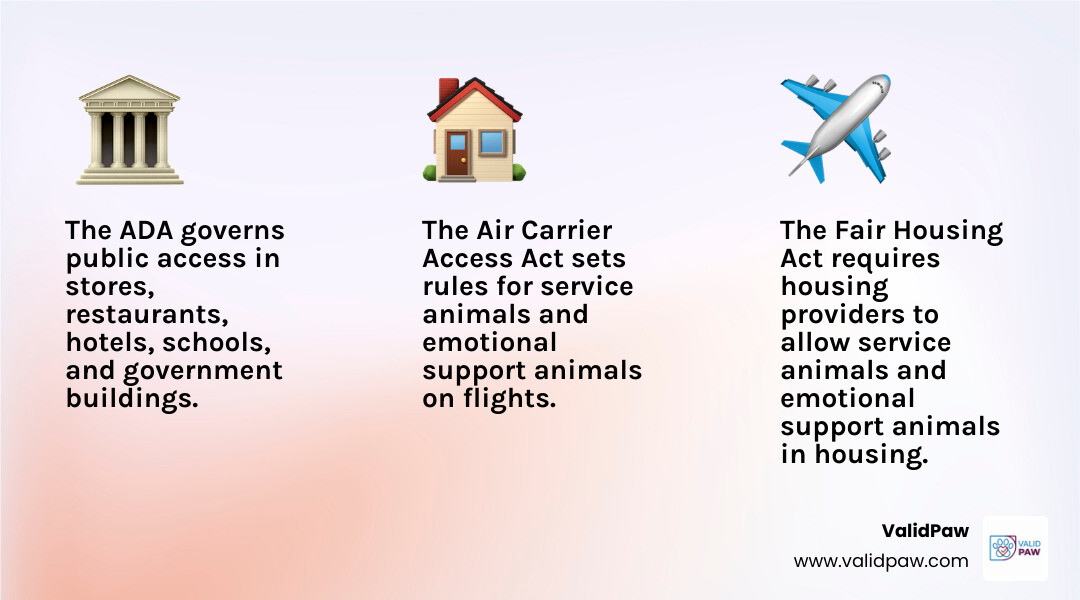
The ADA governs public access in places like stores, restaurants, hotels, schools, and government buildings.
Under the ADA:
- Service animals are generally dogs trained for disability-related tasks
- ESAs are not service animals
- Public access rights are broad
- Businesses cannot require documentation
FHA
The Fair Housing Act governs housing, including many rentals and apartment settings.
Under the FHA:
- "Assistance animals" can include service animals and emotional support animals
- An ESA may qualify even without task training
- Housing providers can request reliable disability-related documentation in some cases, especially when the disability or need is not obvious
- Pet fees generally cannot be charged for a qualifying assistance animal
This is where legitimate documentation matters. If you are dealing with housing, our resources on Is Your ESA Letter Legitimate? How to Spot the Real Deal and Don't Get Hounded: Everything Your ESA Letter Must Include can help explain what landlords should actually look for.
We also recommend reading:
- Emotional Support Verification Letter: What Every Landlord Needs to See
- Everything You Need to Know About Your ESA Landlord Letter
- Rental Verification Letters and How to Get Them Without the Stress
ACAA
The Air Carrier Access Act governs air travel, not the ADA.
As of the current federal framework in May 2026, airlines generally recognize trained service dogs and may require specific U.S. Department of Transportation forms. Emotional support animals do not have the same status they once had on airlines and are typically treated under airline pet policies instead.
That means:
- A dog may qualify as a service animal under the ADA for public access
- Housing rights may involve the FHA
- Airline travel rules are governed separately by the ACAA and DOT rules
If you want a side-by-side federal comparison, the Assistance Animals and Individuals With Disabilities Under Federal Laws: Matrix and Practice Considerations | ADA National Network is especially useful.
Frequently Asked Questions about ADA Service Dog Laws
Can a business ask for a service dog's certification or registration?
No. Under the ADA, businesses and staff cannot require certification, registration, identification cards, training papers, or a vest as a condition of entry.
There is no federal ADA certificate that makes a dog "official." Many online registries sell impressive-looking documents, but those are not what gives a service dog legal status. What matters is whether the dog is individually trained to perform disability-related tasks for a person with a disability.
A business may ask only the two questions we covered above when the need is not obvious.
Are emotional support animals (ESAs) covered under the ADA?
No, not for public access.
An emotional support animal may provide comfort, companionship, or relief from anxiety or depression, but if the animal is not trained to perform a specific disability-related task, it is not a service animal under the ADA.
That said, ESAs can still be protected in housing under the FHA. This is an important distinction, especially for renters. If you need housing-related ESA documentation, a legitimate process matters much more than a flashy certificate.
What can I do if I am denied access with my service animal?
Start by staying calm and explaining the ADA rules clearly. Sometimes the problem is not hostility. It is bad training, confusion, or a front-desk employee who is improvising legal policy from memory.
You can:
- Politely explain that ADA rules allow service dogs in public areas
- Answer the two permissible questions, if asked
- Ask to speak with a manager or ADA coordinator
- Document what happened, including the date, time, names, and what was said
- Keep receipts, photos, or witness information if relevant
- File a complaint with the U.S. Department of Justice when appropriate
If the denial involves a state or local government service, additional complaint procedures may apply. If it involves housing rather than public access, the FHA may be the correct legal framework instead of the ADA.
In especially serious or repeated access-denial situations, consulting a qualified attorney may be appropriate.
Conclusion
Understanding ADA service dog laws comes down to a few core ideas: service animals under the ADA are usually task-trained dogs, public access rights are broad, staff can ask only two questions, and emotional support animals are not covered by the ADA for public access.
Where people often get tripped up is mixing ADA rules with housing rules. If your issue involves a rental property rather than a restaurant, store, or government building, the FHA is usually the law to look at.
At ValidPaw, we focus on legitimate ESA documentation for housing through telehealth evaluations by licensed Texas therapists, serving Texas and all 50 states. Our process is built for speed and compliance, with FHA-minded documentation and instant landlord verification when needed.
If you need help with housing accommodations for an emotional support animal, Apply for your legitimate ESA letter today.