
Your ESA Letter Has an Expiration Date — Here's What That Means for Your Housing
Understanding emotional support animal letter renewal requirements is simpler than most people think. Here's the quick answer:
| Requirement | Details | |---|---| | How long is an ESA letter valid? | 12 months from the date of issuance | | Who can renew it? | A licensed mental health professional (LMHP) in your state | | What triggers a renewal? | Annual expiration, landlord request, or change in housing | | What must the letter include? | LMHP credentials, license number, issuance date, official letterhead, and statement of need | | Can you renew online? | Yes, through a legitimate telehealth evaluation with a licensed professional |
You found housing you love. Your ESA keeps your anxiety manageable. Then your landlord asks for an updated letter — and yours is 14 months old.
This is more common than you'd think. Most housing providers expect an ESA letter issued within the past year. An outdated letter can mean losing your accommodation, paying pet deposits, or even facing a lease dispute — even if your mental health condition hasn't changed at all.
The good news: renewing your ESA letter is straightforward when you know the rules.
I'm Francisco Ortiz, Lead Forensic Mental Health Evaluator and Director of Behavioral Health at District Counseling PLLC, with multi-state licensure across Texas, California, Florida, and three other states — and my work is grounded in the same clinical and legal standards that govern emotional support animal letter renewal requirements for housing compliance. In the sections below, I'll walk you through everything you need to keep your documentation current, legitimate, and accepted.
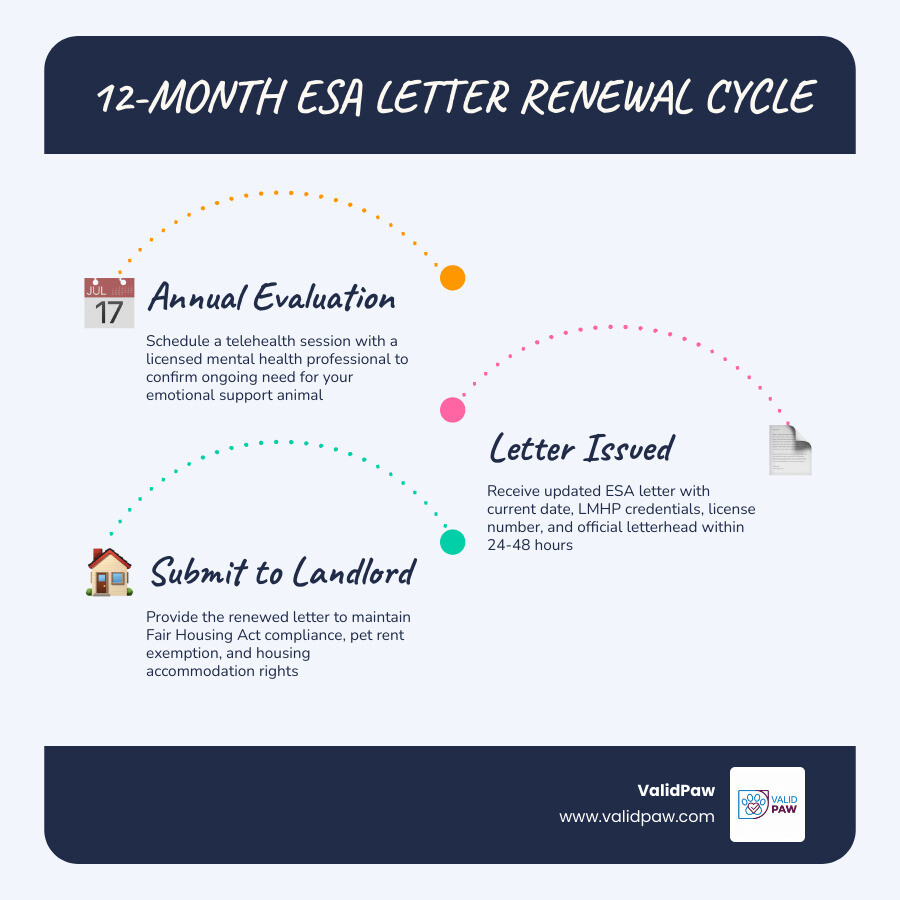
Do ESA Letters Expire? The 12-Month Standard
In practice, yes: most ESA letters are treated as valid for 12 months from the date they were issued.
Here is the important legal nuance. The Fair Housing Act does not spell out a single nationwide expiration date in the statute itself. But in real housing situations, most landlords and housing providers expect documentation that is current, and "current" usually means issued within the past year. That is why annual renewal is the safest standard to follow in May 2026.
For broader fair housing context, the U.S. Department of Housing and Urban Development explains how reasonable accommodation requests are handled under the Fair Housing Act.

Why the one-year standard matters:
- Mental health needs can change over time
- Housing providers often want recent documentation
- A current letter helps avoid delays, disputes, and follow-up requests
- Renewing yearly shows that the need for the ESA has been professionally re-evaluated
Some housing providers may ask for updated paperwork more often, such as every six months, especially during lease renewals or when their internal review process is stricter. That does not mean they can demand endless paperwork on a whim, but it does mean older letters often cause friction.
If you want a deeper breakdown of what landlords can ask for, our guide on ESA landlord letters is a helpful next read.
A simple rule of thumb: if your letter is approaching its one-year anniversary, renew it before your landlord asks. It is the paperwork version of changing your smoke detector batteries before the chirping starts.
Emotional Support Animal Letter Renewal Requirements for Housing
For housing, the renewed ESA letter should support a reasonable accommodation request under fair housing rules. In plain English, it tells the housing provider that you have a disability-related need for the animal's emotional support.
That can matter in situations involving:
- No-pet housing policies
- Pet rent
- Pet deposits or pet fees
- Breed or size restrictions that would normally apply to pets
An ESA is not just a pet with a nicer resume. The animal's role is connected to your mental health, and the letter is what documents that need.

A housing provider can usually request reliable documentation when the disability or disability-related need is not obvious. But they generally should not require:
- "Registration" in an official ESA database
- A vest, badge, certificate, or ID card
- Training records like those used for service animals
- Highly intrusive medical records or full diagnosis details beyond what is necessary
That last point matters. ESAs do not require special task training the way service animals do. And there is no official federal or state ESA registry. If someone tries to sell you a magical registration number that "never expires," save your money and maybe buy your animal a better toy.
ESA housing rights vs. standard pet rules
| Issue | Emotional Support Animal | Standard Pet | |---|---|---| | No-pet policy | May be exempt as a reasonable accommodation | Usually must comply | | Pet rent | Often waived | Commonly charged | | Pet deposit/fees | Often waived | Commonly charged | | Breed/size restrictions | Not automatically applicable if accommodation is approved | Commonly enforced | | Required documentation | Valid ESA letter from licensed professional | Usually vaccination or pet policy forms | | Special training required | No | No |
For a closer look at what a compliant document should say, see what your ESA letter must include.
Essential Information in Emotional Support Animal Letter Renewal Requirements
A renewed ESA letter should be clear, current, and professionally issued. While wording varies by clinician, a valid letter typically includes:
- The licensed mental health professional's official letterhead
- Your full legal name
- The date of issuance
- A statement that you have a qualifying mental or emotional health condition or disability-related need recognized for housing accommodation purposes
- A statement that the emotional support animal is part of that support need
- The clinician's full name and credentials
- License type, license number, and state of licensure
- Contact information for verification
In some cases, the letter may also reflect that an appropriate clinician-patient relationship exists and that the provider has recently evaluated your current circumstances.
What should not worry you:
- Your specific diagnosis may not need to be spelled out in detail
- The letter does not need a government seal
- You do not need an ESA certificate, badge, or laminated card
What should worry you:
- No letterhead
- No license number
- No date
- No way to verify the provider
- Vague language that never actually connects the ESA to your disability-related need
If you want to compare formatting and language examples, these sample ESA letters can help you understand what real documentation looks like.
How to Renew Your ESA Letter Online
Yes, you can renew an ESA letter online, and for many people that is the easiest route.
A legitimate online renewal is not just filling out a form and getting instant approval 90 seconds later. A proper telehealth renewal involves an actual evaluation by a licensed mental health professional authorized to practice in your state.
A typical online renewal process looks like this:
- Complete an intake or screening questionnaire
- Provide updated information about your current mental health symptoms and how your animal helps
- Meet with a licensed mental health professional by phone or video, if required by the provider's process
- The clinician reviews whether an ESA remains clinically appropriate
- If approved, you receive updated documentation dated for the new evaluation period
- You submit the renewed letter to your landlord or housing provider
A legitimate telehealth evaluation should include:
- A real clinician, not just an automated checkout page
- A provider licensed in your state
- A review of your current symptoms and functioning
- Ethical discretion, meaning approval is not guaranteed
- A dated letter delivered securely if approved
At ValidPaw, we focus on legitimate telehealth evaluations and FHA-compliant letters, with no office visits and fast turnaround. If you are trying to understand the process before you start, our guide to getting a legitimate mental health support letter quickly walks through what to expect.
Can you use a different mental health professional for renewal? Yes. You do not have to go back to the exact same provider. A new clinician can issue a renewed letter if they evaluate you and determine the ESA is still appropriate. That is especially helpful if you have moved, changed therapists, or your original provider no longer writes ESA letters.
Navigating State-Specific Emotional Support Animal Letter Renewal Requirements
State law can affect how renewal works, especially when telehealth is involved.
For readers in our service areas, the biggest issue is usually whether the clinician is properly licensed for your state and whether a prior relationship is required before issuing the letter.
Important examples from current research:
- California may require a 30-day clinician-patient relationship before an ESA letter can be issued
- Some sources also identify Montana, Iowa, and Louisiana as states with similar 30-day relationship rules
- Certain states may have their own documentation expectations layered on top of federal housing standards
Because ValidPaw serves Texas and all 50 states, we pay close attention to state compliance. If you live in Texas, Houston, Austin, Dallas, San Antonio, Fort Worth, or Chicago, the practical takeaway is this:
- Your clinician must be licensed where you live
- If you moved to a new state, your old therapist may not be able to renew your letter unless licensed there
- If your state has a relationship rule, same-day "instant" approval may not be legally sufficient
Arkansas is sometimes mentioned in industry content as a state with more regular renewal expectations, but the safest broad advice is still annual review unless your housing provider or state rules require something more current.
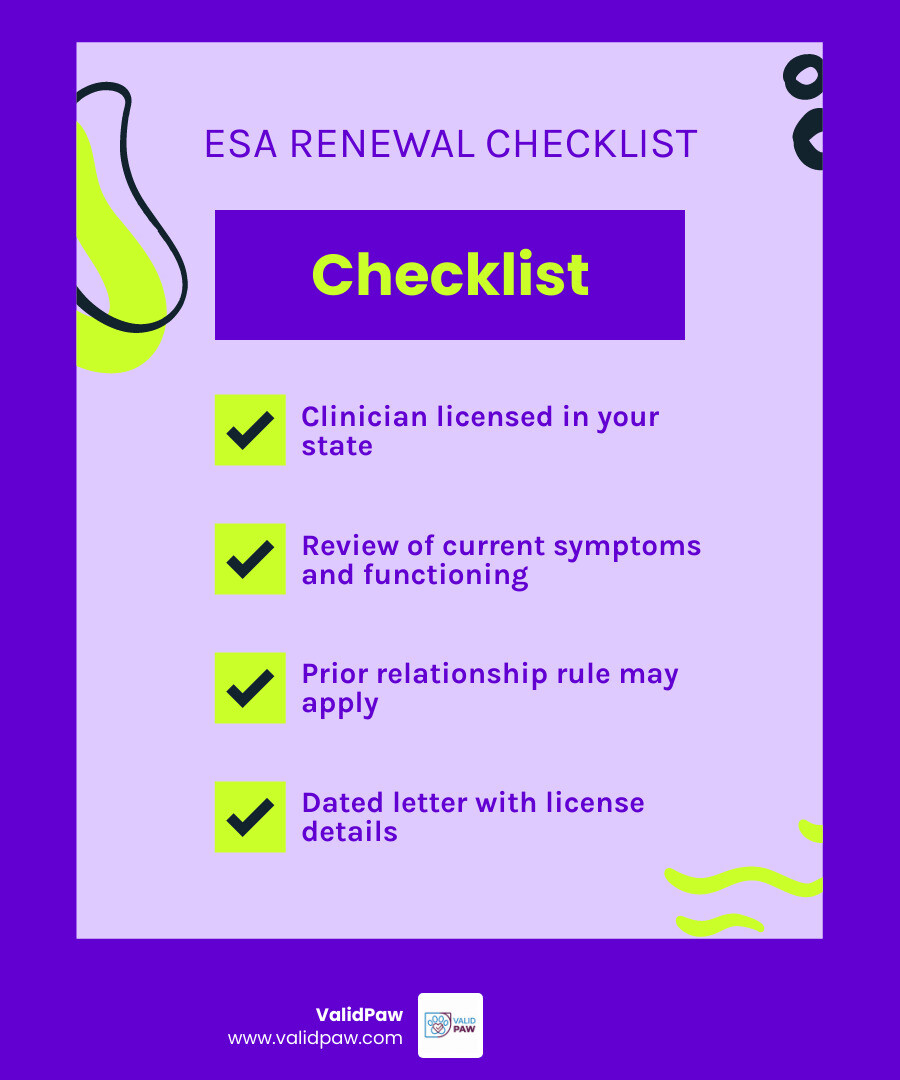
Before renewing, ask:
- Is the provider licensed in my state?
- Is there a required waiting period or prior relationship rule?
- Will the renewed letter include the provider's license information and current date?
- Is there a landlord verification option if my housing provider has questions?
Avoiding Scams and Invalid Documentation
This is the part where the internet gets weird.
ESA scams are everywhere, especially around renewals. Many websites sell "registrations," "certifications," ID cards, vests, or lifetime approvals. None of those things are what housing law actually relies on.
Common ESA renewal scams include:
- Instant approval with no clinical evaluation
- "Lifetime" ESA letters
- Official-sounding ESA registries or databases
- Cheap certificate bundles that do not include a clinician letter
- Providers who will not show license details
- Websites that promise guaranteed landlord acceptance
Here is the reality:
- There is no official ESA registry under federal or state law
- Registration and certification are not substitutes for a real ESA letter
- Since 2021, ESA letters also do not create airline access rights the way many scam sites still imply
- A landlord can reject documentation that is outdated, unverifiable, or not from a properly licensed professional
How to protect yourself during renewal:
- Verify the clinician's license in your state
- Make sure there is an actual mental health evaluation
- Read the letter carefully before sending it to housing
- Look for official letterhead, license details, and issue date
- Avoid any service selling accessories as if they create legal rights
If you are not sure whether your current paperwork is the real deal, read how to spot a legitimate ESA letter.
Frequently Asked Questions about ESA Renewal
Can I renew my ESA letter with a different mental health professional?
Yes. You can renew with a different licensed mental health professional as long as that person is authorized to practice in your state and performs a real evaluation.
People switch providers for all kinds of normal reasons:
- They moved to a new state
- Their therapist retired
- Their original clinician no longer offers ESA letters
- They want telehealth instead of in-person care
The new professional is not "rubber-stamping" the old letter. They must independently assess whether you still have a disability-related need for the animal. If they conclude that you do, they can issue a new letter.
What are the consequences of using an expired ESA letter?
Using an expired or stale letter can create serious housing problems, including:
- Delays in approval for a rental application
- Landlord requests for updated documentation
- Loss of accommodation for no-pet exceptions
- Being charged pet rent, pet fees, or deposits
- Disputes during lease renewal
- Stress at exactly the moment your ESA is supposed to help reduce it
A technically old letter may still be accepted in some long-term housing situations, but that is not something we recommend relying on. Most housing providers want a letter dated within the past 12 months, and a fresh evaluation puts you in a much stronger position.
If your renewed letter is denied or revoked during the process, do not panic. First, ask why. Possible reasons include:
- The clinician did not find sufficient current clinical support
- The provider was not licensed in your state
- The documentation was incomplete
- Your housing provider questioned authenticity
Your next steps may include:
- Request clarification from the clinician or service
- Correct any factual errors
- Seek a new evaluation from a properly licensed professional if appropriate
- Confirm exactly what your housing provider is requesting
- Keep all communication in writing
Do I need to renew my letter if I haven't moved?
Usually, yes. Even if nothing in your life has changed and you are in the same apartment with the same landlord and the same excellent cat who still judges everyone from the windowsill, annual renewal is still the best practice.
Why?
- Housing providers often want current documentation
- Lease renewals can trigger another review
- A current date reduces the chance of a challenge
- Ongoing evaluation supports the idea that the ESA remains part of your care
If your landlord has never asked for an update, an older letter might continue to sit quietly in the file. But once a new property manager, lease renewal, or policy review comes along, an outdated letter may suddenly become an issue.
Conclusion
ESA renewal is less about jumping through hoops and more about keeping your housing documentation current, credible, and easy for landlords to verify. In May 2026, the safest standard is simple: renew your ESA letter every 12 months, make sure it comes from a licensed mental health professional in your state, and confirm it contains all required compliance details.
At ValidPaw, we help people across Texas and all 50 states get legitimate ESA letters through telehealth evaluations with licensed therapists, often within 24 to 48 hours. We also provide instant landlord verification, which can make the renewal process smoother when housing offices have questions.
If you want a fast, compliant path forward, or you just want to understand your options better, visit our ESA FAQ page.
Staying current now can save you a lot of stress later. And your ESA would probably agree, if treats are involved.

