
What a PSA Animal Actually Is (And Why It Matters for Your Housing Rights)
A PSA animal — short for Psychiatric Service Animal — is a dog trained to perform specific tasks that directly reduce the symptoms of a mental health disability.
Quick answer:
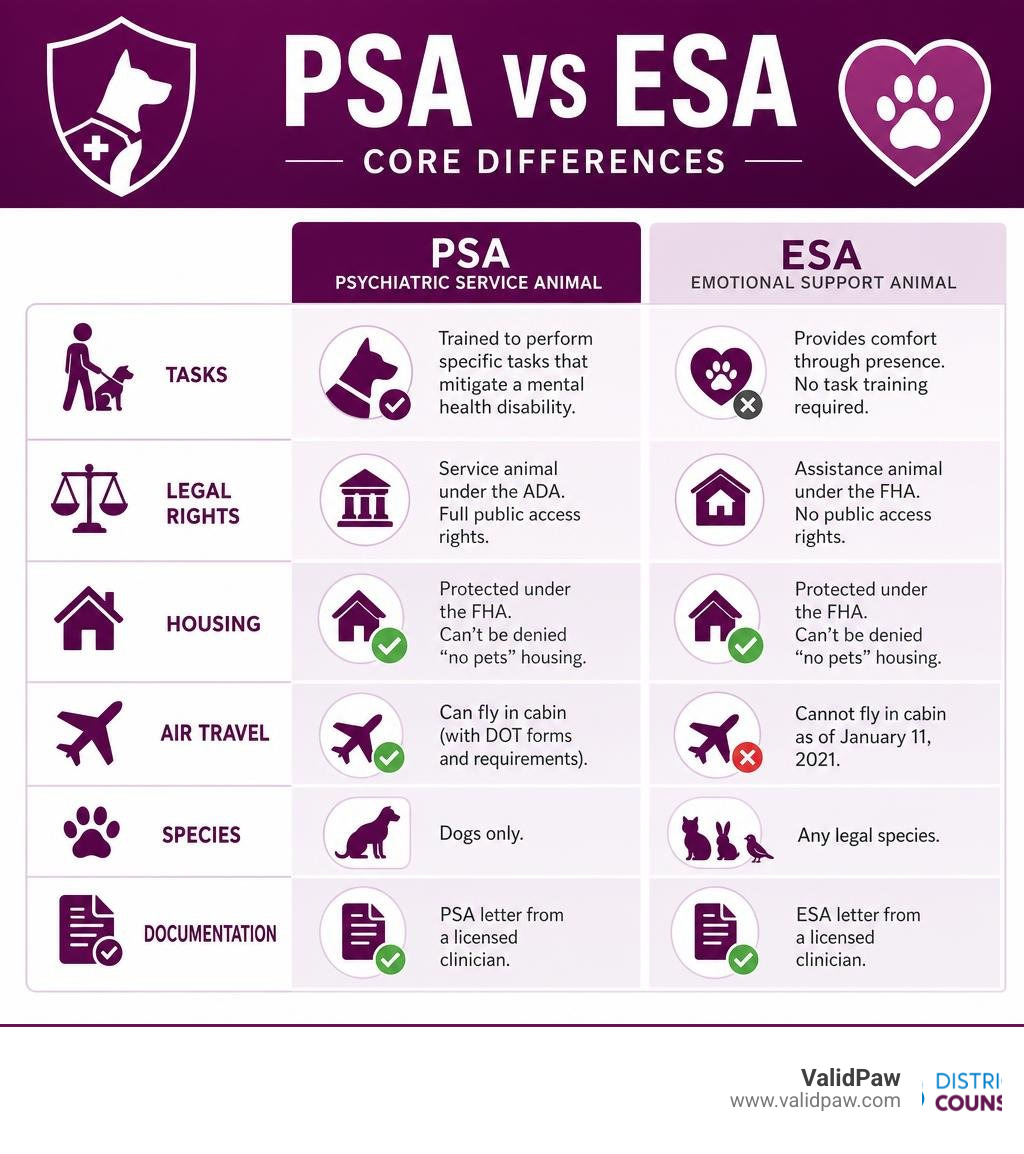
| Feature | PSA (Psychiatric Service Animal) | ESA (Emotional Support Animal) | |---|---|---| | Legal category | Service animal under the ADA | Assistance animal under the FHA | | Species allowed | Dogs only | Any legal species | | Task training required | Yes — specific, disability-related tasks | No | | Public access rights | Yes — restaurants, stores, transit | No | | Housing rights | Yes (FHA) | Yes (FHA) | | Flies in cabin | Yes (with DOT forms) | No (as of January 11, 2021) | | Documentation | PSA letter from licensed clinician | ESA letter from licensed clinician |
This distinction matters more than most people realize. If your landlord is pushing back on your animal, or you've been denied housing because of a "no pets" policy, knowing whether you need a PSA letter or an ESA letter could be the difference between keeping your animal and losing your home.
More than 1 in 5 Americans live with a mental health condition. Yet many people don't know they have legal protections that can override a landlord's pet policy — without ever setting foot in an office.
I'm Francisco Ortiz, Lead Forensic Mental Health Evaluator and Director of Behavioral Health at District Counseling PLLC, with multi-state licensure and extensive experience conducting clinically rigorous PSA animal and ESA evaluations that meet strict legal and housing standards. In the sections below, I'll walk you through everything you need to know to understand your rights and take action.
What is a PSA Animal? Definition and Core Differences
To fully understand what a psa animal is, we must look at how the law defines them. Under the Americans with Disabilities Act (ADA), a Psychiatric Service Animal (PSA) — commonly referred to as a Psychiatric Service Dog (PSD) — is legally recognized as a working animal, not a pet.
The defining characteristic of a PSA is that it has been individually trained to perform active work or physical tasks that directly mitigate a mental, emotional, or learning disability.
This is highly distinct from an Emotional Support Animal (ESA). While an ESA provides vital comfort and therapeutic support simply through its presence, it does not require any specialized training to perform specific tasks. For a deep dive into these differences, check out our guide on Service Dog or ESA? Getting the Facts Straight on Emotional Support Animals.
Defining the PSA Animal vs. ESA
The boundary between a PSA and an ESA comes down to three primary pillars: training, species, and age.
- Task Training vs. Therapeutic Presence: A PSA must be trained to recognize and actively respond to a handler's psychiatric distress. For example, if a dog sits on your lap simply because it likes cuddles, that is comfort (ESA). If the dog is trained to recognize the onset of a panic attack and immediately lie across your chest to apply calming pressure, that is a trained task (PSA).
- Species Limitations: Under federal ADA guidelines, only dogs (and in rare, highly specific cases, miniature horses) can legally qualify as service animals. ESAs, on the other hand, have no species limitations under the Fair Housing Act (FHA); they can be cats, rabbits, birds, or even reptiles.
- Animal Age: While an ESA can be any age (including a young puppy), a fully qualified Psychiatric Service Dog must be developmentally mature enough to perform its tasks reliably. In practice, a dog must be at least 1 year old and fully housebroken to legally operate as a completed PSA in public spaces.
Alternative Meanings of PSA Animal
If you have been searching online for the term "PSA animal," you may have stumbled across a few confusing acronym overlaps. Let's clear up the alphabet soup:
- Protection Sports Association (PSA): In the canine sports world, PSA - PSAK9-AS refers to a highly competitive dog sport that tests obedience and controlled protection under intense distraction (such as ignoring active decoys in bite suits).
- Swiss Animal Protection (Protection Suisse des Animaux - PSA): In Europe, PSA is the acronym for Switzerland's largest national animal welfare organization, which has advocated for agricultural and domestic animal rights for over 160 years.
- State Animals: Sometimes people search for "PSA" thinking of public service announcements regarding local wildlife or state-designated animals. If you're curious about native species across the country, you can check out the official list of what is your state animal? See the list of animals in all 50 states.
For our purposes, we are focusing strictly on the federal and state-protected psa animal used for psychiatric disability support.
Qualifying Conditions and Trained Tasks for Psychiatric Service Dogs
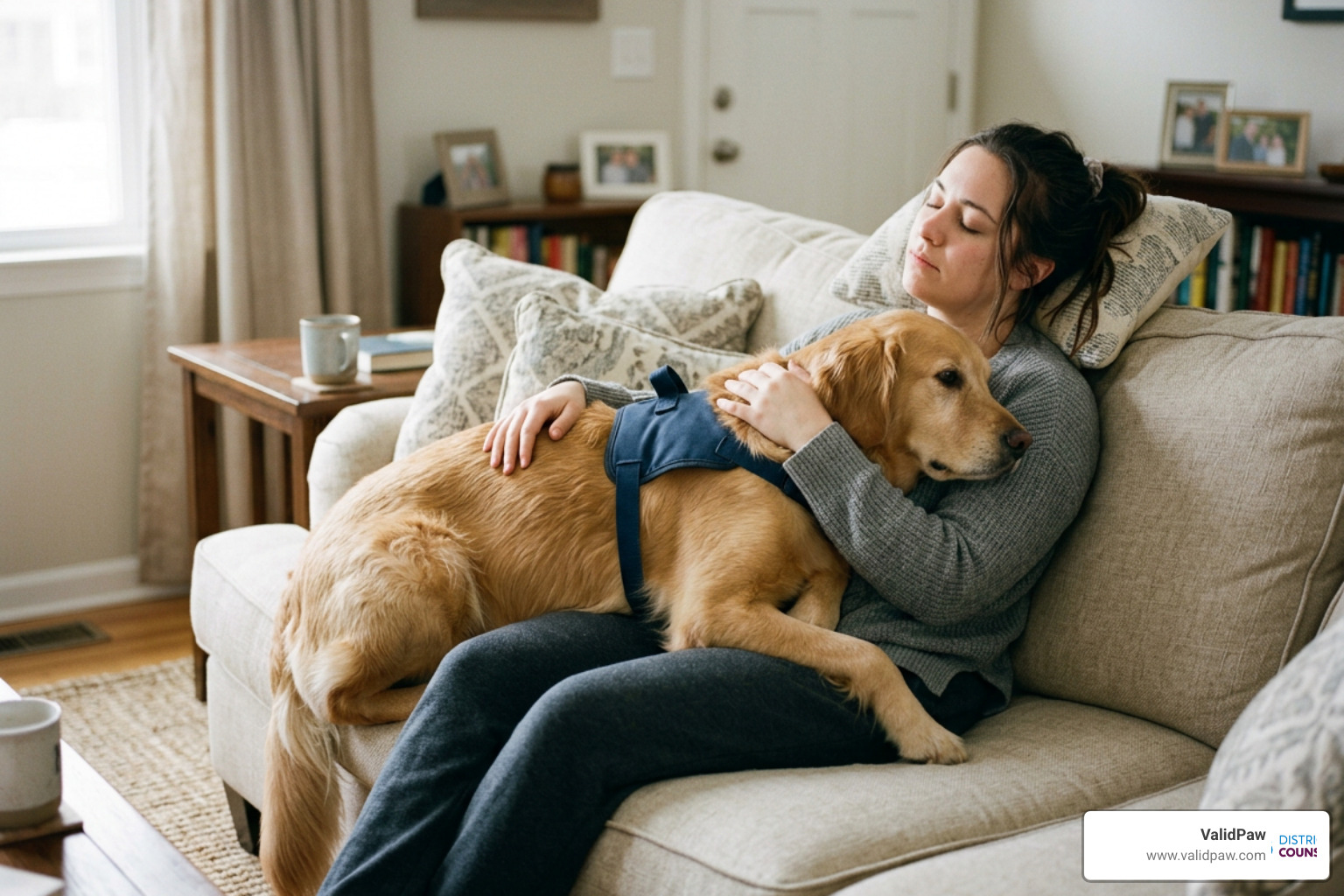
A common misconception is that service dogs are only for visible physical disabilities, such as blindness or mobility impairments. In reality, psychiatric disabilities are often completely invisible, yet they qualify individuals for a PSA under the ADA.
To qualify for a Psychiatric Service Animal, a person must have a diagnosed mental health condition that substantially limits one or more major life activities. Common qualifying conditions include:
- Post-Traumatic Stress Disorder (PTSD)
- Severe Anxiety and Panic Disorders
- Major Depressive Disorder
- Obsessive-Compulsive Disorder (OCD)
- Bipolar Disorder
- Attention-Deficit/Hyperactivity Disorder (ADHD)
Specific Tasks a PSA Can Perform
The legal status of a psa animal hinges entirely on the tasks it is trained to perform. These tasks must be directly linked to the handler’s specific disability.
- Deep Pressure Therapy (DPT): The dog uses its body weight to apply pressure to the handler's chest, lap, or abdomen. This tactile stimulation triggers a calming neurological response, lowering the heart rate during panic attacks or sensory overload.
- Tactile Distraction and Grounding: During a dissociative episode, flashback, or severe anxiety spike, the dog can nudge, lick, or gently apply teeth pressure to the handler's arm to bring them back to the present moment.
- Medication Reminders: A PSA can be trained to retrieve a medicine bottle or ring a physical bell at specific times of the day, persisting until the handler takes their medication.
- Night Terror Interruption: For individuals with PTSD who suffer from severe nightmares, a dog can detect physical signs of distress (such as thrashing or rapid breathing) and gently wake the handler, turning on a light if trained to do so.
- Threat Assessment and Room Searches: For those experiencing hyper-vigilance, a dog can enter a dark room ahead of the handler, perform a search, and bark once or turn on a light to signal that the space is safe.
- Crowd Buffering: In crowded public spaces, a PSA can be trained to stand behind or in front of the handler ("block" or "post" commands) to create a comfortable physical boundary and prevent strangers from getting too close.
Legal Protections and Public Access Rights
Understanding where your psa animal is legally allowed to go is crucial to avoiding public confrontation and protecting your rights.
Under federal law, PSAs enjoy the highest level of legal protection afforded to any assistance animal. They are covered by several landmark civil rights laws:
- The Americans with Disabilities Act (ADA): Titles II and III of the ADA grant fully trained service dogs public access rights. This means they are legally allowed to accompany their handlers into virtually all public spaces, including restaurants, grocery stores, hotels, hospitals, and public transit.
- The Fair Housing Act (FHA): Protects individuals with disabilities from housing discrimination, ensuring both PSAs and ESAs can live with their owners regardless of landlord pet policies.
- The Air Carrier Access Act (ACAA): Governs the rights of travelers with disabilities on commercial flights.
- The Individuals with Disabilities Education Act (IDEA): Allows students with disabilities to bring their trained service dogs into public schools and university classrooms.
For local city guidelines, such as those in Chicago, the Mayor's Office for People with Disabilities provides specific local resources on Service Animals to ensure local businesses comply with federal standards.
Housing and Shelter Rights (FHA & NYC DHS)
Under the Fair Housing Act, a psa animal is not classified as a "pet." Consequently, landlords and housing providers must make reasonable accommodations to waive "no-pet" policies, breed restrictions, and weight limits. Furthermore, housing providers are strictly prohibited from charging pet deposits, monthly pet rent, or application fees for a PSA or an ESA. For a comprehensive breakdown of these protections, read The Ultimate Guide to Emotional Support Animal Housing.
These protections also extend to emergency shelter systems. For example, municipal housing and shelter agencies (such as the NYC Department of Homeless Services) are legally required to accommodate trained service animals immediately.
However, policies can differ slightly regarding ESAs in temporary shelters. While a service dog is granted immediate entry, an ESA request in a shelter often requires submitting a formal Reasonable Accommodation Request (RAR) accompanied by professional documentation. In many municipal shelter systems, an ESA may not be allowed to reside in the facility while the RAR is pending review, highlighting the legal advantage of having a fully trained PSA.
Air Travel and Public Spaces (ACAA & ADA)
When navigating public spaces like retail stores, restaurants, or public transit, a business owner or staff member is legally permitted to ask only two specific questions if your disability is not readily apparent:
- Is the dog a service animal required because of a disability?
- What work or task has the dog been trained to perform?
Staff cannot ask about your specific medical diagnosis, demand to see a demonstration of the dog's tasks, or require "certification" paperwork or vests. Religious institutions (such as churches, temples, and mosques) are generally exempt from the ADA and are not legally required to permit service dogs on their premises.
For air travel, the rules changed significantly on January 11, 2021, when the Department of Transportation (DOT) updated its regulations. Airlines are no longer required to accommodate ESAs in the cabin for free. However, PSAs are fully protected. To fly with a PSA, you must submit the official DOT Service Animal Air Transportation Form to the airline before departure, certifying the animal’s health, training, and behavior.
How to Obtain, Train, and Document a Psychiatric Service Animal
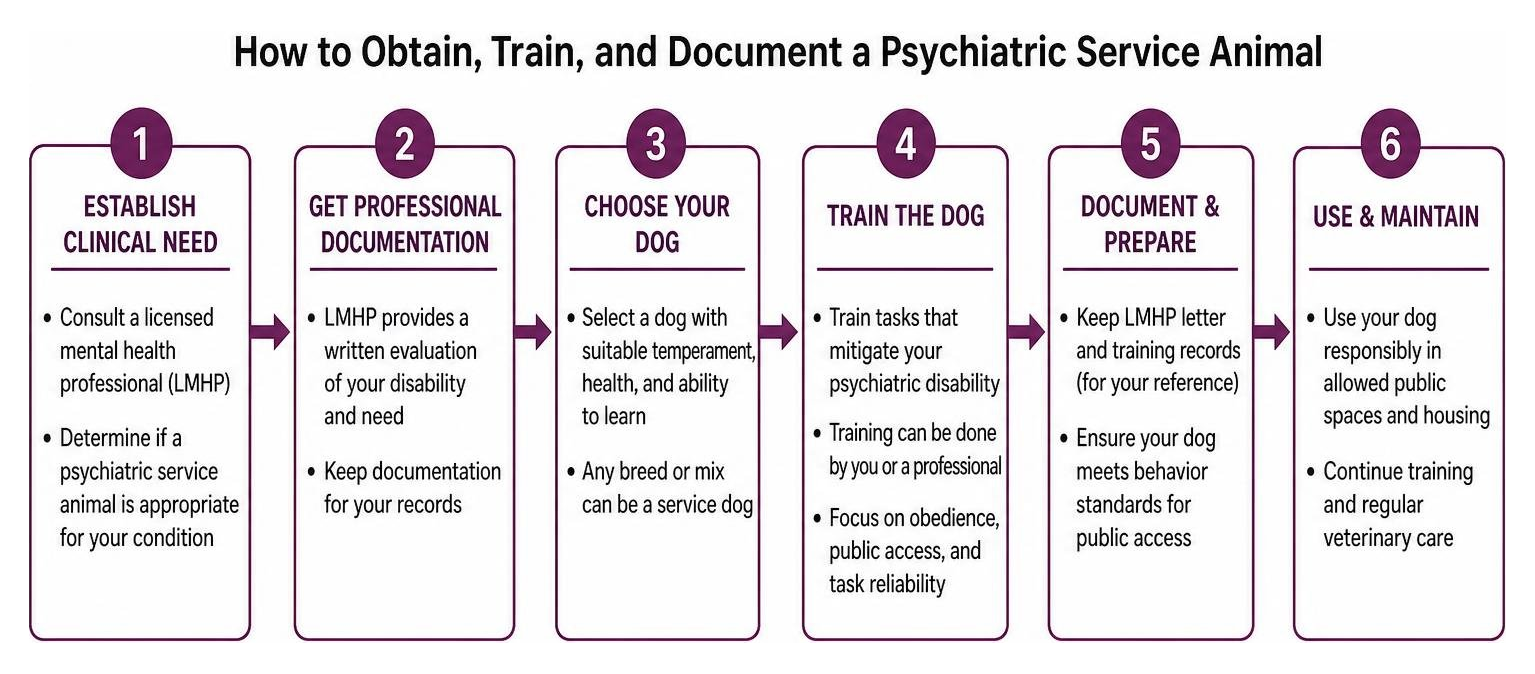
Acquiring a psa animal is a journey that requires careful planning, dedication, and professional support. The process begins with establishing a clinical need for the animal under the guidance of a licensed mental health professional (LMHP). To learn more about how these clinical evaluations work, see The Ultimate Guide to Emotional Support Animal Assessments.
Training Options: Owner-Trained vs. Pre-Trained PSAs
Under the ADA, you are legally permitted to train your service dog yourself. You do not have to use an expensive professional agency. Here is how the options compare:
| Training Route | Average Cost | Timeline | Pros & Cons | |---|---|---|---| | Owner-Training (Self-Train) | $1,000 – $3,000 | 6 – 24 months | Pros: Highly affordable; builds an incredibly strong personal bond. <br>Cons: Requires immense personal time, consistency, and research. | | Professional Trainer Assistance | $3,000 – $10,000 | 6 – 18 months | Pros: Expert guidance ensures high public access behavior standards. <br>Cons: Moderate-to-high out-of-pocket costs. | | Pre-Trained from an Organization | $15,000 – $30,000 | 1 – 3 year waitlist | Pros: Dog arrives fully trained and tested. <br>Cons: Extremely expensive; long waiting lists. |
Regardless of the route you choose, we highly recommend training your dog to pass the Canine Good Citizen (CGC) test. While not a legal requirement, passing the CGC is an excellent benchmark to prove your dog possesses the calm temperament and public manners required of a working service animal.
Documentation and Verification Requirements
While the ADA prohibits public businesses from demanding paperwork, landlords and airlines are legally entitled to request documentation.
A legitimate PSA letter must be written on the official letterhead of a licensed mental health professional (such as a licensed therapist, psychiatrist, or clinical social worker licensed in your state). The letter must confirm:
- That you have a diagnosed mental health disability that meets the criteria of the DSM-5.
- That the presence of your animal is necessary to mitigate symptoms of this disability.
- A Task Justification Statement linking your clinical need to the specific tasks the dog is trained to perform.
To ensure your document remains legally compliant and accepted by housing providers, it should be renewed annually (must not be older than 12 months). For a detailed look at structural requirements, read The Essential Guide to ESA Documentation Requirements.
Handler Responsibilities and Denial Protocols
Owning a psa animal comes with significant responsibilities. Legally protected public access is a privilege that relies entirely on the animal's behavior and your ability to control it.
As a handler, you must adhere to strict public standards:
- Handler Control: The dog must be under your control at all times. This means the animal should be harnessed, leashed, or tethered, unless these devices interfere with the service animal’s safe, effective performance of tasks (in which case, voice or signal control is required).
- Housebreaking: A service animal must be fully housebroken. A single sanitary accident in a public business or shelter is legal grounds for the animal to be excluded from the premises.
- Vaccinations and Local Licensing: Service dogs are not exempt from local public health laws. You must keep your dog fully vaccinated (especially for rabies) and registered according to local municipal codes. For example, if you live in Tarrant County, you must comply with veterinary and licensing rules set by Fort Worth Animal Care & Control.
What to Do If Your Accommodation Request Is Denied
If a landlord or housing provider denies your request for a PSA or ESA accommodation, do not panic. You have legal recourse:
- Request a Written Explanation: Ask the housing provider to state their specific reasons for denial in writing.
- Submit a Formal Appeal: Provide a corrected or more detailed Reasonable Accommodation Request (RAR) along with an updated, clinically rigorous letter from your licensed therapist.
- Utilize Surrender Prevention and Temporary Boarding: If you are entering a temporary shelter system (such as a municipal shelter) that is reviewing your ESA request, do not permanently surrender your animal. Utilize local private, limited-intake shelters or surrender prevention programs that offer temporary boarding while your legal accommodation is being processed.
- File a Federal Complaint: If the landlord remains uncooperative, you can file an official housing discrimination complaint directly with the U.S. Department of Housing and Urban Development (HUD) or your state's civil rights division.
Frequently Asked Questions about PSA Animals
Can any dog breed become a Psychiatric Service Animal?
Yes, any breed can legally become a PSA. The ADA protects handlers from breed-specific legislation (BSL), meaning a landlord or business cannot deny your service dog simply because of its breed (such as a Pit Bull or German Shepherd).
However, the dog must possess the appropriate temperament, size, and physical capability to perform its designated tasks safely. A toy breed might be perfect for medical alerts or tactile grounding, but a larger breed is required if your tasks involve deep pressure therapy or physical crowd buffering.
Do airlines still accept Psychiatric Service Animals for free in the cabin?
Yes. While airlines are no longer required to fly ESAs for free, fully trained Psychiatric Service Animals are protected under the Air Carrier Access Act. They can fly in the cabin at no extra cost, provided you submit the required DOT Service Animal Air Transportation Form at least 48 hours prior to your flight.
What is the penalty for faking a service dog?
Faking a service dog is a serious offense with severe legal consequences. For example, under Texas law, falsely presenting an untrained pet or ESA as a trained service animal is a misdemeanor punishable by a fine of up to $1,000 and 30 hours of mandatory community service. Always be honest about your animal's training level to protect the integrity of the service dog community.
Conclusion
Navigating the legal landscape of Psychiatric Service Animals and Emotional Support Animals can feel overwhelming, but you do not have to do it alone. Ensuring you have the correct, legally compliant documentation is the most critical step to protecting your rights, securing your housing, and keeping your beloved animal by your side.
At ValidPaw, we make the process simple, fast, and completely stress-free. We connect you with licensed mental health professionals in Texas and across all 50 states to provide fully compliant, legally robust ESA and PSA letters. With our streamlined telehealth evaluations, you can complete your assessment from the comfort of your home and receive your letter in as little as 24 to 48 hours — complete with instant landlord verification and zero office visits.
Are you ready to secure your housing peace of mind? Apply for your PSA or ESA letter today and let us help you protect your rights!