What You Need to Know About Emotional Support Animal Housing
Emotional support animal housing rights protect renters with disabilities from being turned away — or charged extra — simply because they have an animal for mental health support.
Here's the quick version:
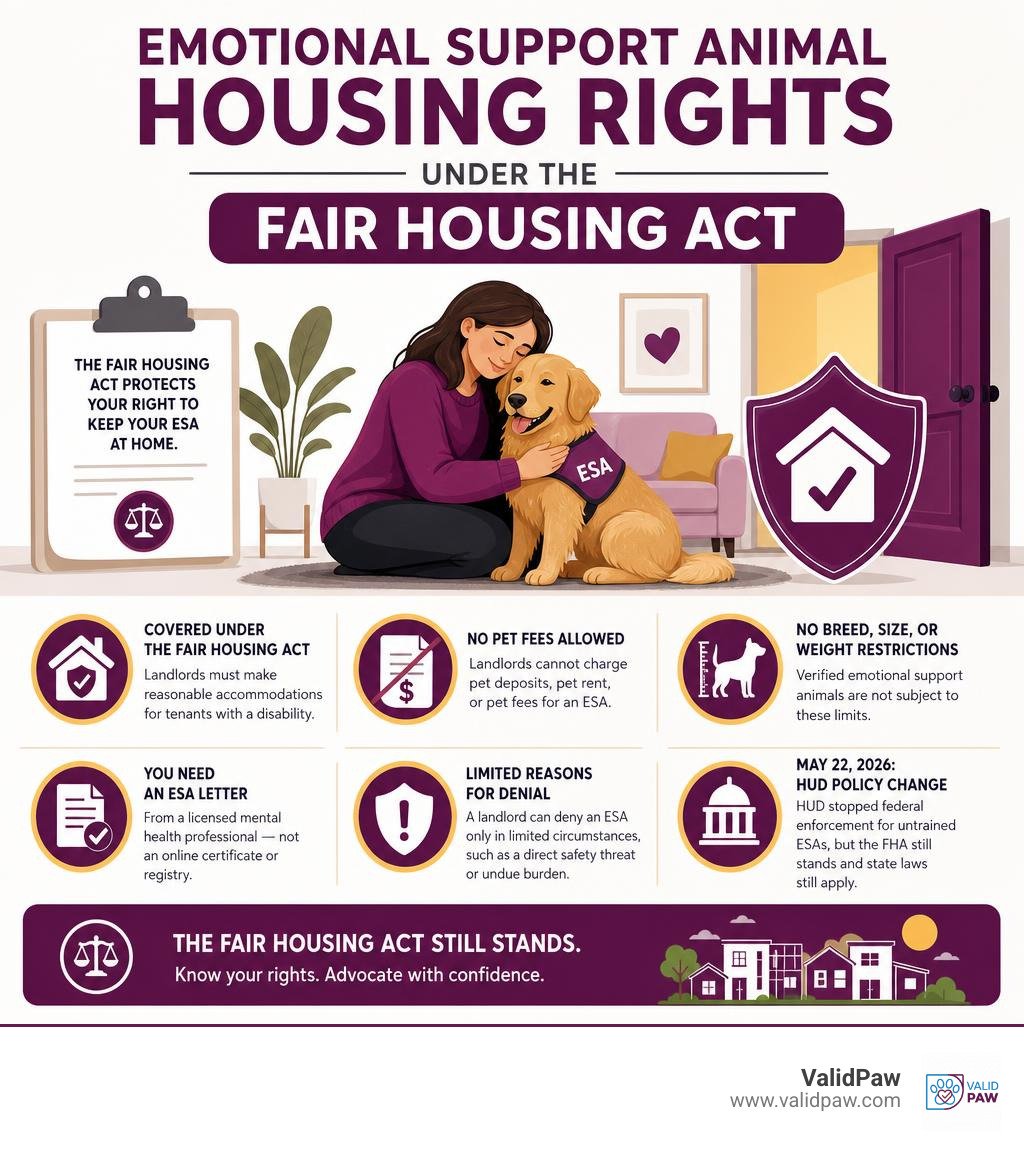
- ESAs are covered under the Fair Housing Act (FHA). Landlords must make reasonable accommodations for tenants with a documented disability-related need.
- No pet fees allowed. Landlords cannot charge pet deposits, pet rent, or pet fees for an ESA.
- Breed, size, and weight restrictions do not apply to verified emotional support animals.
- You need an ESA letter from a licensed mental health professional — not an online certificate or registry.
- A landlord can deny an ESA only in limited circumstances, such as a direct safety threat or undue burden.
- As of May 22, 2026, HUD stopped federal enforcement for untrained ESAs — but the FHA itself still stands, and state laws still apply.
If you're a renter managing anxiety, depression, PTSD, or another mental health condition, the rules around keeping your animal at home can feel overwhelming — especially when a landlord pushes back. The landscape just got more complicated. On May 22, 2026, HUD cancelled its two major guidance documents on ESAs in a single internal memo, effectively pulling back federal enforcement for untrained support animals. That's a significant shift — and it leaves many tenants uncertain about where they stand.
But here's what matters: the Fair Housing Act has not been repealed. State laws like California's Fair Employment and Housing Act (FEHA) remain fully intact. And the private right to sue under the FHA still exists. There are still real, meaningful protections available — you just need to know how to use them.
I'm Francisco Ortiz, Lead Forensic Mental Health Evaluator and Director of Behavioral Health at District Counseling PLLC, with multi-state licensure and over a decade of experience providing clinically rigorous evaluations that meet the legal and ethical standards required for emotional support animal housing accommodations. This guide walks you through everything — from federal law to state protections to exactly what documentation you need.
Understanding Federal Laws and the May 2026 HUD Policy Shift
Navigating the legal landscape of housing accommodations requires understanding three primary federal statutes: the Fair Housing Act (FHA), Section 504 of the Rehabilitation Act of 1973, and the Americans with Disabilities Act (ADA).
While the ADA governs public accommodations (like restaurants and hotels), the FHA is the primary federal law protecting individuals with disabilities in residential settings. Under the FHA, housing providers are prohibited from discriminating against tenants based on physical or mental disabilities. This includes a legal obligation to provide "reasonable accommodations," which often means waiving standard "no-pets" policies for assistance animals.
Section 504 of the Rehabilitation Act applies similar protections but specifically targets housing providers receiving federal financial assistance, such as public housing authorities or university dormitories. For a comprehensive breakdown of how these laws overlap, you can refer to the HUD 2013 Service Animal Notice.
Historically, HUD enforced these rights with a broad interpretation of assistance animals, which included both trained service dogs and untrained emotional support animals. However, a major administrative shift occurred on May 22, 2026, creating a significant federal enforcement gap that tenants must understand.
Service Animals vs. Emotional Support Animals in Housing
To understand how the laws apply, we must first distinguish between service animals and emotional support animals (ESAs). Under federal law, these two categories are treated differently:
| Feature | Service Animals (including Psychiatric Service Dogs) | Emotional Support Animals (ESAs) | | :--- | :--- | :--- | | Primary Law | ADA, FHA, Section 504 | FHA, Section 504 | | Species Allowed | Dogs (and miniature horses) | Any domesticated animal | | Training Required | Yes, individually trained to perform specific tasks | No specialized training required | | Primary Function | Performs physical or mental tasks (e.g., guiding, alerting, deep pressure therapy) | Provides therapeutic comfort and emotional support | | Public Access Rights | Broad access to public spaces | Limited to housing (no public access rights) |
While a psychiatric service dog (PSD) is trained to perform a specific action — such as interrupting a panic attack or waking a handler from a nightmare — an ESA provides therapeutic value simply through its presence. For more details on assistance animal classifications, consult the HUD Assistance Animals Guidance.
The May 22, 2026 HUD Memo and Its Impact on Emotional Support Animal Housing
On May 22, 2026, HUD issued an internal memo that permanently cancelled its landmark 2013 and 2020 ESA guidance documents. This policy reversal has fundamentally changed how federal fair housing complaints are processed.
Under this new directive, HUD has aligned its administrative enforcement standards with the ADA service animal definition. In practice, this means HUD's administrative enforcement branch will no longer pursue discrimination complaints on behalf of tenants with untrained emotional support animals. Additionally, HUD placed all open administrative ESA cases on hold for review and signaled future rulemaking to codify these changes.
What this means for you: While HUD has stepped back from administratively prosecuting landlords who deny untrained ESAs, the FHA itself remains unchanged. The statutory right to a reasonable accommodation still exists, and tenants still possess a private right of action to file lawsuits independently in federal court. Furthermore, state civil rights agencies and state laws remain fully active and unaffected by this federal policy shift.
Tenant Rights and Landlord Obligations Under the FHA
Even with the recent HUD policy shift, the core statutory protections of the FHA remain the law of the land. When a tenant requests an accommodation for an ESA, the housing provider must engage in an "interactive process" to determine if the request is reasonable.
Under the FHA, standard lease provisions regarding animals are modified. This means:
- "No-pets" policies are waived for verified assistance animals.
- Breed, size, and weight limits do not apply. A landlord cannot reject your ESA simply because they have a blanket ban on certain breeds (like Pit Bulls or German Shepherds) or dogs over a certain weight.
- Any denial based on breed must be rooted in an individualized assessment of the specific animal's behavior (e.g., a documented history of aggression), not generalized assumptions.
For a deeper look at basic FHA rights, you can explore the HUD Fair Housing Act Overview.
Can a Landlord Legally Deny an Emotional Support Animal?
A landlord cannot issue a blanket denial, but they do have legal grounds to refuse an ESA accommodation under specific, narrow circumstances:
- Direct Threat to Health and Safety: If the specific animal has a documented history of aggressive behavior, biting, or posing a direct threat to other residents that cannot be mitigated by other reasonable measures.
- Substantial Physical Damage: If the animal has previously caused significant structural damage to the property that would require expensive repairs.
- Undue Financial and Administrative Burden: If accommodating the animal would impose an unreasonable financial or logistical strain on the housing provider.
- Fundamental Alteration: If the presence of the animal would fundamentally alter the nature of the housing provider's operations.
Additionally, certain properties are exempt from the FHA altogether. These include owner-occupied buildings with four or fewer units (often called the "Mrs. Murphy" exemption) and single-family homes sold or rented directly by the owner without the use of a real estate broker.
Pet Fees, Deposits, and Rent for Emotional Support Animal Housing
One of the most critical protections under the FHA is the complete prohibition of pet-related fees for assistance animals. Because an ESA is legally classified as an assistance animal rather than a pet, landlords are prohibited from charging:
- Refundable or non-refundable pet deposits
- Monthly pet rent
- One-time pet application or registration fees
If a landlord attempts to charge these fees, it is considered a constructive denial of a reasonable accommodation. However, tenants remain fully responsible for any actual damage their animal causes to the unit. If your ESA scratches the doors or damages the carpet, the landlord can legally deduct the cost of repairs from your standard, general security deposit when you move out.
For more details on navigating pet bans and fees, read our guide on how to handle No Pets Allowed? Not With a Valid ESA Letter.
Documentation Requirements and the Verification Process

To secure an accommodation for emotional support animal housing, you must provide proper documentation verifying your disability-related need. The standard for this documentation is a legitimate ESA letter written by a licensed mental health professional (LMHP).
We must emphasize: online "registration" websites, certificates, and ID tags are not legally valid. Many commercial sites claim to add your dog to a "national registry" for a fee. HUD and state enforcement agencies explicitly state that these registrations do not establish a legal right to an ESA. Only a personalized evaluation by a licensed healthcare professional can do that. For a complete breakdown of what is required, see The Essential Guide to ESA Documentation Requirements.
What a Valid ESA Letter Must Include
To withstand landlord scrutiny and comply with state and federal standards, your ESA letter must meet specific criteria. It should be written on the professional letterhead of your treating LMHP and include:
- The professional’s name, license type, license number, and state of licensure.
- The date the letter was issued (it should generally be updated annually).
- A statement confirming that you have a diagnosed mental or emotional disability that substantially limits one or more major life activities.
- A clear explanation of the "diagnostic nexus" — meaning how the animal specifically alleviates one or more symptoms of your disability.
To ensure your documentation has everything it needs to protect your rights, read our detailed article on Don’t Get Hounded: Everything Your ESA Letter Must Include and learn Everything You Need to Know About Your ESA Landlord Letter.
Landlord Verification Rights and Limits
When you submit an ESA letter, your landlord has the right to verify its authenticity, but their inquiry is strictly limited by federal privacy laws.
Landlord Verification Limits:
What Landlords Can Do:
- Verify the therapist's license is active
- Confirm the therapist wrote the letter
- Ask if you have a qualifying disability
What Landlords Cannot Do:
- Ask for your specific diagnosis
- Demand medical records or history
- Require a notarized statement
- Contact your therapist for details
Landlords must engage in an interactive process in good faith. If they have doubts about the letter, they can contact the issuing professional to confirm that the letter is genuine, but they cannot demand detailed clinical information. For practical tips on what to expect during this step, check out Emotional Support Verification Letter: What Every Landlord Needs to See.
State-Specific Protections and Tenant Action Steps

Because federal administrative enforcement has shifted, state-level protections have become the primary shield for tenants with emotional support animals. Many states have independent civil rights laws that offer robust, local enforcement mechanisms.
If you reside in Texas (including major metropolitan areas like Houston, Austin, Dallas, San Antonio, and Fort Worth) or Illinois (such as Chicago), you are protected by distinct state statutes that operate independently of HUD's internal policy changes.
State Laws vs. Federal Protections
State-level protections often fill the gaps left by federal enforcement shifts:
- Texas: Texas animal law recognizes housing protections for assistance animals under the Texas Fair Housing Act. The Texas Department of Housing and Community Affairs (TDHCA) and local civil rights offices enforce these rules. For detailed statutory context, you can review the Texas State Law Library Service Animals Guide.
- Illinois: In Chicago and throughout Illinois, the Illinois Human Rights Act provides explicit protections against housing discrimination based on mental disability. The Illinois Department of Human Rights (IDHR) actively investigates denials of assistance animals. You can review the state's specific legislative language via the Illinois General Assembly Assistance Animal Laws.
- California: California's Fair Employment and Housing Act (FEHA) provides independent protections for emotional support animals that are not conditioned on whether the animal is trained. These laws are rigorously enforced by the Civil Rights Department (CRD). California’s AB 468 also protects consumers by requiring businesses selling ESA items to disclose that an ESA does not have the same public access rights as a service dog.
For broader research on how different states handle these rights, the Michigan State University Animal Legal & Historical Center serves as an excellent national database.
What to Do If Your Request Is Denied or Retaliated Against
If your landlord rejects your legitimate ESA accommodation request or threatens you with eviction or pet fees, take these immediate steps:
- Get the Denial in Writing: Ask your landlord to provide their denial and their specific legal reasoning in writing.
- Document All Communications: Keep a written paper trail of all emails, text messages, and letters. Avoid verbal agreements.
- File a Local Complaint: Since HUD's administrative enforcement is limited, file a complaint with your state or local civil rights agency (such as the Texas Workforce Commission Civil Rights Division, the Illinois Department of Human Rights, or local fair housing coalitions in Chicago or Austin).
- Seek Legal Advocacy: Contact local disability rights organizations or fair housing non-profits. They can often intervene, send demand letters, or help you pursue a private lawsuit under the FHA.
Responsibilities of ESA Owners
While you have rights, you also have significant responsibilities as an ESA owner. Having an ESA is not a license to let your animal disrupt the community. You must ensure that:
- Your animal is housebroken and kept in sanitary conditions.
- The animal is under your control at all times (e.g., leashed in common areas).
- The animal does not create a nuisance, such as excessive barking or aggressive behavior toward neighbors.
- You comply with local animal control laws, including vaccination and licensing requirements.
Frequently Asked Questions about Emotional Support Animal Housing
Can I have more than one emotional support animal in my home?
Yes, but it requires a higher standard of proof. If you request accommodations for multiple ESAs, your licensed mental health professional must document the specific, distinct therapeutic benefit that each animal provides. You cannot simply use a single blanket letter for multiple animals; the documentation must show a separate disability-related need for each one.
Does the FHA protect emotional support animals in college dorms?
Yes. University-owned housing and student dormitories are covered under both the FHA and Section 504 of the Rehabilitation Act. Students must typically submit their ESA letters to the university's disability services office. That universities often require a more thorough interactive process and may request verification earlier than private landlords to arrange appropriate housing.
Are short-term rentals like Airbnb covered under ESA housing laws?
It depends on the duration and nature of the stay. The FHA generally applies to "dwellings" intended for long-term residency. Short-term, transient lodging (like a weekend Airbnb stay or a hotel room) falls under the ADA, which does not protect untrained ESAs. However, if you are booking a long-term rental (typically 30 days or more) that serves as your temporary residence, FHA protections may apply.
Conclusion
The rules surrounding emotional support animal housing have evolved, but your right to live with your support animal remains legally protected under the Fair Housing Act and state laws. While federal administrative enforcement has shifted, having a legally compliant, clinically sound ESA letter is still your best defense against unfair housing barriers.
At ValidPaw, we connect you with licensed therapists in Texas and across all 50 states to provide legitimate, telehealth-based evaluations. If you qualify, we deliver FHA-compliant ESA letters within 24 to 48 hours, complete with instant landlord verification and absolutely no office visits required.
Don't let confusing regulations or landlord pushback keep you from the mental health support you deserve. Apply for a Legitimate ESA Letter with ValidPaw today and secure your peace of mind at home.