
What You Need to Know About Emotional Support Dogs (Quick Guide)
If you're looking for emotional support dog information, here's what matters most — fast:
| Topic | Key Fact | |---|---| | What it is | A dog that provides comfort to someone with a mental health condition through companionship | | Legal status | Protected under the Fair Housing Act (FHA) — not the ADA | | Who qualifies | Anyone with a diagnosed mental or emotional disability (anxiety, depression, PTSD, etc.) | | Documentation needed | A letter from a licensed mental health professional — no registry or certification required | | Housing rights | Landlords must allow ESDs even in no-pet buildings | | Air travel | As of 2021, airlines treat ESDs as regular pets — fees may apply | | Public access | ESDs do not have the same public access rights as service dogs |
Life can feel overwhelming when you're managing anxiety, depression, or PTSD — and the last thing you need is confusion about whether your dog qualifies as an emotional support animal, or whether your landlord can legally turn you away. There's a lot of noise online: fake registries, instant certificates, conflicting legal claims. It's hard to know what's real.
This guide cuts through all of that. Whether you're facing a housing denial, unsure how to get a legitimate ESA letter, or just trying to understand the difference between an emotional support dog and a service dog — you're in the right place.
I'm Francisco Ortiz, Lead Forensic Mental Health Evaluator and Director of Behavioral Health at District Counseling PLLC, with licensure across six states and over a decade of experience providing clinically rigorous evaluations — including emotional support dog information and documentation that meets strict legal and housing standards. My background in forensic mental health and disability assessment means I approach this topic with both clinical precision and practical clarity, so you can make informed decisions with confidence.
What is an Emotional Support Dog?
An Emotional Support Dog (ESD) is a companion animal that provides therapeutic benefit to an individual with a mental or emotional disability. Unlike a standard pet, an ESD is recognized under federal housing guidelines as an essential part of an individual's mental health treatment plan.
The primary purpose of an emotional support dog is to offer comfort, companionship, and stability. This relationship is backed by science. Clinical studies have shown that interacting with a dog can significantly lower cortisol (the primary stress hormone) levels while simultaneously triggering the release of oxytocin, prolactin, dopamine, and serotonin—the neurochemicals responsible for bonding, relaxation, and joy.

Whether it is a gentle nudge during a panic attack or simply a quiet presence that motivates you to get out of bed on a difficult day, the therapeutic bond between a human and an ESD is undeniable. For more background on how these animals help, you can read the American Kennel Club guidelines on emotional support animals.
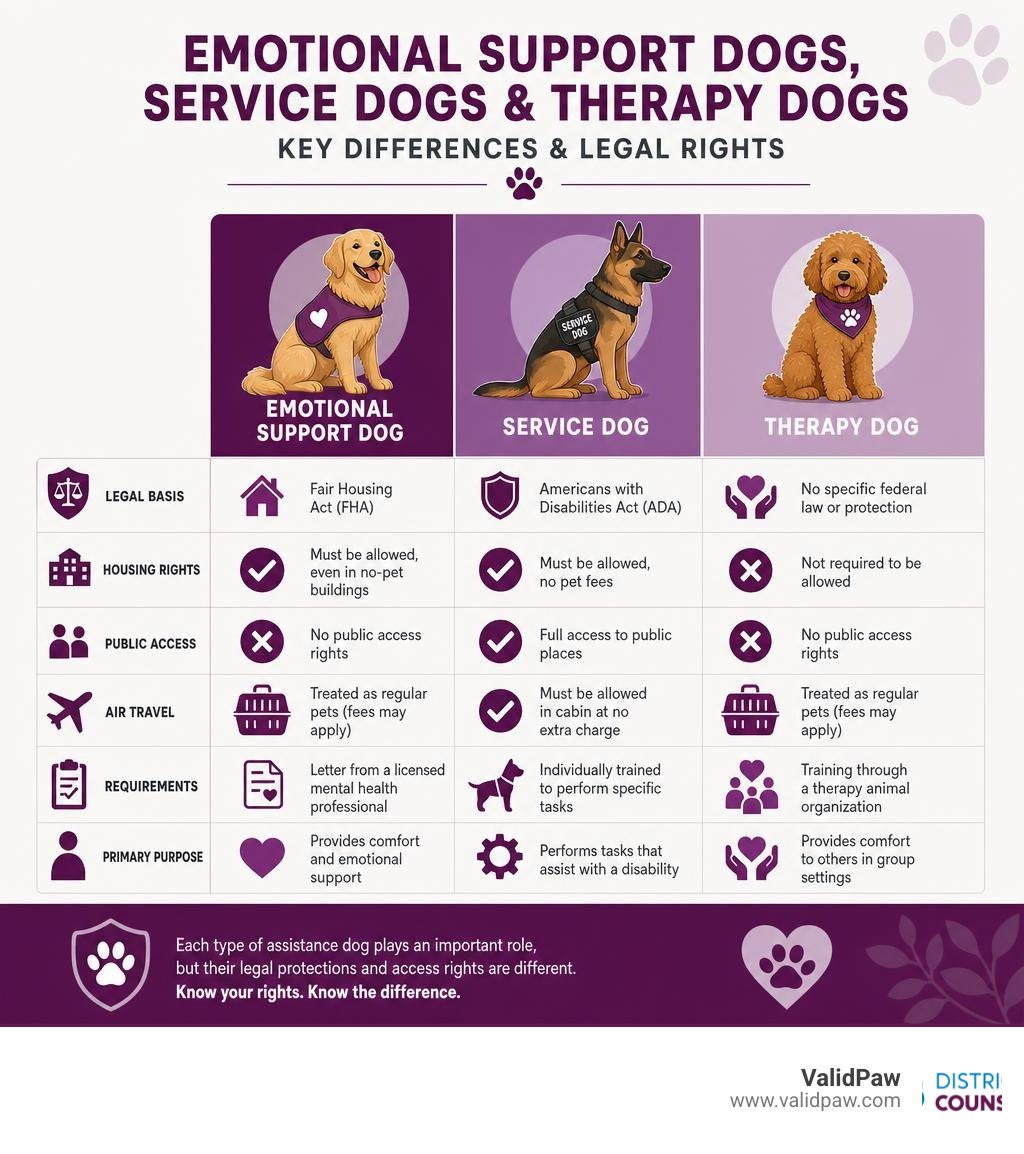
To help you understand where these animals fit into the broader landscape of working dogs, we have put together a comparison table below:
| Feature | Service Dog | Emotional Support Dog (ESD) | Therapy Dog | |---|---|---|---| | Primary Role | Performs specific trained tasks to mitigate a disability | Provides comfort and symptom relief through presence | Provides comfort to many people in clinical/group settings | | Legal Training Required | Yes (highly specialized) | No | Yes (socialization & obedience) | | Public Access (ADA) | Granted everywhere | No public access rights | Only where invited/allowed | | Housing Rights (FHA) | Protected (no fees/deposits) | Protected (no fees/deposits) | No special housing rights | | Air Travel (ACAA) | Allowed in cabin for free | Treated as standard pet (fees apply) | Treated as standard pet (fees apply) |
Service Dogs vs. Therapy Dogs vs. ESAs
The legal and functional distinctions between these three categories are frequently misunderstood. Under Title II and Title III of the Americans with Disabilities Act (ADA), a service dog is defined as a dog that is individually trained to do work or perform tasks for the benefit of an individual with a disability. These tasks must be directly related to the handler’s disability—such as guiding someone with visual impairment, alerting a diabetic handler to low blood sugar, or interrupting a self-harming behavior during a PTSD episode. Because of this intensive training, service dogs are granted full public access rights.
In contrast, therapy dogs are trained to provide comfort to many different people, not just one specific owner. They visit hospitals, schools, nursing homes, and disaster areas to offer temporary psychological relief. They do not have special public access or housing rights under federal law; they only go where they are explicitly invited.
An Emotional Support Dog sits in a unique category. They do not require specialized task training. Their therapeutic benefit comes naturally from their presence, companionship, and unconditional love. While they lack the broad public access rights of service dogs, they are protected under federal housing laws. For a deeper dive into how these roles are evaluated, explore The Ultimate Guide to Emotional Support Animal Assessments or review the Service Animal or Emotional Support Animal: What's the Difference? | ADA National Network resource hub.
Mental Health Conditions That Benefit from an ESA
Approximately 1 in 5 U.S. adults experience mental illness each year, highlighting the immense potential need for supportive interventions. An emotional support dog can be a transformative addition to a treatment plan for a wide range of mental health conditions, including:
- Anxiety Disorders: The calming presence of a dog helps ground individuals experiencing acute worry, social anxiety, or generalized anxiety.
- Clinical Depression: Caring for an ESD encourages healthy daily routines, physical activity, and social interaction, which can combat the isolation and lethargy associated with depression.
- Post-Traumatic Stress Disorder (PTSD): ESDs provide a sense of safety, comfort during night terrors, and a constant, non-judgmental anchor in stressful environments.
- Panic Attacks: The tactile stimulation of petting a dog can disrupt the escalating cycle of a panic attack and help lower a racing heart rate.
- Phobias and Mood Disorders: Companionship helps stabilize mood swings and reduces the severity of emotional crises.
Selecting and Training Your Emotional Support Dog
While federal law does not require emotional support dogs to undergo specialized task training, we highly recommend focusing on basic obedience and socialization. An ESD that is reactive, hyperactive, or poorly behaved can inadvertently increase your stress levels rather than lower them.
When selecting an emotional support dog, temperament is far more important than breed. Look for a dog that is:
- Gentle, patient, and affectionate
- Calm and attentive to your emotional shifts
- Not easily startled by loud noises or sudden movements
For training, we recommend focusing on basic obedience commands such as sit, stay, down, come, and leave it. Teaching loose-leash walking and ensuring your dog is thoroughly housebroken are also essential. Many ESD owners aim for the Canine Good Citizen (CGC) certification as a gold standard for public behavior. For practical tips from veterinary experts on how to structure your training sessions, check out How to Train an Emotional Support Dog: Our Vet Explains – Dogster.
Essential Emotional Support Dog Information: Legal Rights and Public Access
Understanding where your emotional support dog is legally protected—and where they are not—is crucial for avoiding stressful misunderstandings.

Federal laws draw a sharp line between service dogs and emotional support animals. While service dogs are covered under the ADA for public access, emotional support dogs are primarily protected under housing laws. To learn more about these overlapping frameworks, see the guide on Service Animals and Emotional Support Animals | ADA National Network.
Housing Protections Under the Fair Housing Act (FHA)
The Fair Housing Act (FHA) is the primary federal law protecting emotional support dog owners. Under the FHA, housing providers must make "reasonable accommodations" for individuals with physical or mental disabilities. This means that even if a building has a strict "no-pets" policy, a tenant with a legitimate ESA letter must be allowed to live with their emotional support dog.
Key protections under the FHA include:
- No Pet Fees or Deposits: Landlords cannot charge you extra pet rent, animal deposits, or one-time fees for your ESD.
- No Breed or Size Restrictions: Landlords cannot deny your accommodation request based solely on the dog's breed, weight, or size.
- Privacy Protections: Landlords are legally prohibited from asking about the specific details of your diagnosis or requesting your medical records.
To secure these protections, you must provide your housing provider with a valid ESA letter written by a licensed mental health professional. For a complete breakdown of how to navigate this process, read our Ultimate Guide to Emotional Support Animal Housing and learn Everything You Need to Know About Your ESA Landlord Letter. If you reside in Illinois, you can also refer to the [PDF] Assistance Animals - Illinois Attorney General guidelines for state-specific context.
Public Access and Air Travel Rules in 2026
It is important to understand that emotional support dogs do not have a legal right of public access under the ADA. This means private businesses—such as restaurants, grocery stores, hotels, and retail shops—are not legally required to allow your ESD inside. While some establishments may choose to be pet-friendly, they have the right to ask you to leave if they do not permit non-service animals.
Air travel regulations have also evolved. In early 2021, the U.S. Department of Transportation (DOT) updated its rules under the Air Carrier Access Act (ACAA). Airlines are no longer federally required to accommodate emotional support animals in the cabin for free. Today, commercial airlines treat ESDs as standard cabin or cargo pets, meaning they are subject to standard pet fees, size limitations, and carrier requirements.
If you require an animal to travel with you in the cabin for a mental health condition, you may want to research Psychiatric Service Dogs (PSDs), which are still recognized as service animals under the ADA and DOT rules. For official guidelines on service animal access, consult Service Animals | ADA.gov.
How to Qualify and Get a Legitimate ESA Letter
Getting a legitimate ESA letter does not require navigating complex bureaucratic red tape, but it does require a professional clinical evaluation.
A legitimate ESA letter must come from a licensed mental health professional (LMHP) who is actively licensed in your state. For a step-by-step overview of the fastest, most reliable ways to secure this documentation, read our guide on The Fastest Ways to Get a Legitimate Mental Health Support Letter.
The Professional Evaluation Process
The evaluation process is designed to establish a clinical relationship and determine if an emotional support animal is a necessary component of your mental health care. During a telehealth consultation, a licensed therapist will evaluate:
- Whether you meet the criteria for a diagnosed mental or emotional disability under the Diagnostic and Statistical Manual of Mental Disorders (DSM-5).
- How this condition limits one or more major life activities (such as sleeping, socializing, or working).
- How the presence of your dog directly alleviates or mitigates those specific symptoms.
Once approved, your therapist will issue a signed letter on their official letterhead. The letter must include the therapist's license number, state of licensure, contact information, and the date of issuance. For more detail on what makes these documents legally sound, see Everything You Need to Know About Requirements for ESA Letter Success and review the Texas-specific guidelines on the Assistance Animals | Texas Governor's Committee on People with Disabilities portal.
How to Verify Emotional Support Dog Information and Avoid Scams
The internet is flooded with websites offering "instant ESA registration," "official ID cards," and "lifetime certificates." These are scams.
Under federal law, there is no such thing as an official national registry or certification database for emotional support animals. Landlords and housing providers do not accept registrations, vests, or tags as proof of an ESA. The only legally recognized document is a valid ESA letter from a licensed professional.
To protect yourself from fraudulent services, watch out for these red flags:
- Instant Approvals: Any site that promises a letter in minutes without a real, live consultation with a licensed professional is a scam.
- No Therapist Contact: If you do not speak directly with a therapist (via video, phone, or secure chat), the letter is highly likely to be rejected.
- Lifetime Letters: Legitimate ESA letters are typically valid for one year from the date of issuance and must be renewed annually to remain FHA-compliant.
For help identifying fake services, read Is Your ESA Letter Legitimate? How to Spot the Real Deal and review our checklist on Don't Get Hounded: Everything Your ESA Letter Must Include.
Frequently Asked Questions about Emotional Support Dogs
Navigating the legalities of emotional support animals can be tricky. Here are answers to some of the most common questions we receive from pet parents.
FAQ 1: Can a landlord deny my emotional support dog?
In the vast majority of cases, no. Under the Fair Housing Act, landlords must accommodate your ESD. However, there are a few narrow legal exemptions where a landlord can deny your request:
- Owner-Occupied Housing: Buildings with four or fewer units where the owner lives in one of the units are exempt from the FHA.
- Single-Family Homes: Single-family homes rented or sold without the use of a real estate broker are also exempt.
- Direct Threat: If a specific dog has a documented history of aggressive behavior, bites, or poses a direct threat to the safety of other tenants, the landlord can reject that specific animal.
- Property Damage: If the animal causes severe, documented property damage that the tenant refuses to remedy.
To ensure your request is handled professionally and legally, we recommend using a well-structured letter. You can view templates that housing providers accept in our guide on Sample ESA Letters That Actually Work.
FAQ 2: Does my emotional support dog need a vest or ID tag?
No. There is no legal requirement for an emotional support dog to wear a vest, harness, or special ID tag. While some owners choose to purchase vests to signal to neighbors that their dog is an assistance animal, these items have no legal weight. Your ESA letter is your only official proof of your dog's status.
FAQ 3: Where can I find official emotional support dog information?
For verified, legally accurate guidelines, you should always consult official federal resources. Excellent starting points include:
- The U.S. Department of Housing and Urban Development (HUD) website for Fair Housing Act guidelines.
- The ADA National Network for clear comparisons between service dogs and emotional support animals.
- State-level agency portals (such as the Texas Governor's Committee on People with Disabilities or the Illinois Attorney General's office) for local regulations.
- Legitimate, licensed mental health platforms that specialize in telehealth evaluations.
Conclusion
An emotional support dog is far more than a pet—it is a dedicated source of comfort, a clinical aid, and a vital partner in your mental health journey. Understanding your legal rights and securing the proper documentation ensures that you and your dog can live together peacefully, free from unfair pet fees or discriminatory housing policies.
At ValidPaw, we make getting a legitimate, FHA-compliant ESA letter straightforward and stress-free. We connect you directly with licensed mental health professionals for thorough telehealth evaluations across Texas (including Houston, Austin, Dallas, San Antonio, and Fort Worth), Illinois (including Chicago), and all 50 states. Our process is fast, entirely online, and includes instant landlord verification to give you complete peace of mind.
If you are ready to secure your housing rights and support your mental well-being, we invite you to Apply for your legitimate ESA letter today.

