
What You Need to Know About Emotional Support Dogs in Texas
If you're dealing with anxiety, depression, or PTSD and searching for information about emotional support dogs in Texas, here's the short answer:
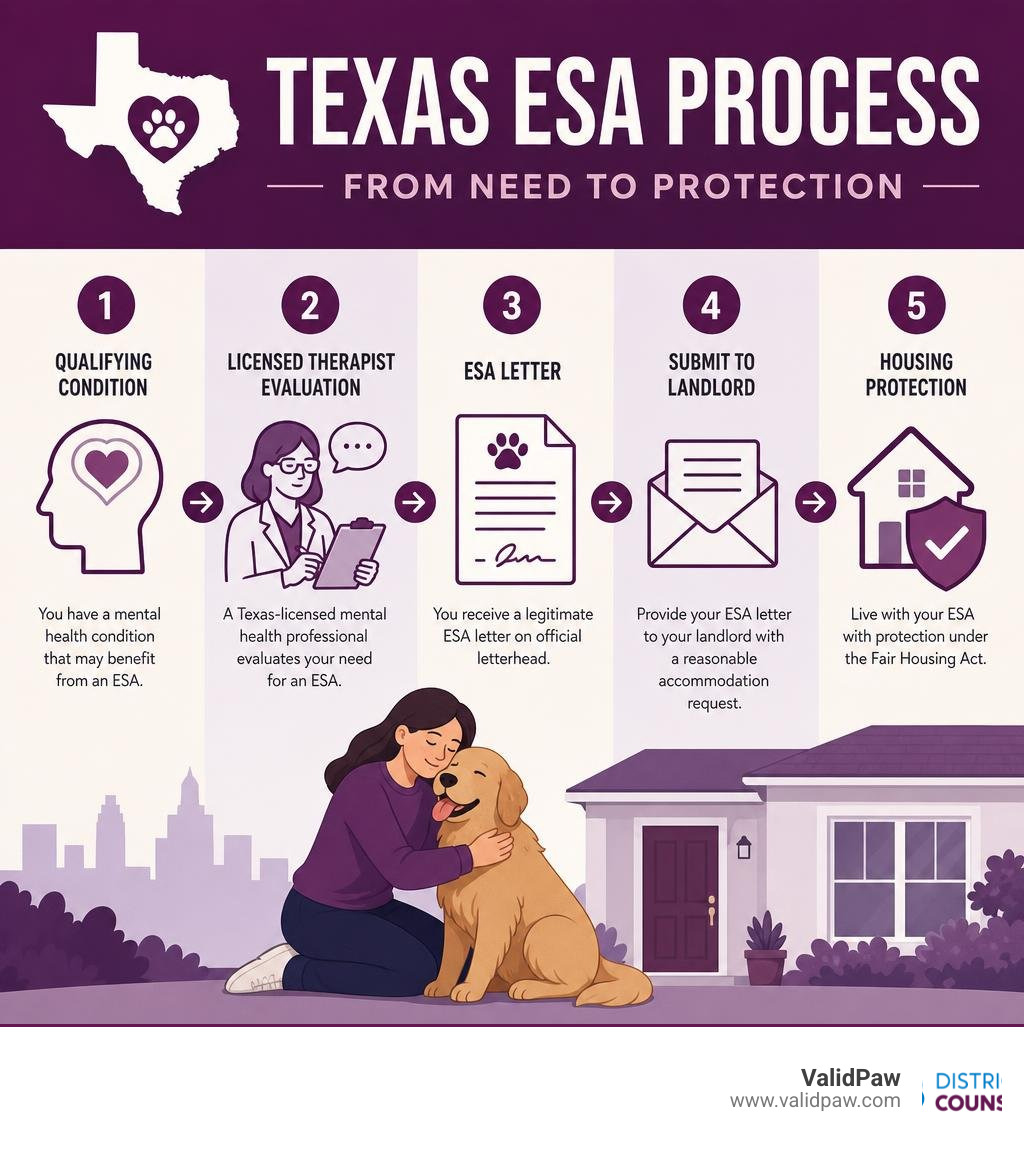
An emotional support dog (ESA) in Texas gives you the right to live with your dog in rental housing — even in no-pets buildings — under the Fair Housing Act. You need a valid ESA letter from a Texas-licensed mental health professional to claim this protection.
Here's a quick breakdown of what that means in practice:
- Housing: Landlords cannot charge pet deposits or pet rent for your ESA
- Public places: ESAs are not allowed in restaurants, stores, or other public spaces — only trained service animals are
- Air travel: Airlines no longer accommodate ESAs under 2021 DOT rules — they're treated as regular pets
- Documentation: You need an ESA letter from a licensed Texas therapist, counselor, or psychologist — not an online registry or certificate
- Penalties: Misrepresenting a pet as a service animal in Texas is a Class B misdemeanor
Living with a mental health condition while fighting a landlord over your dog is exhausting. The law is on your side — but only if your paperwork is legitimate. This guide walks you through every rule, right, and risk you need to know.
I'm Francisco Ortiz, Lead Forensic Mental Health Evaluator and Director of Behavioral Health at District Counseling PLLC, with multi-state licensure and years of experience providing clinically rigorous emotional support dog evaluations in Texas that meet legal and ethical housing standards. Everything in this guide reflects current federal law and Texas-specific statutes as of July 2026.
Service Animals vs. Emotional Support Dogs in Texas
It is incredibly common for Texans to confuse service dogs with emotional support dogs. However, from a legal standpoint, they are completely different animals. Mixing them up can lead to awkward confrontations at your local grocery store or, worse, hefty state fines.
To keep your rights protected, let's look at how federal and state laws separate these two categories. A service animal is defined under the Americans with Disabilities Act (ADA) as a dog (or in rare cases, a miniature horse) that is individually trained to do work or perform specific tasks for the benefit of an individual with a disability. The task performed must be directly related to the handler’s disability.
An emotional support dog, on the other hand, provides therapeutic comfort through its mere presence. They do not require any specialized training to flip light switches, detect blood sugar drops, or guide a visually impaired handler.
To help make these differences crystal clear, we have put together a quick comparison table:
| Feature / Protection | Service Dogs (ADA) | Emotional Support Dogs (FHA) | | :--- | :--- | :--- | | Primary Federal Law | Americans with Disabilities Act (ADA) | Fair Housing Act (FHA) | | Specialized Task Training Required? | Yes | No | | Protected Housing Access? | Yes (No pet fees/deposits allowed) | Yes (No pet fees/deposits allowed) | | Public Access (Stores, Restaurants)? | Yes | No | | Air Travel Protections (In-Cabin)? | Yes (Free of charge) | No (Treated as standard pets) | | Workplace Accommodations? | Case-by-case (ADA Title I) | Case-by-case (ADA Title I) | | Species Restrictions? | Dogs and Miniature Horses only | Any common household pet |
For a deeper dive into these distinctions, you can read our comprehensive guide on Service Dog or ESA: Getting the Facts Straight on Emotional Support Animals. You can also review the federal guidelines provided by the Southwest ADA Center in their Service Animals and Emotional Support Animals resource.
How to Qualify for Emotional Support Dogs in Texas
To legally qualify for an emotional support dog in the Lone Star State, you must have a diagnosed mental or emotional disability that substantially limits one or more major life activities. This diagnosis must be documented by a licensed healthcare professional in an official ESA letter.
Qualifying conditions under the Diagnostic and Statistical Manual of Mental Disorders (DSM-5-TR) include, but are not limited to:
- Generalized Anxiety Disorder (GAD)
- Major Depressive Disorder (MDD)
- Post-Traumatic Stress Disorder (PTSD)
- Attention-Deficit/Hyperactivity Disorder (ADHD)
- Bipolar Disorder
- Severe, chronic insomnia or panic disorders
The legal core of an ESA accommodation is the "nexus"—the direct connection between your mental health condition, the symptoms you experience, and how the presence of your dog mitigates those symptoms. For example, if your severe anxiety triggers nightly panic attacks and your dog's presence naturally grounds you and reduces the duration of those attacks, that is a clear clinical nexus.
To explore the physical and behavioral criteria your canine companion must meet, check out our Ultimate Guide to ESA Dog Requirements.
Rules for Emotional Support Dogs in Texas Public Spaces
One of the most persistent myths is that an ESA letter acts as a golden ticket to bring your dog anywhere you please. This is simply not true.
Under the ADA and Texas Health and Safety Code Section 437.023, only trained service dogs have the legal right to accompany their handlers into public accommodations. This means your emotional support dog does not have automatic public access rights to:
- Restaurants, bars, and coffee shops
- Grocery stores and retail malls
- Public transport (buses, trains)
- Hotels (unless the hotel is pet-friendly or chooses to accommodate you voluntarily)
Additionally, the Department of Transportation (DOT) updated its rules, meaning airlines are no longer required to recognize ESAs as service animals. When flying out of major Texas hubs like DFW, Austin-Bergstrom, or Houston Intercontinental, your emotional support dog will be treated as a standard pet and must comply with the airline's specific pet-in-cabin rules and fees.
What about the workplace? Under Title I of the ADA, you can request to bring your emotional support dog to work as a "reasonable accommodation." However, your employer is not obligated to grant this automatically. They are allowed to evaluate whether having the dog in the office poses an undue hardship or a safety hazard to other employees.
Legal Rights of Emotional Support Dogs in Texas
While public access is restricted, your housing rights under the federal Fair Housing Act (FHA) and Texas Property Code Chapter 301 are incredibly robust.

Under the FHA, emotional support animals are not classified as "pets." Instead, they are legally recognized as assistance animals. This distinction grants you several critical protections when renting a home, apartment, or condo in Texas:
- No Pet Deposits or Fees: Landlords are strictly prohibited from charging you pet deposits, monthly pet rent, or one-time pet fees for your ESA.
- Exemption from "No-Pets" Policies: Even if a lease explicitly states that no animals are allowed in the building, the landlord must make a reasonable accommodation to allow your emotional support dog.
- Exemption from Breed and Size Restrictions: Property managers cannot reject your ESA simply because of its breed, weight, or size. Even if a city ordinance or building policy bans certain breeds (like Pit Bulls or German Shepherds), these restrictions do not apply to legitimate assistance animals under federal law.
To make sure you are navigating this process perfectly, read our walkthrough on How to Register Your Emotional Support Animal in Texas the Right Way.
Be aware that you do not need to register your animal on any commercial database. Legally, there is no official registry for emotional support animals, and landlords cannot require registration as a condition for accommodation.
Landlord Verification and Legitimate Denial Reasons
While Texas housing providers must accommodate your emotional support dog, they are not completely powerless. They have the right to verify your request through a structured process.
When you submit your written accommodation request alongside your ESA letter, your landlord is allowed to:
- Verify that your letter is signed by a currently licensed mental health professional (LMHP) who is registered to practice in Texas.
- Confirm that the professional has personal clinical knowledge of your condition.
- Ask for clarification if the letter lacks the necessary professional credentials or licensing details.
However, landlords cannot demand to see your detailed medical records, ask for a specific diagnosis, or require the therapist to sign documents under penalty of perjury.
According to HUD guidelines, housing providers should respond to your accommodation request within 10 days.
A landlord can legally deny your emotional support dog request under very specific circumstances:
- Direct Threat: The specific dog poses a documented, direct threat to the health and safety of other tenants (e.g., a history of aggressive behavior or biting).
- Substantial Property Damage: The animal has caused severe physical damage to the property that cannot be mitigated.
- Undue Burden: Accommodating the animal would impose an undue financial or administrative burden on the housing provider, or fundamentally alter the nature of their operations.
How to Get a Legitimate ESA Letter in Texas
Getting a legitimate ESA letter in Texas does not require you to jump through impossible hoops, but it does require a real, clinical evaluation.

The state of Texas does not require a mandatory 30-day client-provider relationship before an ESA letter can be written (a rule that states like California enforce). This means you can complete your evaluation and receive your FHA-compliant letter relatively quickly if you qualify.
At ValidPaw, we connect you with Texas-licensed clinicians who conduct thorough, telehealth-based evaluations. The typical process involves:
- Completing a clinical screening questionnaire detailing your mental health challenges and how your dog helps you.
- Meeting virtually with a licensed therapist to discuss your history, symptoms, and functional limitations.
- Receiving your official, signed ESA letter on professional letterhead within 24 to 48 hours if approved.
To make sure your paperwork stands up to landlord scrutiny, read our guides on The Texan’s Guide to Getting a Real Emotional Support Animal Letter and Everything You Need to Know About Texas ESA Letter Requirements.
Finding a Licensed Texas ESA Therapist
To write a legally compliant letter, your clinician must be actively licensed by the Texas Behavioral Health Executive Council (TBHEC). Legitimate providers include:
- Licensed Clinical Social Workers (LCSW)
- Licensed Professional Counselors (LPC)
- Licensed Marriage and Family Therapists (LMFT)
- Licensed Psychologists
- Psychiatrists (MD)
Whether you are looking for a counselor in Austin, Dallas, or Houston, we have localized resources to guide your search:
- If you are in the state capital, read Keep Austin Weird and Certified: Your Guide to Austin ESA Therapists.
- In the DFW metroplex, check out Dallas ESA Guide: Turning Your Best Friend Into a Support System.
- For those down in Space City, view How to Get ESA Letter in Houston in 7 Days.
- For general tips on avoiding shady providers, read No More Barking Up the Wrong Tree and How to Find a Texas ESA Therapist.
Penalties for Misrepresenting an Assistance Animal in Texas
Texas has cracked down hard on fake service dogs and fraudulent ESA claims. Thanks to legislative efforts championed by organizations like the Texas Humane Legislation Network (THLN), state laws carry strict penalties for bad actors.
Under Texas House Bill 4164 (which updated the Texas Human Resources Code), misrepresenting an animal as a trained service dog is a Class B misdemeanor. If you are caught using a fake vest, leash, or ID card to sneak a pet into a restaurant or store by claiming it is a service dog, you can face:
- A fine of up to $1,000
- Up to 30 hours of community service
Additionally, using a fake service animal vest or leash for an untrained animal is a misdemeanor punishable by a $300 fine.
These laws exist to protect truly disabled individuals who rely on highly trained service dogs to survive. Trying to pass off your emotional support dog as a service dog hurts the community and can land you in serious legal trouble.
Avoiding ESA Scams and Red Flags
The internet is flooded with websites promising "instant ESA registration" or "lifetime certifications." These are massive red flags.
Federal agencies like HUD and the Federal Trade Commission (FTC) do not recognize any official ESA registry, certificate, or ID card. In fact, the FTC reported over 500,000 complaints related to ESA scams in 2026 alone, with one prominent scam site being hit with a $1.2 million fine.
Here is how to spot a scam:
- No Live Interaction: If a site promises a letter without having you speak directly (via video, phone, or secure messaging) to a licensed therapist, it is a scam.
- Selling "Registrations" or "Vests" as Legal Proof: If a company tells you that buying an ID card or registration number makes your dog a legal ESA, they are lying.
- Unbelievably Low Prices: A legitimate evaluation involves professional clinical time. If a site offers a lifetime letter for $29, they are likely selling forged or non-compliant documents.
To understand what a real evaluation costs, read our breakdown on The Real Price of a Legitimate Texas ESA Letter. Legitimate evaluations generally range from $250 to $350, though some basic telehealth consultations can start lower depending on the complexity of your clinical history.
Frequently Asked Questions about Texas ESAs
Navigating the legalities of emotional support dogs can raise a lot of questions. Here are some of the most common inquiries we receive from Texas renters.
Does a Texas ESA letter expire?
While federal law under the Fair Housing Act does not explicitly state that an ESA letter expires, most Texas landlords and property managers will only accept documentation that is less than one year old.
Mental health conditions can change over time. An annual renewal ensures that your therapeutic need for the animal is current and documented, protecting you from potential disputes with your housing provider.
Can a landlord deny my ESA based on breed or size?
No. Under the Fair Housing Act, landlords cannot deny your request for a reasonable accommodation based on the animal's breed, size, or weight. Local breed-specific ordinances do not override federal FHA protections for assistance animals.
A landlord can only reject your dog if they have concrete, documented evidence that your specific dog is dangerous or destructive.
Do I need to register my emotional support dog in Texas?
No. There is no such thing as an official state or federal registry for emotional support dogs. Any website that claims to "register" your dog with the government is a scam. The only legal document you need is an FHA-compliant ESA letter written by a licensed mental health professional who has evaluated you.
Conclusion
Securing your housing rights with an emotional support dog in Texas does not have to be a stressful ordeal. By understanding the legal differences between service animals and ESAs, avoiding online registration scams, and working with a legitimate, state-licensed professional, you can keep your best friend by your side without fear of landlord pushback.
At ValidPaw, we are committed to providing fast, professional, and fully FHA-compliant ESA letters. Our network of licensed Texas therapists offers virtual evaluations with a 24-to-48-hour turnaround, giving you the peace of mind you deserve.
Ready to get started? Visit ValidPaw today to schedule your telehealth evaluation and protect your housing rights.