What You Need to Know About an Emotional Support Animal Diagnosis
Getting an emotional support animal diagnosis is the first step to securing legitimate housing protections for your pet — especially if you're living with anxiety, depression, PTSD, or another mental health condition.
Here's a quick answer to what qualifies:
Mental health conditions that commonly qualify for an ESA:
- Anxiety disorders (generalized anxiety, social anxiety, panic disorder)
- Major depressive disorder
- Post-traumatic stress disorder (PTSD)
- Bipolar disorder
- Obsessive-compulsive disorder (OCD)
- Schizophrenia and other severe psychiatric conditions
- Autism spectrum disorder
The key requirement: Your condition must substantially limit at least one major life activity — and a licensed mental health professional must confirm that an emotional support animal helps reduce that limitation.
An ESA letter is not the same as registering your pet online. There is no official national registry. The only document that carries legal weight under the Fair Housing Act is a signed letter from a licensed mental health professional.
If you're a renter facing a "no pets" policy while managing a mental health condition, you're not alone — and you likely have more rights than you realize. Millions of Americans qualify for ESA protections, yet many don't know where to start or what the process actually involves. This guide breaks it all down clearly.
I'm Francisco Ortiz, Lead Forensic Mental Health Evaluator and Director of Behavioral Health at District Counseling PLLC, with specialized experience conducting clinically rigorous emotional support animal diagnosis evaluations across six states. My forensic training ensures every assessment meets strict legal and ethical standards — not just a quick checkbox exercise.
What is an Emotional Support Animal Diagnosis?
An emotional support animal diagnosis is not a physical test or a certificate you can buy from a sketchy website. Instead, it is a formal clinical determination made by a licensed mental health professional (LMHP). This process establishes that you have a recognized mental health condition listed in the Diagnostic and Statistical Manual of Mental Disorders (DSM-5) and that your animal plays an active, therapeutic role in helping you manage that condition.

Under federal law, specifically the Fair Housing Act (FHA), a diagnosis must show that your mental health condition rises to the level of a legally recognized disability. This means your symptoms must cause functional limitations that "substantially limit" one or more major life activities.
Major life activities include essential daily functions such as:
- Sleeping and eating
- Working or attending school
- Interacting with others and socializing
- Coping with stress and regulating emotions
- Leaving the house or performing basic self-care
When a professional evaluates you, they are looking to see if your animal's presence directly mitigates these limitations. For example, if severe anxiety prevents you from sleeping, and the presence of your dog lowers your heart rate so you can rest, that animal is serving a documented therapeutic purpose. To understand the depth of this clinical process, you can read The Ultimate Guide to Emotional Support Animal Assessments.
Qualifying Mental Health Conditions for an Emotional Support Animal Diagnosis
Not every bad day qualifies you for an ESA, but many common and manageable mental health conditions do. Clinicians look for conditions that actively disrupt your daily routine. Some of the most common qualifying conditions include:
- Anxiety Disorders: This includes generalized anxiety disorder (GAD), social anxiety disorder, and panic disorder. For those who experience sudden, overwhelming panic attacks, the sensory grounding provided by petting an animal can help break the cycle of hyperventilation.
- Depressive Disorders: Major depression often robs individuals of motivation and energy. Caring for an ESA creates a gentle structure and routine, giving you a reason to get out of bed, feed your companion, and go outside.
- Post-Traumatic Stress Disorder (PTSD): Individuals with PTSD often suffer from hypervigilance, night terrors, and severe emotional distress. The constant, non-judgmental presence of an ESA can make a home feel like a safe sanctuary again.
- Bipolar Disorder: The emotional stability provided by a steady, loving pet can help ground individuals experiencing the highs of mania or the lows of depression.
- Obsessive-Compulsive Disorder (OCD): An ESA can serve as a healthy distraction and a source of comfort when intrusive thoughts or compulsive urges become overwhelming.
- Schizophrenia and Severe Psychiatric Conditions: For those managing complex psychiatric symptoms, the unconditional companionship of an animal provides a consistent connection to reality and emotional safety.
How Clinicians Determine an Emotional Support Animal Diagnosis
To make a legitimate diagnosis, an LMHP must establish a clear "nexus" (a direct connection) between your disability, the animal's role, and your symptom reduction.
During a clinical assessment, we look at three primary components:
- The Client's Mental Health History: We review your psychological history, current symptoms, and how those symptoms impact your daily functioning.
- The Role of the Animal: We explore how the animal helps you. Does the animal provide grounding during panic attacks? Does its presence reduce the loneliness associated with chronic depression?
- The Overall Treatment Plan: An ESA should ideally complement other evidence-based therapeutic modalities, such as counseling or medication, rather than being the sole treatment.
For a deeper look into how medical and mental health professionals approach these evaluations ethically and systematically, refer to the Scientific guidelines on ESA documentation.
Legal Protections and Limitations for ESAs
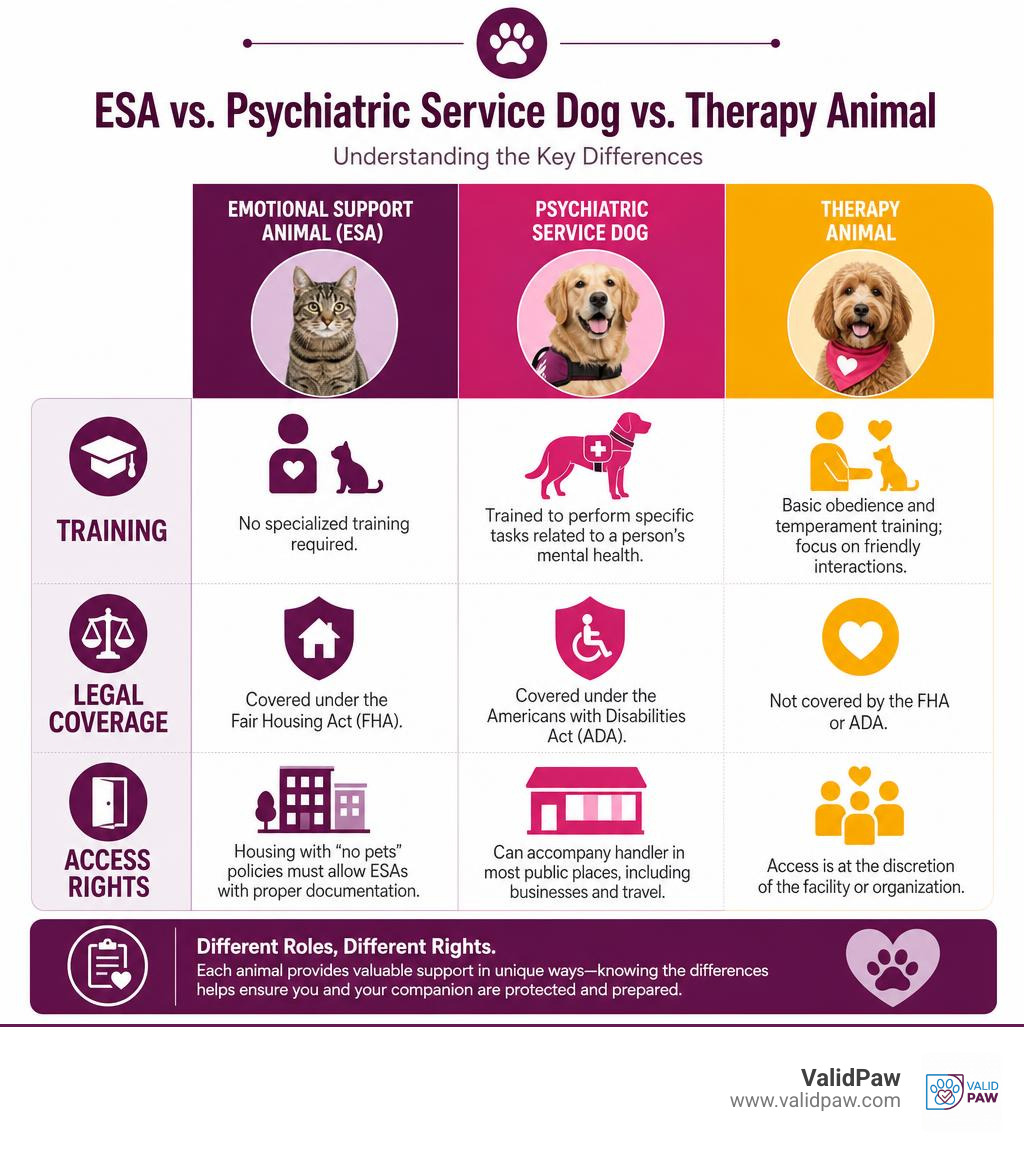
It is incredibly easy to confuse the different types of assistance animals. However, the law treats them very differently. Below is a breakdown of how emotional support animals compare to service dogs and psychiatric service dogs (PSDs):
| Feature | Service Animals (e.g., Guide Dogs) | Psychiatric Service Dogs (PSDs) | Emotional Support Animals (ESAs) | | :--- | :--- | :--- | :--- | | Primary Law | Americans with Disabilities Act (ADA) | Americans with Disabilities Act (ADA) | Fair Housing Act (FHA) | | Training Required | Yes (Highly specialized task training) | Yes (Trained to perform specific tasks) | No (Only basic house training) | | Public Access | Unlimited public access | Unlimited public access | No public access rights | | Housing Rights | Allowed in all housing (No fees) | Allowed in all housing (No fees) | Allowed in all housing (No fees) | | Air Travel | Flies in cabin for free | Flies in cabin for free (with DOT form) | Treated as standard pets (Fees apply) |
As of May 2026, the legal landscape is very clear: ESAs are protected primarily in housing. They do not have the right to accompany you into grocery stores, restaurants, or onto commercial flights for free.
Housing Rights Under the Fair Housing Act
The Fair Housing Act (FHA) is the shield that protects ESA owners. Under the FHA, housing providers must make "reasonable accommodations" for individuals with disabilities who require assistance animals.
This means that if you have a valid emotional support animal diagnosis and a legitimate letter:
- No Pet Fees or Pet Rent: Landlords cannot charge you extra monthly pet rent or demand a pet deposit for your ESA.
- No Breed or Weight Restrictions: Even if a building has a "no Pit Bulls" or "no dogs over 50 lbs" policy, your ESA is exempt.
- "No Pets" Policies Don't Apply: A landlord cannot reject your application or evict you simply because you have an ESA in a building that otherwise bans animals.
To get these protections, you must submit a formal request to your landlord along with your documentation. To ensure you have all your bases covered, check out The Essential Guide to ESA Documentation Requirements.
Air Travel and Public Access Restrictions
A major shift in the ESA legal landscape occurred following a massive 75% surge in emotional support animals on commercial flights between 2016 and 2017. This spike led to safety concerns and a subsequent Department of Transportation (DOT) rule change.
Today, commercial airlines are no longer federally required to accommodate emotional support animals in the cabin for free. If you want to fly with your ESA, they will be treated as standard pets, subject to airline pet fees and carrier size restrictions.
If your disability requires an animal that can travel with you and perform specific tasks (such as deep pressure therapy during a panic attack), you may want to look into a Psychiatric Service Dog (PSD), which still enjoys full air travel protections under the ADA.
How to Obtain a Legitimate ESA Letter
To secure housing protections, you need an official, legally compliant ESA letter. You cannot get this by paying $20 to a registry that emails you a PDF of a "certificate" five minutes later.

A real letter must come from a licensed mental health professional who is registered to practice in your state. Whether you conduct your evaluation in person or via a secure telehealth platform, the process must involve a real clinical interaction. For a comprehensive breakdown of what to look for, read Is Your ESA Letter Legitimate? How to Spot the Real Deal.
Requirements for a Valid ESA Letter
A legally sufficient ESA letter must be highly specific to satisfy a landlord’s legal review. It should include:
- Professional Letterhead: The letter must display the clinician's or practice's name, contact information, and address.
- Licensing Details: The clinician's license type (e.g., LCSW, LMFT, LPC, Psychologist), license number, and the state of licensure.
- The Diagnostic Statement: A statement confirming that you have a mental or emotional disability recognized by the DSM-5 that limits a major life activity. (Note: The clinician does not need to disclose your specific diagnosis or medical history to protect your privacy).
- The Therapeutic Nexus: A clear explanation of how the animal helps alleviate your symptoms.
- Active Date and Signature: The letter must be signed, dated, and is typically considered valid for one year from the date of issuance.
To make sure your paperwork is flawless, consult Don't Get Hounded: Everything Your ESA Letter Must Include.
Avoiding Online ESA Scams and Registries
The internet is flooded with predatory websites offering "instant" ESA registration, badges, vests, and ID cards.
Here is the truth: Federal agencies like HUD and the DOJ do not recognize any registry, database, or ID card. Landlords are fully aware of these scams, and presenting a fake registration certificate will likely result in your accommodation request being denied.
If a website does not require you to speak directly with a licensed professional who is active in your state, it is a scam. To find a fast, legal, and stress-free path to real documentation, read about The Fastest Ways to Get a Legitimate Mental Health Support Letter.
Ethical Considerations and Owner Responsibilities
While having an ESA is a wonderful right, it also comes with heavy clinical, ethical, and practical responsibilities.
From a clinical standpoint, therapists face unique ethical challenges when writing these letters. Many professional organizations advise treating therapists to avoid writing ESA letters for their active therapy clients, as it can create a conflict of interest. Instead, independent forensic evaluators are often utilized to provide objective, unbiased assessments. You can read more about these professional guidelines in the Psychiatric guidelines on ESA letters.
Ethical Challenges for Mental Health Professionals
For clinicians, the primary concern is ensuring the integrity of the evaluation. Research shows that over 30% of disability and worker's compensation cases show some evidence of probable malingering (exaggerating symptoms for personal gain). Therefore, clinicians must conduct thorough, objective assessments rather than simply rubber-stamping letters for anyone who asks.
When we evaluate a client, we are performing a professional assessment to ensure that the therapeutic benefit is genuine and that the client is fully capable of managing the animal.
Responsibilities of the ESA Owner
As an ESA owner, your legal rights do not excuse poor behavior. You are entirely responsible for your animal's conduct and care:
- Behavior Standards: Your ESA must be housebroken and manageable. If your animal barks constantly, damages property, or acts aggressively toward neighbors, a landlord has the legal right to evict the animal, regardless of your ESA letter.
- Veterinary and Financial Care: You must be financially and physically capable of providing food, routine veterinary care, vaccinations, and a safe living environment.
- Respecting Community Rules: While you are exempt from pet fees, you must still clean up after your animal and ensure they do not create a nuisance or health hazard in common areas.
Frequently Asked Questions about ESA Diagnoses
Can a landlord deny an emotional support animal?
Yes, but only under very specific legal conditions. A landlord can deny an ESA if the animal poses a direct threat to the health and safety of others, causes substantial physical damage to the property, or if the accommodation places an "undue financial or administrative burden" on the housing provider. Additionally, certain small-scale properties (like owner-occupied buildings with four or fewer units) are exempt from the FHA.
Do ESA letters expire?
Yes. To ensure your accommodation remains legally solid, HUD guidelines recommend updating your ESA letter annually, especially when signing a new lease or renewing an existing one. To avoid any gaps in your housing protections, check out No More Paperwork Zoomies: Getting Your ESA Documentation Right.
Can I get an ESA letter for multiple animals?
Yes, but you must have a distinct clinical justification for each animal. For example, if you have one animal that helps you sleep due to PTSD, and another that keeps you active during major depressive episodes, a clinician must explicitly document how each animal serves a unique therapeutic purpose. Landlords are highly likely to scrutinize requests for multiple ESAs, so your clinical documentation must be airtight.
Conclusion
Navigating an emotional support animal diagnosis can feel overwhelming, but it doesn't have to be. By understanding your rights, avoiding online registration scams, and working with licensed professionals, you can protect both your mental well-being and your beloved companion.
At ValidPaw, we connect you with licensed therapists who understand state-specific telehealth laws. We provide fast, FHA-compliant evaluations and letters within 24 to 48 hours, complete with instant landlord verification and absolutely no stressful office visits.
Ready to secure your peace of mind? Apply for your ESA letter today and take the first step toward a happier, stress-free home with your animal companion.