
What a Valid ESA Housing Letter Should Say
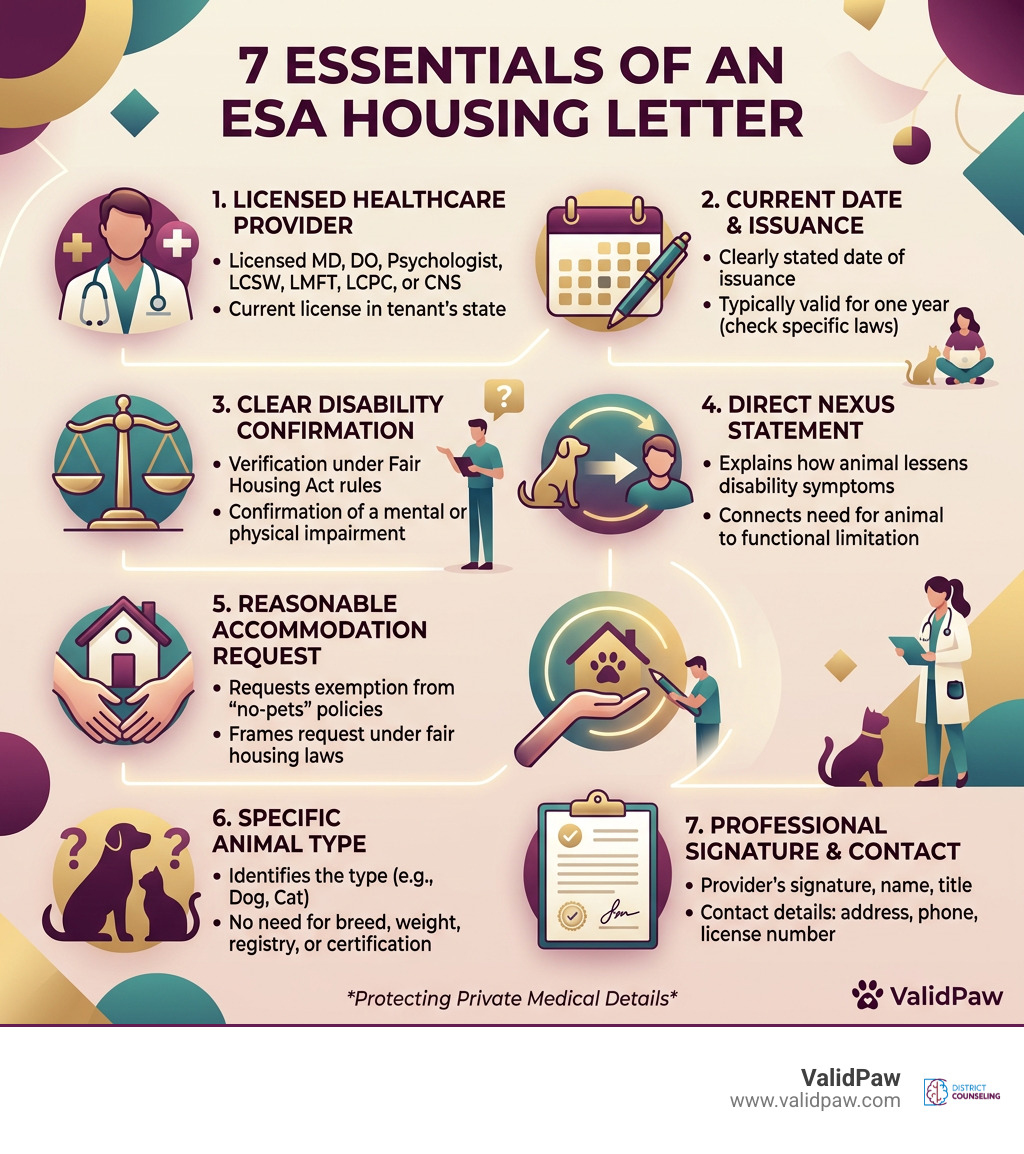
A sample emotional support animal letter for housing should be a signed letter from a licensed healthcare or mental health provider who knows the tenant's condition. It should confirm, without naming a diagnosis, that the tenant has a disability and that the animal helps lessen a disability-related symptom or functional limit.
A strong housing letter includes:
- The provider's name, license, contact details, and signature.
- The date issued and, where appropriate, a current validity or renewal date.
- A clear disability confirmation under fair housing rules.
- A specific nexus statement explaining why the animal is needed.
- The type of animal, such as a dog or cat, without unnecessary breed, weight, name, registry, or certification details.
The goal is not to prove your pet is special. It is to give a housing provider reliable information supporting a reasonable accommodation under the Fair Housing Act while protecting your private medical details.
I am Francisco Ortiz, a Certified Forensic Mental Health Evaluator and behavioral health director who provides disability and ESA evaluations for residents across six states. In this guide, I will break down what makes a sample emotional support animal letter for housing clear, current, and suitable for a legitimate accommodation request.
7 Essential Components of a Legally Compliant ESA Housing Letter

Navigating housing accommodations can feel daunting, but the federal framework is straightforward when your paperwork is structured properly. Under the Fair Housing Act (FHA), housing providers must grant reasonable accommodations to tenants with disabilities, which includes allowing assistance animals in properties with "no-pets" rules.
To maintain full compliance, it helps to understand how assistance animals differ under the law. Emotional support animals provide therapeutic comfort that alleviates symptoms of a mental or emotional impairment, whereas service animals are trained to perform specific physical tasks.
| Feature | Emotional Support Animal (ESA) | Service Animal (Dog/Mini Horse) | | :--- | :--- | :--- | | Governing Housing Law | Fair Housing Act (FHA) | Fair Housing Act & Americans with Disabilities Act (ADA) | | Specialized Training Required | No individual task training required | Yes, individually trained to perform specific disability tasks | | Species Allowed | Common domestic animals (dogs, cats, small birds, rabbits) | Dogs and miniature horses only | | Public Access Rights | Limited to residential housing (no public stores or restaurants) | Full public access under the ADA | | Documentation Needed | Valid letter from a licensed healthcare provider | Landlord can only ask two specific questions if disability isn't obvious | | Pet Deposits / Monthly Fees | Exempt (landlords cannot charge pet fees) | Exempt (landlords cannot charge pet fees) |
Essential Elements to Include in Your Sample Emotional Support Animal Letter for Housing
A legally sound document relies on precise criteria established by the U.S. Department of Housing and Urban Development (HUD). When reviewing our Fair Housing Act compliance guidelines, every valid letter must contain seven core elements:
- Provider Credentials & Letterhead: The letter must appear on the official professional letterhead of a licensed professional, showing their practice address, phone number, license type, license number, and the state where they are licensed to practice.
- Date of Issuance & Expiration: Clear documentation showing when the letter was drafted. Most housing providers accept letters issued within the past 12 months.
- Disability Confirmation: A formal statement certifying that you meet the definition of having a physical or mental impairment that substantially limits one or more major life activities under the FHA.
- The Nexus Statement: The single most critical sentence in the document. It establishes the direct connection (the "nexus") between your condition and how the animal's presence alleviates specific symptoms or functional limitations (such as reducing acute panic, regulating sleep patterns, or easing chronic social withdrawal).
- Type of Animal: Identification of the species (e.g., "dog," "cat," "rabbit"). It should deliberately avoid irrelevant details such as breed, weight, animal name, or registration numbers.
- Provider Signature: A valid physical or secure digital signature from the evaluating clinician.
- Notice of Scope: Explicit language stating that the accommodation applies specifically to residential housing under the Fair Housing Act, preventing confusion with public access rights under the ADA.
Who Can Legally Write Your Documentation
A legitimate letter cannot be generated by an automated quiz or an anonymous website. HUD guidelines mandate that the professional issuing the document must be a licensed healthcare professional with personal knowledge of the individual.
Qualified professionals include:
- Licensed Professional Counselors (LPC / LPCC)
- Licensed Clinical Social Workers (LCSW)
- Licensed Marriage and Family Therapists (LMFT)
- Clinical Psychologists (PsyD / PhD)
- Psychiatrists (MD / DO)
- Primary Care Physicians and Nurse Practitioners
Working with an established clinician ensures your paperwork is defensible. For detailed advice on selecting an evaluator, see our guide on finding a legitimate healthcare provider.
Complete Sample Emotional Support Animal Letter for Housing and How to Use It
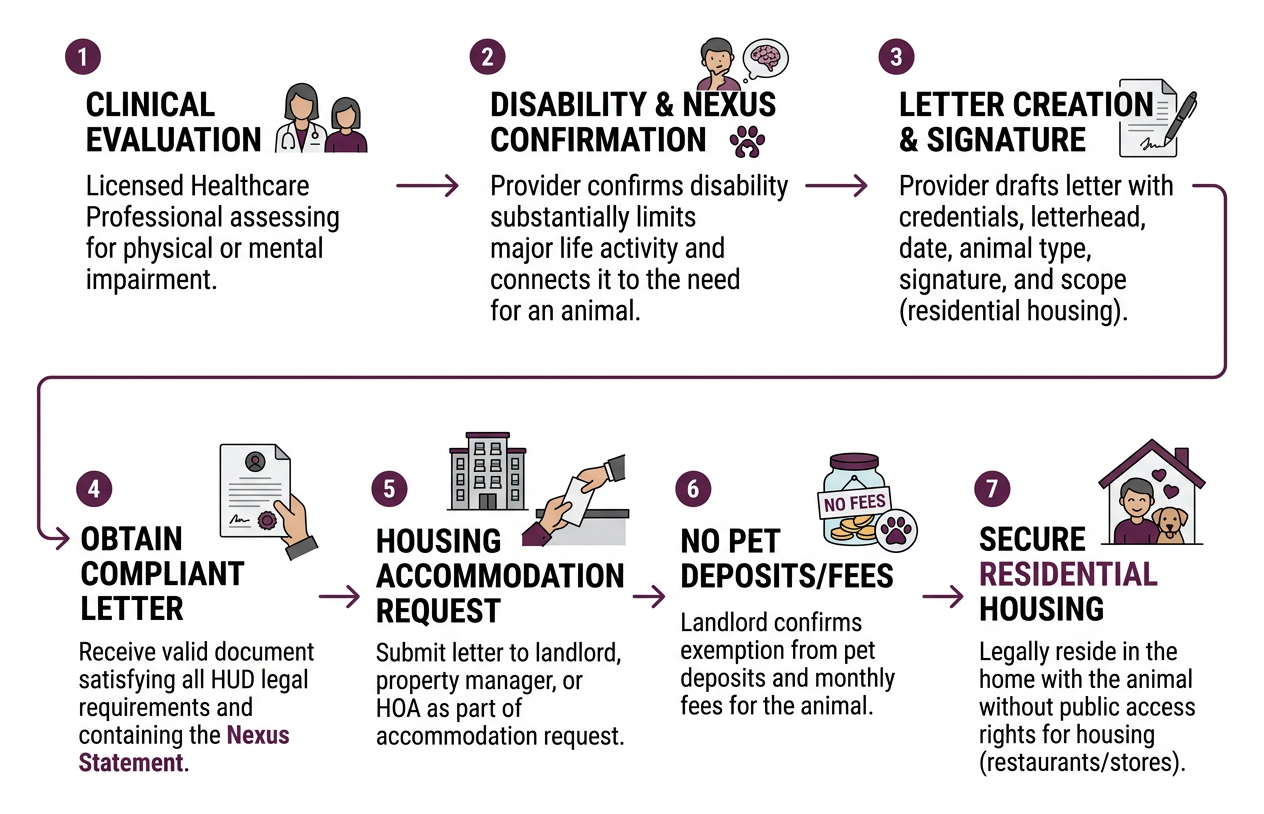
When presenting documentation to a landlord, property manager, or homeowners association, standard formatting makes verification straightforward. Trusted advocacy organizations, such as the Disability Rights Center ESA guidance, emphasize using clear, professional language that satisfies legal standards without oversharing personal medical records.
Standard Sample Emotional Support Animal Letter for Housing Template
Below is a standard clinical verification template modeled on established civil rights and mental health frameworks, including the Bazelon Center housing accommodation resources. Clinicians can adapt this language to their practice letterhead, matching our verified provider letter formats.
[CLINICIAN / PRACTICE LETTERHEAD]
[Practice Name]
[Street Address, Suite Number]
[City, State, Zip Code]
[Telephone Number | Professional Email]
Date: [MM/DD/YYYY]
To: [Landlord, Property Manager, or Housing Authority Name]
Address: [Rental Property Address]
Re: Reasonable Accommodation Request for Assistance Animal under the Fair Housing Act
Tenant Name: [Full Legal Name of Tenant]
Date of Birth: [MM/DD/YYYY]
Dear Housing Provider,
I am the licensed healthcare professional for [Full Name of Tenant], and I have been providing clinical care and evaluating their mental health condition since [Date of Initial Evaluation/Care]. I am familiar with their medical history and the functional limitations imposed by their condition.
[Full Name of Tenant] meets the definition of disability under the Fair Housing Act, the Americans with Disabilities Act, and Section 504 of the Rehabilitation Act of 1973. Specifically, they experience a mental health impairment that substantially limits one or more major life activities, including [coping with stress / emotional regulation / sleeping / social interaction].
In order to help alleviate these difficulties, enhance their ability to live independently, and ensure full use and enjoyment of their dwelling, I have prescribed an emotional support animal (specifically, a [dog/cat/domestic animal]) as a necessary part of their ongoing therapeutic care. The presence of this animal provides essential comfort and emotional support that directly mitigates the functional limitations caused by their condition.
This letter serves as formal documentation of the disability-related need for this assistance animal under the Fair Housing Act (42 U.S.C. § 3604(f)(3)(B)). Please note that under HUD guidelines, this assistance animal is not classified as a pet; therefore, standard pet restrictions, pet deposits, monthly pet fees, or breed/weight limitations do not apply.
I am familiar with the professional literature regarding the therapeutic benefits of assistance animals for individuals with functional impairments. Should you need to verify that I authored this letter and hold an active license in good standing, please contact my office at the telephone number listed above.
Sincerely,
[Clinician's Handwritten or Verified Digital Signature]
[Printed Name of Clinician, Degree/Title]
License Type: [e.g., Licensed Professional Counselor, LCSW, Clinical Psychologist]
State of Licensure: [State]
License Number: [License #]
Expiration Date of Letter: [One year from date of issue, e.g., MM/DD/YYYY]
Tenant Request Letter for Reasonable Accommodation
In addition to the clinician's letter, you should submit a brief written request to your housing provider. Using our written accommodation request template helps you maintain a clear paper trail:
Date: [MM/DD/YYYY]
From: [Your Full Name], Tenant at [Your Apartment Unit Number]
To: [Landlord / Property Management Company]
Subject: Request for Reasonable Accommodation — Emotional Support Animal
Dear [Landlord or Property Manager Name],
I am writing to formally request a reasonable accommodation under the Fair Housing Act (42 U.S.C. § 3604(f)(3)(B)) for an emotional support animal (a [dog/cat]).
I have an impairment that meets the statutory definition of a disability under federal fair housing laws. To help mitigate the functional limitations of my condition and afford me equal opportunity to use and enjoy my home, my licensed healthcare provider has prescribed an emotional support animal.
Attached to this letter is formal verification from my licensed clinician confirming my disability-related need for this accommodation.
Because assistance animals are not considered pets under federal law, I respectfully request a waiver of any pet prohibitions, pet deposits, or recurring pet fees associated with my lease.
HUD guidance indicates that housing providers should review and respond to reasonable accommodation requests within 10 business days. Please provide your written response to this request by [Date: 10 business days from today].
Thank you for your assistance and prompt consideration.
Sincerely,
[Your Signature]
[Your Printed Name]
[Unit Number] | [Phone Number] | [Email Address]
Legal Rights, HUD Rules, and What Landlords Can Demand

Understanding federal protections keeps you informed throughout the accommodation process. Landlords must evaluate reasonable accommodation requests according to fair housing laws, meaning they cannot create arbitrary hurdles or impose financial penalties.
Fair Housing Act Protections Against Pet Fees and Breed Restrictions
Under the FHA, an emotional support animal is legally classified as an assistance animal, not a pet. As a result:
- No Pet Deposits or Monthly Pet Rent: Landlords cannot charge an upfront pet deposit, non-refundable pet fee, or monthly pet surcharge for an ESA. If a property attempts to enforce pet rent, our guide on navigating no-pet lease policies explains how to handle non-compliant property terms.
- Exemption from "No-Pets" Rules: Housing providers must grant an exception to no-pet policies unless doing so causes an undue financial and administrative burden or fundamentally alters the nature of their housing program.
- No Breed or Weight Limits: Blanket breed bans (such as restrictions on Pit Bulls, Rottweilers, or German Shepherds) and weight caps cannot be used to deny an ESA. Each animal must be evaluated individually based on actual behavior, not generalized breed stereotypes.
- Tenant Responsibility for Damages: While landlords cannot collect pet fees in advance, tenants remain financially responsible for any actual property damage the animal causes upon move-out.
Prohibited Inquiries, Medical Privacy, and Verification Limits
HUD guidelines provide strong privacy protections for tenants requesting an assistance animal:
- No Medical Records or Diagnosis: Landlords cannot demand access to your medical records, require a formal medical history, or ask for your specific clinical diagnosis.
- No Comprehensive Provider Questionnaires: Property managers cannot require your therapist to complete extensive multi-page forms, sign liability waivers, or disclose confidential session notes.
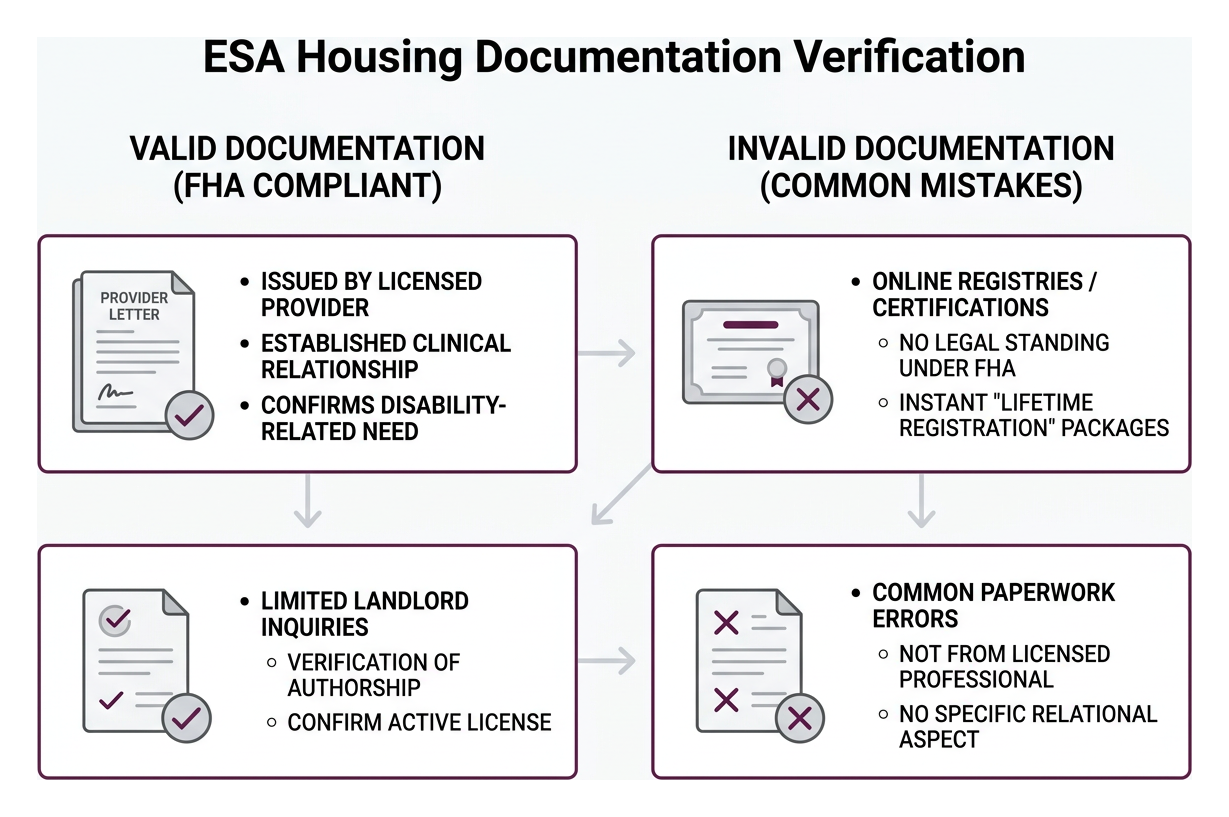
- Verification of Authorship Only: If a landlord contacts your provider, the inquiry must be limited to verifying that the clinician authored the letter, holds an active license, and has an established clinical relationship with you. Clinicians are trained to confirm authorship while keeping your medical details confidential.
Common Mistakes That Invalidate Housing Support Letters
Simple procedural mistakes can cause unnecessary delays with property managers. Avoiding common paperwork errors helps ensure your accommodation request is processed smoothly.
Avoiding Online Registries and Fake Certifications
The most common reason landlords deny accommodation requests is the use of fraudulent online registries.
- No Federal Registry Exists: HUD does not recognize any official registry, identification card, vest, or certificate for emotional support animals. Websites selling instant "lifetime registration" packages provide paperwork with no legal standing under the FHA.
- Landlord Scrutiny: Landlords and housing attorneys are trained to identify instant certification packages. Relying on an unverified online registry can lead to a quick denial. Read our breakdown on spotting fraudulent documentation to protect yourself.
Expiration Rules and State-Specific Mandates
To ensure your documentation remains compliant, keep the following standards in mind:
- 12-Month Validity: Most housing providers only accept emotional support animal letters issued within the past 12 months. Updating your letter annually ensures uninterrupted protection.
- No Backdating: Legitimate providers will not backdate a letter to cover an existing unauthorized pet violation or retroactively waive past fees.
- State-Specific Clinical Mandates: Several states have enacted laws to ensure legitimate provider-patient relationships:
- California (AB 468): Requires clinicians to have an established client relationship for at least 30 days before issuing an ESA letter.
- Montana & Arkansas: Mandate active clinical relationships and explicit licensing compliance for telehealth providers.
- Texas & Illinois: Telehealth providers must hold an active license in good standing in the state where the client resides at the time of clinical evaluation.
Frequently Asked Questions About ESA Housing Letters
How long is an ESA letter valid for housing?
Most housing providers accept emotional support animal letters issued within the past 12 months. While the Fair Housing Act does not explicitly define an expiration date, annual renewals ensure your documentation reflects an active clinical relationship and ongoing therapeutic need.
Does an ESA letter work for air travel after DOT rule changes?
No. In January 2021, the U.S. Department of Transportation (DOT) revised its Air Carrier Access Act regulations. Airlines are no longer required to recognize emotional support animals as assistance animals. Most carriers now treat ESAs as standard pets, subjecting them to regular pet travel fees and carrier dimension requirements. Only individually trained service dogs retain full cabin access rights under federal aviation rules.
How quickly must a landlord respond to an ESA accommodation request?
HUD guidance indicates that housing providers should review and respond to reasonable accommodation requests within 10 business days of receiving complete documentation. Unreasonable delays or ignoring an accommodation request may be treated as a constructive denial under federal fair housing enforcement standards.
Conclusion
Securing your housing rights shouldn't involve unnecessary stress or complex legal hurdles. A properly structured ESA letter from a licensed healthcare provider protects your mental health needs and safeguards you against unauthorized pet fees, unfair breed bans, and restrictive lease clauses.
At ValidPaw, we connect you with licensed clinicians through secure telehealth consultations across Texas—including Houston, Austin, Dallas, San Antonio, and Fort Worth—as well as Chicago, Illinois, and all 50 states. We deliver fully FHA-compliant documentation within 24 to 48 hours, complete with reliable landlord verification support. When you are ready to secure your housing rights, you can apply for a legitimate ESA letter and complete your evaluation from home.