Understanding the Confirmation of Position Letter: Purpose, Context, and Core Distinctions
A formal confirmation of position letter is official written documentation that verifies an employee's job title, effective start date, gross compensation structure, reporting supervisor, and employment status. For ValidPaw readers, this type of employment documentation often becomes relevant when a landlord, property manager, lender, or employer asks for proof of stable employment as part of a housing, tenancy, or accommodation-related file. It is separate from an emotional support animal letter, but both documents may appear in the same housing-administration process when a tenant needs to verify employment while also requesting a Fair Housing Act accommodation.
To draft and issue an effective letter, human resources teams format the document on corporate letterhead, define key terms including role classification, work location, benefits eligibility, and probationary check-ins, and attach a formal signature acknowledgment block with a defined return deadline. Issuing this document immediately after verbal acceptance or internal promotion provides concrete evidentiary value, establishing clear mutual expectations across the employee lifecycle.
In human resources and talent management, documentation serves as both a roadmap and a protective shield. Research shows that the confirmation moment significantly influences employee engagement and retention, with delayed confirmations creating doubt and disengagement. Conversely, employees who receive timely, positive confirmation letters demonstrate higher engagement scores and lower turnover rates in subsequent years.
How It Compares to Offer Letters and Employment Verification
It is common to confuse position confirmations with other standard human resources records. However, each document serves a distinct purpose, targets a specific audience, and carries different legal weight.
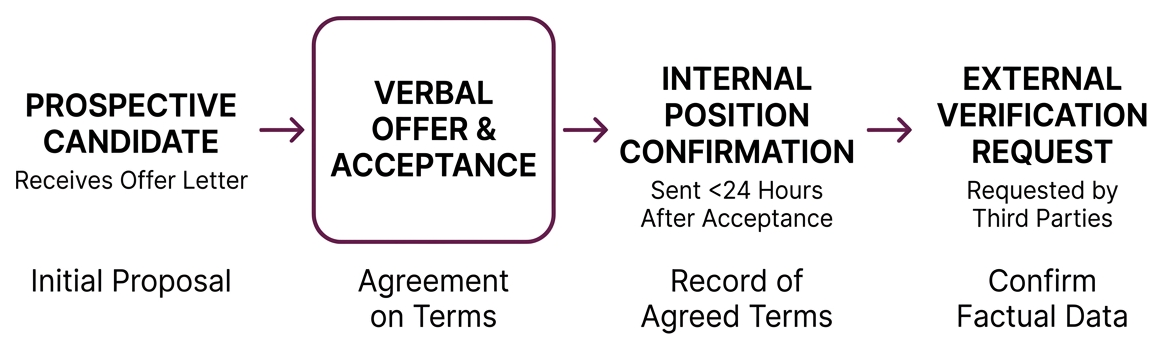
An offer letter is an exploratory, conditional proposal. It outlines what an organization is willing to provide if the candidate accepts. Once the candidate agrees verbally, the employer issues a position confirmation to lock in those terms before drafting extensive formal contracts.
In contrast, an employment verification document is an outward-facing record requested by external third parties such as mortgage underwriters, property managers, or immigration officers. If you need to produce standardized third-party records, using employment verification letter templates helps keep the disclosure focused on appropriate employment facts rather than unnecessary private information. Major institutions like the University of Texas Employee Records Services maintain strict separation between internal personnel change memos and outward-facing verification data to protect employee privacy.
When Employers Should Issue a Position Confirmation
Employers should issue a written confirmation across several key employment milestones:
- Immediate Verbal Offer Acceptance: Sent within 24 hours of reaching an agreement to bridge the gap between a handshake and full onboarding paperwork.
- Completion of a Probationary Period: Transitioning an employee from introductory status to regular full-time standing. A confirmation of permanent employment letter can help formalize this review.
- Internal Promotions and Role Reclassifications: Memorializing new responsibilities, updated compensation grades, and modified reporting structures.
- Transition to Remote or Hybrid Work: Documenting approved work locations, remote equipment stipulations, and schedule requirements.
- Special Project or Temporary Assignments: Outlining the fixed duration, scope, and any temporary pay differentials.
For employees who are also navigating rental applications, ESA accommodation requests, or landlord documentation in Texas or another state, keeping employment confirmation records organized can reduce delays. The position letter confirms job facts; an ESA letter, when clinically appropriate, must come from a licensed professional through a valid evaluation process.
Key Components of a Confirmation of Position Letter
To maintain institutional compliance and avoid ambiguity, every letter must incorporate clear clauses that leave no room for subjective dispute. This is especially important when the employee may later share the document with a landlord, housing provider, or lender alongside other time-sensitive records, such as accommodation documentation.
Essential Clauses: Job Title, Compensation, and Reporting Structure
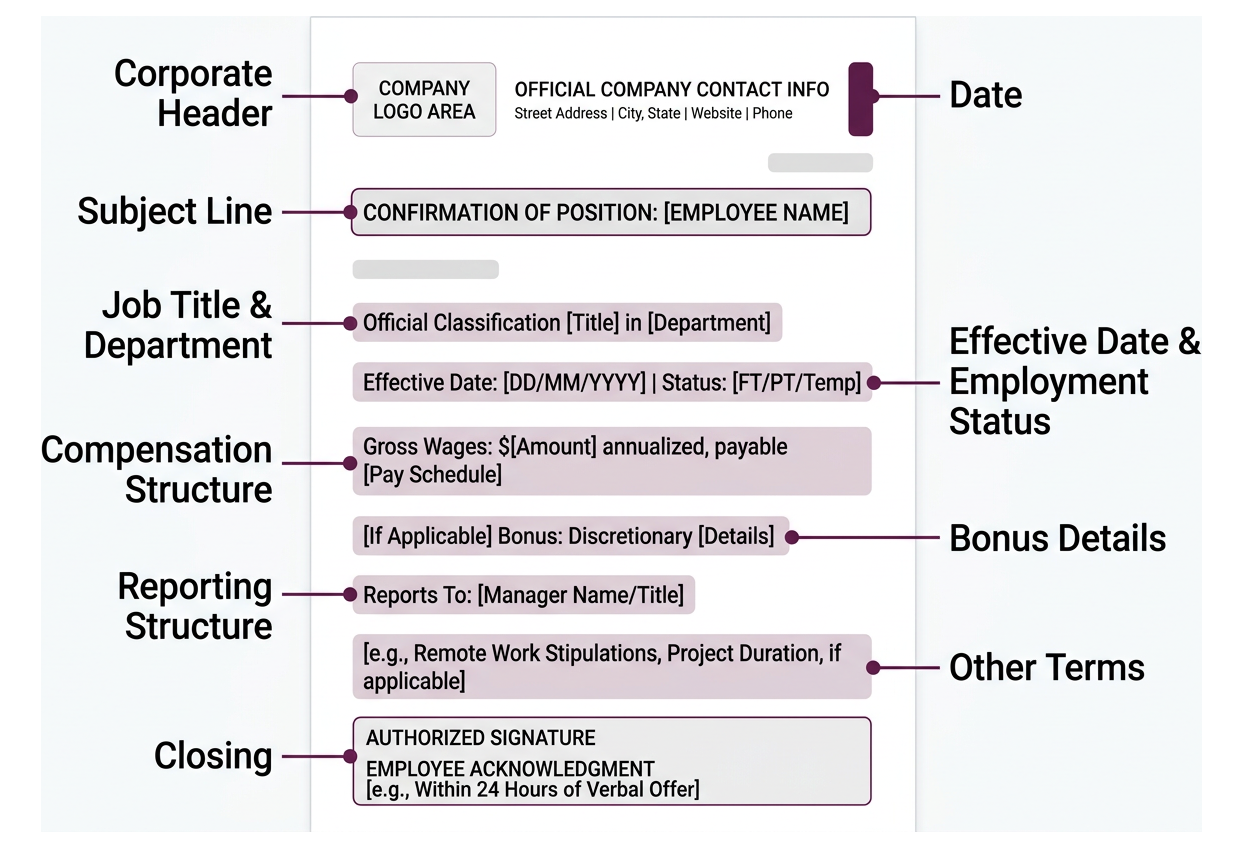
- Accurate Job Title & Department: Use the official corporate classification found in payroll systems rather than informal working titles.
- Effective Date & Employment Status: Explicitly state the exact calendar start date along with whether the role is full-time, part-time, seasonal, or temporary.
- Compensation Structure: State gross wages rather than net take-home estimates (e.g., "$85,000 annualized, payable semi-monthly in accordance with standard payroll cycles"). If bonuses apply, explicitly note that they remain discretionary.
- Reporting Structure: Identify the supervisor by organizational title (e.g., "Reporting directly to the Director of Clinical Operations") rather than by individual name. This ensures document stability if departmental leadership changes.
- Work Location: Identify whether the employee reports to an office in Austin, Dallas, Houston, San Antonio, Fort Worth, or Chicago, or works remotely under an approved telecommuting agreement.
- Benefits Summary: State basic benefits eligibility (medical, dental, 401(k), paid time off) and attach the comprehensive benefits summary as an enclosure.
A position confirmation letter should not include medical information, disability details, or reasons an employee may need an emotional support animal. If an employee needs housing accommodation documentation, that should be handled through the appropriate ESA evaluation and verification process rather than inserted into an HR job-status letter.
Probationary Terms, Performance Reviews, and I-9 Compliance
In many organizations, new hires or newly promoted staff enter an introductory evaluation period lasting 30 to 90 days. The confirmation letter must outline:
- The precise start and end dates of the evaluation window.
- The schedule for performance check-ins (e.g., 30-day, 60-day, and final 90-day reviews).
- Pre-employment contingencies, including statutory identity checks. Under federal employment regulations, employers must collect and verify Form I-9 documentation within three business days of the employee's start date.
Municipal and regional standards, such as the City of Houston Employment Verification Guidelines, reinforce the necessity of keeping strict statutory records to verify identity and employment authorization without administrative delay.
Step-by-Step Guide: How to Draft and Issue the Letter
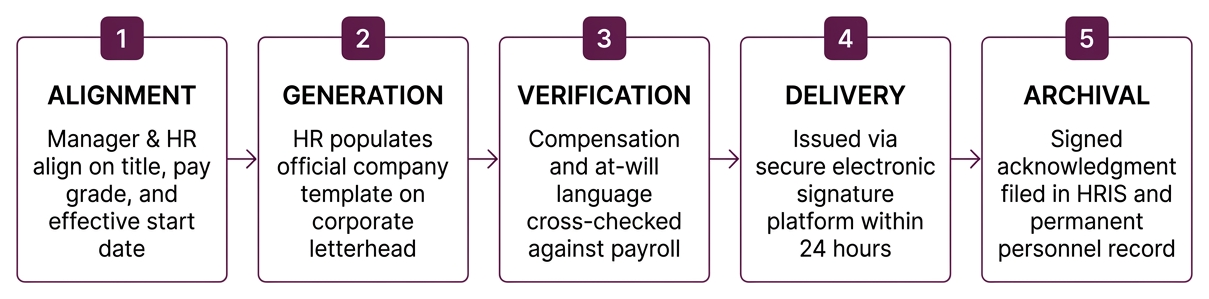
Drafting a position confirmation requires seamless alignment between direct managers and human resources specialists. A standardized workflow also helps employees who need fast, accurate documentation for housing files, relocation paperwork, or landlord screening while they separately manage any ESA accommodation documentation through the appropriate licensed-provider process.
How to Format a Confirmation of Position Letter
A standard business format ensures legal clarity and corporate professionalism:
- Official Letterhead: Display company name, physical address, corporate email domain, and telephone contact.
- Current Date: Always indicate the issuance date.
- Recipient Information: Include the employee's full legal name and current home address.
- Subject Line: State the purpose clearly (e.g., Subject: Confirmation of Appointment - Senior Operations Analyst).
- Salutation: Formal greeting (Dear [Employee First Name],).
- Confirmation Body: Detail title, start date, compensation, supervisor title, and conditions.
- Acknowledgment Section: Include a clear deadline for the employee to sign and return the document.
- Signature Block: Authorized signature, typed name, corporate title, and contact details.
Adapting the Confirmation of Position Letter for Internal Promotions vs. New Hires
When drafting a confirmation for a current team member taking on a new role, the tone shifts from welcoming onboarding to celebrating internal growth. For internal moves, omit introductory I-9 instructions and focus on:
- Effective date of transfer or promotion.
- Adjusted base pay, overtime eligibility, or executive compensation structures.
- Updated department allocations and new reporting relationships.
- Continuity of accrued service benefits (such as PTO tenure tiers).
If you are managing varied internal assignments, reviewing practical employee work verification letters can help you maintain distinct internal and external record templates. That separation is useful when a housing provider needs proof of employment but should not receive unrelated personnel, medical, or accommodation details.
Legal, HR, and Operational Best Practices
A carelessly drafted confirmation letter can inadvertently create an implied employment contract. Maintaining proper administrative guardrails protects the organization while preserving trust. It also helps employees provide landlords, lenders, and property managers with the right record for the right purpose without mixing employment facts with private medical or accommodation information.
Mitigating Legal Risks and Avoiding Implied Contracts
To preserve standard employment protections across jurisdictions:
- Include Clear At-Will Disclaimers: Explicitly affirm that employment remains at-will (where permitted by law) and that the confirmation does not constitute an express or implied contract for a specified duration.
- Frame Incentive Pay as Discretionary: Avoid promising guaranteed bonuses unless contractually required; use terms like "eligible to participate in the annual discretionary incentive plan subject to board approval."
- Require Signed Acknowledgments: Set a concrete return date (typically 3 to 5 business days). Dual-signed documentation provides clean evidentiary support should payroll or role expectations ever be contested.
Handling Third-Party and Tenancy Verification Requests
Employees frequently need proof of their confirmed position when securing housing, obtaining vehicle financing, or applying for mortgages. Financial institutions and leasing offices typically reject documents issued more than 30 days prior.
When preparing documents for housing providers, reviewing tenancy confirmation letter requirements helps ensure you provide the employment or tenancy facts a leasing agent needs without overstepping privacy boundaries. Furthermore, never release compensation data to outside parties without a signed authorization letter for employee verification on file from the employee.
For ESA-related housing requests, a position confirmation letter is not a substitute for a legitimate ESA letter. The employment letter may help establish income or job stability for a rental application, while the ESA letter addresses the disability-related accommodation request and should be verified through a secure, compliant process.
Frequently Asked Questions About Position Confirmation Letters
Is a position confirmation letter legally binding on the employer?
While a confirmation letter is generally not a comprehensive employment contract, it creates binding obligations regarding stated compensation and starting terms once acknowledged by both parties. If the terms in a confirmation letter conflict with a subsequent formal employment contract, reconciliation must occur immediately in writing. Including clear at-will language and explicit contingency clauses prevents the letter from being construed as a guarantee of fixed-term employment.
What is the typical validity window for position confirmation documents?
For internal corporate purposes, the confirmation remains the permanent historical record of a role change. However, when an employee uses the letter as external proof of employment for mortgage lenders, banks, or landlords, third parties generally consider the document valid for only 30 days from the issuance date.
Can a position confirmation letter be used to document probation completion?
Yes. Issuing a position confirmation at the end of an introductory window provides written closure to the probationary period. It records that performance standards have been met, formalizes transition into regular employment status, and details any corresponding merit salary increases.
Can this letter support a rental application or ESA accommodation file?
It can support the employment or income-verification portion of a rental application, but it does not replace an ESA letter. If a tenant is requesting an emotional support animal accommodation, the housing provider should receive appropriate ESA documentation from a licensed professional, while the position confirmation letter should remain limited to job-status facts.
Conclusion
A well-crafted confirmation letter bridges the gap between verbal agreements and operational execution. By clearly defining roles, compensation structures, reporting lines, and evaluation milestones, organizations protect their legal standing while establishing an onboarding experience that fosters long-term employee retention.
For employees and tenants, the same documentation discipline matters during housing, relocation, and accommodation processes. A position confirmation letter can verify job status for a landlord or lender, while ESA accommodation documentation must come from a legitimate clinical evaluation and should not be mixed into an HR employment letter.
Whether managing corporate personnel transitions or handling time-sensitive compliance documentation, accuracy and speed are paramount. For tenants, employees, and property managers requiring rapid, compliant support for emotional support animal documentation, ValidPaw provides reliable telehealth evaluations through licensed Texas therapists. With fast turnaround times, full Fair Housing Act compliance, and seamless verification support, our instant online verification platform ensures that accommodation and verification records remain legally sound, accurate, and readily accessible.