Understanding Assistance Animals: ESAs vs. Service Dogs vs. Therapy Dogs
To get your dog recognized as an emotional support animal (ESA), you do not need to register with any commercial database or online registry. Instead, the only legally valid way to qualify is to complete a mental health evaluation with a licensed mental health professional (LMHP) who issues an official ESA housing letter under the Fair Housing Act (FHA).
To navigate the legal landscape of assistance animals, we must distinguish between emotional support animals (ESAs), service dogs, and therapy dogs. Each category carries distinct legal definitions, training requirements, and public access rights under federal law.
| Feature | Emotional Support Animal (ESA) | Service Dog (Psychiatric or Physical) | Therapy Dog | | :--- | :--- | :--- | :--- | | Primary Legal Protection | Fair Housing Act (FHA) | Americans with Disabilities Act (ADA) Titles II & III | None (regulated by individual visiting facilities) | | Public Access Rights | No (pet-friendly places only) | Yes (restaurants, stores, flights, government buildings) | No (only where invited, like hospitals or schools) | | Training Required | No specialized task training required | Specialized task-oriented training (minimum ~120 hours over 6+ months) | Obedience, temperament, and socialization training | | Housing Fee Exemptions | Yes (no pet rent, deposits, or pet fees) | Yes (fully exempt from all pet restrictions and fees) | No (subject to standard pet policies and fees) | | Air Travel Regulations | Treated as regular pets under 2021 ACAA rules | Permitted in passenger cabin free of charge | Treated as regular pets under standard airline pet policies | | Required Documentation | Valid ESA letter from a licensed mental health professional | No mandatory paperwork for public access; landlord/airline forms | Facility-specific registration and health records |
Under the Americans with Disabilities Act (ADA), a service dog is defined specifically as a dog individually trained to perform active tasks or work directly related to an individual's physical, sensory, psychiatric, or intellectual disability. For example, a psychiatric service dog might turn on room lights to mitigate PTSD flashbacks or physically interrupt repetitive self-harm behaviors.
In contrast, an emotional support dog provides comfort, companionship, and emotional grounding through its mere presence. Because ESAs are not trained to perform specific physical tasks, they do not qualify for public access under the ADA.
Furthermore, following the Department of Transportation's revisions to the Air Carrier Access Act (ACAA), commercial airlines are no longer federally required to accommodate emotional support animals in passenger cabins for free. Today, ESAs flying on commercial carriers are subject to standard airline pet policies, carrier restrictions, and associated pet travel fees. To understand the baseline standards that define these animals, review our guide to ESA dog requirements.
The Truth About ESA "Registration" and Online Registry Databases
A massive misconception exists online regarding assistance animal databases. Countless commercial websites promise instant "lifetime registration," digital identification cards, holographic badges, and official-looking certificates for a fee.
Federal law does not recognize any official ESA registry, database, or certification program. The U.S. Department of Housing and Urban Development (HUD), the Department of Justice (DOJ), and the Fair Housing Act do not manage, endorse, or require any database registration. Purchasing an online registry ID or digital badge provides zero legal rights under federal or state law.
In its official assistance animal guidance, HUD explicitly states that websites selling instant registrations, certificates, or ID cards to anyone who answers a brief questionnaire do not constitute reliable documentation of a disability-related need for an assistance animal. Landlords and property managers are fully legally entitled to reject commercial registry certificates.
For an objective clinical breakdown, see this vet-reviewed advice on certifying an emotional support dog. If you want a clear breakdown of the proper legal path, explore How to Register Animal as ESA in 5 Simple Steps.
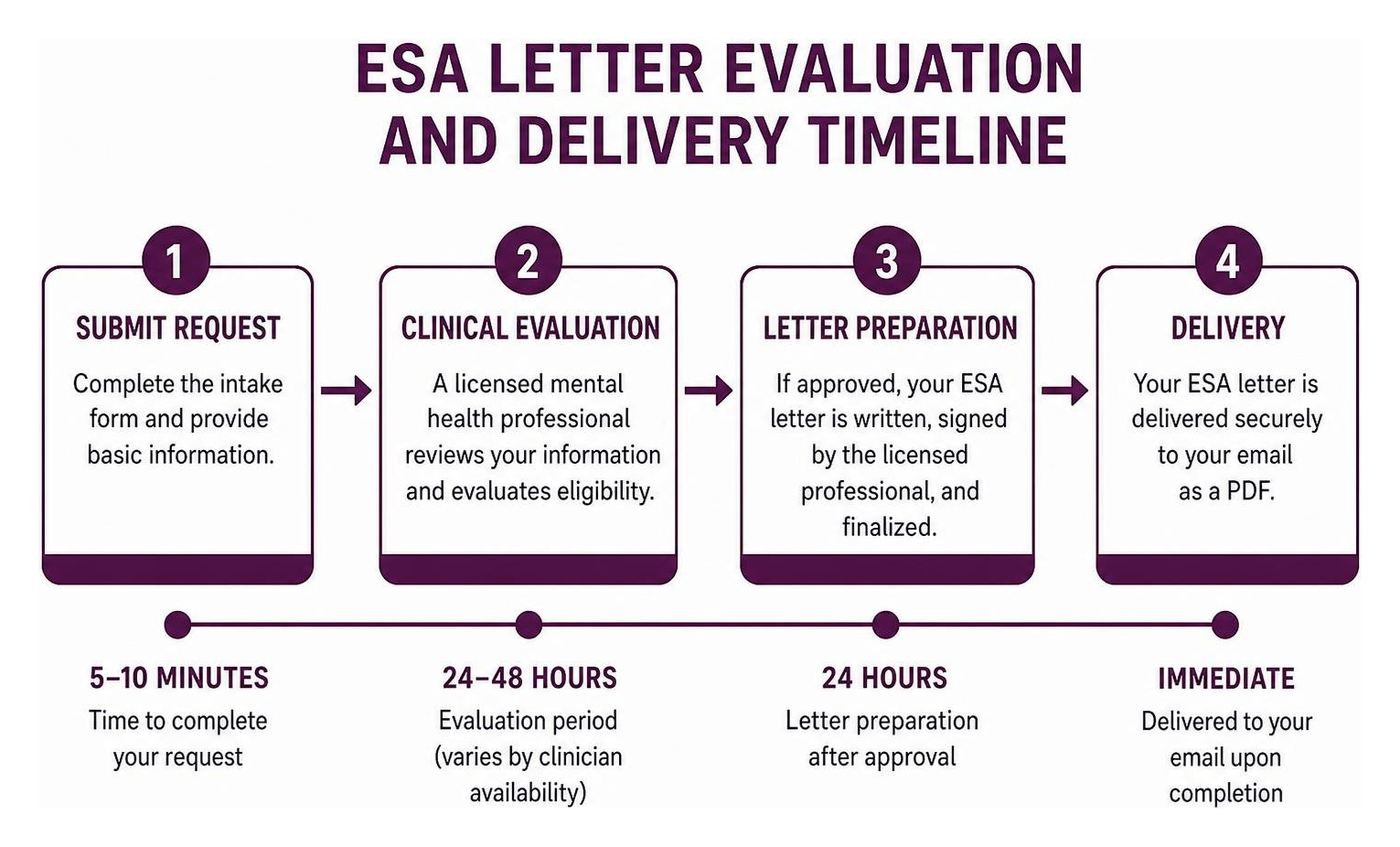
How to Get Your Dog ESA Registered: The Step-by-Step Process
Because commercial registries hold no legal standing, the actual path involves obtaining a legally compliant clinical recommendation letter from a licensed mental health professional (LMHP) or medical doctor. This documentation proves your need for a reasonable accommodation under the Fair Housing Act.
For an exhaustive review of what clinicians must supply, consult our essential guide to ESA documentation requirements.
Qualifying Mental and Emotional Health Conditions
To qualify for an emotional support animal, a person must have a diagnosed mental or emotional condition outlined in the Diagnostic and Statistical Manual of Mental Disorders (DSM-5) that substantially limits one or more major life activities (such as sleeping, concentrating, working, or regulating emotional stress).
Common qualifying conditions include:
- Major Depressive Disorder (MDD)
- Generalized Anxiety Disorder (GAD) and Panic Disorders
- Post-Traumatic Stress Disorder (PTSD) and Complex PTSD
- Bipolar Disorder and Mood Dysregulation
- Autism Spectrum Conditions and Neurodivergent Support Needs
- Chronic Insomnia linked to psychiatric symptoms
- Severe Social Phobia and Panic Episodes
If you manage persistent, complex diagnoses, read our resource on support animals for complex mental health conditions.
Step 1: Complete a Clinical Mental Health Evaluation
The first step is undergoing a formal mental health screening with a provider who is actively licensed in your state. This evaluation can happen through traditional in-person office visits or secure, compliant telehealth sessions.
During the consultation, your clinician will review:
- Your clinical mental health history and current emotional symptoms.
- How your symptoms interfere with daily functioning, focus, emotional regulation, or sleep.
- How the companionship, routine, or affection of your dog alleviates specific symptoms of your mental health condition.
At ValidPaw, we connect clients across Texas (including Houston, Austin, Dallas, San Antonio, and Fort Worth), Chicago, IL, and nationwide with licensed therapists for telehealth evaluations. Depending on where you live, state regulations may require an established clinical relationship before documentation is issued. For specific regional insights, see our emotional support animal evaluation Texas guidelines.
Step 2: Obtaining and Verifying Your Official ESA Housing Letter
If your clinician determines that an emotional support animal is a necessary part of your care plan, they will write an official ESA housing accommodation letter.
A valid ESA letter must include the following details:
- The clinician's full legal name, professional title, and active license number.
- The state of licensure and the date the professional license was issued.
- The provider's official business letterhead, physical office address, and contact phone number.
- The clinician's direct signature and the date of document issuance.
- Confirmation that you have a diagnosed mental or emotional impairment that substantially limits a major life activity.
- A clear clinical affirmation that the presence of your emotional support dog is necessary to alleviate symptoms of your disability.
To maintain patient confidentiality, a valid ESA letter should never disclose your specific clinical diagnosis or personal medical history. Landlords have no legal authority under HUD guidelines to demand access to your psychiatric records or medical charts. For deeper details on formatting, check out our practical guide to ESA letter requirements.
Exercising Your Fair Housing Act Rights as a Tenant

Once you receive your ESA letter, you can present it to your landlord, leasing office, or property management company alongside a written request for a reasonable accommodation under the Fair Housing Act.
Under federal housing protections, housing providers must:
- Grant a reasonable accommodation allowing your support dog to live with you, even in buildings with strict "no-pet" rules.
- Waive all standard pet fees, including upfront non-refundable pet deposits, monthly pet rent, and pet application fees.
- Exempt your emotional support dog from standard residential breed, weight, and size restrictions (such as bans on large dogs or specific breeds like Pit Bulls or German Shepherds).
To learn how federal housing laws apply across various property types, see our ultimate guide to emotional support animal housing.
Managing Landlord Inquiries Without Disputes
While landlords must provide reasonable accommodations, they may verify that your letter comes from a legitimately licensed mental health professional.
When presenting your request:
- Submit your ESA letter and written request in advance of bringing the dog home or moving into a new rental unit.
- Provide the clinician’s public licensing verification details if requested by the leasing office.
- Landlords cannot charge an accommodation processing fee, demand medical files, or require your clinician to answer intrusive questionnaires outside HUD guidelines.
That tenants remain fully liable for any physical property damage their animal causes to the apartment or common grounds. For additional operational insights on communicating with rental offices, read these insights on registering your dog as an emotional support animal.
Daily Care and Behavioral Expectations for Your Support Dog
Although emotional support dogs do not require specialized task training under federal law, they must be calm, housebroken, and manageable within a multi-family housing environment. A landlord can legally seek to remove an assistance animal if it poses a direct health or safety threat to others, displays unprovoked aggression, or creates an ongoing nuisance (such as nonstop barking that violates local noise ordinances).
Essential care and behavioral standards include:
- Basic Obedience: Ensure your dog reliably responds to core commands like "sit," "stay," "leave it," and "come."
- Domestic Socialization: Expose your dog to hallway traffic, elevators, stairwells, and shared community spaces to prevent reactive barking or stress.
- Deep Pressure Therapy (DPT): Many owners teach their support dogs gentle grounding techniques, such as resting their chin or body across their handler's lap during high-stress anxiety spikes.
- Routine Veterinary Care: Keep up with local licensing, rabies vaccinations, parasite prevention, and routine wellness checkups.
Frequently Asked Questions About ESA Registration
Can a landlord legally charge pet rent or deposits for an emotional support animal?
No. Under the Fair Housing Act, an emotional support animal is legally classified as an assistance animal rather than a standard pet. Housing providers cannot charge upfront pet fees, non-refundable pet deposits, or recurring monthly pet rent. However, if your animal causes physical damage to the rental unit, the housing provider can deduct the cost of repairs from your standard, general security deposit.
Are emotional support dogs permitted in non-pet-friendly public places?
No. Emotional support animals do not have public access protections under Title III of the Americans with Disabilities Act. Unlike task-trained service dogs, ESAs are not automatically permitted inside grocery stores, restaurants, movie theaters, hotels, or shopping malls that maintain strict no-pet rules. ESAs are only allowed in public spaces that are openly pet-friendly.
How much does it cost to get a legitimate ESA letter?
A legitimate clinical evaluation and ESA letter generally costs between $50 and $250 for the assessment, while comprehensive independent mental health consultations range from $100 to $300. Avoid online websites selling $20 instant registration IDs or instant certificates, as these are unverified commercial registries that landlords routinely reject.
Conclusion
Understanding how to get your dog recognized as an ESA comes down to one core rule: skip the fraudulent registration databases and work directly with a licensed mental health professional. By securing a legitimate, clinically verified ESA letter, you establish solid legal protections for housing under the Fair Housing Act, avoid unlawful pet fees, and keep your trusted companion by your side.
At ValidPaw, we help you complete the clinical process smoothly. We connect clients with licensed therapists who conduct thorough telehealth evaluations and deliver FHA-compliant documentation within 24 to 48 hours, backed by instant landlord verification.
Apply for your legitimate ESA letter online today and secure your housing rights with confidence.