
Why an Emotional Support Animal for a Mood Disorder Could Change Your Housing Situation
An emotional support animal mood disorder connection is recognized under federal law — meaning if you have a diagnosed mood disorder, you may qualify for an ESA letter that protects your right to live with your animal, even in a no-pet building.
Quick answer for renters with mood disorders:
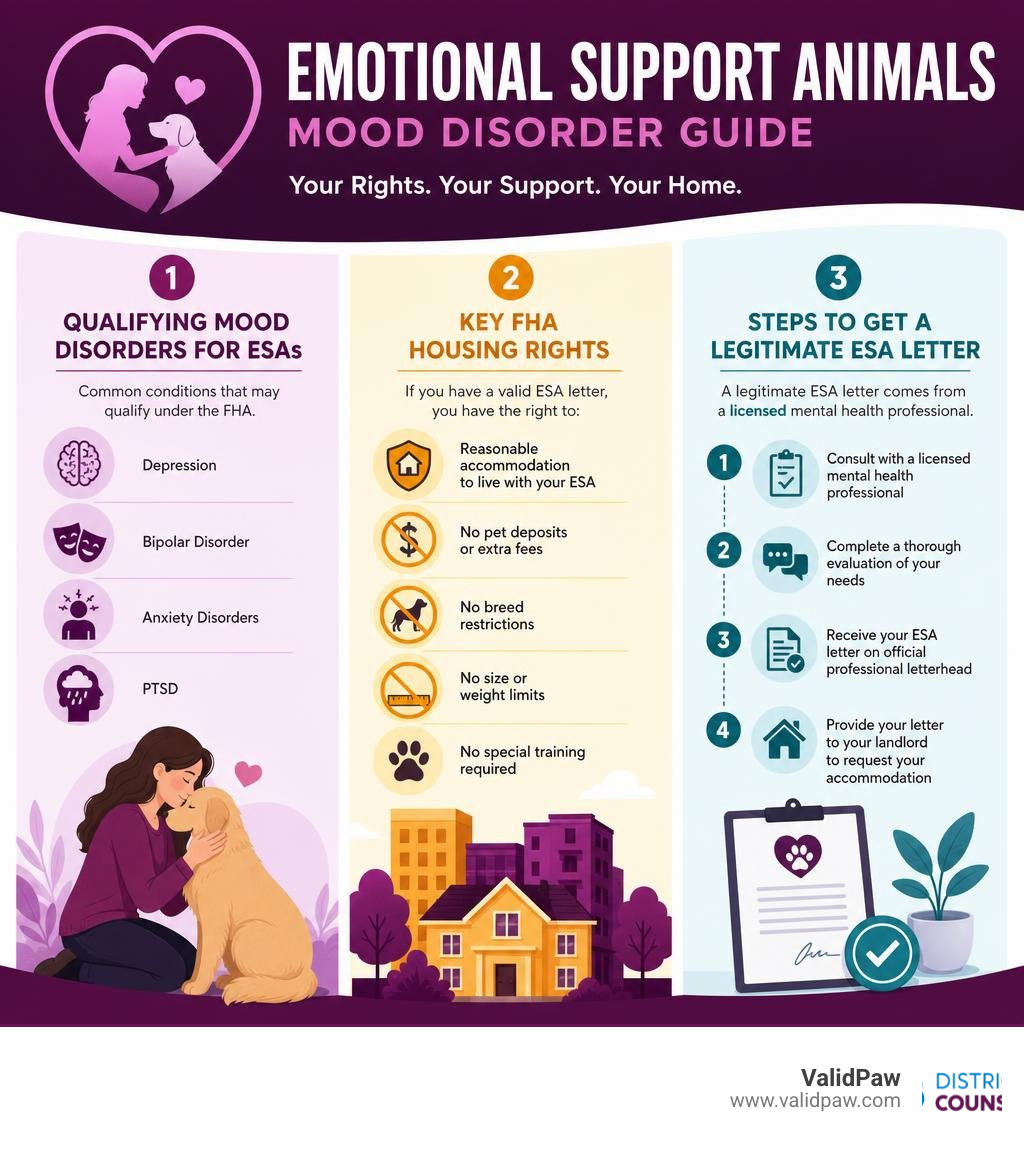
- Mood disorders like depression, bipolar disorder, anxiety, and PTSD are recognized qualifying conditions under the Fair Housing Act (FHA)
- You need a letter from a licensed mental health professional — not a registration or certificate
- That letter requires your landlord to make a reasonable accommodation for your ESA
- No pet deposits, no breed restrictions, no size limits apply to a documented ESA
- ESAs do not need special training to qualify
More than 1 in 4 U.S. adults live with some form of mental disorder. For many of them, an animal companion is not just a comfort — it is a clinically meaningful part of managing daily life. Research confirms that ESA owners report significant reductions in anxiety, depression, and loneliness. Yet the documentation process remains confusing, and far too many people get tripped up by scams or misinformation before they ever get the housing protection they are entitled to.
This guide cuts through the noise. You will learn exactly which mood disorders qualify, what the law protects, and how to get a legitimate ESA letter without leaving your home.
I'm Francisco Ortiz, Lead Forensic Mental Health Evaluator and Director of Behavioral Health at District Counseling PLLC, with multi-state licensure and specialized expertise in clinically rigorous emotional support animal mood disorder evaluations grounded in forensic protocols and disability assessment. I'll walk you through everything you need to know to make an informed, confident decision.
Service Dogs vs. Emotional Support Animals: Key Differences
When we discuss assistance animals, it is easy to get overwhelmed by the terminology. Many people use the terms "service dog" and "emotional support animal" interchangeably, but under federal law, they are entirely different legal entities. Understanding these distinctions is critical to ensuring you remain compliant with local regulations in states like Texas and Illinois, while fully exercising your civil rights.

To get started, we need to look at what the animal actually does. A service dog is individually trained to perform active work or tasks directly related to a handler’s disability. An ESA, on the other hand, provides therapeutic comfort simply through its passive presence. This functional difference dictates where the animal is legally allowed to go.
For a deep dive into these legal and practical differences, we recommend checking out our comprehensive guide: Service Dog or ESA: Getting the Facts Straight on Emotional Support Animals.
Here is a quick reference table to help you compare the two:
| Feature | Service Dogs & Psychiatric Service Dogs (PSDs) | Emotional Support Animals (ESAs) | | :--- | :--- | :--- | | Primary Law | Americans with Disabilities Act (ADA) | Fair Housing Act (FHA) | | Training Required | Yes (Highly specialized task training) | No (Basic obedience only) | | Public Access Rights | Full access to public spaces (restaurants, stores) | No public access rights (subject to business policies) | | Housing Protections | Yes (Exempt from pet rules and fees) | Yes (Exempt from pet rules and fees) | | Air Travel Rights | Yes (Permitted in-cabin for free under DOT rules) | No (Treated as standard pets since 2021) | | Species Allowed | Dogs (and in rare cases, miniature horses) | Any domesticated species (cats, dogs, rabbits, etc.) |
Legal Protections Under the ADA and FHA
The Americans with Disabilities Act (ADA) is the federal civil rights law that guarantees people with disabilities equal access to public spaces. Under the ADA, only service animals (dogs and miniature horses) have the right to accompany their handlers into restaurants, grocery stores, hotels, and public transit. Because ESAs are not trained to perform specific tasks, they do not have public access rights under the ADA.
Conversely, the Fair Housing Act (FHA) is a completely different law administered by the Department of Housing and Urban Development (HUD). The FHA protects individuals with physical and mental disabilities from housing discrimination. Under the FHA, both service dogs and emotional support animals are grouped under the broader umbrella of "assistance animals."
According to the HUD Assistance Animals Guidance, housing providers must make reasonable accommodations for assistance animals, meaning they must waive no-pet policies, breed restrictions, and pet fees for documented ESAs.
Task Training vs. Passive Therapeutic Presence
The dividing line between a Psychiatric Service Dog (PSD) and an ESA is task training. A PSD is trained to take specific action to mitigate a psychiatric crisis. For example, a PSD might be trained to:
- Apply deep pressure therapy during a severe panic attack.
- Interrupt self-harming behaviors or repetitive OCD compulsions.
- Retrieve medication or a phone during a depressive episode.
- Conduct a room search to ease hypervigilance for someone with PTSD.
An ESA does not need to do any of this. The therapeutic benefit of an ESA comes from the bond you share. Their passive presence, companionship, and the daily structure of caring for them are what help alleviate symptoms of an emotional support animal mood disorder. While they do not need task training, we always emphasize that ESAs must be housebroken and well-behaved so they do not pose a nuisance or threat to neighbors.
Understanding the Emotional Support Animal Mood Disorder Connection
Mood disorders can disrupt every aspect of daily life, making simple tasks like getting out of bed, maintaining a routine, or socializing feel like climbing a mountain. This is where the therapeutic relationship with an animal becomes a clinical tool.
The clinical validity of ESAs is backed by real science. In a landmark publication, Exploring Benefits of Emotional Support Animals (ESAs): A Longitudinal Pilot Study with Adults with Serious Mental Illness (SMI), researchers tracked individuals with severe mental health diagnoses over 12 months. The study demonstrated significant, measurable reductions in anxiety, depression, and loneliness among participants who were matched with an ESA.
Qualifying Mood Disorders and DSM-5 Criteria
To qualify for an ESA under the FHA, an individual must have a diagnosed mental or emotional impairment that substantially limits one or more major life activities (such as sleeping, working, or caring for oneself). These conditions must be recognized in the Diagnostic and Statistical Manual of Mental Disorders (DSM-5).
Common qualifying conditions we evaluate include:
- Major Depressive Disorder (MDD): Characterized by persistent sadness, loss of interest, and severe fatigue.
- Bipolar Disorder (I & II): Involving extreme shifts in mood, energy, and activity levels, ranging from manic or hypomanic highs to depressive lows.
- Generalized Anxiety Disorder (GAD) & Panic Disorder: Marked by chronic, overwhelming worry or sudden panic attacks.
- Post-Traumatic Stress Disorder (PTSD): Triggered by trauma, causing severe hypervigilance, flashbacks, and emotional numbing.
- Persistent Depressive Disorder (Dysthymia): A chronic form of depression that can drain your motivation over years.
How an Emotional Support Animal Mood Disorder Prescription Alleviates Symptoms
For someone struggling with a mood disorder, an ESA acts as a form of behavioral scaffolding. When depression strips away your motivation, the physical reality of a dog needing a walk or a cat needing to be fed forces you into action. This concept, known in psychology as "behavioral activation," is a core component of cognitive behavioral therapy. It interrupts the cycle of withdrawal and isolation by establishing a mandatory, healthy routine.
Additionally, during manic or hypomanic phases of bipolar disorder, an ESA can serve as a grounding anchor. The calm, predictable routine of caring for an animal helps regulate erratic energy levels. In times of severe distress or depressive detachment, having an animal that offers non-judgmental affection provides a vital sense of purpose and unconditional safety.
The Science of Human-Animal Interaction for Mood Regulation
The benefits of an ESA are not just psychological; they are physiological. Interacting with an animal triggers rapid, positive changes in your body chemistry:
- Oxytocin Boost: Often called the "bonding hormone," oxytocin levels spike in both the human and the animal during positive interactions, promoting feelings of trust and calm.
- Cortisol Reduction: Spending just 10 to 15 minutes petting an animal has been shown to significantly lower cortisol, the primary stress hormone.
- Cardiovascular Regulation: Human-animal interactions help lower blood pressure and heart rate, directly countering the physical symptoms of anxiety and panic.
These neurochemical shifts act as a natural buffer against the nervous system dysregulation that characterizes most mood disorders.
Legal Protections for ESAs Under the Fair Housing Act (FHA)
The Fair Housing Act is the shield that protects your right to live with your ESA. Under the FHA, housing providers are prohibited from discriminating against tenants with physical or mental disabilities. This means landlords must provide "reasonable accommodations" to allow individuals with disabilities equal opportunity to use and enjoy their dwelling.

Housing Rights and Landlord Obligations
When you present a legitimate ESA letter to your landlord, several strict federal rules apply:
- No Pet Fees: Landlords cannot charge you pet rent, pet deposits, or one-time pet fees. Your ESA is classified as an assistance animal, not a pet.
- No Breed or Weight Restrictions: Even if your building has a strict ban on certain breeds (like Pit Bulls or German Shepherds) or weight limits, these restrictions do not apply to your ESA.
- Privacy Protections: Under HUD guidelines, landlords cannot ask for your detailed medical records, demand to see your medical history, or ask you to explain the specifics of your diagnosis. They are only entitled to verify that you have a documented disability and a disability-related need for the animal.
To learn more about what makes a housing request successful, take a look at our article: Everything You Need to Know About Requirements for ESA Letter Success.
Air Travel and Public Access Rules in 2026
It is vital to understand the current legal landscape. In January 2021, the U.S. Department of Transportation (DOT) updated its rules under the Air Carrier Access Act (ACAA). Airlines are no longer required to recognize emotional support animals as service animals.
In June 2026, this rule remains firmly in effect. If you plan to fly with your ESA, they will be treated as standard pets. This means they must meet the airline's size requirements to fit in an under-seat carrier, and you will be subject to standard pet cabin fees.
The only animals that retain free, in-cabin travel rights are fully trained Psychiatric Service Dogs (PSDs). Likewise, ESAs do not have the right of entry into private businesses, workplaces, or restaurants unless those establishments are explicitly pet-friendly.
Crucial Documentation Requirements for a Legitimate ESA Letter
To secure your rights under the FHA, you must possess a legally sufficient ESA letter. There is no such thing as an official "ESA certificate," "registration card," or "government badge." The only document that carries legal weight is a signed recommendation letter from a licensed healthcare professional.
For a comprehensive breakdown of these rules, we invite you to read The Essential Guide to ESA Documentation Requirements.
Steps to Secure an Emotional Support Animal Mood Disorder Letter
Securing a legitimate letter through ValidPaw is a straightforward, clinically sound process:
- Initial Assessment: You begin by completing a secure online screening to share your mental health history and current symptoms.
- Clinical Evaluation: We connect you with a licensed mental health professional (LMHP) in your state (such as in Texas or Illinois) for a comprehensive telehealth evaluation. This is a real clinical conversation to assess how a diagnosed mood disorder impacts your life.
- Drafting and Delivery: If the clinician determines that an ESA is a necessary part of your treatment plan, they will write and sign your FHA-compliant ESA letter, typically delivered within 24 to 48 hours.
To prepare for your consultation, read our walkthrough: The Ultimate Guide to Emotional Support Animal Assessments.
What Your ESA Letter Must Include
To withstand landlord scrutiny, your letter must be highly specific. Under HUD guidelines, a legally sufficient letter must be written on the professional’s official letterhead and include:
- The clinician’s name, license type, license number, and state of licensure.
- The date of issuance (most landlords expect the letter to be dated within the last 12 months).
- A statement confirming that you have a mental or emotional impairment recognized in the DSM-5.
- A clear assertion that the animal mitigates specific symptoms of your disability (establishing the "disability-related need").
- The clinician's signature and contact information.
To see what a compliant letter looks like, you can review our articles on Don't Get Hounded: Everything Your ESA Letter Must Include and Sample ESA Letters That Actually Work.
Avoiding Online Registration Scams and Letter Mills
The internet is flooded with "letter mills" promising instant approvals and lifetime registrations for a small fee. We want to warn you: landlords easily spot these fake certificates.
If a website sells you a registration number or a PDF certificate without requiring a live consultation with a licensed professional, it is a scam. Using these services can lead to your housing request being legally denied.
To protect yourself, read our guide on Is Your ESA Letter Legitimate? How to Spot the Real Deal.
Practical Considerations and Risks of ESA Ownership
While an ESA provides incredible therapeutic benefits, adding an animal to your life is a major, long-term commitment. It is important to look at the practical realities before taking this step.
Financial and Caregiving Responsibilities
Caring for an animal requires regular financial and physical effort:
- Financial Costs: Food, toys, grooming, and routine veterinary care add up quickly. According to industry data, owning a dog can cost between $1,500 and $2,500 annually, while a cat can range from $800 to $1,500.
- Daily Routine: Animals require consistent care. If your mood disorder causes severe depressive episodes where you struggle to care for yourself, you must have a backup plan to ensure your animal is fed, exercised, and kept clean.
- Long-Term Commitment: Dogs and cats live for 10 to 15+ years. This is not a temporary coping mechanism, but a lifetime relationship.
Assessing If an ESA is Right for Your Situation
To determine if an ESA is appropriate for you, ask yourself these questions:
- Do I have the physical energy and emotional bandwidth to care for this animal daily?
- Is my housing situation stable enough to accommodate this specific animal?
- Does the animal's temperament match my needs? (For example, an energetic puppy might worsen severe anxiety, whereas an adult cat might provide the perfect quiet companionship).
- Can I afford unexpected veterinary emergencies?
Frequently Asked Questions about ESAs and Mood Disorders
Can a landlord deny my emotional support animal?
Generally, no. Under the FHA, a landlord must grant a reasonable accommodation request if you provide a valid ESA letter. However, there are a few rare, legal exceptions where a landlord can deny your request:
- If the specific animal poses a direct threat to the health or safety of other tenants that cannot be mitigated.
- If the animal causes substantial, physical property damage.
- If the building is an owner-occupied property with four or fewer units (known as the Mrs. Murphy exemption), or a single-family home rented directly by the owner without a broker.
Do emotional support animals require professional training?
No, federal law does not require ESAs to have any professional task training or obedience certification. Their therapeutic value is derived from their companionship. However, as an owner, you are legally responsible for your animal's behavior. If your ESA barks constantly, damages property, or acts aggressively, your landlord has the legal right to evict the animal.
Can any domesticated animal qualify as an ESA?
Yes. Under the FHA, emotional support animals are not limited to dogs. Common household pets such as cats, rabbits, guinea pigs, birds, and even reptiles can qualify as ESAs, provided a licensed mental health professional documents that the animal mitigates your symptoms.
Conclusion
Navigating an emotional support animal mood disorder recommendation can be life-changing, offering both therapeutic relief and essential housing security. At ValidPaw, we are dedicated to helping you navigate this process with absolute clinical and legal integrity.
We connect you with licensed professionals in Texas (including Houston, Austin, Dallas, San Antonio, and Fort Worth), Illinois (Chicago), and across all 50 states to provide fast, compliant telehealth evaluations. Our letters are fully FHA-compliant, delivered within 24 to 48 hours, and backed by instant landlord verification.
If you are ready to secure a legitimate, professionally backed document, read about The Fastest Ways to Get a Legitimate Mental Health Support Letter and apply for your legitimate ESA letter today.

