
What You Need to Know About Emotional Support Animal Evaluation in Texas
Getting an emotional support animal evaluation in Texas is the first — and most important — step to securing your housing rights if you rely on a pet for mental health support.
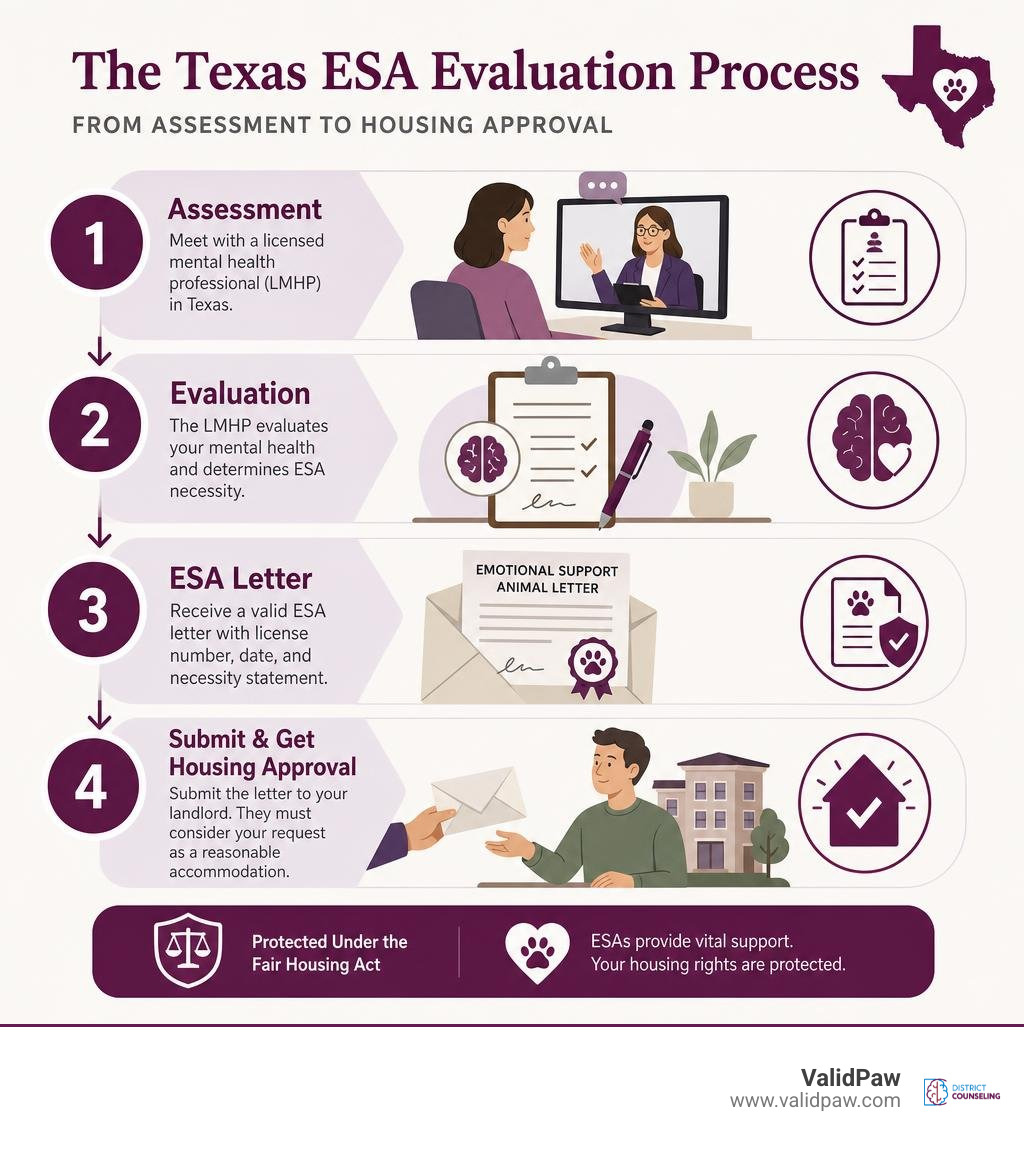
Here's a quick overview of how it works:
- See a licensed mental health professional (LMHP) — a therapist, psychologist, or licensed counselor licensed in Texas.
- Complete an evaluation — the LMHP assesses whether you have a qualifying mental health condition.
- Receive a valid ESA letter — the letter must include the provider's license number, date of issuance, and a statement that an ESA is necessary for your mental health.
- Submit the letter to your landlord — your landlord must consider your request as a reasonable accommodation under the Fair Housing Act.
A valid evaluation typically costs $100–$200, and the entire process can often be completed online through a licensed provider.
Note: ESAs are not the same as service animals. They do not have public access rights under the ADA, but they are protected in housing under the Fair Housing Act.
ESA-related housing accommodation requests in Texas have grown by over 40% since 2020 — meaning landlords are more familiar with the process, but also more likely to scrutinize letters that don't meet legal standards.
I'm Francisco Ortiz, Lead Forensic Mental Health Evaluator and Director of Behavioral Health, and I specialize in clinically rigorous emotional support animal evaluations in Texas that meet strict legal and ethical standards for housing. My forensic training and multi-state licensure ensure every evaluation I conduct holds up to the scrutiny your landlord — or a court — might apply.
Understanding Texas ESA Laws and Definitions
In Texas, navigating the legal landscape for emotional support animals can sometimes feel like trying to fold a fitted sheet—confusing and slightly frustrating. However, the legal definition of an emotional support animal (ESA) is actually quite straightforward. Under Texas law and federal guidelines, an ESA is an animal that provides therapeutic support to an individual with a mental or psychiatric disability. Unlike service dogs, these animals do not need to be trained to perform specific tasks. Their mere presence is what helps alleviate the symptoms of a mental health condition.
At the federal level, ESAs are protected under the Fair Housing Act (FHA). The U.S. Department of Housing and Urban Development (HUD) oversees these regulations. According to the HUD Assistance Animals Guide, housing providers must make reasonable accommodations for individuals who require assistance animals, which includes both service animals and emotional support animals.
In the Lone Star State, state property codes and human resources codes align closely with these federal protections. This means that if you have a legitimate disability-related need for your animal, Texas landlords are legally required to accommodate you, provided you can present a valid, professionally written recommendation.
Service Animals vs. Therapy Animals vs. ESAs in Texas
To keep your legal ducks (or dogs) in a row, it is crucial to understand the differences between service animals, therapy animals, and emotional support animals under Texas law. Mixing these up is one of the most common mistakes pet owners make, and it can lead to awkward situations at your local grocery store or favorite taco joint.
- Service Animals: Under the Americans with Disabilities Act (ADA) and Texas law, service animals are strictly dogs (and in rare cases, miniature horses) that have been individually trained to perform specific tasks directly related to a person's disability. Examples include guiding individuals who are blind, alerting someone to an oncoming seizure, or pulling a wheelchair. Because they are highly trained, service animals have full public access rights. They can go anywhere their handler goes, including restaurants, hospitals, and public transit.
- Emotional Support Animals (ESAs): ESAs can be almost any species of common household pet—most commonly dogs and cats. They do not require specialized training because their primary job is to provide comfort, companionship, and emotional stability. However, because they are not trained to perform specific physical tasks, they do not have public access rights under the ADA. They cannot accompany you into retail stores, restaurants, or onto commercial flights as a matter of right. Their legal protections are strictly limited to housing.
- Therapy Animals: These are pets trained to provide comfort to other people, not their handlers. You will often see therapy dogs visiting hospitals, nursing homes, and schools to help reduce stress in others. They have no special housing rights and no general public access rights; they only go where they are invited.
To dive deeper into these distinctions, check out our guide on Service Dog or ESA Getting the Facts Straight on Emotional Support Animals and read up on the rules in Everything You Need to Know About ADA Service Animals.
Texas Housing Rights and the Fair Housing Act
When it comes to housing, the Fair Housing Act is your shield. Under the FHA, an emotional support animal is not considered a "pet." Instead, it is classified as an assistance animal. This distinction is vital because it means that standard "no pets" policies, breed restrictions, and weight limits do not apply to your ESA.
Furthermore, Texas landlords cannot charge you pet deposits, monthly pet rent, or any additional fees for living with your ESA. If they do, they are violating federal law. However, you are still responsible for any physical damage your animal might cause to the property. If your support dog decides to chew through the baseboards, you will have to foot the bill for the repairs.
Landlords are allowed to ask for documentation proving your need for the animal if your disability is not readily apparent. This is where your official ESA letter comes in. If you present a valid letter from a licensed mental health professional, the landlord must grant a reasonable accommodation unless they can prove that the animal poses a direct threat to the health and safety of others or would cause substantial physical damage to the property.
For more detailed strategies on protecting your housing rights, review our Ultimate Guide to Emotional Support Animal Housing and learn how to handle restrictive lease terms in No Pets Allowed Not With a Valid ESA Letter.
Who Qualifies for an Emotional Support Animal Evaluation Texas?
To qualify for an ESA in Texas, you must have a diagnosed mental or emotional disability that substantially limits one or more major life activities (such as sleeping, working, socializing, or concentrating). According to data from the Texas Department of State Health Services, approximately 10-15% of Texas residents experience a mental health condition that could qualify for an emotional support animal.
Common qualifying conditions include:
- Generalized Anxiety Disorder (GAD)
- Major Depressive Disorder (MDD)
- Post-Traumatic Stress Disorder (PTSD)
- Social Anxiety Disorder
- Bipolar Disorder
- Panic Disorders
- Severe Stress or Insomnia
During an assessment, a clinical evaluator will look at how your symptoms impact your daily routine and whether the presence of an animal provides measurable relief. You can read more about what professionals look for in our Ultimate Guide to Emotional Support Animal Assessments.

Who Can Conduct an Emotional Support Animal Evaluation Texas?
Not just anyone can write you an ESA letter. Your cousin who took one psychology class in college cannot do it, and neither can a random website that promises "instant registration" for a fee.
In Texas, your evaluation must be conducted by a Licensed Mental Health Professional (LMHP) who is actively licensed to practice in the state of Texas. This is a crucial detail because Texas landlords are legally permitted to reject letters written by out-of-state professionals who do not have a valid Texas license or a legitimate therapeutic relationship with you.
Qualified professionals include:
- Licensed Professional Counselors (LPCs)
- Licensed Clinical Social Workers (LCSWs)
- Licensed Marriage and Family Therapists (LMFTs)
- Licensed Psychologists
- Psychiatrists or Licensed Medical Doctors (MDs) treating your mental health
When seeking an evaluator, make sure they are in good standing with their respective state licensing board. If you are looking for local professionals, we recommend reading No More Barking Up the Wrong Tree and How to Find a Texas ESA Therapist or exploring our regional guides like Keep Austin Weird and Certified Your Guide to Austin ESA Therapists.
Preparing for Your Emotional Support Animal Evaluation Texas
Preparing for your evaluation doesn't have to be nerve-wracking. Think of it as an open, honest conversation about your mental health and how your pet fits into your overall wellness plan.
To prepare for your consultation, we suggest taking the following steps:
- Reflect on Your Symptoms: Write down how your mental health affects your daily life. Do you struggle with panic attacks, insomnia, or intense feelings of loneliness?
- Identify the Animal's Role: Be ready to explain exactly how your animal helps you. Does petting your cat lower your heart rate during an anxiety attack? Does walking your support dog force you to get out of bed on depressive days?
- Gather Your History: If you have seen other therapists or have a history of mental health diagnoses, have those details handy.
- Confirm Licensing: Ensure the service or professional you are speaking with is licensed in Texas.
For a comprehensive walkthrough of this preparation, take a look at The Texan's Guide to Getting a Real Emotional Support Animal Letter and familiarize yourself with the structural requirements in Everything You Need to Know About Texas ESA Letter Requirements.
Requirements for a Legitimate Texas ESA Letter
A legitimate ESA letter is a legal document, and like any legal document, it must contain specific information to be considered valid by Texas landlords. If any of these elements are missing, your landlord has the legal right to ask for clarification or deny your accommodation request.
Every valid Texas ESA letter must include:
- The professional’s official letterhead, including their practice name, address, and contact information.
- The professional’s license type, license number, and the state where it was issued (which must be Texas for Texas residents).
- The date the letter was issued.
- A clear statement that you have a diagnosed mental health condition that meets the definition of a disability under the Fair Housing Act.
- An explicit recommendation stating that the emotional support animal is necessary to help alleviate your symptoms and improve your quality of life.
- The therapist's signature.
To ensure your documentation is airtight, refer to our guides on Don't Get Hounded Everything Your ESA Letter Must Include and The Essential Guide to ESA Documentation Requirements.
Here is a quick comparison to help you distinguish between a real letter and a fake one:
| Feature | Legitimate Texas ESA Letter | Scam / Fake Registry Document | | :--- | :--- | :--- | | Provider | Licensed Mental Health Professional (LMHP) licensed in Texas | Automated website generator or "registry" office | | Evaluation | One-on-one live or telehealth clinical assessment | None (just pay a fee and fill out a 2-minute form) | | Licensing Info | Clearly displays therapist's active Texas license number | Missing, fake, or out-of-state license | | FHA Compliance | Specifically references FHA and housing accommodations | Focuses on "official registration" or "ID badges" | | Landlord Verification| The therapist can verbally or written-verify the letter | No way to contact a real doctor; dead-end phone number |
Spotting ESA Scams and Fraudulent Registrations
The internet is filled with predatory websites offering "official ESA registration," "national registry certificates," or "shiny ESA badges." Let us be completely clear: There is no such thing as an official ESA registry. Neither HUD nor the State of Texas recognizes any database, registration number, or vest as proof of an ESA's legitimacy.
These scam sites exist solely to take your money. If you present a "registration certificate" to a savvy Texas landlord, they will likely recognize it as a scam and deny your request immediately.
Furthermore, misrepresenting a pet as an emotional support animal or a service animal carries serious legal consequences in Texas. Under Texas law, fraudulently presenting an animal as an assistance animal to secure housing or public access can result in fines and even misdemeanor charges.
Learn how to protect yourself by reading Is Your ESA Letter Legitimate How to Spot the Real Deal and find out how to do things the right way in How to Register Your Emotional Support Animal in Texas the Right Way.
How to Present Your ESA Letter to Your Landlord
Once you have your legitimate ESA letter in hand, the next step is presenting it to your landlord. We always recommend doing this in writing (via email or certified mail) so you have a clear paper trail of your request.
Here is the step-by-step process we recommend:
- Draft a Polite Request: Write a brief, formal request asking for a "reasonable accommodation for an assistance animal" under the Fair Housing Act.
- Attach Your Letter: Include a digital or physical copy of your Texas ESA letter.
- Do Not Over-share: You do not need to provide your medical records, describe your diagnosis in detail, or give them access to your therapist. Your ESA letter is all they need.
- Give Them Time: Landlords are allowed a reasonable amount of time (typically 10 to 14 days) to review and respond to your request.
For templates and tips on this step, read How to Give Your Landlord ESA Proof That Actually Sticks and Emotional Support Verification Letter What Every Landlord Needs to See.

Frequently Asked Questions About Texas ESAs
Do Texas ESAs have public access rights?
No. Emotional support animals do not have public access rights in Texas. They are not permitted in grocery stores, restaurants, offices, or shopping malls unless the business is explicitly pet-friendly.
Additionally, airline rules have changed significantly over the last few years. Under current Department of Transportation rules, airlines are no longer required to accommodate emotional support animals in the cabin for free. If you wish to travel with your ESA, they will be treated as standard pets and subject to the airline's specific pet fees and carrier size limits. For more information on flying, see Cleared for Takeoff Navigating the New Emotional Support Animal Airline Rules.
How much does a Texas ESA evaluation cost?
A legitimate emotional support animal evaluation in Texas typically costs between $100 and $200. This fee covers the professional clinical assessment by a licensed therapist and the writing of your official letter. If a service is charging significantly less (such as $29 or $49), it is highly likely a scam that does not involve a real consultation with a Texas-licensed professional. To learn more about pricing, check out The Real Price of a Legitimate Texas ESA Letter.
How often do I need to renew my Texas ESA letter?
While the Fair Housing Act does not explicitly state that ESA letters expire, most landlords will not accept a letter that is more than one year old. To ensure your housing protections remain uninterrupted, we recommend renewing your letter annually. This proves to your landlord that your mental health condition is ongoing and that you still require the support of your animal.
Read more about keeping your paperwork current in The Annual Checkup How Often Does an ESA Letter Need to Be Renewed and Keep Your Paws Legal With an ESA Letter Renewal.
Conclusion
Securing a valid emotional support animal evaluation in Texas is a straightforward process when you work with the right professionals. By avoiding online registration scams and getting a legitimate evaluation from a Texas-licensed therapist, you can protect your rights, keep your beloved pet by your side, and avoid unnecessary landlord disputes.
At ValidPaw, we provide fast, ethical, and fully compliant telehealth evaluations. Our network of licensed Texas therapists serves residents in Houston, Austin, Dallas, San Antonio, Fort Worth, and throughout the state. We can help you secure an FHA-compliant letter within 24 to 48 hours, complete with instant landlord verification.
Ready to get started? Apply for your Texas ESA letter today and take the first step toward stress-free housing with your support animal.