
Navigating the legal protections for assistance animals can feel overwhelming, but federal law provides clear distinctions between pets, emotional support animals (ESAs), and service animals. Understanding these distinctions helps ensure your request for reasonable accommodation is valid and legally enforceable.
The three primary federal statutes governing animals in public spaces, housing, and transportation are:
- The Fair Housing Act (FHA): Administered by the U.S. Department of Housing and Urban Development (HUD), the FHA protects individuals with physical or mental disabilities from housing discrimination. Under the FHA, emotional support animals are recognized as assistance animals rather than pets.
- The Americans with Disabilities Act (ADA): Overseen by the Department of Justice, the ADA covers public accommodations, government buildings, and commercial spaces. ADA protections apply specifically to service animals, not ESAs.
- The Air Carrier Access Act (ACAA): Regulates disability accommodations in commercial air travel.
For detailed statutory guidance regarding service animals and disability accommodations, you can review resources provided by the Guides: Animal Law: Service Animals - Texas State Law Library and explore our comprehensive Ultimate Guide to Fair Housing Act ESA Letters.
Key Federal Protections for Housing and Travel
Under the Fair Housing Act, a qualifying tenant with a valid ESA letter receives critical housing accommodations. Housing providers must make reasonable accommodations by waiving "no-pet" policies, breed restrictions, and weight limits. Furthermore, landlords cannot charge pet deposits, advance move-in pet fees, or ongoing monthly pet rent for an ESA.
However, rules regarding travel shifted significantly in January 2021 when the U.S. Department of Transportation updated its ACAA regulations. Commercial airlines are no longer legally mandated to accommodate emotional support animals free of charge in the cabin. Today, most major commercial airlines treat ESAs as standard pets, subjecting them to carrier pet fees and carry-on size limits. Passengers requiring task-trained assistance during flights must utilize Psychiatric Service Dogs (PSDs), which remain fully protected under the ACAA.
To learn more about your rights as a tenant, check out our Ultimate Guide to Emotional Support Animal Housing.
Service Animals vs. Emotional Support Animals
It is crucial to understand that an emotional support animal is not a service animal. Service animals—specifically dogs and miniature horses—must be individually trained to perform specific tasks or do work directly related to a person's disability (such as guiding a visually impaired individual or alerting to an oncoming seizure). Because of this specialized training, service animals enjoy full public access rights under the ADA.
In contrast, ESAs provide therapeutic benefit through their presence, affection, and companionship, helping to alleviate symptoms of conditions such as depression, anxiety, PTSD, or severe insomnia. ESAs do not require task-specific training, and they do not have broad rights to enter restaurants, stores, or other public establishments that prohibit pets.
| Feature / Rights | Service Animals (ADA) | Emotional Support Animals (FHA) | Standard Pets | |---|---|---|---| | Primary Function | Performs specific task-trained work | Alleviates mental/emotional symptoms | Companionship | | Training Required | Specialized individual task training | No specialized training required | Basic obedience | | Public Access Rights | Full access to restaurants, stores, etc. | Restricted; housing only | None in pet-restricted areas | | Housing Protections | Protected under FHA & ADA | Protected under FHA | Subject to landlord pet rules | | Pet Fees & Rent | Exempt | Exempt | Required | | Air Travel Protections | Protected under ACAA | Treated as standard pets | Subject to airline pet policies |
Essential Fair Housing Act ESA Letter Requirements

To satisfy federal standards, your documentation must strictly align with HUD guidelines (specifically HUD Notice FHEO-2020-01). A casual note on a prescription pad or a certificate bought online will not suffice. Housing providers are legally permitted to reject documentation that fails to establish a legitimate nexus between your disability and the assistance your animal provides.
For an in-depth breakdown of these criteria, review What Does an ESA Letter Need to Say? HUD Requirements - LegalClarity alongside The Essential Guide to ESA Documentation Requirements.
What Must Be Included to Satisfy FHA ESA Letter Requirements
An FHA-compliant letter must be issued on official letterhead from a licensed healthcare professional. According to HUD guidelines and standard clinical practices, the letter must contain the following core elements:
- Patient Identification: Clear identification of the patient (your full legal name).
- Establishment of Relationship: Confirmation of an established professional provider-patient relationship.
- Disability Affirmation: Explicit statement that you meet the definition of a person with a disability under the Fair Housing Act (i.e., a physical or mental impairment that substantially limits one or more major life activities).
- Therapeutic Nexus: Clear explanation that the animal provides emotional support or therapeutic relief that alleviates one or more identified symptoms or functional limitations associated with your disability.
- Animal Species Identification: Identification of the specific assistance animal species (e.g., dog, cat).
- Provider Credentials: Professional license number, license type, issuing state, and date of issuance.
- Signature and Date: Official signature of the practitioner and the date the document was executed.
For sample formats and specific drafting guidelines, view the EMOTIONAL SUPPORT ANIMAL (“ESA”) SAMPLE VERIFICATION LETTERS and read Don't Get Hounded: Everything Your ESA Letter Must Include.
What Housing Providers Cannot Demand Under HUD Guidelines
While landlords have the right to request reliable verification, HUD guidelines strictly prohibit them from overreaching. A housing provider cannot demand:
- Your specific medical diagnosis or DSM-5-TR diagnostic code.
- Detailed clinical chart notes or full medical records.
- That your provider complete specific custom forms, affidavits, or notarized statements.
- Statements made under penalty of perjury.
- Proof that the animal has received specialized training or commercial certification.
Your privacy rights remain protected under HIPAA and fair housing regulations. The provider only needs to establish that a disability exists and that the animal provides therapeutic relief for that condition.
Provider Qualifications and State-Specific Rules

A critical component of meeting esa letter requirements lies in who writes your letter. Housing providers are increasingly scrutinizing the legitimacy of clinical credentials, and state legislatures across the country have enacted laws to curb fraudulent documentation.
To ensure your documentation stands up to scrutiny, explore The Ultimate Guide to Finding a Legitimate ESA Letter Writer.
Who Is Qualified to Issue Documentation?
Under HUD guidelines, an ESA letter must be authored by a licensed healthcare professional acting within the scope of their practice. Qualified professionals include:
- Licensed Clinical Social Workers (LCSWs)
- Licensed Professional Counselors (LPCs) / Licensed Mental Health Counselors (LMHCs)
- Licensed Marriage and Family Therapists (LMFTs)
- Psychiatrists and Licensed Clinical Psychologists
- Licensed Psychiatric Nurse Practitioners and Medical Doctors (MD/DO)
The professional writing your letter must hold an active, valid license in the state where you reside. A provider licensed solely in another jurisdiction cannot issue a valid ESA recommendation for your local housing accommodation unless they are explicitly authorized to practice in your state via telehealth compacts or dual licensure.
Learn more about clinical evaluations in The Ultimate Guide to Emotional Support Animal Assessments.
State Regulations and State-Specific ESA Letter Requirements
In addition to federal standards, several states have instituted specific statutes governing the clinical relationship required before an ESA letter can be issued:
- California: Enacted Assembly Bill 468 (effective January 1, 2022), requiring healthcare practitioners to maintain an established client-provider relationship for at least 30 days prior to issuing an ESA recommendation letter. Providers must also conduct a clinical assessment and inform the individual that an ESA does not possess service animal privileges.
- Florida: Florida Statute 760.27 mandates that out-of-state or telehealth practitioners conduct an in-person assessment or maintain an established provider relationship before providing assistance animal documentation.
- Colorado: State regulations require mental health professionals to establish a bona fide provider-patient relationship, requiring in-person evaluations for professional counselors, while allowing physicians to utilize telehealth under strict statutory rules (Section 12-245-229 C.R.S.).
- Texas: Texas law requires providers to operate within their licensed scope of practice and establish a genuine therapeutic relationship through valid telehealth or in-person care. Misrepresenting a pet as a trained assistance animal carries statutory legal fines and penalties under Texas Human Resources Code.
For a deeper dive into local Texas rules, consult Everything You Need to Know About Texas ESA Letter Requirements.
Landlord Rights, Authentication, and Verification Protocols

Landlords have legal rights when reviewing accommodation requests, but their actions are strictly bounded by HUD regulations. Understanding how housing providers evaluate paperwork helps ensure a smooth, conflict-free approval process.
Read How to Give Your Landlord ESA Proof That Actually Sticks for effective communication strategies.
How Landlords Verify ESA Letters Legally
When you submit an ESA letter, a landlord or property manager is legally permitted to verify its authenticity. However, their verification rights are strictly limited:
- Permissible Inquiries: Landlords may contact the signing clinician to confirm that the professional authored the letter, that the signature is genuine, and that the provider’s license is active and in good standing.
- Impermissible Inquiries: Due to HIPAA and federal privacy laws, landlords cannot ask the provider about your medical history, specific diagnostic details, severity of symptoms, or ongoing clinical treatment plans.
Providers receiving verification inquiries from landlords generally respond by confirming signature validity and licensure while maintaining patient confidentiality. See Emotional Support Verification Letter: What Every Landlord Needs to See for full verification details.
Avoiding Scam Websites and Fake Certificates
Online registration mills pose a significant threat to legitimate ESA accommodations. Hundreds of commercial websites claim to provide "official animal registrations," "lifetime ESA certificates," or "instant ID badges."
It is vital to remember: There is no legally recognized registry, mandatory certification, or official ID badge for emotional support animals under federal law.
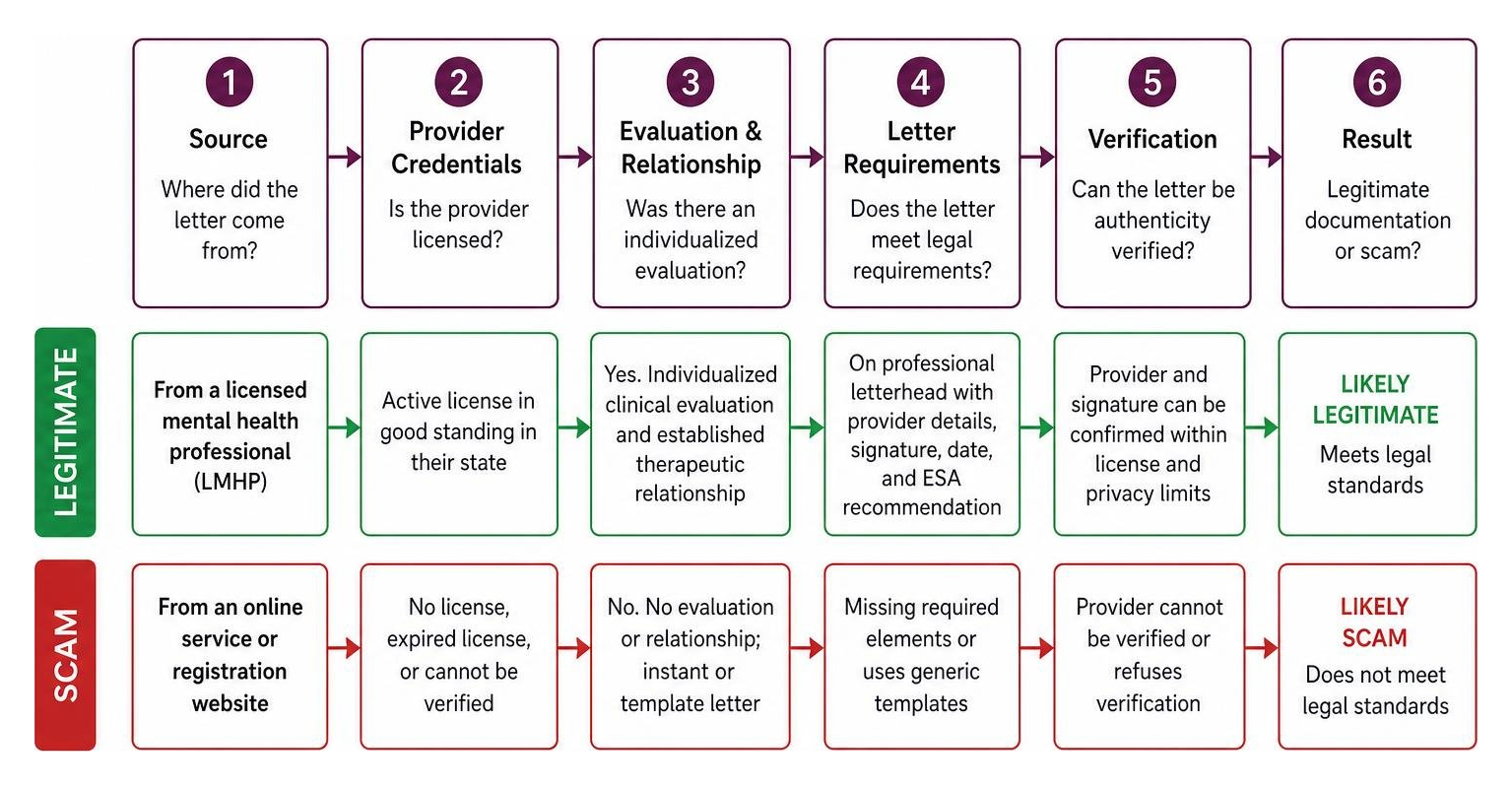
HUD guidelines explicitly state that paid online registries, ID cards, and generic certificates obtained without an individualized clinical evaluation are insufficient to establish a disability-related need for an accommodation. Furthermore, roughly a dozen states impose criminal penalties or financial fines for submitting fraudulent assistance animal documentation.
To protect yourself, read Is Your ESA Letter Legitimate? How to Spot the Real Deal.
Frequently Asked Questions About ESA Letters
Do ESA letters expire, and how often must they be renewed?
While the Fair Housing Act does not specify an explicit expiration date for ESA letters, HUD guidance indicates that housing providers may reasonably request updated documentation if your letter is over one year old.
In clinical and legal practice, standard ESA letters are considered valid for 12 months from their date of issuance. Maintaining an annual checkup and updating your letter yearly ensures your accommodation remains current and prevents delays when renewing your lease.
For full renewal details, read The Annual Checkup: How Often Does an ESA Letter Need to Be Renewed.
Can a landlord deny an ESA accommodation request?
Yes, under narrow statutory circumstances outlined by HUD, a housing provider can legally deny an ESA accommodation request:
- Direct Threat to Health or Safety: If objective evidence shows the specific animal poses a direct threat to the health or safety of others that cannot be reduced or eliminated by another reasonable accommodation.
- Substantial Physical Damage: If the specific animal demonstrates violent or destructive behavior causing substantial physical property damage.
- Undue Financial or Administrative Burden: If accommodating the animal imposes an unreasonable financial or operational burden on the housing provider.
- Exempted Properties: Certain small housing arrangements are exempt from the FHA, such as owner-occupied buildings with no more than four units, or single-family homes sold/rented without the use of a real estate broker.
Denials cannot be based on generalized assumptions, breed restrictions, or size limits. Learn more in When to Tell Your Landlord About an Emotional Support Animal Without Getting Rejected.
Can you bring an emotional support animal on commercial flights?
No. Following regulatory changes enacted by the U.S. Department of Transportation under the Air Carrier Access Act (ACAA) in January 2021, airlines are no longer required to treat emotional support animals as service animals.
Most commercial airlines treat ESAs as standard pets. If your animal meets carrier size and species restrictions, it may travel in an under-seat carrier upon payment of standard pet fees. Only task-trained Psychiatric Service Dogs (PSDs) retain full cabin protection without added fees under current ACAA regulations.
Conclusion
Understanding esa letter requirements protects both your legal rights as a tenant and your therapeutic connection with your support animal. By ensuring your documentation comes from a licensed healthcare provider licensed in your state, contains all HUD-required elements, and is renewed annually, you can secure fair housing accommodations without fear of rejection or unnecessary friction.
At ValidPaw, we provide fast, professional, and fully compliant telehealth evaluations. Our team connects individuals in Texas and across all 50 states with licensed mental health professionals to issue legitimate 24-48 hour FHA-compliant ESA letters featuring instant landlord verification.
Ready to protect your rights and keep your support animal by your side? Apply for an ESA Letter Assessment with ValidPaw today!

