Why Getting an Emotional Support Animal Letter for an Exotic Pet Is More Complex Than You Think
Getting an emotional support animal letter for an exotic pet is absolutely possible — but it works differently than most people expect.
Here's the short answer if you need it fast:
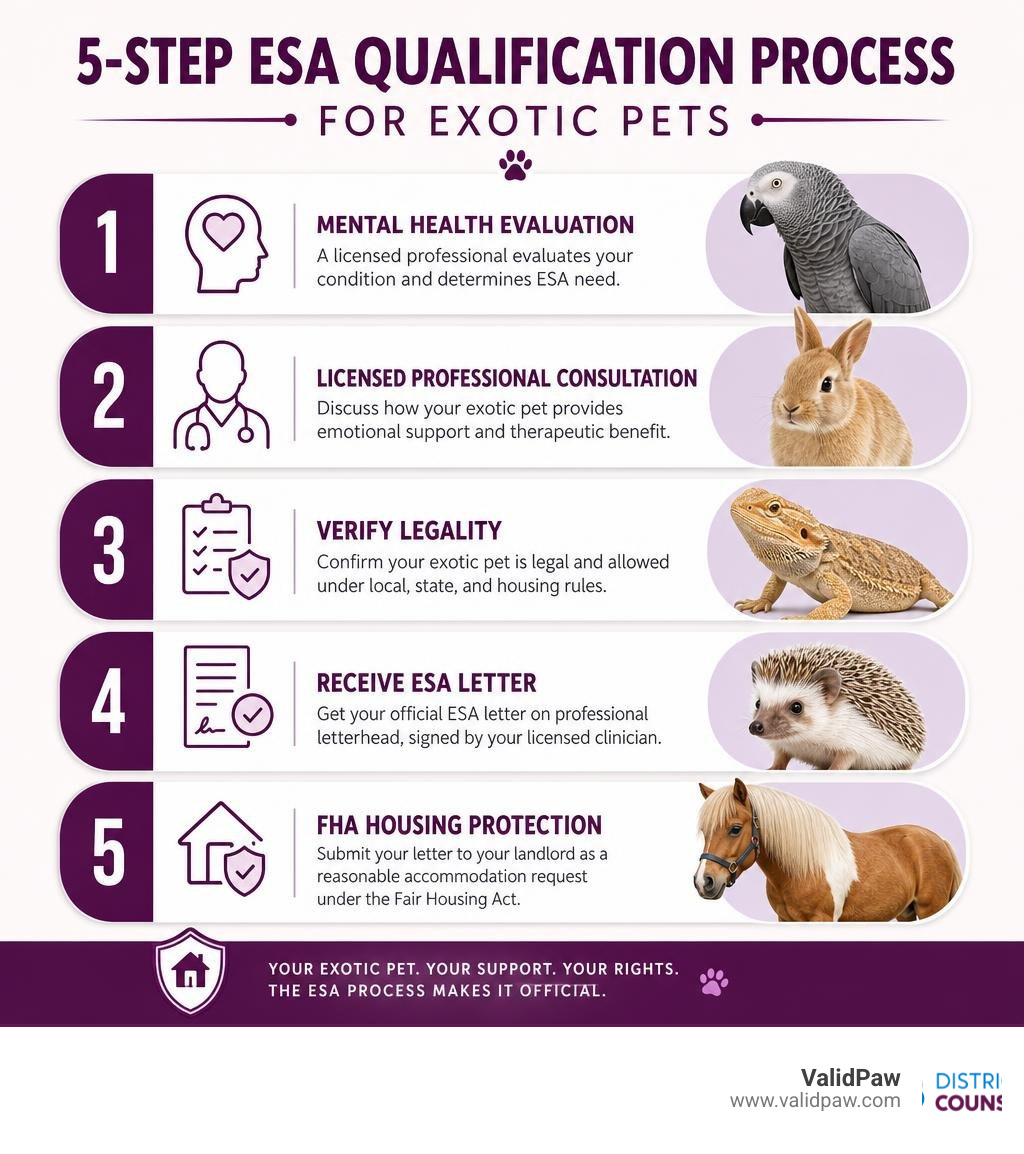
How to get an ESA letter for an exotic pet:
- Confirm your mental health condition qualifies — anxiety, depression, PTSD, and similar conditions are common examples
- Consult a licensed mental health professional (LMHP) — they must evaluate you and determine the animal genuinely supports your treatment
- Verify your exotic pet is legal — check local zoning laws and state regulations for your specific species
- Receive your ESA letter — it must be on official letterhead, signed by a licensed clinician, and include a therapeutic nexus statement
- Submit to your landlord as a reasonable accommodation request under the Fair Housing Act (FHA)
Important: No official ESA registry exists. Any website selling "ESA registration" or "ESA certification" has zero legal weight. Only a letter from a licensed mental health professional provides housing protections.
The process sounds simple. But exotic pets — think parrots, reptiles, rabbits, or miniature horses — add layers of complexity around housing rules, landlord pushback, and finding a clinician willing to evaluate a non-traditional animal.
Real people do make this work. A 66-year-old former bull rider, for example, successfully registered an alligator as his emotional support companion after a licensed mental health professional confirmed the animal was attentive, trainable, and genuinely therapeutic for him. Unusual? Yes. Impossible? No.
I'm Francisco Ortiz, Lead Forensic Mental Health Evaluator and Director of Behavioral Health at District Counseling PLLC, and I've conducted clinically rigorous emotional support animal letter for exotic pet evaluations across six states using forensic-grade psychological assessment protocols. In this guide, I'll walk you through exactly what's legally required — and what to watch out for.
What is an Emotional Support Animal (ESA) and How Does It Differ From a Service Animal?
Understanding the legal landscape of assistance animals is the first step in qualifying your unique companion. Many people confuse emotional support animals with service animals, but the law treats them very differently.
An Emotional Support Animal (ESA) is a companion animal that provides therapeutic benefit, comfort, and warmth to an individual with a diagnosed mental, emotional, or psychological disability. Unlike service dogs, ESAs do not require any specialized training to perform specific physical tasks. Their mere presence is what helps alleviate symptoms of conditions like generalized anxiety, chronic stress, or depression.
A Service Animal, as defined by the Americans with Disabilities Act (ADA), is strictly limited to dogs (and in rare instances, miniature horses) that have been individually trained to perform specific tasks directly related to an owner's physical, sensory, psychiatric, or intellectual disability. Examples include guiding the visually impaired, alerting a diabetic owner to low blood sugar, or physically grounding someone during a severe panic attack.
Because of this intense training, service animals have broad public access rights under the ADA, meaning they can go into restaurants, grocery stores, and hospitals. ESAs do not share these public access rights. Instead, their legal protections are primarily focused on housing under the Fair Housing Act (FHA).
To understand how these roles differ, especially if you are considering whether your pet fits into a specific category, you can read The Ultimate Guide to Emotional Support Animal Assessments.
Here is a quick breakdown to help you visualize the differences:
| Feature | Service Animal | Psychiatric Service Dog (PSD) | Emotional Support Animal (ESA) | | :--- | :--- | :--- | :--- | | Primary Law | Americans with Disabilities Act (ADA) | Americans with Disabilities Act (ADA) | Fair Housing Act (FHA) | | Species Allowed | Dogs (and miniature horses) | Dogs only | Any domestic species (including exotic pets) | | Special Training | Required (task-specific training) | Required (task-specific training) | None required | | Public Access | Full public access rights | Full public access rights | No general public access | | Housing Rights | Exempt from pet fees and bans | Exempt from pet fees and bans | Exempt from pet fees and bans | | Air Travel | Allowed in cabin for free | Allowed in cabin for free | Treated as standard pets (fees apply) |
How to Qualify for an Emotional Support Animal Letter for an Exotic Pet
If your therapeutic companion is a parrot, a bearded dragon, a ferret, or a rabbit, you might wonder: Does the law actually protect non-traditional pets?
The answer is yes, but with a few caveats. Under the Department of Housing and Urban Development (HUD) guidelines, housing providers must accommodate "common household pets" (such as dogs, cats, small birds, rabbits, hamsters, gerbils, fish, and turtles) under the Fair Housing Act.
If your companion falls outside this "common household pet" definition—such as a unique reptile, a miniature pig, or an exotic bird—the legal standard is slightly higher. To qualify an exotic pet, you must demonstrate a therapeutic nexus (a direct connection) between your specific disability and the unique characteristics of that particular animal.

For example, an individual with severe night terrors or PTSD might find that a highly interactive parrot is the only animal capable of mimicking a morning routine or physically waking them up from a nightmare. A person with severe sensory processing disorders might benefit uniquely from the calm, slow movements and dry texture of a bearded dragon.
When applying for an emotional support animal letter for exotic pet accommodations, your licensed mental health professional must clearly document why a traditional pet (like a dog or cat) is not sufficient, and how your unique companion directly mitigates your mental health symptoms.
Legal Protections and Limitations for Exotic ESAs
Having a legitimate ESA letter unlocks crucial legal protections under the Fair Housing Act (FHA). These protections apply even if you live in cities with strict housing markets like Houston, Austin, Dallas, San Antonio, Fort Worth, or Chicago.
Under the FHA, once you present a valid ESA letter to your landlord:
- No-Pet Policies are Waived: You are legally permitted to live with your emotional support animal even in buildings that strictly ban pets.
- Pet Fees and Deposits are Waived: Landlords cannot charge you pet deposits, monthly pet rent, or upfront registration fees for your ESA.
- Breed and Size Restrictions Do Not Apply: General building rules regarding weight limits or specific breed bans cannot be used to deny your assistance animal.
However, there are distinct limitations to these laws, particularly for exotic pets:
- No Air Travel Protections: The Air Carrier Access Act (ACAA) was updated in 2021. Airlines are no longer required to accommodate emotional support animals for free in the cabin. Your exotic pet will be subject to standard airline pet policies, fees, and carrier size restrictions.
- No Public Access: You cannot legally bring your emotional support parrot or lizard into grocery stores, restaurants, or public transit.
- Zoning Laws and Safety Threats: If your exotic pet is illegal to own under local municipal ordinances (for example, keeping a wild animal or a venomous snake in a Chicago or Fort Worth apartment), the FHA does not override local safety laws. Additionally, if the animal poses a direct, documented threat to the health and safety of other tenants, landlords have the legal right to deny the accommodation.
For a deeper dive into making sure your documentation meets every legal standard to prevent landlord rejection, check out Everything You Need to Know About Requirements for ESA Letter Success.
How to Legally Obtain an ESA Letter for Your Unique Companion
The only way to legally qualify your exotic pet as an ESA is to obtain a signed letter from a licensed mental health professional (LMHP) who is currently registered and practicing in your state.

To secure a valid letter, you must establish a clinical relationship with a provider. This can be done conveniently online through telehealth evaluations. During your evaluation, the clinician will assess your mental health history and determine if you meet the criteria for a qualifying mental health condition.
Qualifying Mental Health Conditions
Many emotional and mental health struggles qualify for an ESA accommodation under the FHA, including:
- Generalized Anxiety Disorder (GAD)
- Major Depressive Disorder (MDD)
- Post-Traumatic Stress Disorder (PTSD)
- Severe Phobias and Panic Disorders
- Social Anxiety Disorder
- Chronic Stress and Mood Disorders
- Autism Spectrum Disorder (ASD) and sensory processing challenges
To ensure your paperwork is legally airtight and contains all necessary clinical elements, review The Essential Guide to ESA Documentation Requirements.
If you are looking to understand the federal framework and state-specific guidelines, you can review the official HUD Assistance Animals Guidance to see how regional rules and federal protections impact your rights.
Step-by-Step Process to Secure an Emotional Support Animal Letter for an Exotic Pet
To ensure your request is legally compliant and ready to present to your landlord, follow this structured process:
- Complete an Initial Assessment: You will fill out a brief screening questionnaire detailing your mental health history, daily struggles, and how your exotic pet helps you cope.
- Consult with a Licensed Clinician: You will participate in a telehealth consultation with a therapist licensed in your state (such as Texas or Illinois). They will evaluate your symptoms and discuss the therapeutic role of your pet.
- Drafting the Therapeutic Nexus: The clinician will draft an official letter. Because you have an exotic pet, the therapist must explicitly outline the connection between your mental health needs and the unique support your animal provides.
- Review Letterhead Requirements: Ensure the final document is written on the clinician's official letterhead, includes their license number, state of practice, contact details, and is dated within the last 12 months.
To see what a compliant letter looks like before you begin, you can read through Sample ESA Letters That Actually Work.
Red Flags and Scams to Avoid When Seeking an Emotional Support Animal Letter for an Exotic Pet
As the demand for emotional support animals has grown, so has the number of online scams. Landlords are increasingly trained to spot fake documentation, and presenting a fraudulent letter can lead to immediate denial of your accommodation request—or even legal penalties in states like Texas and Illinois.
Avoid these common red flags:
- "Instant Approval" or No Consultation: If a website promises a letter in minutes without a live or clinical interaction with a licensed therapist, it is a scam.
- Paid Registries and Databases: Any service claiming to "register" your exotic pet in an official federal database is selling a useless piece of paper. The federal government does not maintain any registry for ESAs.
- Lifetime Validity: Legitimate ESA letters are generally expected to be updated annually, especially when moving into a new rental property.
- Incredibly Cheap Letters: Legitimate evaluations require clinical time. Highly cheap, automated PDF templates will be quickly flagged and rejected by savvy property managers.
To protect yourself and your pet from these predatory services, read Don't Get Hounded: Everything Your ESA Letter Must Include.
Frequently Asked Questions About Exotic Emotional Support Animals
Can a landlord deny an exotic pet ESA based on local zoning laws?
Yes. The Fair Housing Act does not protect animals that violate local municipal safety ordinances or zoning laws. If your city bans keeping miniature pigs, venomous reptiles, or certain wild animals within city limits, your landlord is legally obligated to follow those local laws, and your ESA letter cannot override them. Additionally, if the animal poses a direct threat of property damage or physical harm to others, the request can be denied.
Do airlines accept exotic emotional support animals in the cabin?
No. Since the Department of Transportation updated its rules in January 2021, airlines are no longer required to recognize emotional support animals of any species. Your exotic pet will be subject to standard airline policies, which usually restrict cabin travel to small, traditional domestic pets in approved carriers for an extra fee.
Who is qualified to write an ESA letter for a non-traditional pet?
Only a licensed mental health professional (LMHP) in active standing within your state can write a valid ESA letter. This includes licensed clinical social workers (LCSWs), licensed professional counselors (LPCs), licensed marriage and family therapists (LMFTs), psychologists, and psychiatrists. The clinician must have an established clinical relationship with you and conduct a real evaluation.
Conclusion
Qualifying your unique companion as an emotional support animal is a powerful way to protect your mental health and secure a stable living environment. While the process for an exotic pet requires a bit more clinical detail than a standard dog or cat, working with the right professionals makes all the difference.
At ValidPaw, we specialize in providing fast, legitimate, and 100% FHA-compliant ESA letters through convenient telehealth evaluations. Our network of licensed therapists—including dedicated professionals in Texas and across all 50 states—can help you establish the necessary therapeutic nexus to keep you and your unique companion together.
Are you ready to take the next step? Apply for your legitimate ESA letter today and enjoy peace of mind with instant landlord verification and professional support.