Understanding the Fair Housing Act for Pets, Service Animals, and ESAs
Legal Differences Under the Fair Housing Act for Pets vs Assistance Animals
When navigating rental rules, the legal category an animal falls into determines everything. Under federal housing law, there is a strict divide between ordinary household pets and assistance animals.
A pet is kept purely for companionship, pleasure, or hobby. Landlords hold full authority to restrict pets, limit how many can live in a unit, charge extra deposits, or enforce complete "no-pet" community bans.
In contrast, assistance animals are not classified as pets. Under the federal framework, assistance animals fall into two main categories:
- Service Animals: Defined strictly under the Americans with Disabilities Act (ADA) and recognized under housing rules as dogs (and in specific cases miniature horses) individually trained to do work or perform specific physical tasks for an individual with a disability. Examples include guide dogs for visual impairment, alert dogs for seizures, or stability dogs for mobility impairments.
- Support Animals (ESAs): Animals of common domestic species that alleviate the symptoms or effects of a physical, mental, or psychiatric disability by providing therapeutic comfort, presence, and companionship. Unlike service animals, support animals do not require specialized behavioral task training.
The governing foundation of assistance animal legal protections is the Fair Housing Act (FHA). Under the FHA, housing providers must offer reasonable accommodations—meaning exceptions or adjustments to standard policies, practices, or rules—so that individuals with disabilities have an equal opportunity to use and enjoy their home.
Because an assistance animal serves as a disability-related accommodation rather than a pet, how a no-pet lease applies to assistance animals comes down to this core rule: standard pet bans cannot be used to block a qualifying tenant.
| Animal Classification | Governing Laws | Specialized Training Required? | Species Permitted | Housing Pet Fees & Rent Apply? | Public Access Rights (Stores, Cafes) | | :--- | :--- | :--- | :--- | :--- | :--- | | Pet | State & Local Property Law | No | Any legal domestic species | Yes | No | | Service Animal | ADA, FHA, Section 504 | Yes (disability-specific tasks) | Dogs (and miniature horses) | No | Yes (all public spaces) | | Emotional Support Animal (ESA) | FHA, Section 504, State Fair Housing Laws | No specialized task training required | Common household animals | No | No (limited to residential dwelling) |
Assistance Animal Fee Exemptions and Breed Restrictions
One of the most immediate benefits of assistance animal classification is complete exemption from pet-related charges. Landlords cannot require:
- Upfront pet deposits (refundable or non-refundable)
- One-time pet move-in fees
- Recurring monthly pet rent
- Mandatory application screening fees designed specifically for pets
Additionally, standard property restrictions regarding size, weight caps, and specific dog breeds do not apply to assistance animals. A property manager cannot reject an assistance animal simply because a dog weighs 65 pounds in a building with a 25-pound pet limit, nor can they enact blanket bans on breeds often targeted by restrictive leasing policies, such as German Shepherds, Rottweilers, or Pit Bulls.
Understanding landlord restrictions on animal breeds and the facts around apartment weight limit rules helps both parties avoid costly misunderstandings. Accommodations must be decided through an individualized assessment of the specific animal's behavior, not broad breed stereotypes or speculative insurance surcharges.
How HUD Enforcement and State Laws Regulate Assistance Animals in 2026
How Recent HUD Guidance Impacts the Fair Housing Act for Pets and ESAs
In 2026, the regulatory landscape surrounding animal accommodations experienced notable updates. Following the issuance of federal enforcement guidance from the Department of Housing and Urban Development (HUD), administrative enforcement standards underwent a significant shift.
HUD rescinded its prior broad notices from 2013 and 2020, moving federal enforcement priorities toward trained service animals. This change came partly in response to growing administrative backlogs, where more than 20% of HUD’s fair housing complaints involved untrained emotional support animals. Under this updated administrative stance, HUD paused open ESA-related administrative complaints for individualized review.
For property managers and tenants, this federal shift created widespread questions. Some mistakenly believed that the Fair Housing Act itself had been rewritten to eliminate ESAs. However, the underlying statutory protections of the Fair Housing Act remain intact.
Federal courts continue to interpret the statutory requirement for reasonable accommodations to cover support animals, and property owners who institute blanket rejections of all untrained animals face severe legal liability. Reviewing understanding landlord restrictions under fair housing law makes it clear that housing providers must maintain objective, non-discriminatory review procedures. You can read the official HUD 2026 enforcement guidance to see the administrative parameters directly.
Navigating Stricter State Laws in California, Florida, and Beyond
Federal enforcement guidelines set a regulatory baseline, but state and local jurisdictions hold independent authority to grant equal or greater civil rights protections to renters.
- California: Under state law (including California AB 468), healthcare providers issuing documentation for emotional support animals must hold an active, valid license, establish a bona fide client-provider relationship, and conduct a clinical evaluation for at least 30 days before providing an ESA letter.
- Florida: Florida Statute 760.27 outlines clear rules against fraudulent representation of assistance animals, establishing specific documentation criteria and criminal misdemeanor penalties for providing falsified documentation.
- Texas and Other States: State property and human resources codes consistently protect individuals with disabilities requiring assistance animals, as outlined in the Texas State Law Library assistance animal regulations.
Because state fair housing statutes operate independently, housing providers must comply with both local legislation and broader federal mandates. Our complete guide to emotional support animal housing breaks down how these regional variations function in practice.
Valid ESA Documentation and Spotting Fraudulent Letters
Legitimate Healthcare Provider Letter Requirements

When a disability or disability-related need for an animal is not obvious, housing providers have the legal right to ask for reliable documentation from a qualified professional. A legally sound ESA letter must come from a licensed healthcare professional acting within the scope of their practice.
Eligible professionals include:
- Licensed Professional Counselors (LPC / LPCC)
- Licensed Clinical Social Workers (LCSW)
- Licensed Marriage and Family Therapists (LMFT)
- Licensed Clinical Psychologists (PsyD / PhD)
- Licensed Medical Doctors (MD / DO) and Psychiatrists
- Advanced Practice Registered Nurses (APRN / NP)
A compliant verification letter must be written on official letterhead, state the provider's professional title, active license number, licensing board, state of jurisdiction, and contact details. It must confirm that the tenant meets the legal threshold of a physical or mental impairment that substantially limits one or more major life activities and explain the nexus—how the animal's presence alleviates specific symptoms or effects of that impairment.
Tenants should review comprehensive ESA documentation standards and ensure their documentation reflects what landlords look for in verification letters.
Identifying Misleading ESA Claims
With the rise of unregulated online operations, property managers frequently encounter invalid accommodation paperwork. Knowing the difference between legitimate telehealth clinical care and misleading paperwork mills protects both properties and genuine disability rights.
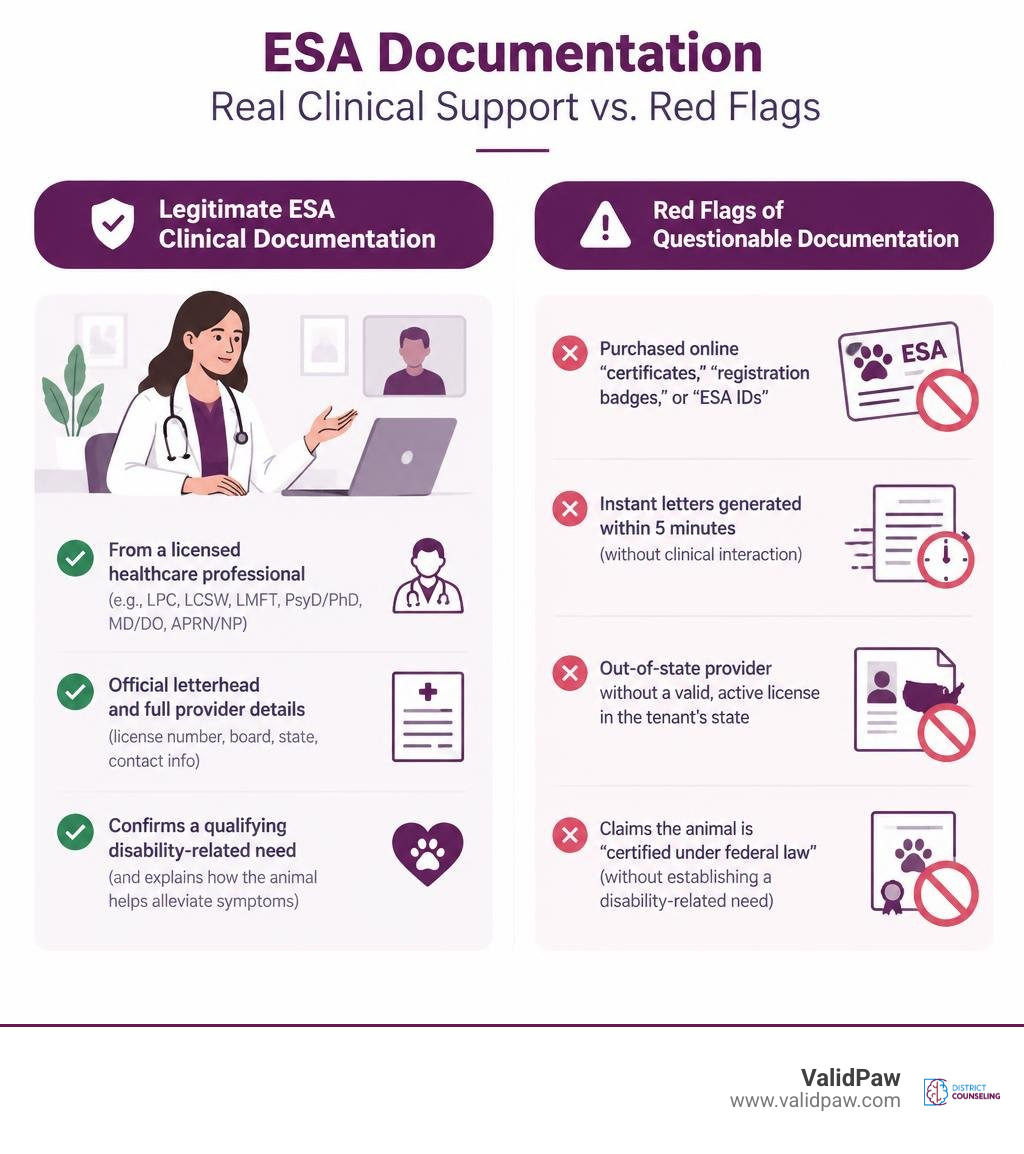
Red Flags of Invalid Documentation:
- "Certificates," "official registration badges," or "ESA IDs" purchased online (HUD and the FHA do not recognize any official registry or certification system).
- Instant letters generated within 5 minutes without clinical interaction with a licensed professional.
- Letters issued by an out-of-state provider who does not hold a valid, active license in the state where the tenant resides.
- Documents claiming an animal is "certified under federal law" without establishing a disability-related need.
Landlords who encounter questionable paperwork should verify the provider’s active license status directly on the corresponding state licensing board website before issuing a denial. Renters who want to avoid disputes should learn how to provide reliable proof to landlords through legitimate clinical evaluations.
Step-by-Step Landlord Accommodation Workflow and Denial Grounds
Standardized Accommodation Request and Review Process
Processing accommodation requests requires a fair, consistent, and prompt approach. When a tenant submits an assistance animal request, landlords must engage in an "interactive process"—a cooperative dialogue to understand the request rather than issuing immediate rejections.
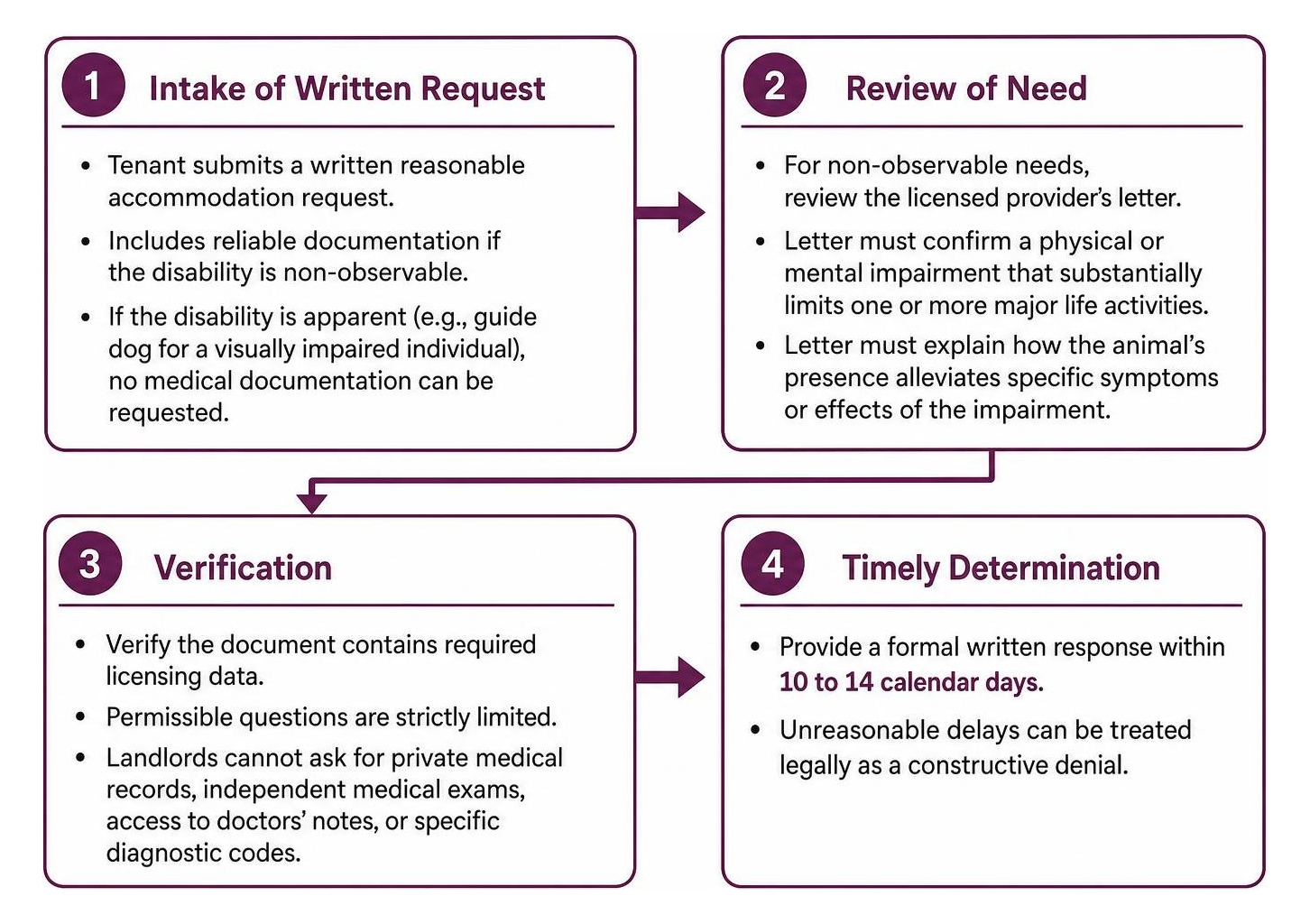
- Intake of Written Request: The tenant provides a written reasonable accommodation request alongside reliable documentation (if the disability is non-observable). Renters can use our structured template for accommodation requests.
- Review of Need: If the tenant's disability is apparent (such as a guide dog for a visually impaired individual), the landlord cannot request medical documentation. For non-observable needs, the landlord reviews the provider's letter.
- Verification: The housing provider verifies that the document contains required licensing data. Permissible questions are strictly limited: landlords cannot ask for private medical records, independent medical exams, access to doctors' notes, or specific diagnostic codes.
- Timely Determination: Standard industry practice requires a formal written response within 10 to 14 calendar days. Unreasonable delays can be treated legally as a constructive denial.
Tenants looking to streamline this review can consult our walkthrough on how to secure landlord accommodation approval.
Lawful Grounds for Denying an Assistance Animal

While the Fair Housing Act provides broad protections, accommodation rights are not absolute. Landlords can lawfully deny an assistance animal under specific, evidence-backed conditions:
- Direct Threat to Health and Safety: The specific animal has a documented history of aggressive behavior, biting, or menacing other residents or staff, and no reasonable adjustments can eliminate that threat.
- Substantial Physical Property Damage: The animal has caused severe, unmitigated damage to property or structural fixtures.
- Undue Financial and Administrative Burden: Accommodating the animal would impose extreme, structural financial hardship on property operations.
- Fundamental Alteration: The request would fundamentally alter the basic operational nature of the housing provider's services.
- Exempt Housing Types: The Fair Housing Act does not apply to owner-occupied buildings with four or fewer units, or single-family homes rented directly by the owner without a broker (provided the owner owns no more than three single-family homes).
Any denial must rely on objective, credible evidence concerning the specific animal in question, not subjective fears or generalized assumptions. For official standards on these exceptions, review the HUD Section 504 and FHA assistance animal guidelines.
Tenant Responsibilities and Behavioral Enforcement
Securing a reasonable accommodation does not give an animal free rein over a property. Handlers hold full legal responsibility for their assistance animals and must adhere to standard behavioral rules applied across the community.
Animal Behavioral and Sanitation Expectations
- Control and Restraint: Assistance animals must remain under handler control at all times, utilizing leashes, harnesses, tethers, or clear voice/signal controls in common hallways, elevators, and outdoor grounds.
- Waste Management: Handlers must promptly clean up and dispose of all animal waste in designated trash receptacles.
- Noise Control: Excessive, sustained barking or disruptive screeching that breaches local noise ordinances or interferes with neighbors' peaceful enjoyment can result in lease violations.
Financial and Property Liability
While landlords cannot charge pet deposits or pet rent upfront, tenants remain 100% financially liable for any physical damage their animal causes to the rental unit, fixtures, or common grounds. Repair expenses can be deducted from the standard general security deposit at move-out, or billed directly if costs exceed the deposit.
Review our comprehensive guide to FHA ESA accommodation rules for a complete overview of handling lease clauses and behavioral expectations.
Frequently Asked Questions about Fair Housing and Animals
Can a landlord charge a pet fee or deposit for an assistance animal?
No. Under the Fair Housing Act, service animals and emotional support animals are categorized as assistance animals, not pets. Housing providers are prohibited from charging pet deposits, non-refundable animal fees, or monthly pet rent. However, landlords may charge for the actual cost of repairs if an animal damages property, deducting funds from the standard security deposit.
What questions can a landlord legally ask about a disability or assistance animal?
If a disability is not obvious, a landlord may ask whether the animal is required because of a disability and request reliable documentation confirming the disability-related need from a licensed healthcare provider. Landlords cannot ask about a specific medical diagnosis, demand access to confidential medical files, or require a healthcare professional to provide detailed medical histories.
Can an assistance animal be evicted or removed for disruptive behavior?
Yes. If an animal creates an ongoing, unmitigated nuisance (such as incessant barking), causes substantial property damage, or poses a direct threat to the safety of others, a landlord can issue standard lease violation notices. If the tenant fails to correct the behavior, the landlord may require the animal's removal while allowing the tenant to remain in the home.
Conclusion
Understanding fair housing protections requires balancing tenant accommodation rights with legitimate property management standards. Assistance animals provide life-changing support for individuals living with disabilities, and federal and state laws ensure these renters are not unfairly denied housing or burdened with discriminatory fees. At the same time, maintaining valid documentation and ensuring community safety protects everyone involved.
At ValidPaw, we connect renters across Texas and all 50 states with licensed mental health professionals for thorough, telehealth-based clinical evaluations. Our consultations provide legally compliant documentation designed to meet all Fair Housing Act standards. If you require a legitimate clinical assessment, apply for an FHA-compliant ESA letter today.