
Apartment Weight Limits Do Not Usually Control ESA Housing Rights
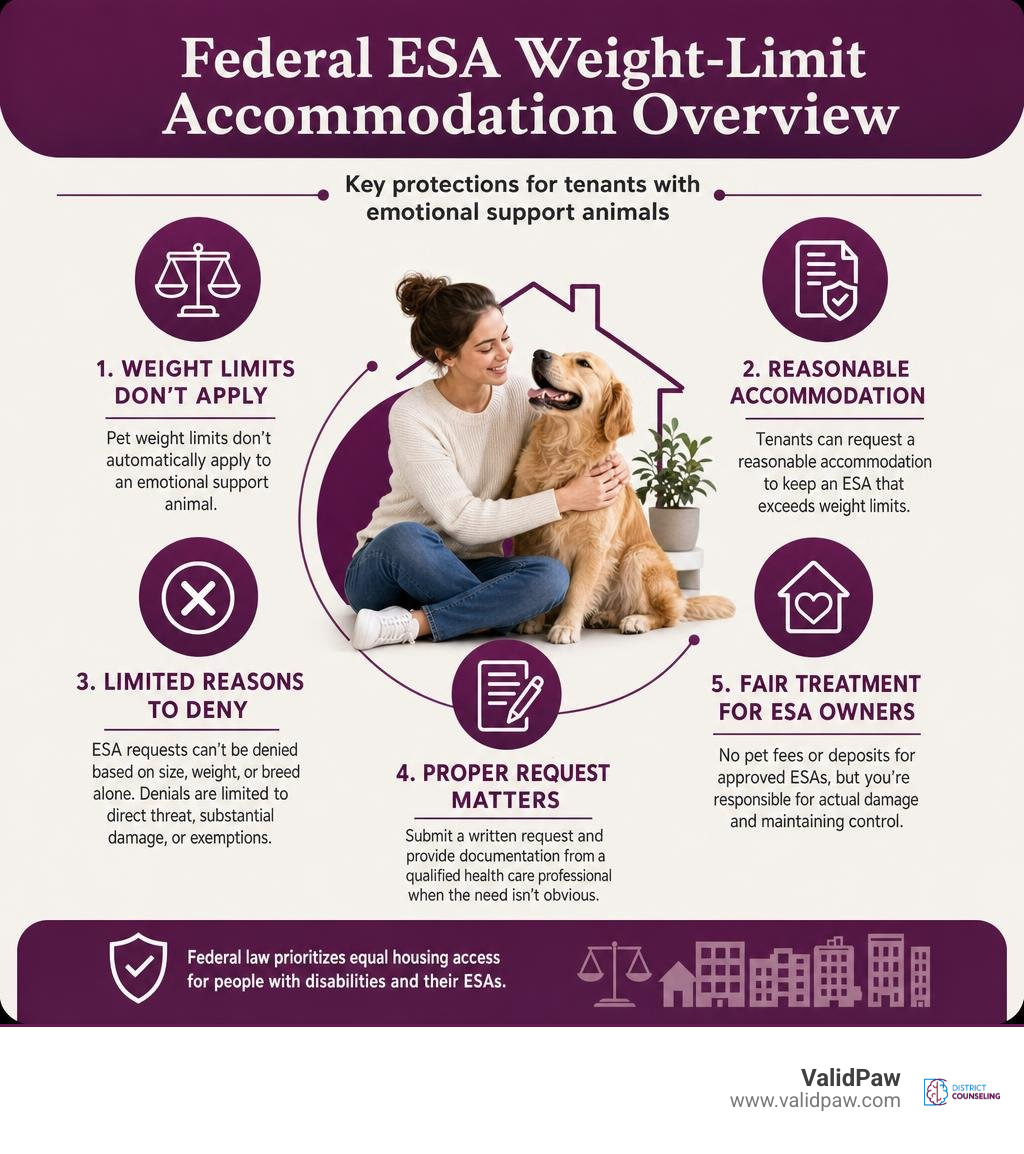
In most covered housing, an apartment's pet weight limit does not automatically apply to an emotional support animal. Under the Fair Housing Act, a tenant can request a reasonable accommodation to keep an ESA that exceeds a building's size or weight cap when the animal helps with a disability-related need.
A landlord generally cannot deny an ESA only because it is large, heavy, or a restricted breed. They may still assess whether the specific animal poses a direct threat, would cause substantial property damage, or whether the housing is exempt from federal fair-housing rules. A proper request should be made in writing and include reliable documentation from a qualified health care professional when the disability-related need is not obvious.
This matters because a 25-pound pet policy is a pet rule, not a blanket reason to reject a needed assistance animal. You may not owe pet rent or a pet deposit for an approved ESA, but you remain responsible for damage your animal actually causes and for keeping it controlled and non-disruptive.
I am Francisco Ortiz, a forensic mental health evaluator and behavioral health director who conducts disability-focused ESA evaluations in several states. In this guide, I will explain how an emotional support animal for weight restrictions request works, what documentation can support it, and what to do when a housing provider says no.
Federal Law and Your Emotional Support Animal for Weight Restrictions
Finding a great apartment only to discover a strict 25-pound or 50-pound pet cap can feel discouraging, especially if your support animal is a 70-pound Golden Retriever or an 85-pound German Shepherd. Fortunately, federal disability law provides clear protections that prioritize tenant mental health over standard property management limits.
Under the federal Fair Housing Act (FHA) and administrative guidance from the U.S. Department of Housing and Urban Development (HUD), emotional support animals are categorized as assistance animals, not standard pets. Because an ESA functions as an auxiliary aid to alleviate symptoms of a mental or emotional impairment, ordinary pet rules simply do not apply to them.
HUD guidance explicitly confirms that blanket size, weight, and breed restrictions cannot be used to automatically disqualify an assistance animal. Landlords must treat ESA requests on an individualized basis rather than enforcing generic pet size caps.
Furthermore, housing providers cannot charge extra fees, pet application costs, monthly pet rent, or dedicated pet deposits for an ESA. Understanding what landlords legally cannot do to renters with emotional support animals is essential for asserting your tenant rights under federal law.
| Feature / Rule | Standard Pet Policy | Emotional Support Animal (ESA) | | :--- | :--- | :--- | | Weight Limits | Strictly enforced (e.g., max 25 lbs) | Exempt via reasonable accommodation | | Monthly Pet Rent | Often required ($25–$100/mo) | Prohibited by federal law ($0) | | Pet Deposits / Fees | Common ($200–$800 upfront) | Prohibited by federal law ($0) | | Breed Bans | Fully enforceable | Inapplicable without specific direct threat | | No-Pet Policies | Fully enforceable | Overridden with valid documentation | | Damage Liability | Handled via pet deposit/lease | Deducted from general security deposit |
Pet Rules vs. Reasonable Accommodations
The legal mechanism that allows an assistance animal to live in a building with weight caps is known as a reasonable accommodation. A reasonable accommodation is a change, exception, or adjustment to a rule, policy, practice, or service that enables a person with a disability an equal opportunity to use and enjoy a dwelling.
Because an ESA is not legally a pet, a landlord who enforces a standard pet rule against a qualified assistance animal is effectively denying an accommodation. For renters facing strict lease language, overriding no-pet lease policies with an ESA follows this exact legal principle: the property's standard pet policies yield to federal civil rights statutes.
Legal Precedent: The Bhogaita v. Altamonte Heights Case
The legal weight behind these protections was reinforced in the landmark federal case Bhogaita v. Altamonte Heights Condominium Assn., Inc. (Eleventh Circuit Court of Appeals).
In this case, Ajit Bhogaita, a U.S. Air Force veteran suffering from Post-Traumatic Stress Disorder (PTSD), lived in a condominium community with a strict 25-pound pet weight limit. Bhogaita kept a dog weighing over 40 pounds that assisted him in managing his psychiatric symptoms.
When the condominium association demanded the dog's removal and repeatedly delayed his accommodation request by asking for excessive and unnecessary medical records, Bhogaita filed a fair housing complaint. The federal court ruled decisively in Bhogaita's favor, determining that:
- Unnecessary delays equal denial: Excessive demands for extraneous medical details constitute a constructive denial of a reasonable accommodation.
- Weight limits do not override need: A property association cannot use arbitrary size limitations to block an animal that ameliorates disability symptoms.
- Substantial damages apply: The jury awarded Bhogaita damages, and the court ordered the housing association to pay more than $127,000 in attorney fees.
The Bhogaita precedent makes it clear to property managers nationwide that dragging their feet or citing arbitrary weight caps against a documented ESA carries severe legal and financial consequences.
How to Qualify and Request an Accommodation for a Large ESA
To qualify for an ESA accommodation when an animal exceeds a building's weight restriction, a tenant must have a verifiable disability-related need. A disability under the Fair Housing Act is defined broadly as a physical or mental impairment that substantially limits one or more major life activities (such as sleeping, concentrating, regulating mood, or coping with anxiety).
The bedrock of any accommodation request is a legitimate ESA letter written by a state-licensed mental health professional (LMHP) or medical provider who has evaluated your condition. Reviewing the ultimate guide to Fair Housing Act ESA letters will help ensure your clinical documentation meets all statutory criteria.

Requesting a Reasonable Accommodation with an Emotional Support Animal for Weight Restrictions
When seeking an accommodation, submit your request formally to property management. While oral requests are technically recognized under the FHA, a written submission provides an undeniable paper trail.
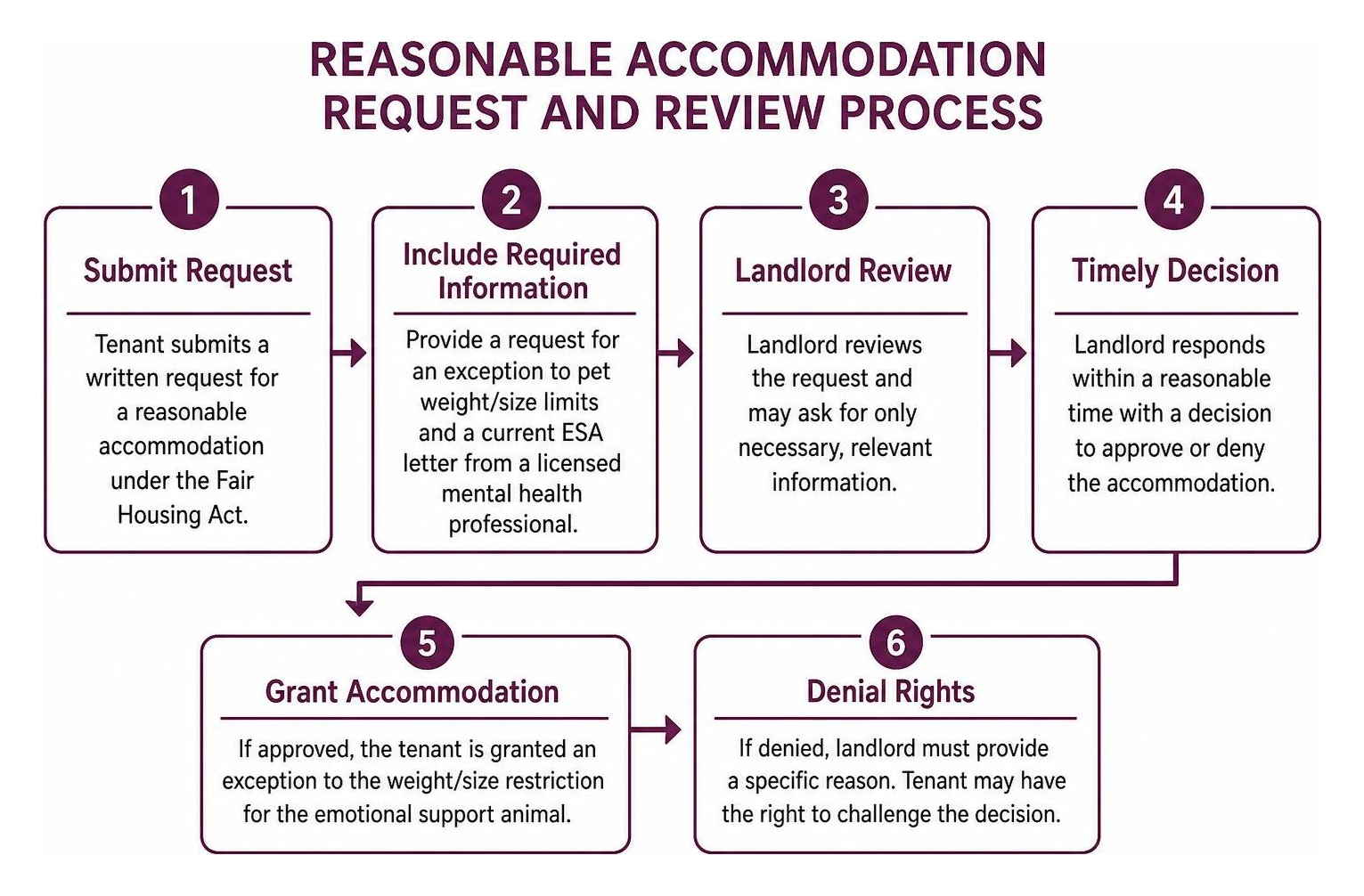
When submitting an ESA landlord letter, include:
- A formal written request stating that you are requesting a reasonable accommodation under the Fair Housing Act for your assistance animal.
- A clear statement requesting an exception to the building's standard pet weight, size, or breed restrictions.
- Your current ESA letter issued by your licensed mental health professional, dated within the past 12 months, detailing that you have a disability-related need for the animal.
Once received, the landlord must engage in a good-faith interactive process. They are not permitted to interrogate you about your specific medical history or demand access to your confidential medical records.
State-Specific ESA Regulations and Variations
While the Fair Housing Act provides a uniform federal baseline across all 50 states, state-level statutes often add complementary layers of enforcement. You can review the comprehensive Table of State Service Animal Laws to see how individual states handle assistance animal provisions.
- Texas: Under the Emotional Support Animal Laws in Texas, the Texas Fair Housing Act mirrors federal standards across major metro markets like Houston, Dallas, Austin, San Antonio, and Fort Worth. Housing providers cannot enforce pet weight limitations against valid ESAs, and landlords face penalties under state administrative codes for unlawful denials.
- Illinois: According to Illinois Emotional Support Animal Laws, the Illinois Human Rights Act strictly protects tenants in cities like Chicago from discriminatory pet policies, ensuring that larger assistance animals are reasonably accommodated without unlawful surcharges.
Regardless of your state, local housing authorities and human rights commissions enforce these anti-discrimination measures alongside HUD.
Legal Exceptions and Tenant Responsibilities
While the protections for large ESAs under the Fair Housing Act are robust, they are not absolute. Landlords are not required to grant an accommodation under specific, narrow statutory exemptions.
Understanding the broader housing accommodation guidelines for tenants helps clarify when a property provider can legally issue a denial:
- Direct Safety Threat: If the specific animal demonstrates aggressive behavior, unprovoked lunging, or a documented bite history, the landlord may deny it. The threat must be based on objective, actual evidence—not generalized breed stereotypes or size assumptions.
- Substantial Property Damage: If the animal has a documented record of causing major structural destruction that cannot be mitigated, an accommodation may be refused.
- Undue Financial or Administrative Burden: If accommodating the animal would fundamentally alter the housing provider's operations or create extreme financial hardship (e.g., if the property's insurance carrier would cancel coverage specifically due to that animal, and no comparable alternative insurer is available).
- Exempt Housing Types: The Fair Housing Act does not cover owner-occupied buildings with four or fewer units (or three or fewer under certain federal thresholds), nor single-family homes rented without the use of a broker or advertising (subject to specific statutory limits).

Common Misconceptions About Using an Emotional Support Animal for Weight Restrictions
Several persistent myths circulate among tenants and property managers regarding larger ESAs:
- Myth 1: Large dogs inherently pose higher property risks. Weight alone does not correlate with behavioral disruption or damage. A placid 80-pound Great Dane often causes significantly less property disruption than an untrained 10-pound terrier.
- Myth 2: Landlords can enforce breed bans against ESAs. Even when buildings ban specific breeds, our guide on emotional support animals and breed restrictions explains that assistance animals are legally exempt from standard breed bans unless an individual animal poses a verifiable danger.
- Myth 3: An ESA requires formal obedience certification. The FHA does not require an emotional support animal to undergo specialized task training or pass behavioral exams like service dogs under the Americans with Disabilities Act (ADA).
- Myth 4: Commercial online registries provide legal status. Paid registrations, certificates, and badges sold online have no legal standing under federal housing law.
Handler Obligations and Property Damage Liability
Holding an approved accommodation for a large ESA does not exempt a tenant from community rules regarding health, cleanliness, and safety. Tenants must uphold several key responsibilities:
- Financial Responsibility: Landlords cannot charge pet deposits, but they can deduct legitimate repair costs from your standard security deposit or bill you directly if your ESA damages carpets, doors, walls, or landscaping.
- Behavior and Control: The animal must remain under the handler's control at all times, whether on a leash, harness, or by voice command in common areas.
- Nuisance Prevention: Persistent, unmitigated barking, aggressive displays toward other residents, or uncollected waste violate standard lease covenants and can result in lawful eviction proceedings.
- Sanitation and Care: Handlers are required to maintain basic hygiene, vaccination standards, and local licensing compliance for their animals.
What to Do If a Landlord Refuses Your Accommodation
If a landlord or leasing office refuses to waive their weight limit after receiving your valid ESA letter, take methodical steps to protect your rights.
- Request the Denial in Writing: Ask the property manager to state their specific legal basis for rejecting the accommodation. If they claim an undue burden or direct threat, they must articulate objective evidence rather than subjective opinions.
- Clarify the Legal Framework: Remind the provider—in writing—that under HUD guidelines, pet weight limits do not apply to assistance animals. Direct them to the comprehensive framework covering everything tenants must know about emotional support animal accommodations.
- Document All Interactions: Keep detailed records of all emails, letters, timestamps, and notes from phone conversations. Inordinate delays in responding often constitute constructive denial under federal case law.
- File a Formal Complaint: If the landlord remains unyielding, you can file a discrimination complaint with HUD’s Office of Fair Housing and Equal Opportunity (FHEO) or your state’s human rights commission. These regulatory agencies investigate violations at no cost to the tenant.
Frequently Asked Questions About ESA Weight Restrictions
Can my landlord charge extra pet rent if my ESA exceeds building weight limits?
No. Under the Fair Housing Act, landlords are strictly prohibited from charging pet rent, pet fees, or pet deposits for an assistance animal, regardless of how much the animal weighs. Any general damage caused by the animal may be deducted from your standard refundable security deposit at move-out.
Can a landlord deny an ESA solely based on its size or breed?
No. Blanket bans based on an animal's weight, size, or breed are not permissible for assistance animals under HUD regulations. A landlord can only deny an accommodation after an individualized assessment demonstrating that the specific animal poses an actual direct threat to health and safety or an undue financial and administrative burden on the property.
Do I need to register my large emotional support animal on an official registry?
No. There is no official, government-recognized registry or certification for emotional support animals. Websites selling registration numbers, ID cards, and vests are commercial entities with no legal authority under the Fair Housing Act. The only legally valid documentation is a signed letter from a state-licensed mental health professional confirming your disability-related need.
Conclusion
A building's pet weight restrictions should never prevent you from receiving the therapeutic support you need. Federal fair housing laws ensure that your emotional support animal is treated as an essential assistance animal rather than an ordinary pet, allowing you to live together safely, comfortably, and without discriminatory surcharges.
At ValidPaw, we connect renters with licensed mental health professionals through secure telehealth consultations across Texas—including Houston, Austin, Dallas, San Antonio, and Fort Worth—as well as Chicago and all 50 states. We provide fast, 24- to 48-hour FHA-compliant documentation complete with instant landlord verification so you can navigate the housing process with confidence.
Ready to secure housing protections for your assistance animal? Apply for an official ESA letter today and take the first step toward stress-free living with your support companion.

