
Understanding ESA Housing Protections Under Federal and State Laws
Federal and state housing laws recognize that assistance animals perform a vital function for individuals living with mental health challenges or physical disabilities. Under the federal Fair Housing Act (FHA) (42 U.S.C. § 3604(f)(3)(B)), property owners, housing providers, and homeowners associations (HOAs) are prohibited from discriminating against renters based on disability. When you provide a valid emotional support animal letter to landlord management, you are formally requesting an exception to existing housing rules.
Because federal law categorizes emotional support animals as "assistance animals" rather than standard pets, traditional lease restrictions lose their force. If your building maintains a strict "no pets" policy, a legitimate letter waives that rule entirely. To explore how federal regulations shield tenants from arbitrary animal bans, see our guide on No Pets Allowed? Not With a Valid ESA Letter.
State laws offer additional layers of protection while establishing clear standards to prevent fraud. For instance, Florida's ESA law (Section 760.27) explicitly prohibits housing providers from denying housing to individuals with disability-related needs, while requiring authentic clinical relationships. Similarly, state statutes like the Minnesota Human Rights Act reinforce federal non-discrimination mandates, enabling tenants to submit reasonable accommodation requests without fear of administrative retaliation.
Key Differences Between Emotional Support Animals and Service Animals
It is essential to distinguish emotional support animals from service animals, as they are governed by different legal frameworks and standards:
- Service Animals (ADA Standard): Under the Americans with Disabilities Act (ADA), service animals are strictly limited to dogs (and in some cases, miniature horses) that have been individually trained to perform specific physical tasks or work for a person with a disability. Service animals enjoy full public access rights, meaning they can enter restaurants, stores, and public transit.
- Emotional Support Animals (FHA Standard): Under the Fair Housing Act, an ESA can be almost any common household animal (including dogs, cats, rabbits, or birds). ESAs do not require specialized task training; their therapeutic benefit comes directly from their presence, providing grounding, comfort, and emotional stability. However, ESAs do not have automatic public access rights outside of residential housing settings.
Fee Waivers and Financial Protections for Renters
One of the most significant benefits of submitting a proper emotional support animal letter to landlord representatives is complete exemption from animal fees. Under federal regulations, housing providers are legally prohibited from charging:
- Upfront Pet Deposits: Landlords cannot require refundable or non-refundable pet deposits for assistance animals.
- Monthly Pet Rent: Property managers cannot add recurring monthly pet surcharges to your base rent.
- Application or Processing Fees: Landlords cannot charge administrative fees to review your reasonable accommodation request.
It is important to remember that fee waivers do not grant immunity from actual physical damage. If your support animal causes damage to the rental unit, the housing provider can deduct repairs from your general security deposit or bill you upon move-out. For a deep dive into financial rights and housing documentation rules, review The Ultimate Guide to Fair Housing Act ESA Letters.
Essential Components of an Emotional Support Animal Letter to Landlord

A property manager is not required to accept a simple verbal statement or a informal note from a friend. To be legally binding, your documentation must meet strict criteria set by the Department of Housing and Urban Development (HUD). For complete formatting details, read Don't Get Hounded: Everything Your ESA Letter Must Include.
Every compliant ESA letter must include:
- Official Letterhead: Issued on the healthcare professional's official stationary, displaying their business name, address, and phone number.
- Provider Licensing Credentials: The provider’s license type (e.g., LCSW, LMFT, LPC, Psychologist, MD), active license number, and the state where it was issued.
- Established Relationship: Confirmation that the provider maintains an active, ongoing therapeutic relationship with you.
- Disability Confirmation: A statement that you meet the definition of a person with a disability under the Fair Housing Act.
- Functional Limitation Nexus: An explanation connecting the animal’s presence to symptom alleviation or improved daily functioning.
- Current Date & Expiration: A date of issuance within the past 12 months.
What Landlords Can and Cannot Legally Ask You
When evaluating your request, property managers must respect strict privacy boundaries outlined by federal guidance and HIPAA laws. Learn what property owners are searching for in Emotional Support Verification Letter: What Every Landlord Needs to See.
| What Landlords CAN Ask | What Landlords CANNOT Ask | | :--- | :--- | | For confirmation that you have a qualifying disability | For your specific medical diagnosis or medical records | | How the animal alleviates functional limitations | For detailed clinical session notes or medical histories | | For verification that the issuing provider is licensed | That your provider complete custom, legal-liability forms | | For animal vaccination and local licensing compliance | That your support animal undergo specialized task training |
Avoiding Online Registries and Fake Certificate Red Flags
Landlords and property managers are increasingly trained to identify fraudulent support animal paperwork. Purchasing an instant "registration card," digital badge, or downloadable certificate from a registry website is a quick way to get your accommodation request rejected.
The Department of Housing and Urban Development states that online registries and fake certificate sites do not provide valid documentation. Furthermore, state statutes penalize fraudulent requests. Under Florida law (Section 760.27), misrepresenting a support animal or submitting fake documentation is a second-degree misdemeanor carrying penalties such as 30 hours of court-ordered community service. Read our guide on Is Your ESA Letter Legitimate? How to Spot the Real Deal to ensure your documentation stands up to verification.
How to Submit Your Reasonable Accommodation Request

Submitting your emotional support animal letter to landlord representatives requires strategic timing and clear written communication. While federal law does not prescribe a rigid disclosure schedule, presenting your paperwork correctly sets a positive tone and builds a clear paper trail.
When to Disclose Your ESA to Your Landlord
- Existing Tenants: Submit your request as soon as you receive clinical documentation from your provider, well before introducing the animal into your home.
- Prospective Tenants: While you are legally allowed to submit an accommodation request after signing a lease, many tenants prefer providing documentation right after approval to establish open communication.
For additional timing strategies, consult When to Tell Your Landlord About an Emotional Support Animal Without Getting Rejected and Everything You Need to Know About Your ESA Landlord Letter.
Crafting a Formal Request
When submitting your request, combine your clinical letter with a clear cover letter referencing the Fair Housing Act. You can review proven examples in Sample ESA Letters That Actually Work.
Always deliver your request via email with read receipts or certified mail to establish proof of receipt. Under standard HUD guidelines, housing providers are expected to respond to reasonable accommodation requests within 10 business days.
How Landlords Verify an ESA Request
Once received, property managers follow a standard verification procedure. For details on ensuring your submission passes inspection, see How to Give Your Landlord ESA Proof That Actually Sticks.
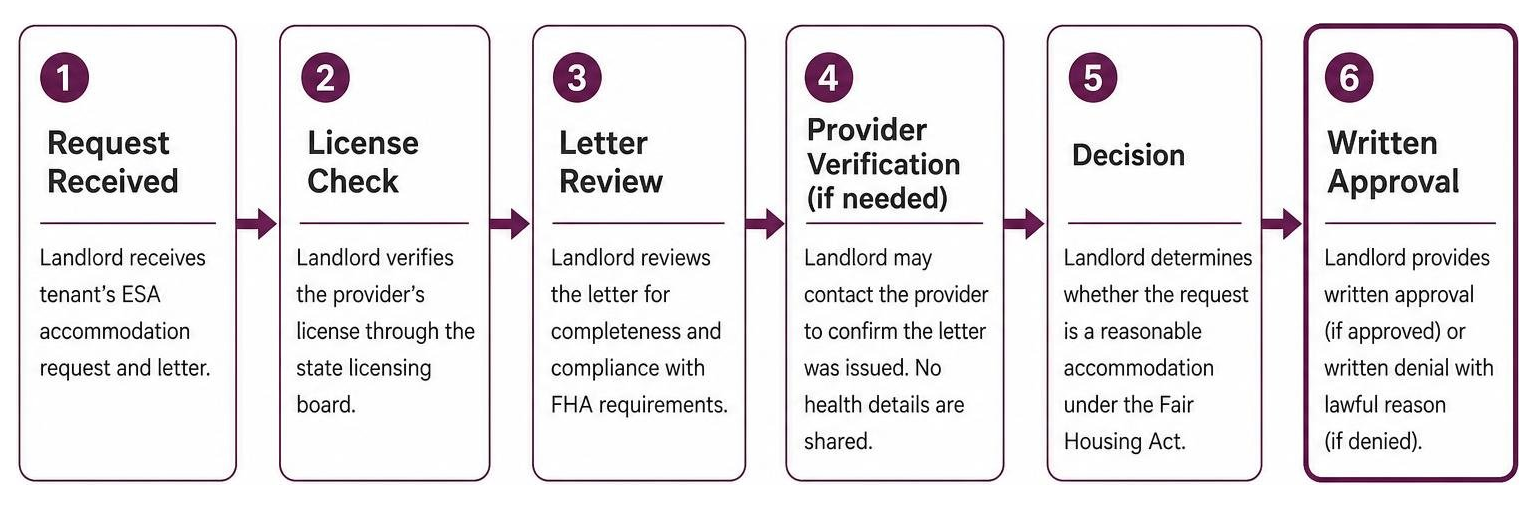
During this process, housing providers may search state licensing databases to confirm your practitioner's license status. If they contact your provider directly, federal privacy laws dictate that the practitioner can only confirm that they issued the document — they cannot share confidential health details.
Legitimate Denials, Landlord Violations, and Legal Remedies
While the Fair Housing Act strongly favors accommodating tenants with disabilities, landlord obligations are not unlimited.
| Lawful Denial Grounds | Unlawful Denial Grounds | | :--- | :--- | | The specific animal poses a direct threat to safety | Blanket prohibitions based on breed, size, or weight | | The animal causes substantial physical property damage | Refusal because the building has a "No Pets" policy | | The request creates an undue financial or administrative burden | Demanding pet deposits, fees, or monthly pet rent | | Documentation is unverified or fraudulent | Demanding access to personal medical histories |
What to Do If Your Landlord Ignores or Denies Your Request
If your landlord fails to respond within 10 business days or issues an improper denial, take the following steps:
- Send a Written Follow-Up: Send a courteous email referencing your initial request date and reminding them of the 10-business-day response expectation under HUD guidance.
- File a HUD Complaint: You can file a free discrimination complaint with the U.S. Department of Housing and Urban Development within one year of the alleged violation.
- Contact State Agencies: Submit a grievance to local human rights commissions (such as the Minnesota Department of Human Rights or local fair housing councils).
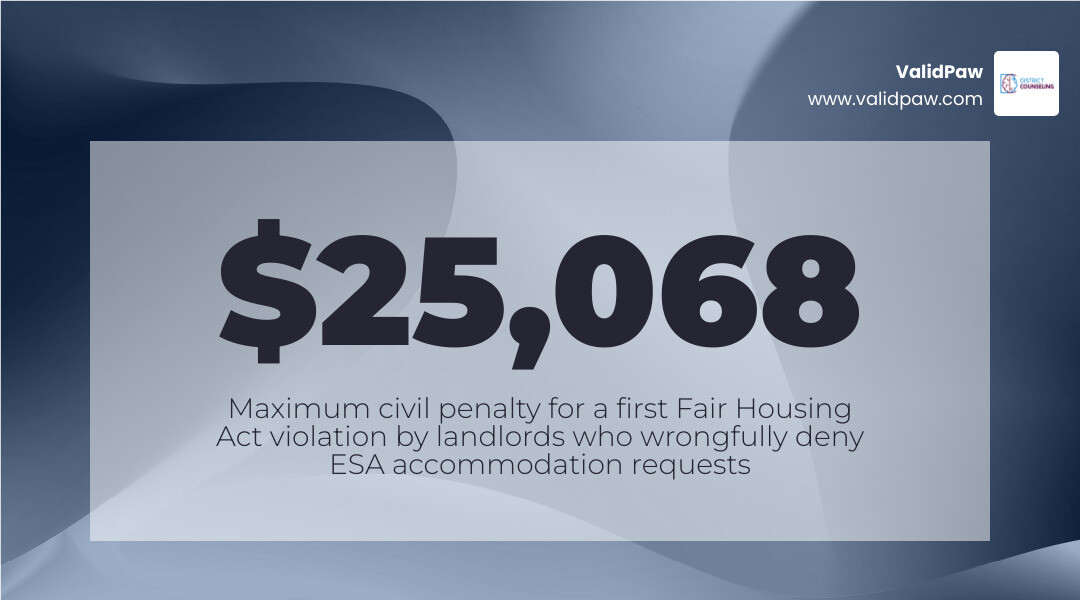
Penalties for fair housing violations are severe. Landlords facing HUD administrative enforcement can incur civil penalties up to $25,068 for a first offense, alongside compensatory damages for emotional distress and mandatory coverage of tenant legal fees. Learn more about legal remedies in The Ultimate Guide to Emotional Support Animal Housing.
Frequently Asked Questions About ESA Housing
Can a landlord reject an emotional support animal based on breed or weight limits?
No. Standard breed, size, and weight restrictions do not apply to assistance animals under the Fair Housing Act. Landlords cannot reject a support dog simply because it is a Pit Bull, German Shepherd, or over a specific weight limit. Any rejection must be based on objective evidence of an individual animal's actual conduct.
Can I have more than one emotional support animal in my rental unit?
Yes. Tenants can house multiple support animals if a licensed healthcare provider documents a distinct therapeutic need for each individual animal. For example, your provider might explain that a cat assists with daily anxiety grounding while a dog supports nighttime panic responses.
Does my emotional support animal require specialized training or registration?
No. Unlike service animals governed by the ADA, emotional support animals do not require specialized training, behavioral certifications, or registration badges. Their primary function is to provide comfort through their presence.
Secure Your Legitimate ESA Documentation with ValidPaw
Navigating housing accommodations can feel overwhelming, but you do not have to do it alone. At ValidPaw, our team of licensed Texas mental health professionals provides thorough, legal evaluations for residents across Texas, Illinois, and nationwide.
We deliver valid, HUD-compliant emotional support animal letters within 24 to 48 hours — complete with instant landlord verification support to make your approval process smooth and stress-free.
Ready to protect your rights and keep your support animal by your side? Apply for Your Legitimate ESA Documentation with ValidPaw today.

