
Fair Housing Act Rules: Can Landlords Enforce Breed and Weight Limits?
When navigating standard rental agreements, pet restrictions are commonplace. Many multi-family properties maintain strict lists of restricted dog breeds or enforce rigid weight ceilings. However, federal civil rights laws change the dynamic entirely when an assistance animal enters the conversation.
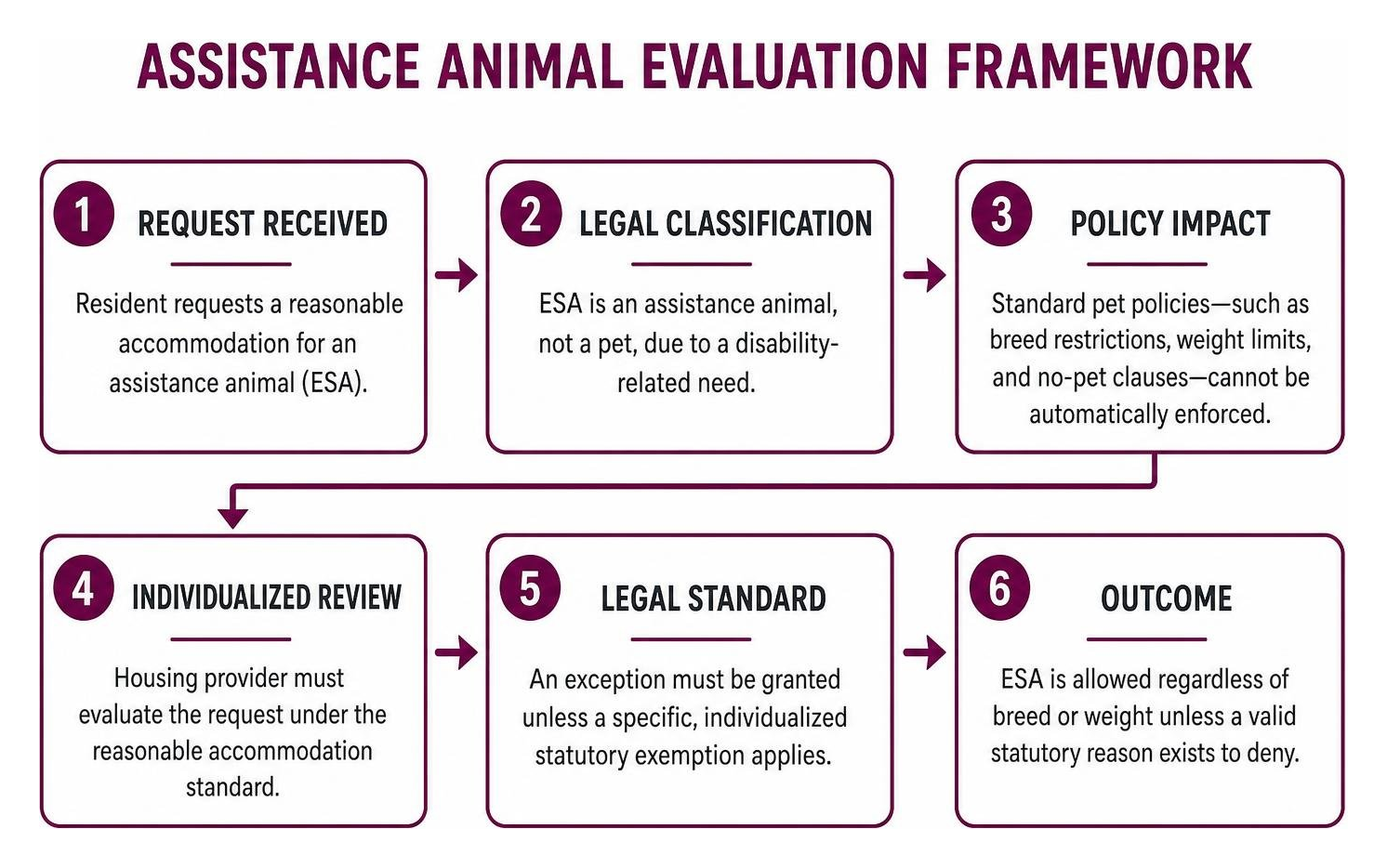
Under the Fair Housing Act (FHA), administered by the U.S. Department of Housing and Urban Development (HUD), an emotional support animal is legally classified as an assistance animal rather than an ordinary pet. This critical distinction means that standard pet policies—including prohibited breed lists, size limitations, and weight maximums—cannot be automatically enforced against an ESA. Instead, housing providers must evaluate the situation under the framework of a reasonable accommodation request.
Federal assistance animal regulations establish that housing providers cannot apply blanket pet rules to deny access to individuals who experience mental or emotional health conditions. Comprehensive guidance on these protections can be explored in our housing rules for assistance animals resource.
Legal Status of an Emotional Support Animal for Breed Restrictions
The core principle under federal law is that assistance animals are not pets. Because they serve a disability-related need—providing therapeutic comfort, emotional stability, or symptom alleviation—they exist in a separate legal category. Consequently, when a tenant presents an emotional support animal for breed restrictions, the landlord's typical lease clauses regarding prohibited animals are superseded by federal protections.
Federal fair housing laws hold supremacy over private lease agreements. While a property manager has the right to maintain a "no dangerous breeds" policy for common household pets, they cannot use that policy as an automatic veto against a legitimate ESA. The legal standard requires the housing provider to grant an exception unless specific, individualized statutory exemptions apply. This legal mechanism clarifies how assistance animals bypass no-pet lease terms across housing communities.
Assistance Animals vs. Service Animals vs. Ordinary Pets
Confusion frequently arises when comparing emotional support animals to service animals and standard household companions. Each category operates under different legal frameworks, rights, and public access standards.
| Feature / Protection | Service Animal (Dog / Miniature Horse) | Emotional Support Animal (ESA) | Ordinary Household Pet | | :--- | :--- | :--- | :--- | | Primary Governing Law | Americans with Disabilities Act (ADA), FHA | Fair Housing Act (FHA) | Local Property & Contract Law | | Specialized Training Required | Yes (Trained for specific disability tasks) | No (Provides comfort via presence) | No | | Housing Breed/Weight Ban Exemptions | Yes (Evaluated individually) | Yes (Evaluated individually) | No (Subject to landlord rules) | | Public Access Rights (Restaurants, Stores) | Yes | No (Housing only) | No | | Pet Deposits / Monthly Pet Rent | Exempt | Exempt | Landlord Discretion | | Required Housing Documentation | Two ADA qualifying questions (if not obvious) | Valid ESA letter from a licensed provider | Standard pet registration forms |
Under the Americans with Disabilities Act (ADA), service dogs must be trained to perform discrete tasks directly related to an individual's physical, sensory, psychiatric, or intellectual disability. Service dogs enjoy broad public access protections across retail stores, medical facilities, and restaurants.
In contrast, ESAs provide therapeutic support simply through their presence and companionship; they do not require specialized behavioral task training and do not have public access rights under Title III of the ADA. However, in residential housing governed by the FHA, both service animals and ESAs are categorized as assistance animals, affording both groups relief from arbitrary breed and weight bans. For a deeper look at these distinctions, review our guide on service dog and emotional support animal differences.
When a Landlord Can Legally Deny an Emotional Support Animal for Breed Restrictions
While the Fair Housing Act offers strong protections against blanket breed bans, those protections are not absolute. Landlords are not forced to accept an animal that jeopardizes the safety of the community or imposes severe financial burdens on the property owner.
Crucially, any decision to deny an accommodation cannot be based on stereotypes, assumptions, or community stigma surrounding a breed. The law demands an individualized assessment of the specific animal in question.
Direct Threat and Property Damage Criteria
A housing provider can lawfully reject an assistance animal if reliable, objective evidence proves that the specific animal poses a direct threat to the health or safety of other residents, or would cause substantial physical damage to the property that cannot be mitigated by reasonable measures.
To meet the legal threshold for a "direct threat," the landlord must point to actual conduct, such as:
- An unprovoked bite history or aggressive physical lunging at neighbors.
- Documented incidents of severe, uncontrolled barking, snarling, or destructive scratching.
- Prior municipal citations or dangerous-dog designations involving that specific animal.
A landlord cannot declare a direct threat merely because a dog is a Pit Bull, Rottweiler, or Doberman Pinscher. Generalizations regarding breed temperament, statistical bite tables from insurance trade groups, or another resident's subjective fear of large dogs do not meet the legal standard of objective evidence.
Insurance Policy Restrictions and Undue Financial Burden
Another common challenge occurs when a property owner's commercial liability insurance carrier includes a restrictive breed schedule. If a landlord's policy explicitly excludes coverage for certain breeds (such as German Shepherds or Mastiff-type dogs), the landlord might argue that accommodating the animal would result in policy cancellation or substantial financial loss.
Under HUD guidelines, an insurance restriction can only justify an accommodation denial if accommodating the animal would impose an undue financial and administrative burden. To establish this defense, the landlord must:
- Contact their insurance carrier to verify if an assistance animal exception applies.
- Demonstrate that the carrier will definitively cancel the policy or dramatically spike premiums if the ESA is permitted.
- Make a good-faith effort to find comparable, alternative insurance coverage on the market that accommodates assistance animals without prohibitive costs.
If viable, alternative coverage is readily available at comparable market rates, the landlord cannot rely on their existing policy's restricted breed clause to deny the ESA.
How to Qualify and Request an Accommodation for Restricted Breeds
Securing an accommodation for an ESA that belongs to a restricted breed requires clear communication, complete documentation, and adherence to established legal processes. Being proactive helps de-escalate potential conflicts with property management before move-in.

Understanding best practices for disclosing an assistance animal to landlords enables renters to submit their paperwork with confidence, avoiding misunderstandings from the start.
Documentation Requirements for an Emotional Support Animal for Breed Restrictions
To establish a legitimate accommodation request, you must provide written documentation from a licensed healthcare professional—such as a licensed mental health counselor, clinical social worker, psychologist, psychiatrist, or physician.
Legitimate documentation must adhere to specific standards:
- It must be written on the provider's official letterhead, including their professional license type, license number, issuing jurisdiction, and contact details.
- It must state that the individual has an impairment that substantially limits one or more major life activities.
- It must explain that the animal provides emotional support, comfort, or therapeutic benefit that alleviates one or more identified symptoms of the condition.
- It should be current (issued within the preceding 12 months).
Telehealth evaluations are fully recognized under HUD guidelines, provided the clinician is properly licensed in the jurisdiction and conducts a legitimate clinical evaluation. Learn more about these core criteria in our overview of essential Fair Housing Act letter requirements.
Step-by-Step Guide to Landlord Approval
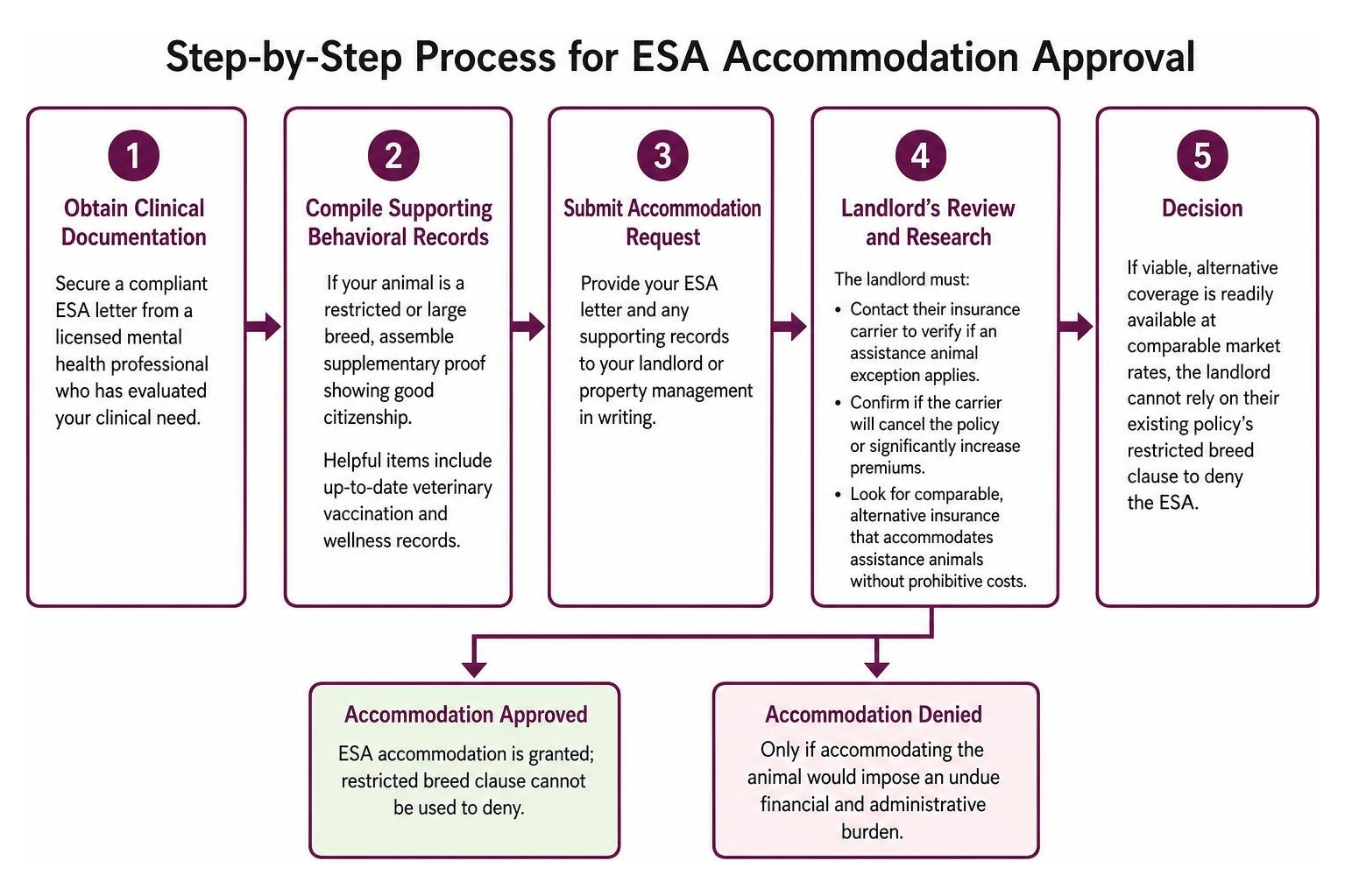
Navigating the approval process smoothly involves following a structured approach:
- Obtain Your Clinical Documentation: Secure a compliant ESA letter from a licensed mental health professional who has evaluated your clinical need.
- Compile Supporting Behavioral Records: If your animal is a restricted or large breed, assemble supplementary proof showing good citizenship. Helpful items include:
- Up-to-date veterinary vaccination and wellness records.
- Proof of spay/neuter status.
- Certificates from basic obedience courses or the AKC Canine Good Citizen (CGC) program.
- Reference letters from past landlords confirming the dog's calm demeanor.
- Draft a Formal Accommodation Request: Submit a clear, polite written request referencing your rights under the Fair Housing Act, enclosing your ESA letter and behavioral evidence.
- Engage in the Interactive Process: Allow the landlord reasonable time to review the submission. If they raise questions regarding insurance or safety, provide clarifying documentation promptly.
- Maintain Written Records: Keep digital and physical copies of all emails, application forms, and letters exchanged throughout the process.
For additional practical recommendations, check our detailed strategies for getting landlord approval on ESA letters.
What to Do If Your Emotional Support Animal Is Denied Due to Breed

If a property manager denies your accommodation request citing a restricted breed list or size limitation, you have legal remedies available:
- Request a Written Explanation: Ask the landlord to supply the specific, factual basis for the denial in writing. If they cite an insurance policy exclusion, ask for written confirmation from their insurance carrier detailing the exact coverage implications.
- Reiterate HUD Guidelines: Send a polite response noting that under HUD's assistance animal guidance, blanket breed exclusions cannot be applied without an individualized assessment demonstrating a direct threat or undue financial burden.
- Seek Local Mediation or Legal Advocacy: Connect with a local fair housing advocacy organization or legal aid society. In many instances, a brief letter from a tenant rights advocate resolves the matter promptly.
- File a Formal Complaint: If the landlord persists in an unlawful denial based strictly on breed, you can file a discrimination complaint directly with the U.S. Department of Housing and Urban Development (HUD) Office of Fair Housing and Equal Opportunity (FHEO), or with your corresponding state civil rights agency.
For comprehensive guidance on dispute resolution, read our walkthrough on resolving ESA landlord rejection disputes.
Frequently Asked Questions About ESA Breed Restrictions
Can an HOA or apartment complex enforce breed weight limits on an ESA?
No. Homeowners Associations (HOAs), condominium boards, and private apartment complexes are all bound by the provisions of the Fair Housing Act. Even if an HOA's bylaws establish that no animals over 35 pounds are permitted in the community, the board must grant a reasonable accommodation for a legitimate ESA exceeding that weight threshold, provided the individual animal does not pose a direct threat.
Can a landlord charge a pet deposit or monthly pet rent for a restricted breed ESA?
No. Assistance animals are not pets under federal law. Consequently, housing providers cannot charge upfront pet deposits, non-refundable pet fees, or recurring monthly pet rent for an ESA—regardless of the animal's breed, size, or weight. However, the tenant remains financially responsible for any actual property damage the animal causes during the tenancy.
What dog breeds are most commonly disputed in ESA housing requests?
The most frequently disputed dog breeds in housing accommodation requests include:
- Pit Bull-type dogs (including American Staffordshire Terriers and American Bullies)
- German Shepherds
- Rottweilers
- Doberman Pinschers
- Mastiffs and Cane Corsos
- Siberian Huskies and Alaskan Malamutes
- Large mixed-breed dogs over 50 pounds
Despite their frequent appearance on standard lease restriction schedules, all of these breeds are entitled to an individualized assessment under fair housing regulations when serving as an assistance animal.
Conclusion
Breed and weight restrictions remain widespread in the rental market, but the Fair Housing Act ensures that individuals with mental and emotional health challenges are not arbitrarily separated from their vital support systems. Landlords cannot use generalized stereotypes, neighborhood assumptions, or generic restricted-breed lists to deny housing to a legitimate emotional support animal. Every animal must be evaluated on its individual behavior, temperament, and safety profile.
Securing housing without unnecessary hurdles starts with obtaining dependable, legally compliant documentation. At ValidPaw, we connect renters with licensed mental health professionals for telehealth evaluations across Texas (including Houston, Austin, Dallas, San Antonio, and Fort Worth), Chicago, Illinois, and nationwide across all 50 states. Our clinical process delivers fast 24–48 hour FHA-compliant letters with instant landlord verification.
Ready to protect your housing rights? You can qualify for a valid ESA letter online and take the first step toward living comfortably with your support animal.

