Defining Assistance Animals vs Service Animals Under Federal Law
An emotional support animal accommodation provides individuals with mental health conditions legal protections to live with their animals under the Fair Housing Act (FHA), exempting them from pet fees, deposits, and no-pet lease policies. In employment settings, Title I of the Americans with Disabilities Act (ADA) requires employers to evaluate support animal requests through an interactive accommodation dialogue. Navigating these rights requires understanding the distinct legal boundaries governing assistance animals across residential, workplace, and public settings. Under Titles II and III of the ADA, a service animal is strictly defined as a dog (and in specific instances, a miniature horse) individually trained to do work or perform specific physical or psychiatric tasks for an individual with a disability.
In contrast, an emotional support animal (ESA) provides therapeutic companionship, affection, and comfort that alleviates symptoms of a mental or emotional condition. Because ESAs are not required under historical interpretations to have task-specific training, their legal standing differs fundamentally from ADA service animals.
| Category | Legal Definition | Federal Coverage | Training Requirements | Public Access Rights | Fee & Deposit Exemptions | | :--- | :--- | :--- | :--- | :--- | :--- | | Service Animal | Dog or miniature horse trained to perform specific disability-related tasks | ADA Titles I, II, III; FHA; Section 504; ACAA | Individually trained for specific tasks | Broad public access (restaurants, stores, transit) | Exempt from pet fees and deposits in housing and travel | | Emotional Support Animal | Animal providing therapeutic comfort that mitigates mental health symptoms | Fair Housing Act (FHA); Section 504 (workplace case-by-case under Title I) | No task training required historically | No public access rights to standard commercial facilities | Exempt from housing pet rent, deposits, and fees | | Standard Pet | Domesticated animal kept for personal companionship without disability nexus | None | General domestic obedience | Restricted to pet-friendly establishments | Subject to pet deposits, monthly rent, and breed bans |
For a deeper dive into task-specific training standards, review Everything You Need to Know About ADA Service Animals. To understand how emotional support animals interact with these definitions, read our analysis on Service Dog or ESA? Getting the Facts Straight on Emotional Support Animals.
Distinct Protections Across the ADA, FHA, and ACAA
Federal protections are divided across distinct regulatory environments:
- The Americans with Disabilities Act (ADA): Covers public accommodations, state and local government entities, and private commercial facilities. ESAs are not recognized under Title II or Title III, meaning businesses can lawfully exclude them.
- The Fair Housing Act (FHA): Prohibits disability discrimination in residential dwellings. The FHA covers assistance animals—including support animals—as reasonable accommodations to ensure equal opportunity to use and enjoy a home.
- Section 504 of the Rehabilitation Act: Applies to programs receiving federal financial assistance, such as public housing agencies, prohibiting discrimination based on disability.
- The Air Carrier Access Act (ACAA): Following rule revisions at the end of 2020 (effective January 2021), airlines are no longer required to recognize untrained emotional support animals. Only trained service animals, including psychiatric service dogs (PSDs), are federally protected for free in-cabin flight access. Learn how airline regulations operate in Cleared for Takeoff: Navigating the New Emotional Support Animal Airline Rules.
State-specific statutory frameworks also provide guidance on these distinctions; see the Guides: Animal Law: Service Animals - Texas State Law Library for regional context.
Legal Framework for Emotional Support Animal Accommodation in Housing
Under the Fair Housing Act, landlords and housing providers must make reasonable accommodations in rules, policies, practices, or services when necessary to afford a person with a disability equal opportunity to use and enjoy a dwelling.
When a tenant makes a valid accommodation request:
- No-Pet Policies: Blanket restrictions cannot be used to bar an assistance animal. Discover how this works in Can a No-Pet Lease Stop Your Emotional Support Animal?.
- Pet Fees and Deposits: Housing providers cannot charge advance pet deposits, upfront application fees, or ongoing monthly pet rent for an assistance animal.
- Breed and Weight Limits: Landlords cannot deny an animal based on general breed stereotypes, weight thresholds, or size restrictions. Denials must rest on objective, individualized evidence of danger or structural impossibility.
For an extensive structural breakdown of residential rights, consult The Ultimate Guide to Emotional Support Animal Housing.
The Impact of HUD’s May 2026 Guidance and Judicial Rulings
In response to executive directives concerning regulatory enforcement and public safety, HUD’s Office of Fair Housing and Equal Opportunity (FHEO) issued a memorandum on May 22, 2026, signed by Assistant Secretary Craig W. Trainor. The guidance noted that over 20% of FHEO’s fair housing complaints revolve around untrained ESAs.
Effective immediately, the HUD Enforcement Guidance Memorandum directed agency investigators to prioritize enforcement resources and recommend formal administrative charges only for cases involving animals trained to provide disability-related assistance.
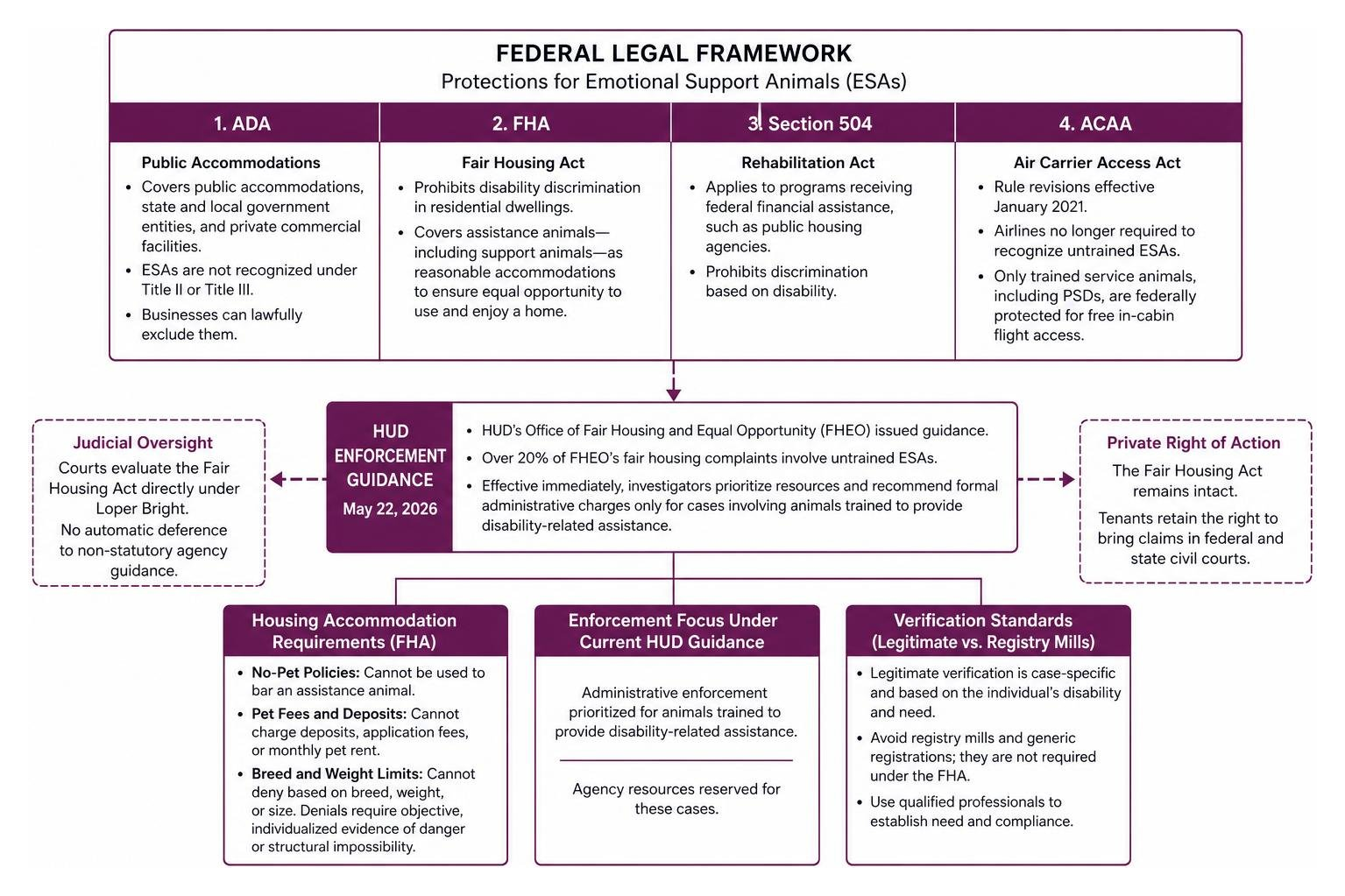
This administrative shift aligns with recent judicial rulings such as Henderson v. Five Properties LLC, where courts scrutinized whether waiving fees for untrained animals constituted an automatic requirement under the statute. Following the Supreme Court's Loper Bright precedent, federal courts evaluate the Fair Housing Act directly without deferring blindly to non-statutory agency guidance.
While HUD shifted its administrative complaint triage, the underlying Fair Housing Act remains intact, and tenants retain a private right of action in federal and state civil courts. Review The Ultimate Guide to Fair Housing Act ESA Letters to see how statutory compliance is established under current oversight standards.
Legitimate Verification Standards and Avoiding Registry Mills
When a disability or the disability-related need for an animal is not obvious, housing providers are legally permitted to request reliable medical documentation. A compliant ESA letter must establish:
- A recognized mental health impairment or disability.
- An ongoing therapeutic relationship with a licensed professional.
- A clear clinical nexus explaining how the animal mitigates specific disability-related symptoms.
Unverified online registries, downloadable certificates, ID badges, and instant "instant pass" websites do not constitute reliable documentation and are routinely rejected by property managers. For complete documentation criteria, read The Essential Guide to ESA Documentation Requirements and Emotional Support Verification Letter: What Every Landlord Needs to See.
Managing Emotional Support Animals in Employment Settings

Under Title I of the Americans with Disabilities Act, employers with 15 or more employees must provide reasonable accommodations to qualified individuals with disabilities, unless doing so creates an undue hardship on business operations.
Unlike public accommodation titles, Title I does not contain rigid definitions that categorically exclude emotional support animals from the interactive accommodation process. An employee may request the presence of an emotional support animal as a reasonable modification to an existing "no-animals" workplace policy.
To document employment verifications cleanly, consult Employee Work Verification Letters: Templates, Tips, and Tricks.
Employer Guidelines for Emotional Support Animal Accommodation at Work
When evaluating an ESA accommodation request, employers should follow a standardized interactive framework:
- Engage in the Interactive Dialogue: Discuss the specific functional limitations of the employee's role and how the animal supports their job performance.
- Review Medical Documentation: If the disability is non-obvious, request medical documentation from the employee's treating clinician outlining the therapeutic need.
- Conduct an In-Person Behavioral Assessment: Interview the handler with the animal present to verify that the animal is housebroken, quiet, and well-behaved.
- Establish a Written Trial Period: Implement a formal, temporary trial period (e.g., 30 to 60 days) to assess real-world impacts on office productivity, safety, and hygiene.
Employers can lawfully deny an ESA request if the animal poses a direct safety threat, causes significant disruption (such as persistent barking), triggers severe allergic reactions in coworkers that cannot be resolved through spatial separation, or compromises sterile work environments (such as medical laboratories or commercial food prep lines).
Handler Responsibilities and State-Level Protections
An accommodation does not grant an animal unconditional immunity from standard behavioral expectations. Handlers carry distinct legal responsibilities across residential, workplace, and public settings:
- Behavioral Control: The animal must remain under the handler's direct control at all times via leash, harness, or voice commands.
- Sanitation and Housebreaking: The animal must be fully housebroken. Handlers must promptly clean up and dispose of waste.
- Property Damage: While housing providers cannot charge pet deposits, handlers remain financially liable for any physical damage the animal inflicts upon the premises.
- Nuisance Prevention: Persistent disruptions, aggressive posturing, or safety violations justify the revocation of an accommodation.
To review regional state mandates, see Everything You Need to Know About Texas ESA Letter Requirements.
State Law Variations and Broader Local Protections
State and local statutes often expand protections beyond federal baselines:
- California Fair Employment and Housing Act (FEHA): Explicitly protects emotional support animals in residential housing and eliminates certain federal exemptions for small, owner-occupied properties.
- Texas Human Resources Code: Outlines service animal access protections and penalizes fraudulent claims, while housing protections align with the Texas Fair Housing Act.
- Local Human Rights Ordinances: Municipal bodies in major metropolitan hubs (such as Chicago, Austin, Dallas, and Houston) maintain specialized civil rights commissions that process housing discrimination complaints independently of federal HUD priorities.
How to Handle a Denied Emotional Support Animal Accommodation Request
If a landlord or employer denies an accommodation request, take the following procedural steps:
- Obtain the Denial in Writing: Require the housing provider or employer to state their specific factual and legal reasons for rejection.
- Review the Documented Rationale: Determine whether the refusal is based on documentation deficiencies, undue hardship claims, direct threat assertions, or statutory exemptions.
- Supplement Clinical Documentation: If the rejection stemmed from missing information, provide an updated, detailed clinical evaluation from your licensed therapist.
- Issue a Formal Reconsideration Letter: Submit a formal written response addressing the landlord's concerns, citing Fair Housing Act obligations and relevant case precedents.
- File an Administrative Complaint or Seek Counsel: If the denial constitutes unlawful discrimination, file a complaint with your state or municipal civil rights agency, or consult a fair housing attorney to evaluate private legal action.
Utilize our Free Template and Guide for ESA Reasonable Accommodation Requests to structure your housing correspondence correctly.
Frequently Asked Questions About ESA Accommodations
Can a housing provider charge pet deposits or monthly fees for an ESA?
No. Under the Fair Housing Act, an assistance animal is not classified as a pet. Landlords are legally prohibited from charging standard pet fees, non-refundable deposits, or monthly pet rent for a properly documented assistance animal. However, if the animal causes physical damage to the rental unit, the tenant is financially responsible for repair costs, which can be deducted from the regular security deposit. Read How to Give Your Landlord ESA Proof That Actually Sticks for clear communication strategies.
Can an employer legally deny an emotional support animal in the workplace?
Yes. Title I of the ADA does not mandate automatic entry for emotional support animals. Employers must evaluate the request through an interactive dialogue but can lawfully deny it if the animal would create an undue operational hardship, disrupt other employees, pose health and safety risks, or compromise clean operating environments.
What recourse do tenants have if an ESA is rejected under HUD’s 2026 enforcement policy?
While HUD's FHEO prioritized complaints involving trained animals in May 2026, the underlying Fair Housing Act remains in full effect. Tenants whose legitimate requests are denied can seek remedies through state or municipal civil rights agencies, file private civil lawsuits in federal or state court, or submit updated, clinically robust documentation establishing the direct connection between their disability and the assistance animal.
Conclusion
Understanding the shifting legal framework around emotional support animal accommodations ensures that both individuals with disabilities and property managers operate within clear, lawful boundaries. While federal enforcement priorities evolve, the fundamental protections established by civil rights statutes remain a vital resource for those managing mental health conditions.
Securing compliant documentation from a licensed mental health professional is the most critical step in safeguarding your rights. At ValidPaw, our network of licensed clinicians provides comprehensive, telehealth-based psychological evaluations that meet rigorous clinical and legal standards. If you require verified documentation for your housing needs, apply for an FHA-compliant accommodation letter today.