
Section 504 Emotional Support Animal Rights in Housing
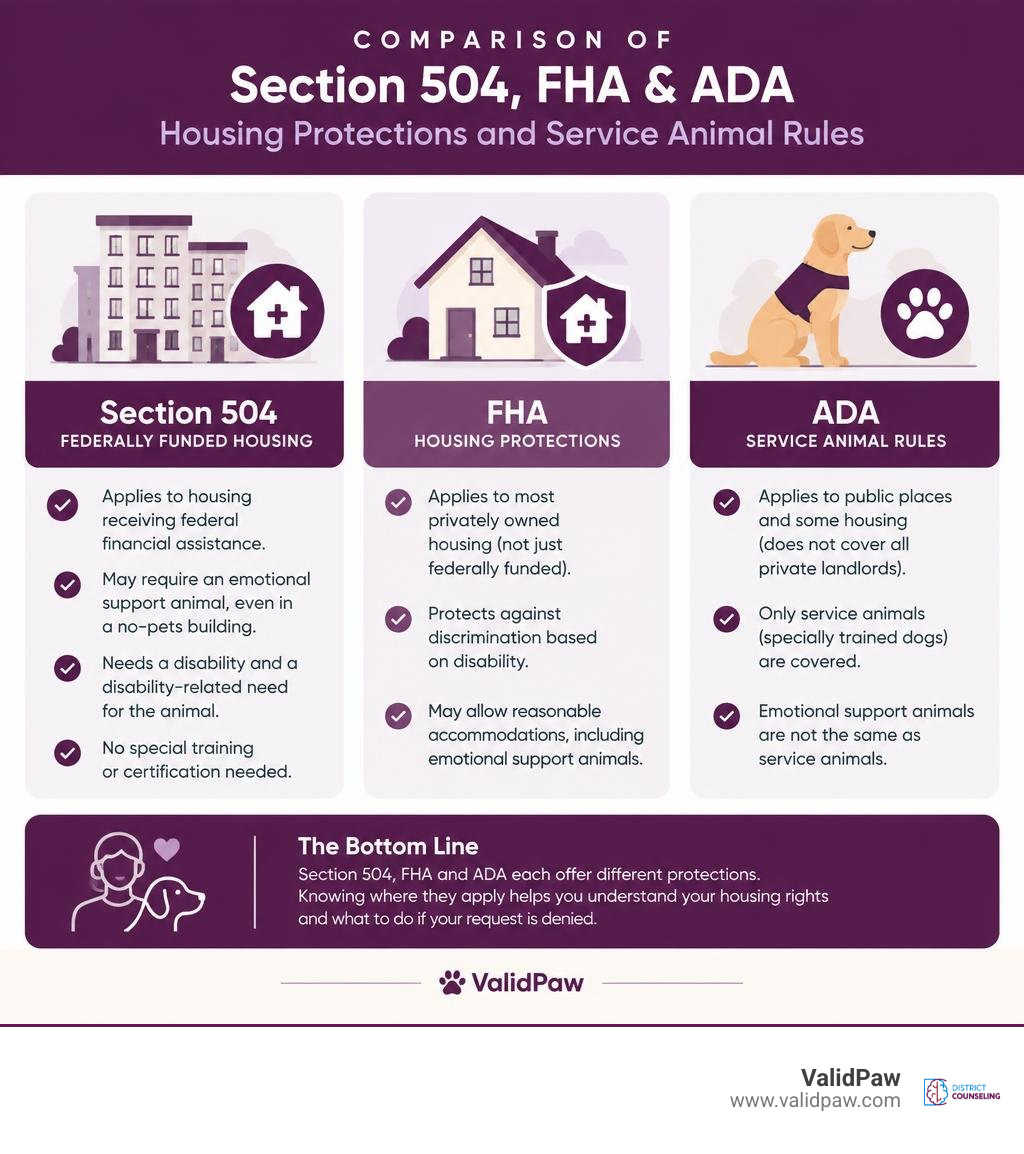
Section 504 may require federally funded housing providers to allow an emotional support animal, even in a no-pets building. The renter must have a disability and a disability-related need for the animal. The animal does not need special task training or certification. To request an accommodation, ask the housing provider in writing and, if your need is not clear, offer reliable documentation from a qualified healthcare professional.
Section 504 is not the same as the ADA rule for service dogs, and it does not cover every private landlord. This guide explains where it applies and what to do if your request is denied.
I am Francisco Ortiz, a licensed mental health evaluator who conducts ESA assessments across six states. My work includes evaluating disability-related needs and preparing clinical documentation relevant to section 504 emotional support animal requests.
Understanding Section 504 Emotional Support Animal Housing Rights
Enacted as part of the Rehabilitation Act of 1973, Section 504 was the first major federal civil rights law protecting individuals with disabilities from discrimination. It states that no qualified individual with a disability shall, solely by reason of their disability, be excluded from participation in, denied the benefits of, or subjected to discrimination under any program or activity receiving federal financial assistance.

In housing and educational environments, this statute requires entities receiving federal funds to make reasonable accommodations in their rules, policies, and practices. An accommodation ensures a person with a mental, emotional, or physical disability has equal opportunity to use and enjoy their living space. Under Section 504 regulations, assistance animals include both task-trained service dogs and untrained emotional support animals (ESAs). The core standard is straightforward: if an animal provides therapeutic comfort that mitigates symptoms or effects of a documented disability, housing providers must allow that animal unless specific legal exemptions apply.
What Programs and Properties Fall Under Section 504?
Section 504 does not apply to strictly private landlords who accept no federal money. Instead, it governs entities funded directly or indirectly by federal agencies such as the U.S. Department of Housing and Urban Development (HUD) or the U.S. Department of Education. For an overview of overall residential coverage, review our comprehensive emotional support animal housing guide.
Entities governed by Section 504 include:
- Public Housing Agencies (PHAs): Public housing complexes and Section 8 housing voucher programs managed by municipal authorities.
- Subsidized Multifamily Housing: Section 202 housing for the elderly, Section 811 housing for persons with disabilities, and Section 236 properties receiving federal rental subsidies.
- Postsecondary Dormitories: College and university residence halls at institutions that accept federal funding, including federal student aid programs.
- Emergency Shelters and Transitional Housing: Programs funded through Community Development Block Grants (CDBG) or Emergency Solutions Grants (ESG).
How HUD’s 2026 Policy Reversal Impacts Section 504 vs. Fair Housing Act Claims
On May 22, 2026, HUD issued an enforcement memorandum that altered how the agency handles administrative complaints under the Fair Housing Act (FHA). Under this 2026 guidance, HUD instructed its administrative staff to prioritize federal FHA enforcement actions only for animals individually trained to perform specific disability-related tasks, rescinding prior administrative guidance that protected untrained support animals under the FHA.
However, Section 504 of the Rehabilitation Act remains completely unaffected by this FHA administrative memo. As detailed in the legal analysis of HUD's policy reversal on emotional support animals, Congress has not altered the statutory language of Section 504, and federal courts continue to enforce reasonable accommodations for non-task-trained assistance animals in federally funded settings. Recipients of federal financial assistance must continue accommodating emotional support animals under Section 504 regardless of HUD's internal administrative shifts regarding private market FHA investigations.
Section 504 vs. ADA vs. FHA: Navigating Overlapping Federal Laws
Understanding federal disability law requires separating three distinct statutory frameworks: Section 504 of the Rehabilitation Act, the Americans with Disabilities Act (ADA), and the Fair Housing Act (FHA). You can explore how these interact in depth via the ADA National Network's brief on legal protections for assistance animals under federal law.
| Federal Statute | Primary Scope | Covered Animals | Training Required? | Pet Fees / Surcharges Allowed? | | :--- | :--- | :--- | :--- | :--- | | Section 504 | Federally funded housing, programs, and higher education | Service animals & emotional support animals (any domestic species) | No | No | | Fair Housing Act (FHA) | Most private and public residential dwellings | Assistance animals (service animals & emotional support animals) | No (by statute / judicial precedent) | No | | ADA Title II & III | State/local government services and commercial public accommodations | Service dogs and miniature horses only | Yes (individually trained for specific tasks) | No |
Key Differences Between an ADA Service Dog and a Section 504 Emotional Support Animal
The ADA maintains a narrow definition of a service animal: a dog (or miniature horse) individually trained to do work or perform specific physical or psychiatric tasks for the benefit of an individual with a disability. Examples include guiding someone with vision loss, alerting an individual with diabetes to blood sugar changes, or physically interrupting panic behaviors in a person with PTSD. Because they are task-trained, service animals have broad public access rights in places like restaurants, retail stores, and medical facilities.
In contrast, an emotional support animal under Section 504 provides passive therapeutic comfort, companionship, and emotional stability without needing task training. While ESAs lack general public access rights to grocery stores or transit, Section 504 guarantees them access within residential units, private campus dorms, and associated common areas. Learn more about how these baseline standards work in our breakdown of how fair housing rules apply to pets and support animals.
University Housing and Campus Access Under Section 504 and Title II
Postsecondary institutions often must navigate both the ADA and Section 504 simultaneously. Under Title II of the ADA, university classrooms, libraries, cafeterias, and auditoriums must permit task-trained service dogs. Emotional support animals, however, are evaluated as reasonable accommodations under Section 504 and the FHA.

Universities must assess ESA requests on an individualized, case-by-case basis. While an ESA is typically approved for the student’s on-campus residential hall room and designated outdoor relief areas, the university may decline ESA access to lecture halls, science laboratories, or food service lines unless an individual academic accommodation review determines it necessary. For a model higher-education framework, review the campus policies on emotional support and service animals.
Documenting and Requesting a Section 504 Animal Accommodation
To establish a reasonable accommodation under Section 504, a tenant or student must engage in an interactive dialogue with their housing provider. The accommodation process is designed to be accessible, informal, and free from administrative hurdles.

Submitting a Compliant Section 504 Emotional Support Animal Accommodation Request
When requesting an accommodation, the resident should submit a written letter explaining their need to management or the university accessibility office. If you need a starting point, use our template for ESA reasonable accommodation requests.
If the disability is not visible, the housing provider may request reliable documentation verifying:
- That the individual meets the statutory definition of having a mental or physical disability (an impairment that substantially limits one or more major life activities).
- That there is an identifiable connection (nexus) between the disability and the functional support or symptom alleviation the animal provides.
This documentation should come from a licensed mental health professional, physician, psychiatrist, or social worker with an established therapeutic relationship with the individual. At ValidPaw, our licensed therapists provide clinical telehealth evaluations for residents across Texas and nationwide, delivering valid clinical letters within 24 to 48 hours.
Prohibited Inquiries and Verification Limits for Housing Providers
Housing providers receiving federal funds are strictly limited in what they can ask during the accommodation review. Management may not interrogate applicants about their medical history or request extensive health records.
Staff are limited to asking:
- Does the person seeking to live in the housing have a disability?
- Does the person have a disability-related need for the assistance animal?
Property managers cannot demand access to medical files, require psychological evaluations, demand independent medical examinations, or insist on notarized forms. You can verify what information is necessary in our breakdown of essential details required in an emotional support verification letter.
Lawful Grounds for Denying an Assistance Animal Under Section 504
While Section 504 provides protections, housing providers are not required to accept every animal unconditionally. However, denials must be based on verified, objective facts rather than speculation, generalized fears, or third-party complaints. For a review of prohibited landlord practices, see our guide on unlawful landlord actions regarding emotional support animals.
Direct Threat, Property Damage, and the Undue Burden Standard
Under Section 504, a housing provider may deny an assistance animal only if:
- Direct Threat: The specific animal poses a direct threat to the health or safety of others that cannot be eliminated or reduced by another reasonable accommodation.
- Substantial Property Damage: The specific animal causes substantial physical damage to the property of others.
- Fundamental Alteration or Undue Burden: Accommodating the animal would impose an undue financial and administrative burden on the provider or fundamentally alter the nature of the housing program.
Under federal housing regulations (such as HUD Handbook 4350.3), simply accommodating an assistance animal in housing is established as not constituting an undue burden. Furthermore, standard lease rules cannot override federal protections; see our guide on handling no-pet lease clauses with an emotional support animal.
Breed, Weight, and Fee Prohibitions in Federally Assisted Housing
Federally funded housing providers cannot enforce generalized pet policies against assistance animals. Specifically, housing providers are prohibited from:
- Enforcing breed bans or arbitrary weight restrictions against an ESA. Determinations must be based solely on the individual animal’s documented behavior. Check out our analysis on breed restrictions and assistance animal policies and our review of apartment weight limit rules for support animals.
- Charging pet deposits, monthly pet rent, or application fees for an emotional support animal. Assistance animals are classified as auxiliary aids rather than pets.
- Requiring commercial registration certificates, specialty vests, or obedience school paperwork.
While landlords cannot charge pet deposits, tenants remain financially responsible for actual damage caused by their animal beyond normal wear and tear.
Legal Recourse and Remedies for Unlawful Section 504 Denials
If a federally funded housing provider or university denies a valid ESA request, residents have clear administrative and legal avenues for recourse.
Filing Complaints with HUD and the Office for Civil Rights
Residents who experience disability discrimination under Section 504 can seek federal administrative enforcement:
- HUD Office of Fair Housing and Equal Opportunity (FHEO): Enforces Section 504 across all federally assisted housing programs, including public housing and Section 8 developments.
- U.S. Department of Education Office for Civil Rights (OCR): Handles discrimination complaints against colleges, universities, and schools receiving federal funds. For details on institutional standards, consult the federal investigation guidance for postsecondary accessibility.
Administrative filings prompt a federal investigation into the housing provider’s compliance policies. If violations are identified, federal agencies can require policy revisions, mandate staff training, restore housing rights, or withhold federal financial funding from the non-compliant entity.
Court Evaluations, Case Law Precedents, and State Protections
Courts evaluate Section 504 claims by determining whether the plaintiff has a qualified disability, whether the housing provider received federal assistance and knew of the disability, and whether the provider failed to grant a necessary accommodation.
In the Sixth Circuit case Anderson v. City of Blue Ash (2015), the court confirmed that assistance animals provide valid accommodations under federal disability law when an individualized need is demonstrated.
Additionally, state laws provide independent protections that operate alongside Section 504:
- Florida Law: Florida Fair Housing standards under Section 760.27 prohibit discrimination against assistance animals and detail specific verification parameters; see the Florida statutory protections for emotional support animals.
- Texas & Other States: Tenants across all 50 states retain access to state human rights commissions and fair housing enforcement agencies that investigate discriminatory denials.
Frequently Asked Questions About Section 504 Animals
Does an emotional support animal require training under Section 504?
No. Unlike service dogs under Title II and Title III of the ADA, an emotional support animal under Section 504 does not require specialized task training. The animal qualifies based on its ability to provide therapeutic comfort and alleviate symptoms of a documented disability.
Can a federally funded landlord charge pet fees or deposits for an ESA?
No. Federal regulations prohibit charging pet deposits, move-in surcharges, or monthly pet rent for an assistance animal. However, the housing provider may bill the resident for actual repairs if the animal causes damage to the unit.
What distinguishes Section 504 coverage from private housing rules?
Section 504 applies specifically to programs, agencies, and housing providers that receive federal financial assistance (such as public housing authorities and universities). Purely private housing that receives no federal funding is governed primarily by the Fair Housing Act and relevant state civil rights statutes.
Conclusion
Section 504 of the Rehabilitation Act provides protections for tenants, students, and residents living in federally assisted housing. If you have a mental or emotional health condition that impairs daily functioning, an emotional support animal can serve as an essential component of your wellness routine. By understanding your rights, submitting verified clinical documentation, and knowing how federal laws interact, you can navigate the accommodation process with confidence.
If you are ready to secure your documentation from a licensed mental health professional, you can apply for a telehealth ESA evaluation through ValidPaw today.

