
Fair Housing and Service Animals: What Renters Need to Know
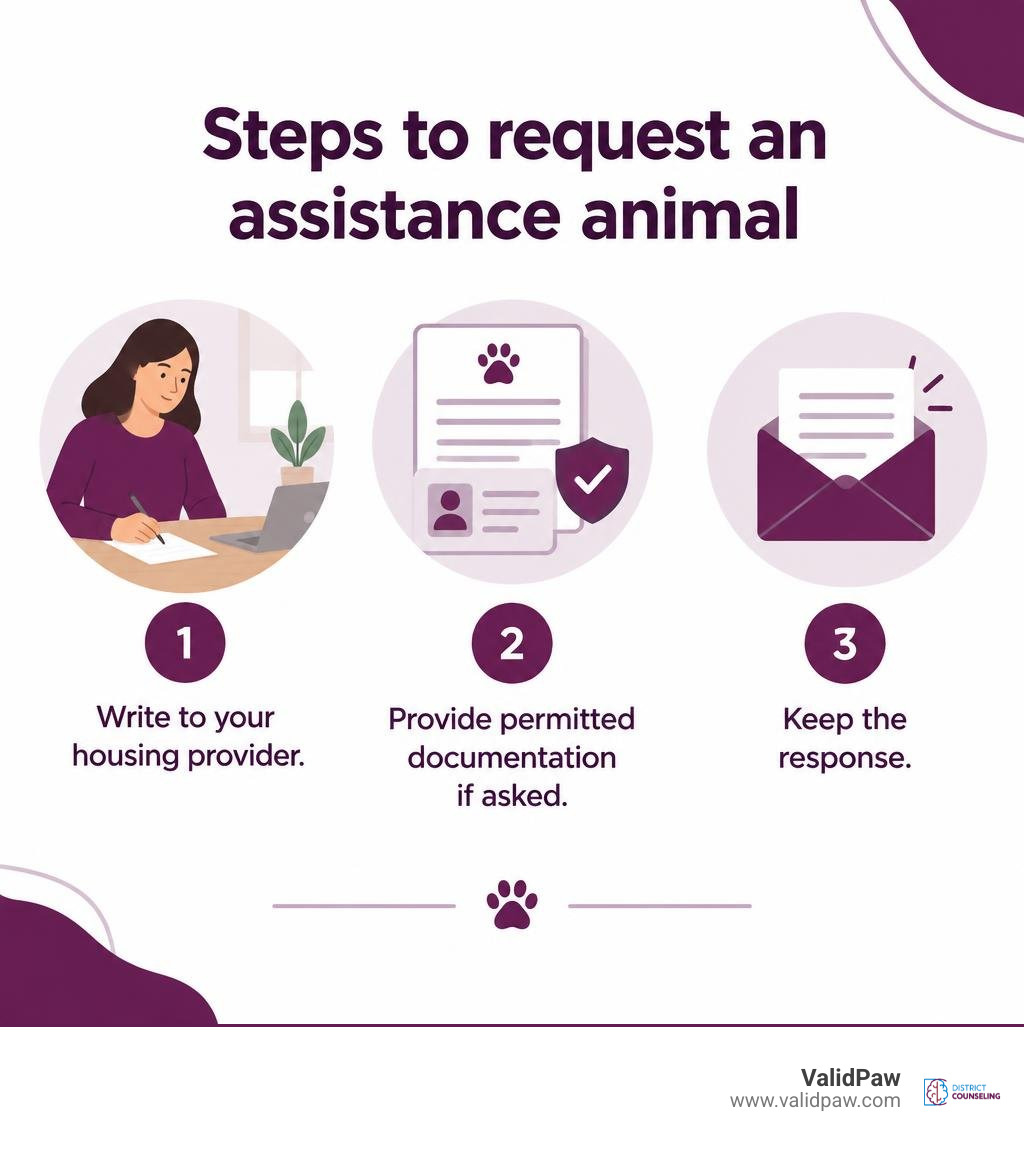
Fair housing and service animals: If you need a trained service dog because of a disability, you can ask your housing provider to make an exception to a no-pets rule. An approved assistance animal is not a pet, so pet rent and pet deposits generally do not apply. Put your request in writing and keep a copy. If the provider denies it, ask for the reason in writing.
Emotional support animals have different rules. HUD changed its enforcement policy in May 2026, so renters seeking an accommodation for an untrained ESA should also check state law and whether their housing receives federal assistance.
I’m Francisco Ortiz, a forensic mental health evaluator who conducts disability and ESA assessments. My work on fair housing and service animals helps renters document their needs; next, we’ll look at the rules that apply to each type of animal.
Understanding Fair Housing and Service Animals Under Federal Law
Renting an apartment when you rely on an assistance animal can feel intimidating, especially when confronting dense leases and strict property managers. Fortunately, federal civil rights statutes protect tenants with physical and mental health impairments from discriminatory housing practices. The cornerstone of these protections is Title VIII of the Civil Rights Act of 1968, widely recognized as the Fair Housing Act (FHA).
Federal administrative guidelines, such as FHEO Notice: FHEO-2013-01, clarify that housing providers must grant reasonable accommodations for individuals with disabilities. Under the FHA, a disability is defined as a physical or mental impairment that substantially limits one or more major life activities, such as walking, seeing, hearing, breathing, performing manual tasks, or working.
Disability-related accommodation disputes represent a massive portion of federal housing discrimination claims. According to estimates released by the U.S. Department of Housing and Urban Development (HUD), nearly 60% of all Fair Housing Act complaints nationwide involve the denial of reasonable accommodations and disability access. At the state level, the numbers are equally striking: in Texas, disability-related grievances comprised nearly 50% of all fair housing complaints filed between 2013 and 2018, with 67% specifically alleging a landlord's failure to grant a reasonable accommodation. Understanding an overview of ADA service animal regulations alongside fair housing statutes is essential for protecting your rental rights.
Federal Disability Statutes in Rental Housing
Multiple federal laws interact to protect disabled individuals across different housing environments. While the Americans with Disabilities Act (ADA) primarily governs public commercial spaces, the FHA and Section 504 of the Rehabilitation Act of 1973 directly regulate residential dwellings.
| Statute | Primary Scope | Definition of Animal | Permissible Species | | :--- | :--- | :--- | :--- | | Fair Housing Act (FHA) | Private and public residential housing | Broad "Assistance Animal" umbrella (Service & Support) | Dogs, domestic household animals (and miniature horses) | | Section 504 (Rehabilitation Act) | Federally funded housing programs & public housing | Assistance animals mitigating functional limitations | Dogs and other domestic assistance species | | ADA (Title II & Title III) | Public accommodations & government facilities | Individually trained "Service Animals" | Dogs (with separate miniature horse provision) |
The Fair Housing Act covers almost all private rental dwellings, condominium associations, and residential leasing complexes. Public housing authorities and properties receiving federal financial assistance must also adhere to HUD guidance on Section 504 accommodation rules, which impose rigorous accessibility requirements without the owner-occupied exemptions found in certain private leasing scenarios.
Legal Differences: Service Animals vs. Emotional Support Animals (ESAs)
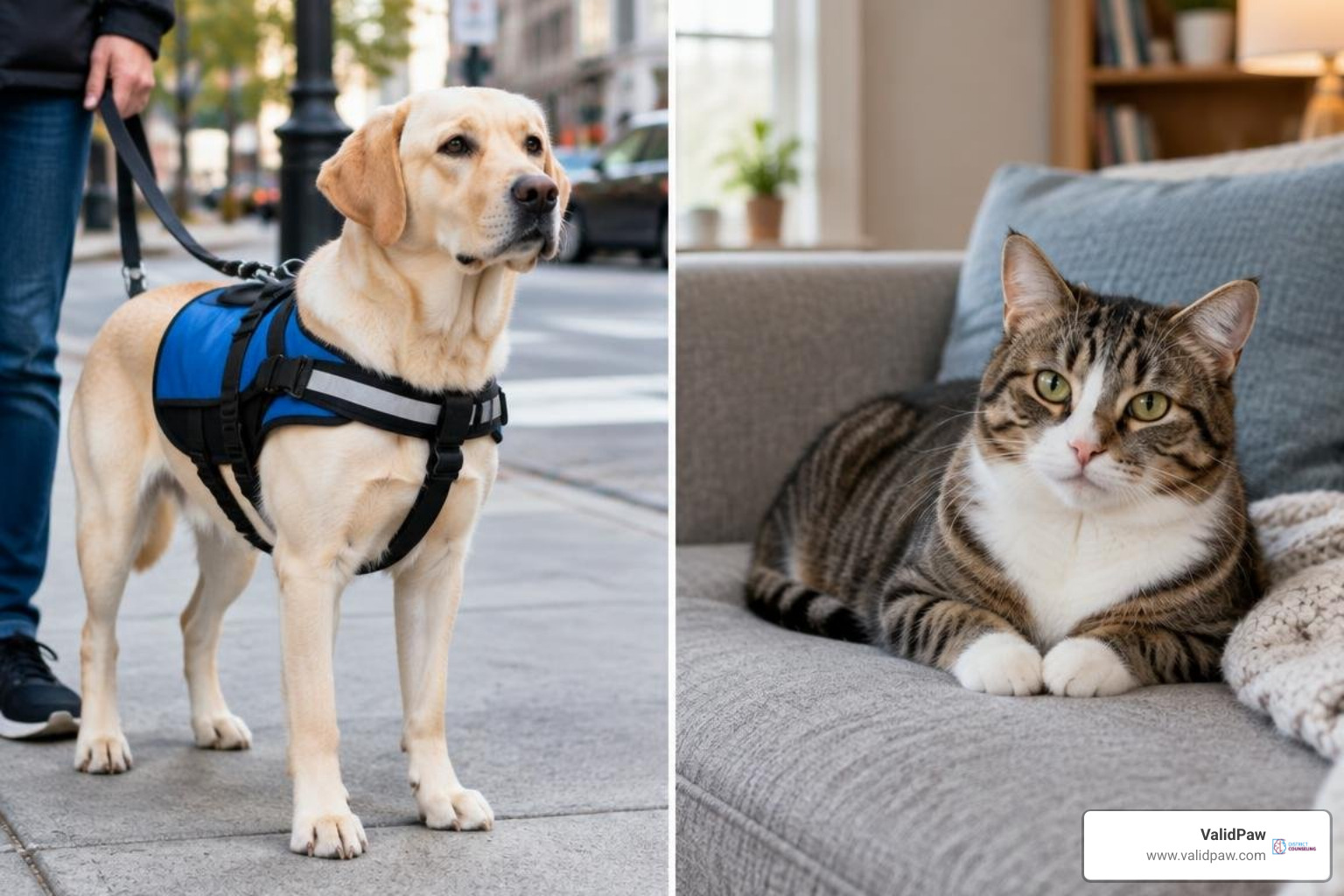
Many renters confuse service dogs with emotional support animals. While both function as assistance animals in housing, their legal definitions, training requirements, and public access rights diverge significantly under federal law. Reviewing the differentiation between service dogs and emotional support animals prevents misunderstandings when communicating with leasing offices.
A service animal is defined under the ADA as a dog that is individually trained to perform specific work or tasks directly related to an individual's physical, sensory, psychiatric, or intellectual disability. Examples include guide dogs for visual navigation, medical alert dogs that signal drop-offs in blood sugar or oncoming seizures, and psychiatric service dogs trained to interrupt self-harming behavior or provide deep pressure therapy during panic attacks.
In contrast, an emotional support animal provides therapeutic comfort, companionship, and stability simply through its presence. An ESA does not require specialized task training to mitigate symptoms of depression, anxiety, or post-traumatic stress.
Key Protections: Fair Housing and Service Animals vs. Other Assistance Animals
Historically, HUD treated all assistance animals under a unified framework. Whether an animal was a guide dog or an emotional support cat, housing providers were required to grant reasonable accommodation exceptions to no-pet policies. Understanding FHA ESA letter requirements and definitions allows renters to properly format accommodation packages.
For comprehensive insights on everyday residential policies, our general guide to fair housing animal rules details how assistance animals are categorized legally as functional medical tools rather than ordinary companion pets.
Species Qualifications and the May 2026 HUD Policy Update
Federal standards historically recognized common domestic species as potential assistance animals. Under established ADA Requirements: Service Animals, public service animals are restricted to dogs and miniature horses. However, residential housing rules have evolved.
In May 2026, HUD issued an internal policy memorandum altering its administrative enforcement posture regarding untrained emotional support animals. Under this policy update, HUD aligned its Fair Housing Act complaint enforcement standard more closely with trained assistance animals, setting aside earlier guidance from 2013 and 2020 that presumed automatic administrative enforcement for untrained ESAs.
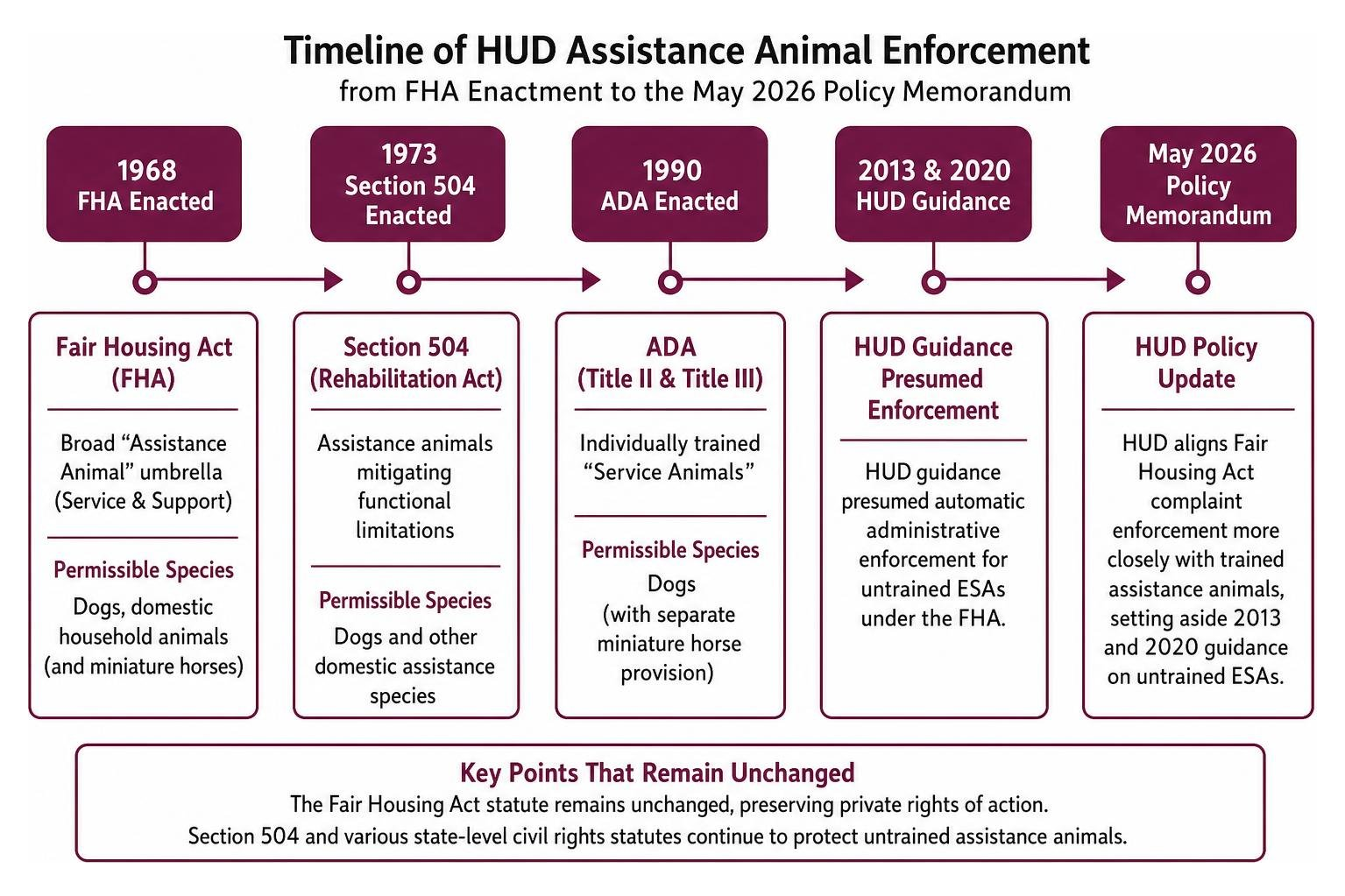
While this administrative shift affects HUD's direct complaint intake process for untrained ESAs, the Fair Housing Act statute itself remains unchanged, preserving private rights of action. Furthermore, Section 504 and various state-level civil rights statutes continue to protect untrained assistance animals. When dealing with unique animal species (such as capuchin monkeys or farm animals), tenants carry a substantial burden to prove why a traditional household animal cannot satisfy their disability-related functional needs.
Landlord Rules: Verification, Inquiries, and Fee Exemptions
State housing authorities and federal regulators distribute strict standards, such as the HUD Guidance on Assistance Animals, to outline what landlords can and cannot ask. Understanding landlord restrictions under ESA housing law shields tenants from invasive medical inquiries and unlawful lease demands.
Navigating Inquiries on Fair Housing and Service Animals
When an applicant or tenant requests an accommodation for a service dog, a landlord's inquiry scope depends entirely on whether the disability is visible. If a tenant is blind and uses a guide dog, the landlord cannot demand additional paperwork or ask questions.
If the disability or the dog's task is not readily apparent, a housing provider may ask two specific questions:
- Is the animal required because of a disability?
- What work or task has the animal been trained to perform?
Housing providers are legally prohibited from asking for medical charts, demanding access to doctors, or requiring an applicant to demonstrate the dog's trained task. For non-apparent disabilities requiring an emotional support animal or psychiatric assistance animal, our practical tenant guide to fair housing protections details how legitimate documentation from a licensed healthcare professional establishes the disability-related need without disclosing confidential diagnosis details.
No-Pet Leases, Pet Deposits, and Weight Restrictions
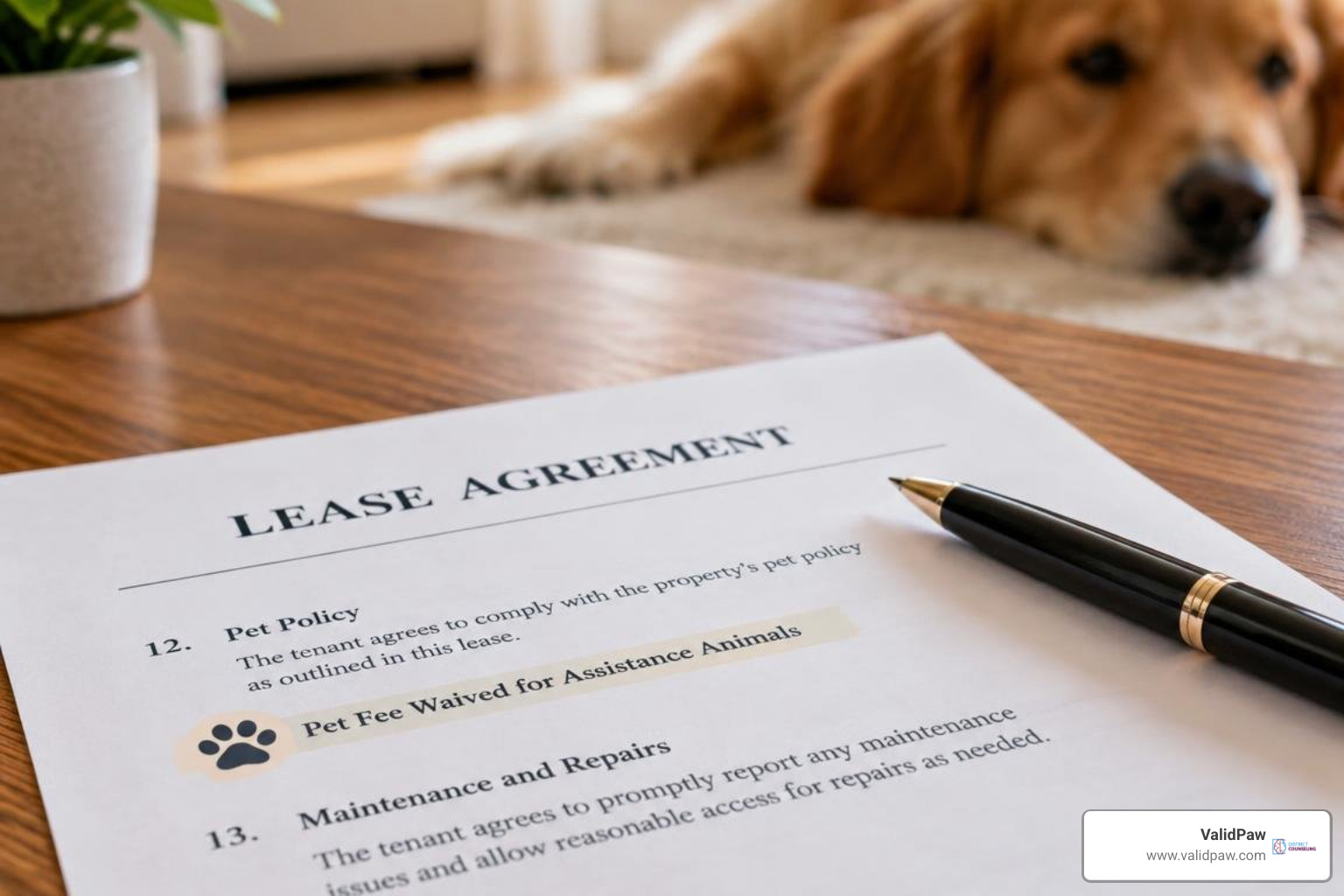
Because assistance animals are medical accommodations rather than pets, standard pet clauses do not apply to them. Landlords cannot enforce "no-pets" lease rules against legitimate service dogs or assistance animals. More details on overcoming lease restrictions can be found in our guide on navigating no-pet lease clauses with assistance animals.
Furthermore, housing providers cannot charge:
- Mandatory upfront pet deposits
- Non-refundable pet cleaning fees
- Recurring monthly "pet rent"
- Breed, weight, or size surcharge penalties
Landlords are also prohibited from applying breed bans or weight limits to assistance animals. As explained in our breakdown on handling breed and weight restrictions under FHA, blanket insurance restrictions or municipal breed bans cannot be used to automatically reject a service dog without an individualized assessment. However, tenants remain financially responsible for any actual property damage their animal causes to the rental unit.
Reasonable Accommodations, Modifications, and Legal Exceptions
A reasonable accommodation is a change, exception, or adjustment to a rule, policy, practice, or service that enables a person with a disability to have an equal opportunity to use and enjoy a dwelling. Our comprehensive guide to emotional support animal housing walks renters through creating an airtight accommodation request.
Once an accommodation request is submitted, the landlord is legally obligated to engage in an open "interactive process" rather than issuing an immediate refusal.
Accommodations vs. Structural Modifications
It is vital to distinguish between a reasonable accommodation (a policy or rule change) and a reasonable modification (a structural or physical alteration):
- Reasonable Accommodation: A landlord waiving a no-pets policy, assigning an accessible parking space near a ground floor, or accepting rent through an alternative method.
- Reasonable Modification: A tenant installing grab bars in a shower, widening an interior doorway for a wheelchair, or building an exterior access ramp.
In standard private housing, reasonable accommodations must be granted at the housing provider's expense (e.g., absorbing the loss of pet rent). Conversely, structural modifications are typically funded by the tenant, who may be required to restore the interior premises to their original condition upon moving out, normal wear and tear excepted. In federally funded Section 504 housing, the housing provider is generally required to pay for necessary structural modifications.
When a Landlord Can Legally Deny an Assistance Animal
A landlord cannot reject an assistance animal based on speculation, fear, or generalized breed biases. A legally defensible denial must be rooted in specific, documented evidence under narrow legal criteria:
- Direct Threat to Health or Safety: The specific animal demonstrates aggressive behavior, biting history, or unprovoked lunging that cannot be mitigated by reasonable handling.
- Substantial Physical Damage: The specific animal causes severe property destruction that cannot be reduced or eliminated.
- Undue Financial and Administrative Burden: The accommodation would create an extreme, unmanageable operational expense for the property owner.
- Fundamental Alteration: The request alters the essential nature of the housing provider's business operations.
- Statutory Exemptions (Mrs. Murphy Exemption): The Fair Housing Act exempts owner-occupied buildings with four or fewer independent rental units, as well as single-family homes sold or rented without the use of a real estate broker (provided the owner holds no more than three such homes).
What to Do If Your Service Animal Accommodation Is Denied
If a property manager refuses your accommodation request, do not panic. Landlords often issue denials due to outdated policies or misunderstanding civil rights statutes.
First, request the denial in writing, asking the housing provider to specify the exact legal and factual basis for their refusal. Maintain a complete paper trail of all written communications, dates, and medical documentation submitted.
Interactive Process and Administrative Complaints
Housing providers must engage in a good-faith interactive dialogue to explore whether alternative accommodations can resolve their concerns. If the landlord remains uncooperative or issues an unlawful eviction threat, you have formal legal options:
- File an Administrative Complaint: Submit a housing discrimination complaint directly with HUD’s Office of Fair Housing and Equal Opportunity (FHEO). HUD will investigate the property management's actions at no cost to you.
- State and Local Civil Rights Enforcement: File a complaint with your municipal or state human rights commission.
- Private Right of Action: Retain a fair housing attorney to file a civil lawsuit in federal district court seeking injunctive relief and damages.
State-Level Protections and Section 504
State and municipal laws frequently offer stronger protections than federal baseline rules. In places with comprehensive civil rights departments—such as the guidance enforced by BOLI : Fair Housing : Civil Rights : State of Oregon or local rental municipal codes outlined in Pets vs Service Animals - RentinginSeattle | seattle.gov—assistance animals receive explicit statutory definitions that safeguard tenants even when federal policies shift.
In federally subsidized developments governed by Section 504, administrative protections remain comprehensive regardless of changes in private market guidance.
Frequently Asked Questions About Fair Housing and Service Animals
Can a landlord demand to see training certifications or medical records for a service dog?
No. A landlord cannot require training certificates, official diplomas, or digital registration cards for a service dog. Under the FHA and ADA, no mandatory federal or state registry for service animals exists. Landlords are also strictly barred from demanding a tenant's private medical records, psychological case notes, or clinical diagnoses.
Are miniature horses recognized under housing disability regulations?
Yes. While dogs are the most common service animals, Department of Justice ADA Title III regulations explicitly recognize miniature horses that have been individually trained to perform disability-related tasks. In housing, a landlord must accommodate a trained miniature horse unless structural constraints (such as ceiling clearance, hallway dimensions, or floor-load capacities) make housing the animal an undue administrative burden.
What is the Mrs. Murphy exemption under the Fair Housing Act?
The "Mrs. Murphy" exemption applies to owner-occupied buildings with four or fewer rental units. Under federal law, if a property owner lives in one unit of a fourplex and rents out the remaining three without using commercial brokers or discriminatory advertising, they are exempt from federal Fair Housing Act accommodation mandates. However, many municipal and state fair housing statutes eliminate this exemption entirely.
Conclusion
Securing your home with an assistance animal should never involve intimidation, unlawful pet fees, or invasive medical interrogations. Under federal law, individuals with disabilities possess well-established rights to keep their service dogs and assistance animals in their homes without facing discriminatory lease terms.
To protect your tenancy, avoid online scam registries selling useless badges, fake certificates, or ID cards, as housing providers routinely reject these invalid documents. If you have an emotional support animal or psychiatric condition requiring an accommodation letter, work directly with a licensed healthcare professional.
At ValidPaw, we connect renters across Texas and all 50 states with licensed mental health professionals who conduct thorough telehealth evaluations. If you qualify, you will receive a fast, legitimate, FHA-compliant accommodation letter with instant landlord verification. Ready to protect your housing rights? Apply for a compliant accommodation evaluation today.